Being arrested in Texas for DWI can be terrifying—but you don’t have to face it alone. The hours and days that follow an arrest are critical for protecting your future, as the consequences of DWI in Texas are severe and start almost immediately. You're not just facing a criminal charge; you're also up against a separate, time-sensitive administrative battle to save your driver's license.
Understanding this two-front battle is the first step toward building a defense that protects your rights and your future.
Your First Steps After A Texas DWI Arrest

The moments after a DWI arrest can feel like a blur—flashing lights, confusing questions, and a wave of anxiety. It’s a disorienting experience, but your actions from this point forward matter immensely. The most important thing you can do is protect your legal rights.
You have the right to remain silent, and it is almost always in your best interest to use it. Beyond providing basic identification, you are not required to answer questions about where you were coming from, what you may have had to drink, or how you’re feeling. You can politely but firmly state, "Officer, I am exercising my right to remain silent, and I would like to speak with an attorney." That simple sentence is one of the most powerful defenses you have.
The Two Battles You Now Face
After a DWI arrest, you are not just dealing with one legal problem—you are facing two separate cases that run on parallel tracks. This is a crucial concept to grasp.
- The Criminal Case: This is the fight in a Texas criminal court. A prosecutor will try to prove you are guilty of Driving While Intoxicated under the Texas Penal Code. The potential outcomes include fines, probation, community service, and even jail time.
- The Administrative Case (ALR): This is a civil case handled by the Texas Department of Public Safety (DPS). It's all about your driving privileges. If you refused a breath or blood test, or if your test showed a BAC of .08 or higher, the DPS will automatically try to suspend your license.
You have only 15 days from the date of your arrest to request an Administrative License Revocation (ALR) hearing. If you miss this deadline, your license will be automatically suspended.
Why Contacting An Attorney Is Urgent
That 15-day deadline is exactly why you cannot afford to wait. An experienced DWI defense attorney can immediately request the ALR hearing for you, preserving your chance to fight the license suspension. This move does more than just help save your license; it also gives your attorney an early opportunity to gather evidence and question the arresting officer under oath, which can be invaluable for your criminal defense.
For a more detailed look, our guide on what to do after a DUI arrest offers a step-by-step breakdown of this critical period.
Taking control of the situation starts with getting professional legal help on your side. An attorney will guide you through the booking and arraignment process, work to have a reasonable bond set, and begin building a defense strategy tailored to the specifics of your case. You don’t have to navigate this alone.
Understanding The Criminal Penalties For A Texas DWI

When you're facing a DWI charge in Texas, one of the first questions on your mind is, "What can the court actually do to me?" The criminal penalties are serious, and they are designed to get much tougher with each offense. Understanding these potential consequences is the first step toward realizing how high the stakes are.
The Texas Penal Code lays out a clear and punishing structure for DWI offenses. Let's break down what this means for you in plain English.
Penalties For A First DWI Offense
A first-time DWI is typically charged as a Class B Misdemeanor, assuming there are no aggravating factors. While it's the lowest-level DWI charge, the consequences are still enough to turn your life upside down.
If you are convicted, the penalties can include:
- Jail Time: A minimum of 72 hours and up to 180 days in county jail.
- Fines: A fine of up to $2,000.
- License Suspension: Your driver’s license can be suspended for up to one year.
- Annual Surcharges: You may be forced to pay an annual fee of up to $2,000 for three years just to keep your license.
On top of that, a judge will likely order community service, a mandatory DWI education class, and possibly the installation of an ignition interlock device on your car.
When Penalties Escalate For A Second DWI
If you find yourself arrested for a second DWI, the state's approach changes dramatically. A second offense is elevated to a Class A Misdemeanor, which essentially doubles the potential punishment. The system is designed to come down much harder on repeat offenses.
The penalties for a second DWI conviction jump to:
- Jail Time: From 30 days up to one year in county jail.
- Fines: A fine of up to $4,000.
- License Suspension: Your driver’s license can be suspended for up to two years.
- Ignition Interlock Device: Installation of an ignition interlock device becomes practically mandatory.
The annual license surcharges also increase, and the terms of probation become far more restrictive. For a deeper dive into these consequences, you can learn more about the punishment for DWI in Texas in our detailed guide.
The Third Strike: A Felony DWI Conviction
A third DWI charge is where the consequences become truly life-altering. In Texas, a third DWI is not a misdemeanor—it's a Third-Degree Felony. This jump is critical, bringing the very real possibility of state prison time and the loss of fundamental civil rights, like your right to own a firearm.
With a staggering 30.52% recidivism rate for DWI offenders in Texas, the state takes a hard line. While a first offense might mean up to 180 days in jail and a $2,000 fine, a third conviction means 2 to 10 years in prison and fines up to $10,000. These figures come straight from the Texas Department of Public Safety's own DWI recidivism report.
To put the penalties into perspective, here's a quick summary of how things escalate.
Texas DWI Criminal Penalties At A Glance
| Offense Level | Classification | Potential Jail Time | Maximum Fine |
|---|---|---|---|
| First Offense | Class B Misdemeanor | Up to 180 days | Up to $2,000 |
| Second Offense | Class A Misdemeanor | Up to 1 year | Up to $4,000 |
| Third Offense | Third-Degree Felony | 2 to 10 years | Up to $10,000 |
This table makes it clear: the state's penalties aren't just a slap on the wrist. They are designed to become progressively more severe to deter repeat offenses.
Aggravating Factors That Increase Penalties
It's not just about the number of prior convictions. Certain circumstances surrounding your arrest can automatically elevate the charges and penalties, even on a first offense. These are known as aggravating factors.
Common examples that make a difficult situation worse include:
- High Blood Alcohol Concentration (BAC): If your BAC is 0.15 or higher, a first-time DWI is automatically enhanced to a Class A Misdemeanor.
- Open Container: Having an open container of alcohol within your reach elevates a first-time DWI to a Class B Misdemeanor with a mandatory minimum of six days in jail.
- Child Passenger: If you are arrested for DWI with a child under 15 years old in the car, the charge becomes a State Jail Felony, carrying a sentence of up to two years in a state jail facility.
These factors show that the specific details of your arrest are incredibly important. A skilled Texas DWI attorney knows how to scrutinize every piece of evidence to challenge not only the core charge but also any aggravating circumstances the prosecution tries to use against you.
The Administrative Battle to Save Your Driver’s License
When you are arrested for a DWI in Texas, you aren't just facing a criminal charge. A second, entirely separate legal battle begins at the same time—and this one is aimed squarely at your driver’s license.
This is not a criminal case. It is an administrative one handled by the Texas Department of Public Safety (DPS). It is crucial to understand this parallel process because it moves much faster than your criminal court case.
The moment you are arrested for DWI, a clock starts ticking. The DPS automatically begins the process to suspend your license if you either refused a breath or blood test or provided a sample with a Blood Alcohol Concentration (BAC) of .08 or higher. This is called an Administrative License Revocation, or ALR.
The Critical 15-Day Deadline
From the day of your arrest, you have exactly 15 days to formally request an ALR hearing and challenge this automatic suspension. This is one of the most important deadlines you will face in your case.
If you miss that 15-day window, your license will be automatically suspended on the 40th day after your arrest. There are no extensions or second chances. This is why calling a DWI defense lawyer immediately is so important—they can ensure this deadline is met and your right to drive is protected.
Missing the 15-day deadline to request an ALR hearing means an automatic license suspension. Acting fast is the only way to protect your driving privileges and begin challenging the state's case against you.
What Is An ALR Hearing?
The ALR hearing is a civil proceeding, completely separate from your criminal trial. Its purpose is not to decide if you are guilty of DWI, but simply to determine if the DPS has enough reason to suspend your license.
The state only needs to prove two things:
- That the officer had reasonable suspicion to stop you and probable cause to arrest you for DWI.
- That you either refused a chemical test or provided a sample that showed a BAC of .08 or more.
While the state’s burden of proof is much lower here than in a criminal court, the ALR hearing gives your attorney a massive advantage. It's often the first opportunity to question the arresting officer under oath, gather evidence, and find weaknesses in the state’s case—all of which can be used to strengthen your criminal defense later.
Grounds For License Suspension
How long the DPS can suspend your license depends on what happened during your arrest. The DPS will seek to suspend your license based on these state guidelines:
- Refusal of a Chemical Test: If you refuse to provide a breath or blood sample, the suspension period is 180 days for a first offense.
- Failed Chemical Test: If you provide a sample with a BAC of .08 or higher, the suspension period is 90 days for a first offense.
These suspension periods become much longer if you have prior alcohol-related driving offenses on your record.
Staying on the Road With an Occupational Driver’s License
Even if your license does get suspended through the ALR process, you may still have a way to drive legally for essential needs. An Occupational Driver’s License (ODL), sometimes called an essential need license, is a special, restricted license that allows you to drive to and from work, school, and for essential household duties.
Getting an ODL is not automatic. You must petition the court and prove that a total inability to drive would cause you an undue hardship. This usually involves filing specific paperwork, obtaining an SR-22 insurance certificate, and possibly installing an ignition interlock device on your car. An experienced attorney can guide you through this complex process to help you stay independent while your DWI case is ongoing.
The Hidden Costs And Collateral Consequences Of A DWI
Beyond the criminal penalties everyone knows about—fines, potential jail time, and court dates—a DWI conviction unleashes a wave of hidden consequences that can follow you for years. These are the collateral consequences, the personal and professional fallout that is not written into the Texas Penal Code but can be just as damaging.
From your finances to your career, a DWI conviction creates ripples that spread through every part of your life. Understanding these long-term effects is the only way to appreciate the true weight of the charges you are facing.
The Overwhelming Financial Burden
The fines ordered by the court are just the beginning of the financial challenge. A DWI conviction triggers a series of new expenses that can quickly add up to thousands of dollars.
One of the most immediate and painful hits to your wallet will be your car insurance premiums. After a DWI, insurance companies will label you a high-risk driver. As a result, your rates will skyrocket, often doubling or even tripling for years to come.
On top of that, the state will almost certainly require you to file an SR-22 certificate. This is not an insurance policy itself, but a document your provider files to prove you have the minimum liability coverage required by law. Keeping an SR-22 on file is mandatory to maintain your license, typically for at least two years after a conviction.
Other mandatory expenses you can expect to pay for include:
- Ignition Interlock Device: If the court orders one, you will be responsible for installation and monthly monitoring fees, which can easily cost over $100 per month.
- DWI Education Classes: You will have to pay for any court-mandated alcohol education or intervention programs out of your own pocket.
- License Reinstatement Fees: Once your suspension period ends, you will have to pay fees to the DPS to get your driver's license back.
When you add it all up, the total financial damage is often staggering. To get a clearer picture of these expenses, take a look at our detailed guide on the complete DWI cost breakdown and consequences in Texas.
The chart below lays out the crucial first steps in the Administrative License Revocation (ALR) process. It’s a stark reminder of just how time-sensitive saving your license really is.
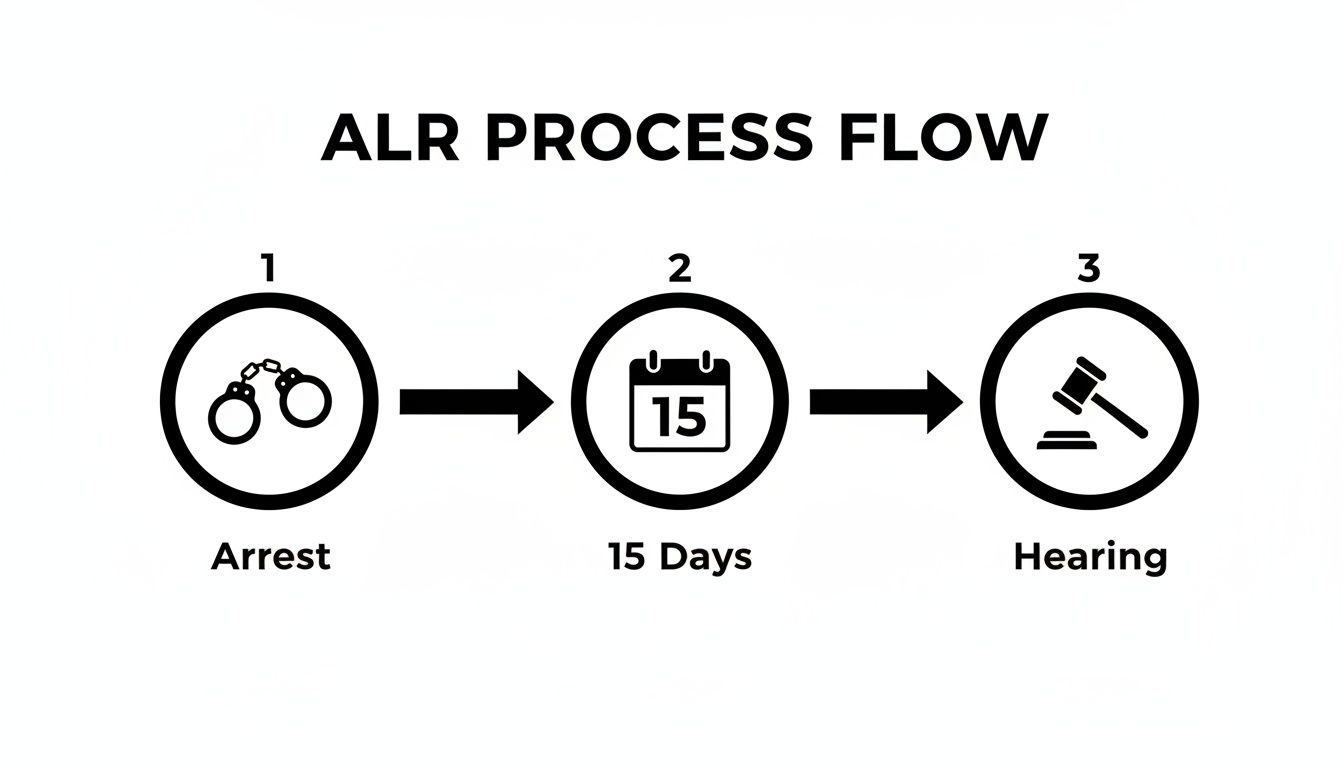
This process flow highlights the critical 15-day window you have after an arrest to request a hearing and fight the automatic suspension of your license. Miss it, and your license is gone.
Professional and Personal Fallout
A DWI conviction creates a permanent criminal record that appears on background checks, which can create serious roadblocks in your professional life. For many people, this is one of the most stressful consequences of a DWI in Texas.
Many employers have policies against hiring individuals with certain criminal records, especially for jobs that involve driving, operating machinery, or handling sensitive information. Your current job could be at risk, and finding a new one can become significantly harder.
A DWI conviction can threaten professional licenses for nurses, pilots, teachers, commercial drivers, and other licensed professionals. State licensing boards have the authority to suspend or revoke licenses based on criminal convictions.
The impact also bleeds into your personal life in ways you might not expect.
- Child Custody: In a family law case, a DWI can be used by the other parent as evidence of irresponsible behavior, which could seriously harm your custody or visitation rights.
- Firearm Rights: If you are convicted of a felony DWI (your third or subsequent offense), you will lose your right to own a firearm under both Texas and federal law.
- Immigration Status: For non-U.S. citizens, a DWI conviction can trigger devastating immigration consequences, including deportation, denial of naturalization, or being deemed inadmissible when trying to re-enter the country.
These hidden consequences make it clear that a DWI charge is far more than a simple traffic ticket. It is a life-altering event that demands a serious, strategic legal defense to protect your future.
What Happens When a DWI Involves Injury or Fatality?
When a driving-while-intoxicated incident leads to someone getting hurt or, tragically, killed, the situation escalates dramatically. This is no longer a standard DWI. The legal landscape shifts from a misdemeanor to a serious felony, and the consequences become life-altering.
If you find yourself in this devastating position, it’s critical to understand that the Texas Penal Code has specific, incredibly harsh laws for these exact scenarios. The charges you face are no longer just about intoxication; they’re about the direct harm your actions allegedly caused.
The Charge of Intoxication Assault
If an accident you caused while allegedly intoxicated results in someone suffering a serious bodily injury, you will almost certainly face charges for Intoxication Assault. Texas law defines "serious bodily injury" as an injury that creates a substantial risk of death or causes serious permanent disfigurement or long-term loss of any bodily function.
This is not a minor charge; it is a third-degree felony. The potential consequences are severe:
- Prison Time: A sentence of 2 to 10 years in a Texas state prison.
- Fines: A fine of up to $10,000.
- Driver's License Suspension: A lengthy suspension of your driving privileges.
- Permanent Felony Record: A felony conviction follows you for life. It can never be sealed and will impact your right to vote, own a firearm, and find a job.
When a DWI Leads to Intoxication Manslaughter
The situation becomes even more grave if the accident results in a fatality. In Texas, causing the death of another person while operating a vehicle intoxicated leads to a charge of Intoxication Manslaughter. This is a second-degree felony and one of the most serious charges a person can face.
A conviction for Intoxication Manslaughter is a life-shattering event. The Texas Penal Code § 49.08 mandates a prison sentence of 2 to 20 years and a fine of up to $10,000, with very limited opportunities for probation.
The human toll of impaired driving in Texas is tragically high. In 2023 alone, alcohol was a factor in a staggering 40% of all motor vehicle fatalities in the state, with 1,699 deaths involving drivers with a BAC of .08 or higher. These sobering statistics, detailed in reports like the Texas Impaired Driving Plan, are why prosecutors pursue these cases so aggressively.
Facing Both Criminal and Civil Battles
It's crucial to understand that the felony criminal case is only one part of the legal storm you'll face. The victims or their surviving family members also have the right to file a civil lawsuit against you. This is a completely separate case seeking money for damages like medical bills, lost wages, pain and suffering, and funeral costs.
A civil lawsuit can result in a judgment ordering you to pay a massive sum of money, creating a lifelong financial burden on top of the severe criminal penalties. In these complex cases, the testimony of skilled forensic expert witnesses is often used to establish facts about the accident or cause of death, making the defense even more challenging. Navigating both of these legal arenas at once requires an exceptionally skilled and aggressive defense team.
How To Rebuild Your Life After A DWI Case

Dealing with the consequences of a DWI in Texas can feel like a heavy weight, but the end of your criminal case doesn't have to be the end of your story. Texas law provides powerful tools to help you clear your name and get your future back on track. Understanding these post-conviction options is your first step toward moving forward.
Even after you have paid fines or finished probation, a DWI arrest can remain on your criminal record, creating roadblocks when you apply for a job or housing. Fortunately, two key legal processes—expunctions and orders of nondisclosure—offer a path to a cleaner slate. They are not available for every case, but for those who qualify, they can be life-changing.
Can Your DWI Record Be Erased With An Expunction?
An expunction is the closest thing to a legal "undo" button. It effectively erases your arrest record by ordering every agency, from the police to the courthouse, to destroy all files related to your case. Once a judge grants an expunction, you can legally deny the arrest ever happened.
However, the eligibility requirements for a DWI expunction are very narrow. Generally, you only qualify if:
- The prosecutor ultimately dismissed your case.
- You went to trial and were found "not guilty" (an acquittal).
- You were convicted but later received a pardon or were proven to be actually innocent.
There are also strict waiting periods you must follow before you can file the petition with the court. An attorney can quickly determine if this powerful tool is an option for you.
Sealing Your Record With An Order of Nondisclosure
If an expunction is not an option, you may still be able to seal your record with an order of nondisclosure. This legal tool does not destroy your record, but it does hide it from public view. This means most private employers, landlords, and the general public will not see it on a background check.
You may be eligible for an order of nondisclosure if:
- You successfully completed deferred adjudication probation for a first-time DWI.
- Your BAC was below 0.15.
- The offense did not involve an accident with another person.
There is a mandatory waiting period of two years after completing your probation before you can petition for an order of nondisclosure. This makes it crucial to act as soon as you become eligible.
Navigating these post-conviction remedies is complex. The rules are buried in the Texas Code of Criminal Procedure, and these processes are never automatic—you have to proactively fight for them in court. An experienced attorney can guide you through every step, from determining your eligibility to filing the correct paperwork and arguing your case before a judge. Taking these steps can finally help you put the consequences of a DWI in Texas behind you for good.
Common Questions About Texas DWI Consequences
Facing a DWI charge brings up many urgent questions. The uncertainty can be overwhelming, but getting clear, direct answers is the first step toward regaining control. Here are some of the most common questions people ask about what happens after a DWI in Texas.
Will I Definitely Go to Jail for a First-Time DWI in Texas?
Not necessarily. While a first-time DWI is a Class B misdemeanor that carries potential jail time of up to 180 days, it is not an automatic sentence. An experienced DWI defense attorney can often negotiate for alternatives like probation, especially if it is your first offense and there are no aggravating factors.
The outcome depends on the specifics of your case—such as your BAC, your driving record, and the circumstances of your arrest. A strong legal strategy is crucial when fighting to avoid jail and secure the best possible result.
How Long Does a DWI Stay On My Record in Texas?
A DWI conviction in Texas is permanent. It stays on your criminal record forever unless you take specific legal action to have it removed. It will not simply fall off after a certain number of years.
However, depending on how your case was resolved, you may have options. You could be eligible for an expunction, which completely destroys the arrest record, or an order of nondisclosure, which seals it from the public. An attorney can review your case and advise you if you qualify for these powerful solutions.
Can I Refuse a Breathalyzer or Blood Test?
Yes, you have the right to refuse a chemical test in Texas. However, you should be aware that doing so triggers immediate administrative penalties under the state's "implied consent" law.
Refusing the test will cause the DPS to automatically try to suspend your driver’s license for 180 days for a first offense. You have only 15 days from the date of your arrest to request an ALR hearing to fight this suspension.
Even if you refuse, the prosecution can still charge you with DWI based on the officer's observations and other evidence. During this process, handling all legal paperwork correctly is critical. Many people wonder how to accurately translate legal documents related to their case to ensure every deadline and requirement is met.
What Is An SR-22 And Why Do I Need It?
An SR-22 is not an insurance policy. It is a certificate that your insurance company files with the state to prove you have the minimum liability coverage required by law.
It is often a mandatory requirement after a DWI conviction or license suspension. The SR-22 requirement typically lasts for two years and will cause a significant increase in your car insurance premiums, making it one of the largest hidden financial consequences of a DWI.
If you’ve been charged with a crime in Texas, call The Law Office of Bryan Fagan, PLLC for a free and confidential consultation. Our defense team is ready to protect your rights.