Being arrested for an intoxicated driving charge in Texas can be a terrifying and disorienting experience. The legal language alone can feel overwhelming, with terms like DWI and DUI often used interchangeably. But in the eyes of Texas law, they are worlds apart. Understanding this crucial distinction is the first step toward understanding your charges and building a strong defense. You don't have to face this alone.
The Core Difference Between a DWI and DUI in Texas
So, what’s the real story? It all boils down to one simple factor: your age.
For anyone 21 years or older, the charge is almost always Driving While Intoxicated (DWI). A DWI means the prosecutor must prove you were legally intoxicated while operating a motor vehicle in a public place. This is the standard criminal charge for adults in Texas.
On the other hand, Driving Under the Influence (DUI) is a completely separate offense reserved for minors—anyone under the age of 21—who has any detectable amount of alcohol in their system. A first-offense DUI is a non-criminal offense that falls under a different set of laws entirely.
Understanding the Legal Standards
The biggest split between a Texas DWI and DUI is the legal standard of proof required for a conviction.
For an adult DWI, the prosecutor has to prove intoxication in one of two ways:
- Your Blood Alcohol Concentration (BAC) was 0.08% or higher.
- You lost the normal use of your mental or physical faculties because of alcohol, drugs, or a combination of both.
But for a minor facing a DUI, Texas operates on a strict "Zero Tolerance" policy. This means if you are under 21, you can be charged just for having a measurable trace of alcohol in your system. Whether you felt impaired or not doesn't matter.
This decision tree clearly maps out how a driver's age determines the legal path forward in Texas.
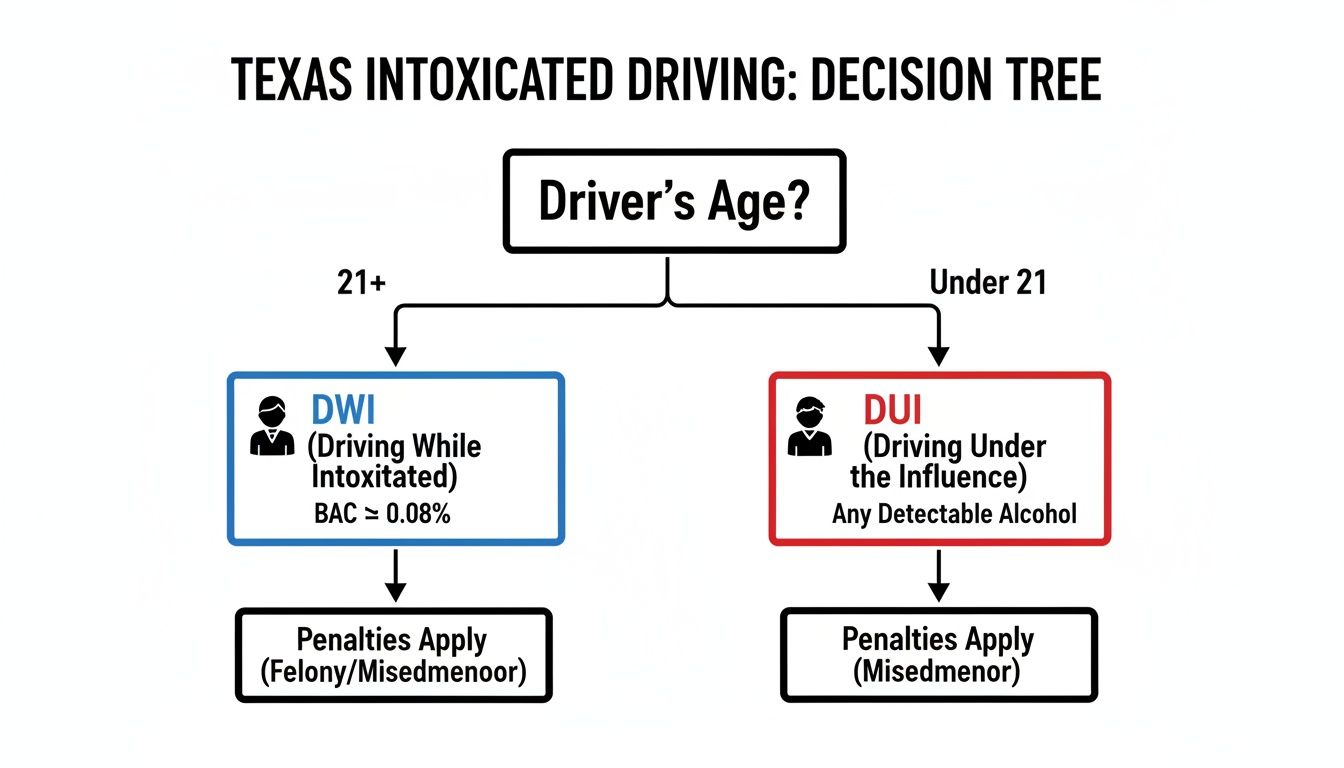
As you can see, the moment an officer determines your age, the entire nature of the charge changes. One path leads down the criminal code, while the other follows the alcoholic beverage code.
To make it even clearer, here’s a quick rundown of the key differences between a DWI and a DUI in Texas.
Quick Comparison Texas DWI vs DUI
This table breaks down the fundamental differences between DWI and DUI charges under Texas law, highlighting the critical distinctions in age, legal standards, and offense classification.
| Factor | DWI (Driving While Intoxicated) | DUI (Driving Under the Influence) |
|---|---|---|
| Applicable Age | 21 years and older | Under 21 years old |
| Legal Standard | BAC of 0.08% or higher, OR loss of normal faculties | Any detectable amount of alcohol in the system |
| Governing Law | Texas Penal Code § 49.04 | Texas Alcoholic Beverage Code |
| Offense Level | Typically a Class B Misdemeanor or higher | Class C Misdemeanor (for a first offense) |
Ultimately, a DWI is a serious criminal charge with the potential for jail time, while a first-offense DUI for a minor is handled more like a severe traffic ticket, though the consequences are still life-altering. Understanding this from the start is crucial for building a solid defense.
Deconstructing a Texas DWI Charge
Getting charged with a DWI can feel like the world is closing in. Suddenly, you're thrown into a legal system filled with confusing acronyms and complicated rules. Our goal is to break down exactly what a DWI charge means in Texas, so you can get a clear picture of what you're up against and start seeing a path forward.
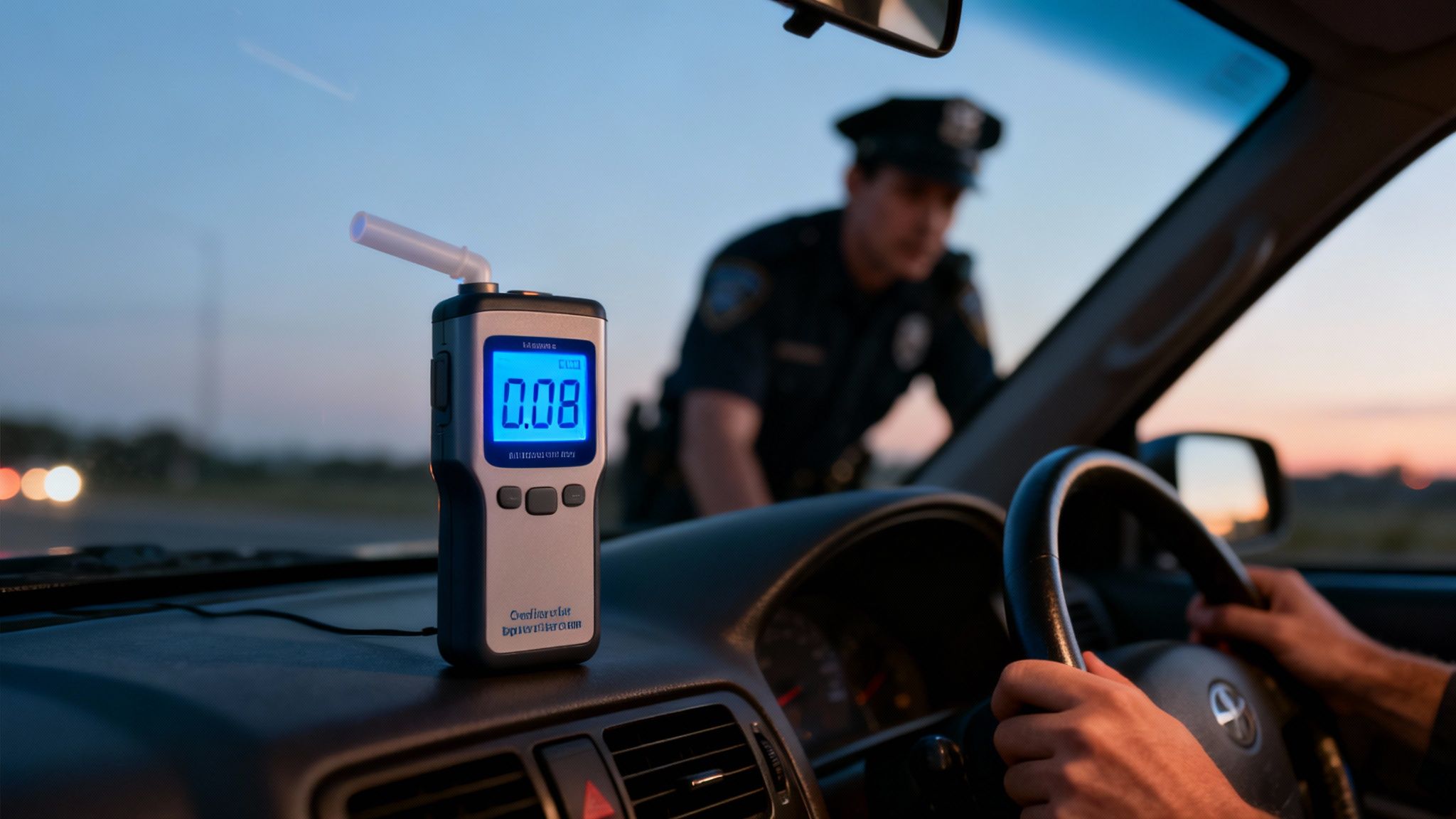
When the State of Texas charges you with Driving While Intoxicated, the prosecutor has a specific checklist they must prove beyond a reasonable doubt. They have to show you were operating a motor vehicle in a public place while you were legally intoxicated. It sounds simple enough, but that definition of "intoxicated" is where countless cases are won or lost.
The Two Definitions of Intoxication
Under Texas Penal Code § 49.01, the state gets two different shots at proving you were intoxicated when you were arrested. The thing is, they only need to prove one of them to get a conviction.
The first route is what we call the "impairment" theory. This defines intoxication as not having the "normal use of mental or physical faculties" because of alcohol, drugs, or a mix of both. This is a purely subjective standard that hinges entirely on the arresting officer's personal observations and opinions.
The second path is the "per se" theory. This one is more scientific, defining intoxication as having a Blood Alcohol Concentration (BAC) of 0.08% or higher. If a valid chemical test—like a breath or blood sample—shows your BAC is at or above this number, you are considered legally intoxicated, period. It doesn't matter if you felt perfectly fine to drive.
The Evidence Used Against You
To prove either impairment or a specific BAC, prosecutors will lean on a variety of evidence they gathered during your traffic stop and arrest. Understanding this evidence is the first step in your defense, because every single piece of it can be challenged by a skilled defense attorney.
Common evidence in a DWI case includes:
- Officer Observations: The officer will testify about things they saw, smelled, or heard—like the smell of alcohol, slurred speech, red or glassy eyes, or fumbling to get your license and insurance.
- Field Sobriety Tests (FSTs): These are the roadside exercises you've probably seen on TV, like the Walk-and-Turn or One-Leg Stand. They're designed to test your coordination and ability to follow instructions, but your performance is judged subjectively by the officer.
- Chemical Test Results: This is the hard number from a breathalyzer or a blood test that shows a specific BAC.
A key point to remember is that an arrest is not a conviction. The evidence collected by the police is often flawed. Breathalyzers can be improperly calibrated, medical conditions can affect FST performance, and an officer's subjective opinion is not undeniable fact.
It’s incredibly common for people unfamiliar with Texas law to mix up DWI and DUI. While some states might use the terms interchangeably, Texas law is very specific. Out-of-staters often use DUI and DWI as if they're the same, but legally, Texas almost exclusively uses DWI (Driving While Intoxicated), which packs a much heavier punch than what most people think of as a "DUI" elsewhere.
Unlike a minor DUI charge in another state that might end with a $500 fine and community service, a first-time Texas DWI means at least 72 hours in jail, fines up to $2,000, a license suspension for up to a year, and mandatory alcohol education classes. You can discover more insights about Texas DWI penalties and statistics on the state's official data portal.
Knowing how the state plans to define and prove intoxication is the first step in building your defense. An attorney can scrutinize every piece of evidence to find the cracks in the prosecution’s case against you.
What About DUI Charges for Minors?
Getting pulled over is nerve-wracking for anyone, but for a young driver in Texas, it can be a downright terrifying experience. While adults typically face DWI charges, the law takes a different, and in some ways stricter, approach for anyone under 21. This offense is called Driving Under the Influence (DUI), and it’s governed by the Texas Alcoholic Beverage Code—a completely separate set of rules from the Penal Code used in adult DWI cases.
Knowing this distinction is incredibly important because a Texas DUI falls under a “Zero Tolerance” policy. In plain English, this means a minor can be charged just for having any detectable amount of alcohol in their system. The familiar 0.08% BAC limit that applies to adults? It’s completely irrelevant for drivers under 21.
The "Zero Tolerance" Standard Explained
The zero-tolerance law is the state’s way of saying that no one under 21 should be drinking and driving, period. An officer doesn’t have to prove a young driver was swerving, slurring their words, or otherwise impaired. The simple presence of alcohol, no matter how tiny the amount, is all it takes to bring a DUI charge.
This is a much, much lower bar for the state to clear compared to a DWI charge. Even a single beer consumed hours before getting behind the wheel could result in a detectable BAC and land a young person in serious legal trouble.
The Consequences of a Minor DUI
Now, on paper, a first-offense DUI is a Class C misdemeanor, which is the same level as a traffic ticket. But don’t let that fool you—the penalties are far more serious and can create lasting problems for a young person just starting out. It's not something to brush off, even though it’s less severe than an adult DWI.
For a first-time DUI conviction, a minor could be looking at:
- A fine of up to $500.
- A driver’s license suspension for 60 days.
- 20 to 40 hours of mandatory community service.
- Required completion of an alcohol awareness education program.
It’s also critical to know that these consequences get worse with each offense. A second DUI leads to a longer license suspension, and a third can bring even tougher penalties. You can find a deeper dive into what’s true and what’s not by learning more about the consequences of a DUI for someone under 21.
A DUI charge can feel like a massive roadblock in a young person's life, casting a shadow over everything from college applications to job interviews. But here’s the thing: an arrest is not a conviction. There are always legal strategies to protect a minor’s record and fight back.
Even though a DUI is a lesser charge than a DWI, having it on a young person's record can slam doors shut before they even have a chance to open. An experienced attorney can look into options like deferred disposition, which could lead to the charge being dismissed after a probationary period. Once dismissed, it can often be expunged—completely wiped from their record as if it never happened. This is a stressful time for any family, but with the right guidance, it’s a challenge that can be met head-on.
DWI vs. DUI: A Look at the Penalties
When you're staring down an intoxication-related driving charge, the first thing on your mind is almost always, "What happens now?" The potential consequences can feel crushing, but getting a handle on the specifics is the first step toward building a solid defense. In Texas, the penalties for an adult DWI and a minor's DUI couldn't be more different, reinforcing how the law treats them as entirely separate offenses.
An adult DWI is a serious criminal charge, one that can jeopardize your freedom, drain your finances, and follow you for years. A first-offense DUI for a minor, on the other hand, is a Class C misdemeanor. While it’s handled more like a severe traffic ticket, it still carries penalties that can absolutely impact a young person’s future.
Fighting a War on Two Fronts: Criminal vs. Administrative Penalties
One of the most disorienting parts of this ordeal is realizing you’re not just fighting one case—you’re fighting two. After an arrest, you face criminal penalties from the court and entirely separate administrative penalties from the Texas Department of Public Safety (DPS).
The criminal case is where things like jail time, fines, and probation are decided. The administrative side, handled through an Administrative License Revocation (ALR) hearing, deals with one thing and one thing only: the suspension of your driver’s license. These two processes run on parallel tracks, meaning you could win your criminal case and still lose your license, or vice versa. It is absolutely vital that you address both immediately.
Penalty Comparison First Offense DWI vs DUI
To lay out exactly what’s at stake, let’s put the penalties for a standard first-offense adult DWI and a first-offense minor DUI side-by-side. The table below gives you a clear comparison of what to expect from both the criminal court and the administrative process.
| Penalty | Adult DWI (First Offense) | Minor DUI (First Offense) |
|---|---|---|
| Offense Classification | Class B Misdemeanor | Class C Misdemeanor |
| Potential Jail Time | 3 to 180 days | None |
| Maximum Fine | Up to $2,000 | Up to $500 |
| License Suspension | 90 days to 1 year | 60 days |
| Ignition Interlock Device | Often required | May be required |
| Community Service | Up to 100 hours | 20 to 40 hours |
| Mandatory Program | DWI Education Program | Alcohol Awareness Course |
This comparison really highlights the difference in severity. A DWI conviction carries the very real threat of jail, while a DUI focuses more on fines, educational courses, and community service hours.
When DWI Penalties Get Worse
It's crucial to understand that the penalties listed above are for a standard first-offense DWI. Certain circumstances, known as aggravating factors, can ratchet up the consequences in a big way. For a deeper dive into these enhancements, you can read our guide on the full range of penalties for a DWI in Texas.
A few of the most common aggravating factors include:
- A High BAC: If your Blood Alcohol Concentration was 0.15% or higher, the charge gets bumped up to a Class A Misdemeanor. That means potential jail time of up to one year and fines climbing as high as $4,000.
- A Child Passenger: Driving while intoxicated with a passenger under the age of 15 is an automatic State Jail Felony.
- Prior Convictions: Each DWI conviction makes the next one exponentially worse, eventually escalating to felony charges that carry serious prison time.
A DWI or DUI charge feels like your world is ending, but the initial penalties aren’t set in stone. An experienced defense attorney can fight for reduced charges, challenge the evidence to get a dismissal, and guide you through both the criminal and administrative maze to protect your rights and your future.
What to Expect After a DWI or DUI Arrest
A DWI or DUI arrest in Texas is terrifying. One minute you’re driving, the next you see flashing lights in your rearview mirror, feel the cold click of handcuffs, and get placed in the back of a police car. The entire experience is disorienting and designed to be intimidating.
But you're not alone in this. Understanding the road ahead is the first step toward taking back control. The legal system is a process, and knowing what’s coming can help you make smart decisions instead of panicked ones. This is not a journey you should ever try to navigate by yourself. The hours and days after an arrest are critical, and a lawyer can start protecting your rights from the moment you’re in custody.
The First Steps: Arrest and Booking
It all starts with the traffic stop. An officer will ask for your license and registration, and if they suspect you’ve been drinking, they’ll likely ask you to get out of the car for Standardized Field Sobriety Tests (SFSTs). It's important to know you have the right to politely decline these tests.
If the officer believes they have probable cause anyway, they will arrest you. You’ll be handcuffed, put into a patrol car, and driven to a police station or county jail for booking. There, officers will take your fingerprints, snap your mugshot, and confiscate your personal items. It’s usually during booking that they’ll ask you to provide a breath or blood sample.
Remember your Fifth Amendment right to remain silent. You only need to provide basic identifying information. Do not answer questions about where you were, what you did, or if you drank anything. Every word you say can—and will—be used against you.
Arraignment and Getting Out on Bail
After booking, you'll be brought before a judge for an arraignment, which is your first formal court appearance. This typically happens within 24 to 48 hours of the arrest.
At the arraignment, the judge will:
- Formally read the charges against you.
- Advise you of your constitutional rights, including your right to an attorney.
- Set the conditions for your release, which almost always involves posting bail.
Bail is a financial guarantee that you’ll show up for future court dates. You can either pay the full amount in cash or, more commonly, hire a bail bond company to post it for you for a fee (usually 10% of the total bail). Getting out of jail is the top priority so you can work with your attorney to build your defense from home, not from a cell.
Discovery and Plea Negotiations
Once you're released, the real legal work begins. Your attorney will enter a plea of "not guilty" on your behalf and formally request all the evidence the prosecution has compiled. This is known as the discovery process.
This evidence is the foundation of the state's case, and it’s also where a skilled defense attorney finds the cracks. We meticulously review police reports for inconsistencies, challenge how sobriety tests were administered, and scrutinize the maintenance and calibration records of any breathalyzer machines used.
After reviewing all the evidence, plea negotiations often start. The prosecutor might offer a plea bargain, which could mean pleading guilty to a lesser charge for a more lenient sentence. Your attorney will lay out the strengths and weaknesses of your case, helping you decide whether to accept a plea or take your case to trial. Every decision is made with your full understanding and consent, putting you back in control of your future.
How a Strong DWI Defense Is Built
Getting arrested for a DWI can feel like the world is closing in. It’s easy to think that just because an officer put you in handcuffs, a conviction is guaranteed. But let's be clear about one thing: an arrest is not a conviction. The state carries the entire burden of proving its case beyond a reasonable doubt, and a sharp defense attorney knows exactly where to find the weaknesses in their argument.
At The Law Office of Bryan Fagan, PLLC, we believe every single case deserves a relentless, detail-oriented defense. We don't just skim the police report and accept it as fact. Instead, we take apart every piece of evidence to shield your rights, your freedom, and your future.
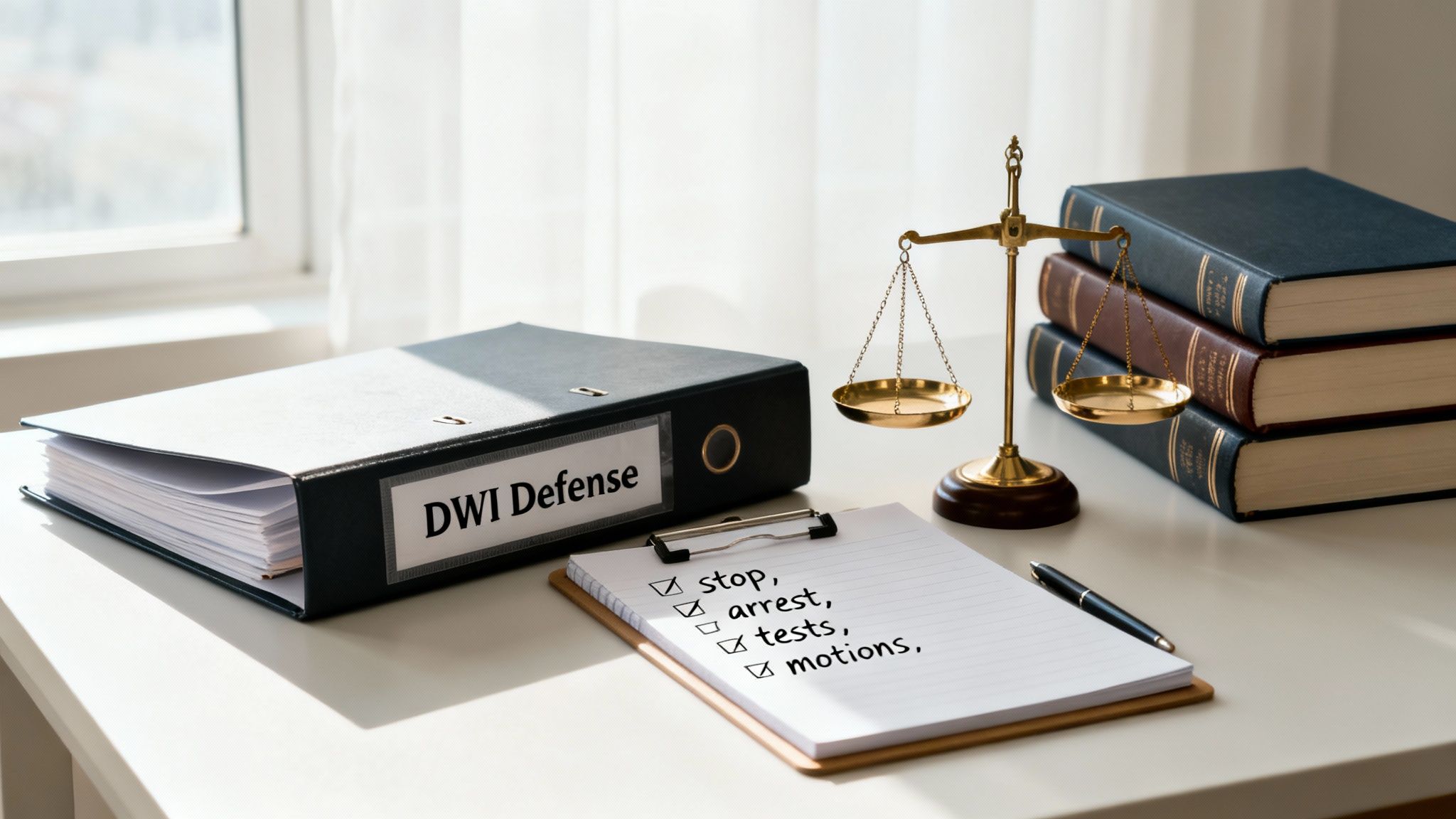
A powerful defense starts by asking the hard questions—the ones the prosecution hopes no one will ask. We dig into every detail, hunting for procedural mistakes, faulty equipment, and any violation of your constitutional rights.
Challenging the Traffic Stop
The entire case against you stands on one critical moment: the initial traffic stop. A police officer can't just pull you over on a hunch or a gut feeling; they need reasonable suspicion that you've broken a law. This could be something as minor as a broken taillight or as obvious as speeding.
If the officer can't provide a legitimate, legally sound reason for that stop, then any evidence gathered afterward—from field sobriety tests to breath or blood samples—could be thrown right out of court. This is often the first, and most effective, line of defense.
Questioning Field Sobriety and Chemical Tests
The evidence used to "prove" you were intoxicated is often far less reliable than prosecutors want a jury to believe. Standardized Field Sobriety Tests (SFSTs) are notoriously subjective. Your performance can be thrown off by anything from bad lighting and uneven pavement to simple nervousness or a pre-existing medical condition.
Likewise, breathalyzer and blood test results are not bulletproof.
- Breathalyzers are sensitive machines that demand strict calibration and regular maintenance. We pull the device’s logs to check for a history of errors or sloppy upkeep.
- Blood tests can be ruined by improper storage, sample contamination, or a broken chain of custody that leaves the results questionable.
Successfully challenging how these tests were administered and their ultimate accuracy can create serious doubt about the state's key evidence. You can find out more about the different strategies used when you learn more about how to fight a DWI in Texas.
Building a DWI defense is like dismantling an engine piece by piece. We examine every component—from the initial stop to the final lab report—to find the one faulty part that makes the entire machine fall apart. Your case is unique, and it deserves a customized, detailed investigation.
A DWI charge in Texas is a serious fight, but it's far from a hopeless one. A strategic, aggressive defense can expose the flaws in the prosecution's case and open the door to a much better outcome, whether that’s a full dismissal, reduced charges, or an acquittal at trial.
Common Questions About Texas DWI and DUI Charges
When you're facing an intoxicated driving charge, your mind is likely racing with questions and fears. Getting clear, straightforward answers is the first step toward regaining a sense of control over your situation. Here, we address some of the most urgent concerns we hear from clients navigating the complexities of Texas DWI and DUI laws.
Can I Refuse a Breathalyzer Test in Texas?
Yes, you have the right to refuse a breath or blood test, but it’s a decision with immediate consequences. Under Texas’s “implied consent” law, your refusal automatically triggers an Administrative License Revocation (ALR).
For a first-time refusal, this means a 180-day license suspension. This penalty is entirely separate from your criminal case and happens regardless of whether you are ultimately convicted. The prosecution can also tell the jury that your refusal is evidence of your guilt.
Will a DWI Charge Be on My Record Forever?
Not necessarily. If your DWI case is dismissed or you are found not guilty at trial, you may be eligible for an expunction, a legal process that completely destroys all records of the arrest.
In other situations, successfully completing a deferred adjudication probation may allow you to file for an order of nondisclosure, which seals the record from public view. Each option has strict legal requirements, making it vital to work with an attorney who can guide you toward the best path for clearing your record.
What Is an ALR Hearing and Why Is It Important?
The Administrative License Revocation (ALR) hearing is a civil proceeding that is completely separate from your criminal DWI case. Its only purpose is to determine whether the Texas Department of Public Safety (DPS) will suspend your driver's license.
You must request this hearing within 15 days of your arrest, or you automatically lose your right to fight the suspension. This hearing is also a critical strategic opportunity for your attorney to question the arresting officer under oath, which can reveal valuable information for defending your criminal case.
Providing clear answers to these common questions contributes to public understanding and builds trust, illustrating a key aspect of the role of legal content in building trust.
If you’ve been charged with a crime in Texas, call The Law Office of Bryan Fagan, PLLC for a free and confidential consultation. Our defense team is ready to protect your rights.