Being arrested in Houston can feel like your life stopped in a single moment. One minute you're driving home, leaving a bar, arguing during a family dispute, or answering a knock at the door. The next, you're in handcuffs, your phone is gone, and you're trying to guess what happens next.
That fear is real. So is the confusion. You may be worried about jail, your job, your family, immigration issues, or what people will find online if your case becomes public.
A criminal charge is serious, but it isn't the end of your story. If you're looking for a criminal defense attorney in Houston, what matters most right now is getting clear about your rights, your options, and the decisions that can protect you from making a bad situation worse.
An Arrest in Houston Is Not a Conviction
A lot of people call a Houston criminal lawyer at the same point. They haven't slept. A family member is trying to post bond. Police asked questions that seemed simple, and now they're replaying every answer in their head.
That's normal.
An arrest creates pressure fast. Police act quickly. Jail staff move you through booking. Friends and relatives start giving advice, much of it wrong. You may even feel tempted to "clear things up" by talking more. In many cases, that's the first mistake.
The better way to think about a criminal case is this. An arrest starts a process. It does not decide the outcome. Your case may involve legal defenses, weak identification, missing witnesses, a search issue, a stop that wasn't lawful, negotiation opportunities, diversion options, or record-clearing possibilities later.
What this moment really means
Right now, you don't need to predict the final result. You need to protect your position.
That means staying quiet, getting counsel involved early, and understanding how Harris County cases usually move from arrest to arraignment, negotiation, trial decision, sentencing, and in some cases, expunction or record sealing. Many people assume the only "win" is a dramatic not guilty verdict. In real practice, smart defense often means reducing exposure before the case ever reaches that point.
Your first job is simple. Don't help the State build its case against you.
Houston is a major criminal defense market. There are many lawyers, many courts, and many kinds of charges. That also means there are real differences in how cases are handled. A DWI case doesn't move like a family violence case. A theft allegation may create different risks than a drug possession arrest. If your criminal matter also affects child custody, a protective order, or divorce, the legal consequences can spread beyond criminal court.
Control comes from good decisions
You do have power here. You can decide whether to speak. You can decide how quickly to hire counsel. You can decide whether to accept a plea offer, fight a search, request a trial, seek a diversion program, or pursue record relief later.
Those decisions shouldn't be rushed. They should be strategic.
What to Do Immediately After a Houston Arrest
The first day matters. What you say, what you sign, and how you behave can affect the rest of your case.
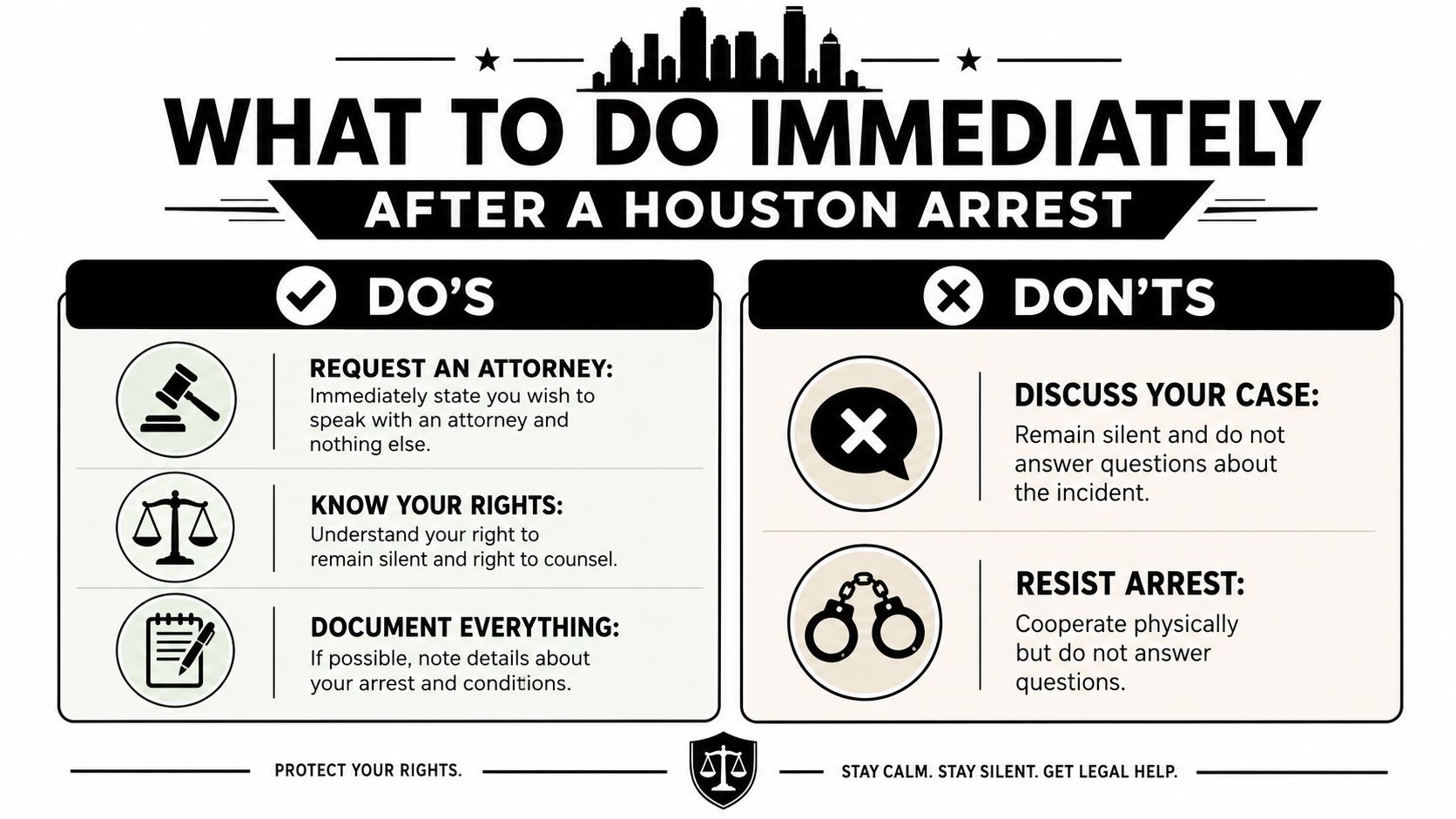
The two sentences that protect you
If police want to question you, keep it simple.
I want to remain silent.
I want a lawyer.
Say those words clearly. Then stop talking about the facts of the case. Don't explain. Don't argue. Don't try to sound cooperative by giving "just a little context." If officers keep talking, you still don't need to answer questions about what happened.
What usually happens first
After an arrest, you'll usually go through booking. That can include fingerprinting, photographs, property intake, and a record of the alleged charges. If you're released later, your case still continues unless it is dismissed.
At arraignment in a Texas criminal case, the judge formally reads the charges, advises you of constitutional rights including the right to remain silent and the right to an attorney, and requires you to enter a plea of guilty or not guilty, as described by Houston Criminal Defense Attorneys PLLC on Texas arraignment procedure.
If you need a practical overview right away, this guide on what to do immediately after getting arrested in Texas is useful because early choices often shape the defense.
Immediate Actions After Arrest Do's and Don'ts
| What to Do | What NOT to Do |
|---|---|
| Ask for counsel and stop answering questions | Don't explain your side to police in hopes of quick release |
| Stay calm and physically cooperative | Don't resist arrest or pull away |
| Pay attention to details like time, location, witnesses, and officer conduct | Don't argue the law with officers on the scene |
| Use the phone call wisely to contact family or a lawyer | Don't discuss the case on a recorded jail line |
| Keep paperwork and release documents | Don't sign documents you don't understand |
Practical do's and don'ts
Use plain language: Tell officers you want to remain silent and want an attorney. You don't need legal jargon.
Protect your memory: As soon as you can, write down what happened. Include names, patrol car numbers if known, where witnesses stood, and whether there were cameras nearby.
Think about representation early: When to Hire a Criminal Defense Lawyer in Texas addresses a basic but important point. Early representation matters after an arrest or investigation.
Don't discuss facts on jail calls: Prosecutors may use statements made to family or friends.
Don't consent casually: If officers ask to search your phone, car, or home, don't try to negotiate on your own.
Don't assume being polite means being talkative: You can be respectful and silent at the same time.
Practical rule: Be physically cooperative, but verbally guarded.
If you can't afford private counsel, ask about appointed counsel and legal aid options. Texas has expanded access to free criminal defense help in some situations, and more people now qualify than many assume. That issue should be discussed directly with counsel or the court, not guessed at in the jail.
Choosing Your Defender How to Find the Right Houston Criminal Attorney
Picking counsel in Houston can feel overwhelming because there are so many names online and so many promises. The market is crowded. According to LawFirm.com criminal defense statistics, Houston has over 2,703 registered criminal defense attorneys, and in Texas only 10% of criminal lawyers are Board Certified in Criminal Law.

That doesn't mean every good lawyer is board certified, and it doesn't mean every non-certified lawyer is the wrong fit. It does mean you should look past slogans. Credentials, local court experience, and case-specific judgment matter.
What actually matters in hiring counsel
Start with fit, not flash. If you're facing DWI, ask about DWI defense. If you're charged with assault involving a spouse or partner, ask whether the lawyer handles the criminal case with awareness of protective order and custody consequences. If your case could affect family court, that overlap matters because Texas judges may consider criminal convictions in custody determinations, a point discussed by Leichter Law in its criminal defense overview.
A good consultation should leave you clearer, not more confused.
Ask questions like these:
- What courts do you work in most often? Harris County practice has its own rhythms.
- What issues do you see first in my case? Listen for specifics, not generic reassurance.
- Who will handle court appearances? The lawyer you meet may not be the lawyer who stands next to you.
- What are the early pressure points? Bond conditions, witness contact, evidence preservation, and suppression issues often matter immediately.
- How do you approach bail and release? If you're still in custody, this overview of Bail and Bond in Texas Criminal Cases explains how bail is set and the options for securing release.
Red flags people miss
Some warning signs are easy to overlook when you're scared.
- Guaranteed outcomes: No honest lawyer can promise dismissal or acquittal.
- Pressure to plead immediately: Fast isn't always smart.
- No discussion of weaknesses: Every case has risks. A serious lawyer will say so.
- No explanation of process: You should understand what comes next.
If you're comparing firms, this article on how to choose a criminal defense attorney can help you organize the decision.
For lawyers, counselors, or other professionals helping a client find coordinated support, Reflections has resources for referring legal professionals that may be useful in cases where legal issues intersect with outside care needs.
The right lawyer doesn't just talk about trial. The right lawyer talks about risk, timing, leverage, and the decisions that matter before trial.
The Law Office of Bryan Fagan, PLLC handles Texas criminal defense matters including DWI, assault, drug cases, record clearing, and cases that overlap with family law issues. That's the kind of scope some clients need when one criminal allegation can affect several parts of life at once.
Navigating the Texas Criminal Justice System
Anxiety often lessens once the path ahead becomes clear. A criminal case isn't one event. It's a series of stages, and each one gives your defense lawyer different tools.
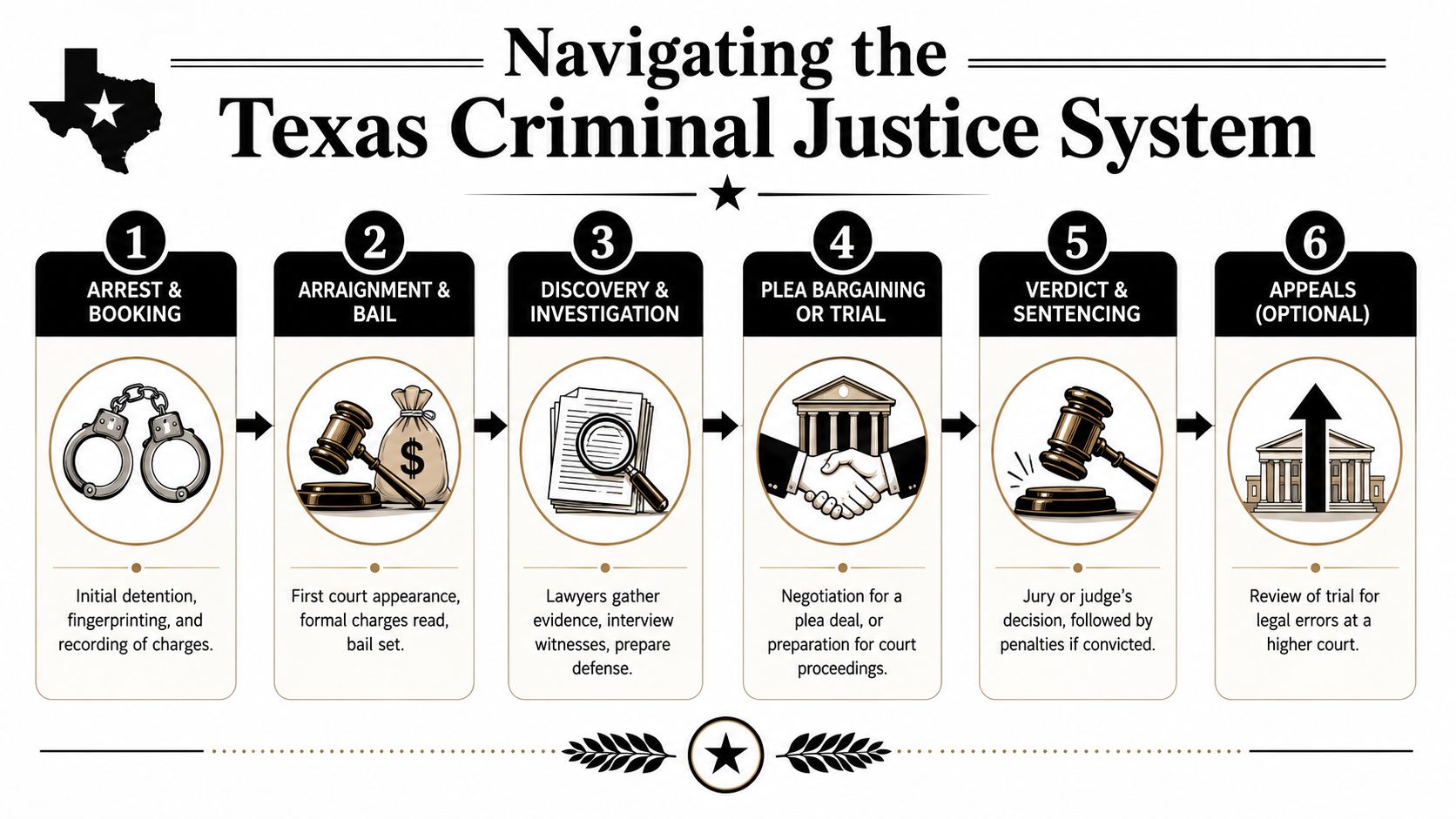
The basic path through a Harris County case
A broader walkthrough of steps in the criminal justice process can help you place your own case on the timeline. In plain terms, most cases move through arrest, release or detention decisions, court appearances, investigation, negotiation, and then either resolution or trial.
Here is what those stages usually mean:
Arrest and booking
Police detain you, process you, and record the allegation.First court appearance
The court addresses the charge, your rights, and often release conditions.Investigation and discovery
The defense reviews reports, video, witness statements, lab records, and other evidence.Pretrial motions
Your lawyer may challenge a stop, search, statement, identification, or other part of the State's evidence.Plea discussions or trial setting
Some cases resolve through negotiated outcomes. Others are prepared for trial.Sentencing or post-trial review
If there's a conviction or plea, the focus turns to punishment, conditions, and possible next steps.
Where cases are often won
Many people think the courtroom trial is where everything happens. In reality, some of the most important work happens well before that. According to Broden & Mickelsen's discussion of trial win claims, actual acquittal rates in jury trials in major Texas jurisdictions are about 10%, and successful outcomes often come through plea negotiations, dismissals, or reduced charges rather than full acquittals.
That fact changes how smart defense works.
A seasoned Texas assault defense or DWI defense strategy often focuses on early intervention, careful review of police conduct, suppression issues, witness problems, and bargaining power in negotiation. The point isn't to avoid trial at all costs. The point is to make the most informed decision about trial risk.
Your role in the process
You aren't there just to appear in court and wait. You help your defense by doing practical things well.
- Keep appointments: Missed court dates create avoidable damage.
- Follow bond conditions: A new violation can make everything harder.
- Save evidence: Messages, photos, GPS data, receipts, and names of witnesses may matter.
- Ask questions before major decisions: A plea can affect employment, licensing, immigration status, and family court.
A strong defense is built piece by piece. Facts, timing, and procedure matter as much as the accusation itself.
Common Charges in Houston and Potential Defense Strategies
Not every charge should be defended the same way. The facts matter. So does the law the State must prove.
DWI charges under Texas law
Under Texas Penal Code § 49.04, a person commits DWI if they operate a motor vehicle in a public place while intoxicated, including having an alcohol concentration of 0.08 or greater, as explained in this discussion of Texas DWI law under Penal Code 49.04.
In plain English, the State usually tries to prove operation, intoxication, and a lawful stop or investigation. A Texas DWI attorney often looks first at the traffic stop, field sobriety testing, video evidence, statements made by the driver, and breath or blood testing issues.
Common defense questions include:
- Was the stop lawful? If police lacked a valid reason to stop the vehicle, later evidence may be challenged.
- Were tests administered properly? Poor instructions or bad conditions can affect reliability.
- Did a medical condition mimic intoxication? Fatigue, injury, anxiety, and certain health issues can complicate observations.
Assault and family violence allegations
Assault cases range from bar fights to highly emotional domestic disputes. The key legal questions often include intent, bodily injury, identity, and whether self-defense applies.
A Texas assault defense may focus on witness credibility, inconsistent statements, lack of injury evidence, or context the initial report left out. In family violence cases, the criminal charge may also trigger protective order issues and affect parenting or possession disputes. That overlap needs careful handling.
Helpful defense themes can include:
- Self-defense or defense of others
- Mutual combat or incomplete investigation
- False accusation during a breakup or custody conflict
Theft allegations
Theft cases may sound straightforward, but they often aren't. The State generally must show unlawful appropriation of property with intent to deprive the owner.
Defense strategy may turn on ownership confusion, lack of intent, mistaken identity, permission, or weak store surveillance. In employee theft cases, records and timelines matter. In retail cases, what happened before a detention can matter a great deal.
Drug possession charges
Drug cases often rise or fall on search and seizure issues. Police may recover drugs from a car, home, pocket, or shared space, but possession is not always as simple as proximity. The State still has to connect the substance to you in a legally sufficient way.
A Houston criminal lawyer often examines:
- How police found the evidence
- Who had access to the place where it was found
- Whether lab testing supports the charge
- Whether diversion or treatment-based outcomes are available
In many drug and DWI cases, the first real defense question isn't "Did it happen?" It's "Can the State legally use what it found and what officers claim they observed?"
Rebuilding Your Life Expunctions and Post-Conviction Options
A criminal case can end, but the record may remain. That record can affect work, housing, professional licenses, school applications, and reputation. The good news is that Texas law gives some people a path forward.
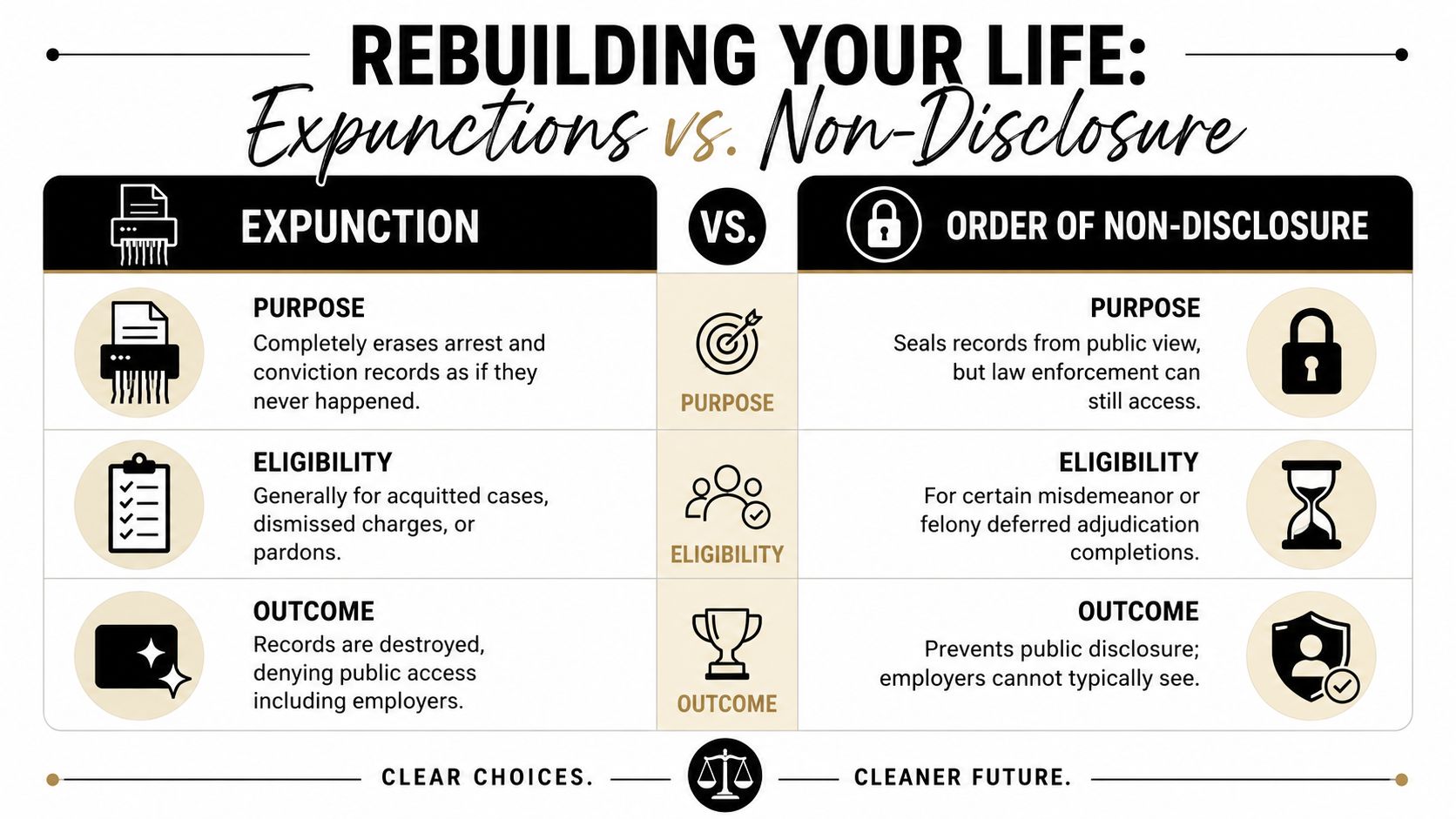
Expunction and nondisclosure are not the same
An expunction is the stronger remedy. In general terms, it is used to erase eligible records so the arrest or case is treated as though it didn't happen for most purposes.
An order of nondisclosure is different. It seals eligible records from public view, but law enforcement and certain agencies may still access them. For many people, that's still a major benefit because ordinary background checks often won't show the sealed matter.
The right option depends on how your case ended. Dismissal, acquittal, deferred adjudication, and conviction do not lead to the same relief.
Diversion and deferred outcomes can change the future
Some people can avoid a formal conviction before they ever need later record relief. In Harris County, certain drug offenses may qualify for pre-trial diversion or deferred adjudication, allowing a person who successfully completes the program to avoid a formal drug conviction, as noted by Dunham & Jones on Houston criminal defense options.
That matters because the way a case is resolved can determine what record-clearing options open up later.
Here are the practical questions to ask:
- Did my case end in dismissal, acquittal, diversion, deferred adjudication, or conviction?
- Am I eligible to clear or seal the record now, or do I need to wait?
- Will this case affect job or housing screenings if I do nothing?
Post-conviction relief and moving forward
Even after a conviction, your legal options may not be over. Depending on the case, there may be appeal issues, probation modifications, early termination possibilities in some contexts, or future record-sealing questions. The right answer depends on the charge, the disposition, and whether the court imposed special conditions.
People also overlook the practical side of recovery. If your case involved substance use, mental health concerns, or a family crisis, legal strategy should work alongside real life repair. Courts notice when a person is taking meaningful steps, and so do prosecutors in the right cases.
Clearing a record isn't just paperwork. It's often the final step in getting your life back.
If you've been charged with a crime in Texas, call The Law Office of Bryan Fagan, PLLC for a free and confidential consultation. Our defense team is ready to protect your rights.