Being arrested in Texas can be terrifying. You may be in the back of a patrol car, sitting in a holding cell, or waiting for a family member to answer a jail call. Your mind jumps to work, your kids, your license, your record, and whether one bad night is about to change everything.
Take a breath. An arrest is serious, but it is not the same thing as a conviction. What you do in the next few hours can protect you, or make the case harder than it needs to be.
If you're searching for what to do immediately after getting arrested in texas, you need a calm plan, not generic advice. You need to know when to speak, when to stop speaking, who to call, what booking will look like, what happens at your first hearing, and what mistakes can send you back to jail after release.
An Arrest is Not a Conviction Your First Steps Matter
The first mistake many individuals make is trying to fix everything on the spot. They explain. They argue. They try to sound cooperative. They think, “If I just clear this up, maybe this goes away.”
That usually doesn't work.
If an officer has decided to arrest you for DWI, assault, theft, drug possession, or another offense, roadside explanations rarely help. They often give the State more statements to use later. The better move is to protect your rights early and let your defense happen in the right place. If you want a broader overview of the process, this guide on what happens when you get arrested in Texas is a useful companion.
Memorize this script
You don't need a speech. You need one clear sentence:
Say this: “I am exercising my right to remain silent and request an attorney immediately.”
Then stop talking about the facts of the case.
That script matters because people often waive rights without realizing it. They answer “just a few questions.” They try to explain why they were at a location, why they drank, why they texted someone, or why there was property in the car. Those details can become evidence.
What works and what doesn't
A simple way to think about the next hour is this:
- What works: staying calm, following physical instructions, clearly invoking your rights, and waiting for counsel.
- What doesn't: arguing with officers, debating the law on the roadside, consenting to extra conversation, or trying to talk your way out of custody.
- What creates new problems: resisting, being disrespectful, giving false information, or talking freely in the hope that honesty alone will save you.
Texas criminal procedure moves fast at the start. The arrest, booking, first call, and magistrate appearance each have a purpose. If you treat those stages as separate decisions instead of one long panic, you'll make better choices.
Your Immediate Rights During a Texas Arrest
The most important moment in many cases comes before formal charges are even filed. It happens when an officer starts asking questions and you're tempted to fill the silence.

Under Texas procedure, arrest begins when you're restrained or when you submit to authority. Once you're in custody, the safest path is simple. Invoke your rights clearly, then stay with that decision. A deeper look at Miranda rights violations in Texas cases can help you understand how these issues are challenged later.
Use direct language, not soft language
Don't say, “Maybe I should get a lawyer.”
Don't say, “I think I don't want to talk.”
Don't ask, “Do I need an attorney?”
Say this exactly:
“I am exercising my right to remain silent and request an attorney immediately.”
That wording matters. According to this Texas arrest rights discussion, Houston-based defense firms like Bryan Fagan PLLC report 85% of cases where clients invoked silence early avoided self-incriminating statements used in 92% of convictions from improper waivers. The same source states that once you clearly invoke your rights, questioning must cease until counsel is present.
What officers may do next
In real life, questioning doesn't always look like a formal interview room scene. It may sound casual.
An officer may say:
- “Help me understand what happened.”
- “If you've got nothing to hide, talk to me.”
- “This is your chance to tell your side.”
- “We're just having a conversation.”
That is still dangerous territory for you. People hurt their cases by talking in fragments. One sentence gets misunderstood. Another sounds inconsistent later. A third puts them at a place they later wish they hadn't admitted.
Casual conversation after an arrest is rarely casual for the prosecutor reviewing your file.
Two more rights people give away too easily
You should also refuse consent to searches. Be polite and firm. Say, “I do not consent to any searches.”
And don't use recorded communications to discuss the case. Calls from jail are commonly monitored. So are many message systems inside the jail.
Here's a short explainer that reinforces the point about staying disciplined after arrest:
Keep your body calm even if your mind isn't
You can protect your case and still comply physically. Those are not opposites.
Use this mental checklist:
- Don't resist physically. Let your lawyer fight the legality later.
- Don't answer investigative questions. Silence is protection, not disrespect.
- Don't consent to searches.
- Don't joke, vent, or explain. Officers write reports. Body cameras run. Memory isn't your friend under stress.
If you're facing a charge under the Texas Penal Code, whether it's a misdemeanor theft, assault family violence allegation, or felony drug case, your first legal defense often starts with what you didn't say.
What to Expect During the Booking Process in Texas
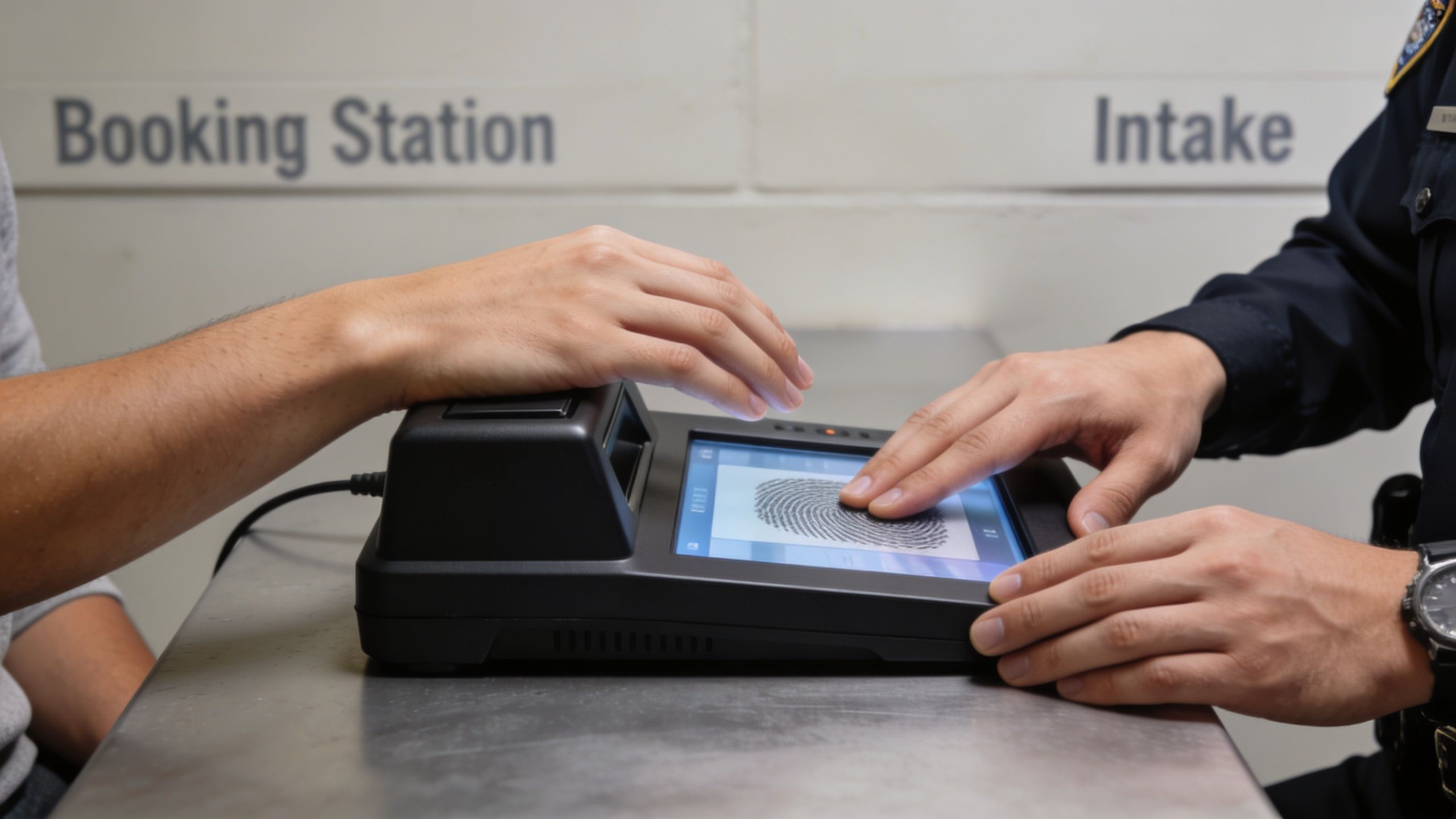
Booking feels slow because it is slow. You may move from a patrol car to a secured entrance, then to a waiting area, then to fingerprints, photos, property intake, and classification. For many people, this is the first time the arrest feels real.
The process is administrative, but it still matters legally.
According to this booking overview, the booking process involves recording your name, address, and fingerprints, and taking your photograph. All your personal property is confiscated and inventoried. This process can take several hours, and it's critical to remember that anything you say can be used against you, so you must continue to exercise your right to remain silent.
What you'll usually go through
Most county jails follow a similar sequence. Details vary by county, but the pattern is familiar.
- Identity intake: Staff record your basic identifying information.
- Photograph and fingerprints: Your mugshot and prints become part of the arrest record.
- Property inventory: Wallet, phone, jewelry, keys, and other belongings are taken, listed, and stored.
- Screening and classification: Jail staff may ask health and safety questions and decide housing placement.
- Waiting: A lot of waiting.
This stage can feel like a strange mix of paperwork and pressure. That pressure causes people to talk more than they should.
What to answer and what not to answer
You may need to provide basic identifying information. But booking is not the time to start giving your version of events.
Use this rule:
| Situation | Best response |
|---|---|
| Basic identification question | Answer truthfully |
| Question about the incident | Invoke silence |
| Request to explain “what happened” | Decline and ask for counsel |
| Casual chat from staff or officers about the case | Say nothing about the facts |
If you lie during intake, you can create a separate problem. If you overshare, you may strengthen the State's case. The smart middle ground is accurate identification and silence about the allegations.
Practical rule: Booking officers may sound administrative, but your words can still end up in reports, recordings, or testimony.
Your property and your phone
Your phone will usually be taken with your other belongings. That means you may not have your contacts list, saved numbers, or messages available when you need help most.
Memorize at least one useful number if you can. If you're reading this after release for a loved one, understand why many arrestees sound scattered on the first call. They may not have access to anything that normally keeps their life organized.
This matters in DWI, assault, theft, and drug possession cases because the first hours set the tone for everything that follows. A clean, quiet booking process gives your defense lawyer fewer statements to undo later.
Who to Call After a Texas Arrest and What to Say
The “one phone call” idea is simpler in movies than in real life, but the principle is still important. You may get a limited chance to contact someone, and that call needs to count.
This becomes harder on a Friday night. According to this discussion of weekend Texas arrests, about 40% of arrests in Texas happen on weekends, when getting a private lawyer quickly can be harder. The same source says you should use the call to reach either a trusted family member or a 24/7 law firm, avoid discussing case details because jail calls are monitored, and act early because prompt firm involvement can help preserve evidence before it's lost.
Your best call depends on your situation
If you know a criminal defense lawyer or can reach a firm that answers after hours, call counsel first.
If you can't, call the one family member who will stay calm, write things down, and follow directions. Don't call the relative who panics, lectures you, or starts posting online before they understand what happened.
A useful first call usually has only a few pieces of information:
- Your full name
- The jail or agency holding you
- The charge, if you know it
- Whether you expect a magistrate hearing soon
- Who should contact a lawyer for you
What to say on that call
Keep it tight. Something like this works:
“I'm in custody at the county jail. I need you to contact a criminal defense lawyer right now. Don't discuss the facts of my case on this call. Please write down where I am and start making calls.”
If you are calling a lawyer or law office, the script changes slightly:
“My name is ____. I'm in custody at ____. I believe the charge is ____. I have a magistrate appearance coming up. Please contact the jail and my family.”
What not to say
Do not treat the call as a private debrief.
Don't say:
- “This is the actual story.”
- “I only had a few drinks.”
- “She started it.”
- “The drugs weren't mine.”
- “Tell my friend to delete that video.”
Those statements can do real damage. Calls are monitored, and your own words can become evidence.
Weekend arrests create real logistical problems
This is one place many articles miss the practical reality. If you're arrested late at night or over the weekend, your normal support system may be asleep, traveling, or impossible to reach. Public defenders usually aren't assigned the instant you're booked. That gap matters.
The fix is preparation and discipline. Call the person most likely to act fast. Ask them to keep notes. Tell them not to post. Tell them not to argue with witnesses, alleged victims, or police. If there may be surveillance footage, dashcam video, store video, or phone evidence that could disappear, early legal help can matter a lot.
Understanding Your Arraignment and Bail Hearing
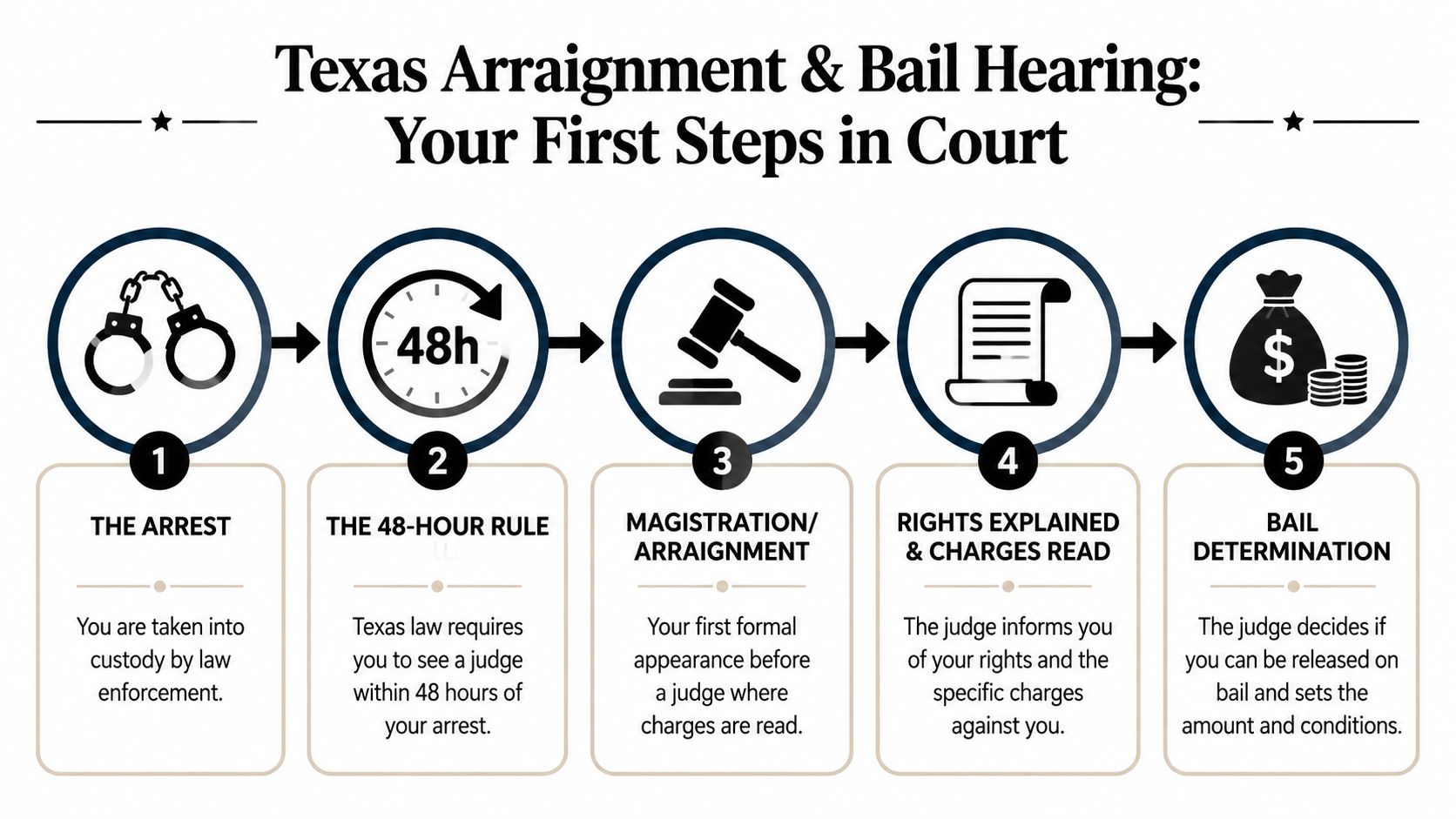
Texas doesn't allow the police to hold you indefinitely without judicial review. Under Texas law on the first magistrate appearance, you must be brought before a magistrate within 48 hours of your arrest. At that hearing, the judge reads the charges, informs you of your constitutional rights, and sets bail. The same source explains that this 48-hour window is a critical constitutional safeguard against detention without judicial oversight.
If you want a closer look at that first court appearance, this article on what happens at an arraignment hearing helps explain the mechanics.
What happens at this hearing
This appearance is often called magistration or an arraignment, depending on the court and context. It is the first formal checkpoint in your criminal case.
The court typically covers these points:
- The charge: You are told what offense the State alleges.
- Your rights: The court advises you of core constitutional rights.
- Bail: The judge sets the amount and sometimes the release conditions.
- Counsel issues: The court addresses your right to legal representation.
The practical trade-off at this stage
People often think they need to “tell their side” to help themselves at the first hearing. Usually, that's not the move.
The smarter approach is caution. In many cases, the safest plea at the start is not guilty, because it preserves your options while your lawyer reviews the evidence, police reports, body camera footage, testing issues, witnesses, and possible defenses.
The first hearing is not the moment to rush into admissions. It is the moment to protect position, secure release, and avoid locking yourself into a bad decision.
Why bail conditions matter as much as bail amount
Focusing solely on securing release is common. That makes sense. However, release conditions can shape your life for months.
Depending on the charge, the court may impose conditions involving:
| Issue | Why it matters |
|---|---|
| Contact restrictions | You may be barred from contacting an alleged victim or witness |
| Travel limits | Leaving the county or state can create violations |
| Substance testing | Missed or failed tests can trigger trouble |
| Firearm restrictions | Common in certain assault or family violence cases |
| Check-ins | You may have to report regularly or monitor compliance |
If you're charged with Texas assault defense issues, especially family violence allegations, conditions about contact and protective orders can affect where you live and whether you can return home. In a Texas DWI attorney case, ignition interlock or alcohol-related conditions may apply. In a drug possession case, testing and travel limits are common practical concerns.
What comes after this stage
After magistration, the case keeps moving. Prosecutors review charges. Defense counsel begins evaluating evidence. Some cases are resolved through negotiation. Some are attacked through motions. Some go to trial. If there is a conviction, sentencing and post-conviction options can matter. If the case is dismissed or qualifies later, expunction or record sealing through nondisclosure may become part of the long-term strategy.
That's why the first hearing matters. It doesn't finish the case. It positions the case.
You're Out on Bail Now Protect Your Freedom
Getting released feels like the hard part is over. It isn't. The period right after release is when many people make preventable mistakes.
According to this discussion of post-release mistakes after a Texas arrest, 25% of bail bond revocations stem from early missteps after release, often involving social media. The same source states that prosecutors in Houston and Dallas increasingly use AI to flag social media activity for violations, and it recommends notifying your employer through an attorney, deleting social media apps, and instructing family not to post about the case.
Treat bond conditions like a court order, because they are
Many clients think a bond condition is more like a suggestion. It isn't. If the judge says no contact, that usually means no direct contact, no indirect contact through friends, and no “just one text to explain things.”
If the court says no alcohol, travel restrictions, GPS monitoring, or regular check-ins, follow those terms exactly. Close enough is not good enough.
Your first day out checklist
Start with these steps:
- Read every bond document carefully. If you don't understand a condition, ask your lawyer before you act.
- Delete social media apps from your phone. Don't trust yourself to “be careful.”
- Tell family and close friends not to post. That includes photos, opinions, jokes, fundraising pages, and attacks on the other side.
- Don't contact co-defendants, witnesses, or the complaining witness unless your lawyer says it's allowed.
- Write down what you remember. Do it privately, for your lawyer, while the timeline is fresh.
- Make a court-date system. Put dates in your phone, on paper, and with one reliable family member.
Important: Relief after release causes sloppy decisions. Slow down before every text, post, trip, and conversation.
Work, school, and daily life
You may need to explain an absence to an employer, professor, coach, or licensing board. That should be handled carefully. A rushed explanation can create problems in both the criminal case and your job.
If possible, let your lawyer help frame the communication. That's especially important for professionals, commercial drivers, healthcare workers, teachers, and anyone in a regulated occupation.
Think beyond the arrest
A criminal case has stages. Immediate release is only one stage.
Later, your path may include:
- Plea bargaining: Sometimes appropriate, sometimes not. It depends on the facts, the evidence, and the collateral consequences.
- Trial preparation: Necessary when the State's case is weak, overcharged, or built on bad assumptions.
- Sentencing advocacy: If needed, mitigation matters during this stage.
- Post-conviction relief: In some cases, appeals or other remedies may exist.
- Expunction or nondisclosure: If your case is dismissed, results in acquittal, or qualifies under Texas law later, clearing or sealing your record may be the next important step.
People often focus on the arrest and miss the long game. The better approach is to protect your freedom now and your future record later.
If you've been charged with a crime in Texas, call Law Office of Bryan Fagan PLLC for a free and confidential consultation. Our defense team is ready to protect your rights.