Being arrested for domestic assault in Texas can be terrifying and confusing. One moment, you're dealing with a private matter at home; the next, you're in the back of a police car, feeling completely isolated and unsure of what comes next. The fallout isn't just about legal trouble—it's a profound personal crisis that can instantly separate you from your home and family. While this is a serious situation, understanding the first few steps can help you regain your footing. You don’t have to face this alone.
What Happens After a Domestic Assault Arrest in Texas

An arrest for domestic assault in Texas sets in motion a specific and fast-moving legal process. The courts and police don’t handle these cases like a standard assault. Because the accusation involves family or household members, the law imposes unique and immediate consequences right from the start.
It begins the moment the police arrive. If officers believe they have probable cause that an assault occurred, they will almost always make an arrest. It doesn’t matter if the alleged victim later has a change of heart and says they don’t want to press charges. That decision is not theirs to make—it belongs to the State of Texas.
The Immediate Legal Consequences
Once you are arrested, you will be taken to jail for booking. This is where they take your fingerprints, your mugshot, and enter your information into the system. Soon after, you will be brought before a magistrate judge, who will formally inform you of the charges and set the conditions for your release.
This first appearance is critically important. Here’s what happens:
- Bail is Set: The judge will set a bail amount that you must pay to get out of jail while your case is pending. The amount depends on the seriousness of the charge and your criminal history. You can learn more about how bail and bond in Texas work to better understand this part of the process.
- An Emergency Protective Order (EPO) is Issued: This is nearly automatic in domestic assault cases. The magistrate will issue an EPO, which is a court order that legally prohibits you from contacting or going near the alleged victim. These orders typically last from 31 to 91 days.
- No-Contact Provisions: The EPO is not a suggestion; it is a legally binding order. If you violate it—by making a phone call, sending a text message, an email, or even asking a friend to pass along a message—you will be arrested again for a new and separate crime.
An Emergency Protective Order can force you out of your own home, even if your name is on the mortgage or lease. It also makes it illegal for you to possess a firearm for the entire time the order is active.
Understanding the Definition of "Family Violence"
Why are these cases handled with such intensity? It's because of how broadly Texas law defines the relationships that fall under this category. The Texas Penal Code doesn't just apply "family violence" to married couples. It covers incidents between:
- Spouses and ex-spouses
- Parents who share a child
- Relatives by blood or marriage
- People who live together or have lived together in the past
- Anyone in a current or former dating relationship
This wide definition means that a heated argument with a live-in partner, a roommate, or even an ex-girlfriend can result in domestic assault charges in Texas. Facing this reality is overwhelming, but it is crucial to remember that an arrest is not a conviction. You have the right to defend yourself, and the first step is understanding the path ahead.
Understanding the Different Levels of Assault Charges
Not all domestic assault charges are treated the same in Texas. The specific details of an incident determine how the offense is classified, and that classification directly impacts the severity of the potential penalties. Understanding these distinctions is the first step toward building a strong defense against domestic assault charges in Texas.
Most first-time domestic assault allegations begin as a Class A Misdemeanor. This is the baseline charge. Under the Texas Penal Code, this charge applies when a person intentionally, knowingly, or recklessly causes bodily injury to a family member. It can also be filed if someone threatens a family member with imminent harm or makes offensive physical contact.
Class A Misdemeanor: The Common Starting Point
Don't let the term "misdemeanor" mislead you. A Class A Misdemeanor is a serious charge with consequences that can follow you for life. A conviction can result in up to one year in county jail and a fine of up to $4,000.
Even if you avoid jail time, a conviction means a permanent criminal record and an official finding of family violence, which can strip you of certain rights and close doors to future opportunities.
However, certain factors can quickly escalate that misdemeanor into a much more serious felony. Prosecutors will carefully examine your criminal history and the specifics of the alleged assault to see if they can "enhance" the charge.
When Charges Escalate to a Felony
The stakes become dramatically higher when a domestic assault charge is upgraded to a felony. This can happen for several reasons, and it’s vital to understand what triggers these enhancements. The penalties don't just increase—they skyrocket from a maximum of one year in jail to potentially decades in a state prison.
A charge can be upgraded from a misdemeanor under these conditions:
- Previous Conviction (Third-Degree Felony): If you have a prior conviction for domestic assault, any new charge is automatically filed as a Third-Degree Felony. This carries a penalty of two to 10 years in prison and a fine of up to $10,000.
- Choking or Impeding Breath (Third-Degree Felony): An allegation of impeding a person's normal breathing or blood circulation by applying pressure to their throat or neck—commonly known as choking—is also a Third-Degree Felony. This is true even for a first-time offense with no prior record.
- Use of a Deadly Weapon (First-Degree Felony): If the assault involves using or even just displaying a deadly weapon, the charge becomes Aggravated Domestic Assault. This is a First-Degree Felony, punishable by five to 99 years or life in prison.
- Causing Serious Bodily Injury (First-Degree Felony): Similarly, if the assault results in "serious bodily injury"—an injury that creates a substantial risk of death, permanent disfigurement, or impairment—the charge is elevated to a First-Degree Felony.
The infographic below provides a clear visual of how these penalties stack up.
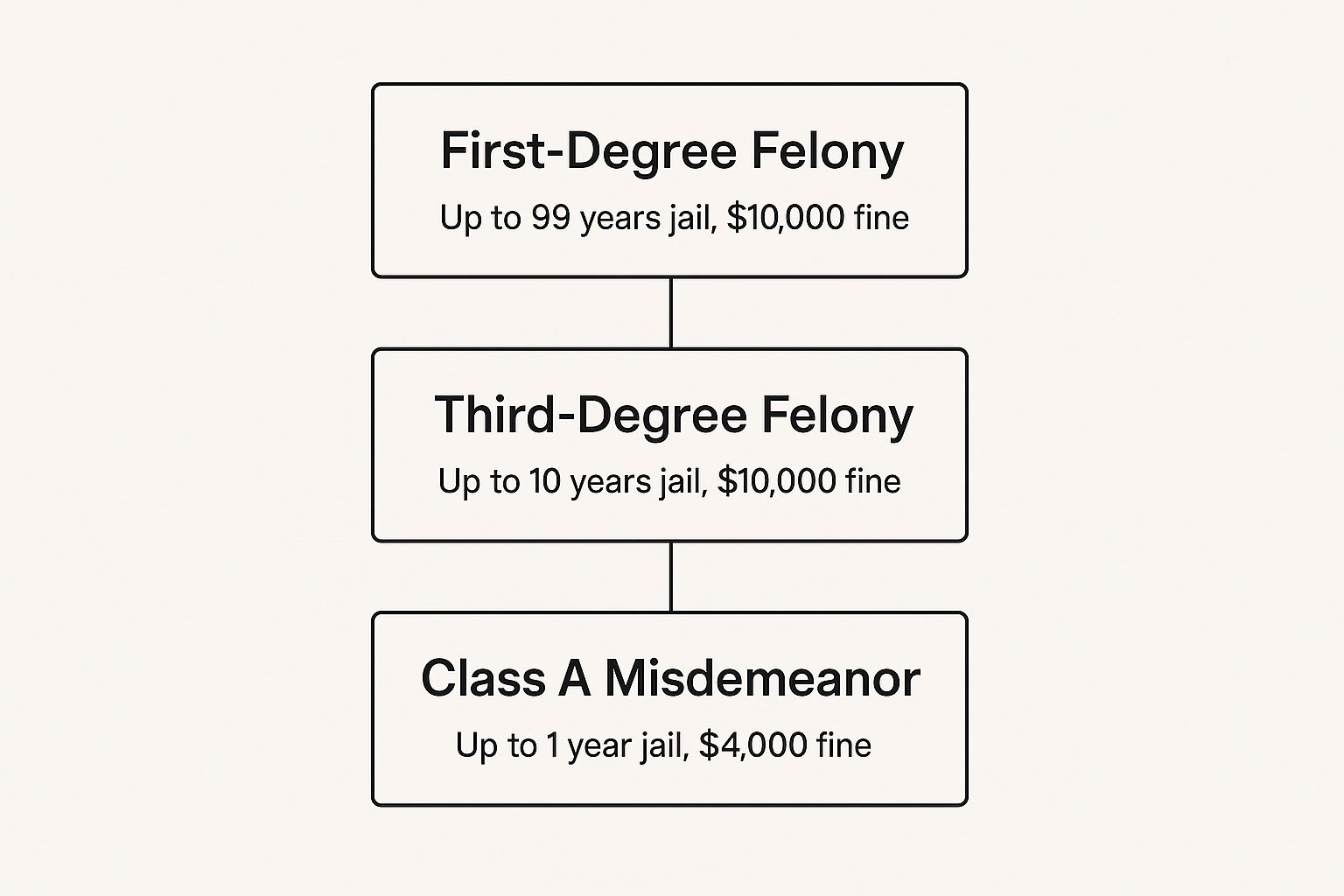
This chart clearly illustrates how quickly potential prison time increases as you move from a misdemeanor to a felony based on the facts of the case. If you'd like to learn more about the legal framework, you can read our detailed guide on the different assault categories in the Texas Penal Code.
A key takeaway is that prosecutors have significant power to enhance charges. What might seem like a minor incident can be legally interpreted in a way that leads to a felony indictment, which is why a robust legal defense from the very beginning is so important.
The table below breaks down these charges side-by-side, helping you understand the specific legal challenge you might be facing.
Texas Domestic Assault Charges and Penalties
This table compares the different levels of domestic assault charges in Texas, their classification, and the corresponding range of punishments.
| Charge Level | Texas Penal Code Classification | Potential Jail or Prison Time | Maximum Fine |
|---|---|---|---|
| Domestic Assault | Class A Misdemeanor | Up to 1 year in county jail | $4,000 |
| Continuous Family Violence | Third-Degree Felony | 2 to 10 years in prison | $10,000 |
| Assault by Choking | Third-Degree Felony | 2 to 10 years in prison | $10,000 |
| Aggravated Domestic Assault | First-Degree Felony | 5 to 99 years (or life) in prison | $10,000 |
Seeing the penalties laid out like this highlights the legal ladder of domestic assault charges in Texas. Knowing exactly where an accusation falls is the first step in figuring out how to fight it.
Why Prosecutors Pursue These Cases Aggressively
When you're facing domestic assault charges in Texas, it can feel like the entire system is working against you from the moment an officer arrives. That feeling is understandable—prosecutors and district attorneys' offices across the state are trained to take these allegations extremely seriously, and their reasons go far beyond the specifics of your individual case.
To understand their aggressive approach, you have to see the bigger picture they’re looking at. State and local governments track crime statistics closely, and recent trends in Texas family violence are alarming to law enforcement and public officials. This data creates immense public and political pressure on prosecutors to secure convictions and appear tough on domestic abuse.
This context is crucial. It means your case isn't being judged in a vacuum. Instead, it's one piece of a much larger, statewide response to what officials see as a growing public safety crisis.
The Statistical Reality Driving Prosecution
Prosecutors are driven by data, and the numbers related to family violence in Texas paint a concerning picture. For several years, Texas has seen a significant and troubling rise in reported domestic assault incidents.
According to the Texas Department of Public Safety (DPS), there were 254,339 family violence offenses in 2022. This number represents a staggering 10% increase from the 231,207 offenses reported just one year prior in 2021. The surge is even more striking when you look at it over a five-year span: between 2018 and 2022, family violence cases jumped by 33%.
These aren't just numbers on a spreadsheet for a prosecutor; they represent a public mandate to act. Every new domestic assault case that lands on their desk is viewed through the lens of these escalating statistics, fueling a determination to prevent the next tragedy.
This high-pressure environment explains why the state often refuses to drop charges, even if the alleged victim changes their story or asks for the case to be dismissed. The prosecutor's client isn't the individual accuser—it's the State of Texas. Their primary goal is to enforce the law and stop what they see as a dangerous trend, which means they will often push forward regardless of the accuser's wishes.
The "No-Drop" Policy and Its Impact
Many Texas counties operate under what's known as a "no-drop" policy for domestic assault cases. This unwritten but powerful rule means that once charges are filed, the district attorney’s office is committed to pursuing the case to a conclusion. They will use every piece of evidence available to build their case, including:
- The initial 911 call recording
- Police officer body camera footage
- Photos of alleged injuries or property damage
- Statements from any witnesses, including children
- Medical records from the hospital or paramedics
Even if the accuser later claims the whole thing was a misunderstanding, the prosecutor will likely argue that this change of heart is a classic sign of manipulation or fear. They will point to the evidence gathered at the scene as the "real" story of what happened.
Understanding this aggressive mindset is the first step toward building a defense that can effectively counter the state's narrative. Your attorney's job is to challenge their evidence, poke holes in their story, and present your side with equal force.
Navigating the Texas Criminal Court Process

The legal system can feel like an intimidating maze, especially when you’re facing serious allegations like domestic assault. But understanding the road your case is likely to follow can remove much of the anxiety that comes from the unknown. Knowing what to expect empowers you to work with your attorney and make informed decisions when it matters most.
From your first court appearance to the exchange of evidence, each stage of the process serves a purpose. Think of this as a roadmap for the journey ahead—one that will leave you prepared for every step.
The Arraignment and Bail Hearing
Your first stop in the court system is the arraignment. This is typically a brief but crucial hearing where a judge officially reads the charges filed against you. At this point, you'll be asked to enter a plea. In most cases, the plea is "not guilty," which is a standard procedure that gets the legal process started.
This hearing is also where the judge will address bail. Bail is the amount of money you must post to be released from jail while your case moves forward. The judge considers several factors when setting this amount:
- The seriousness of the domestic assault charge
- Your criminal history, if any
- Your ties to the community (e.g., job, family, home)
- Whether you are considered a flight risk or a potential danger to others
The judge will also review any Emergency Protective Order (EPO) that was issued after your arrest. These are strict "no-contact" orders, and they are almost always a condition of release in domestic assault cases. Following them precisely is non-negotiable if you want to remain out of jail.
The Pre-Trial Phase: Discovery and Motions
After the arraignment, your case enters the pre-trial phase. This is where the real work of building your defense begins. Your attorney’s main objective here is to obtain all the evidence the prosecutor has against you. This process is called discovery.
Discovery is a formal legal demand for the state's entire case file, which typically includes:
- Police Reports: The official narrative written by the arresting officers.
- Witness Statements: What the accuser or any other witnesses told the police.
- Photos and Videos: Bodycam footage, pictures of alleged injuries, or videos from the scene.
- 911 Recordings: The audio from the emergency call that initiated the police response.
With this evidence in hand, your lawyer can begin to identify weaknesses in the prosecutor's case and build your defense. This often involves filing pre-trial motions—formal requests asking the court to take a specific action. For example, if the police searched your home without a warrant, your attorney might file a Motion to Suppress Evidence to have that evidence excluded from the case.
The pre-trial stage is where many cases are won or lost. A thorough investigation by your defense team can uncover inconsistencies in the prosecution’s evidence, find witnesses who support your side of the story, or identify legal errors that could lead to a dismissal.
Plea Bargaining and Preparing for Trial
As your attorney analyzes the evidence, they will also engage in discussions with the prosecutor. These negotiations are known as plea bargaining. The prosecutor may offer to reduce the charge or recommend a more lenient sentence in exchange for a guilty plea.
The decision to accept a plea offer is entirely yours. Your attorney's role is to provide you with a clear and honest assessment of the strengths and weaknesses of the state's case, the risks of going to trial, and whether the prosecutor's offer is a fair one. If a satisfactory agreement cannot be reached, the next step is to prepare for trial.
Preparing for trial involves finalizing your defense strategy, preparing witnesses to testify, and planning how you will challenge the state's evidence. While only a small percentage of domestic assault charges in Texas go to trial, preparing as if yours will is the only way to ensure the best possible outcome.
Building Your Strongest Legal Defense

An accusation is just that—an accusation. It is not a conviction, and it is not the end of your story. When you're facing domestic assault charges in Texas, the law guarantees you the right to a robust defense. An experienced criminal defense attorney can explore numerous strategies to protect your freedom, challenge the state's narrative, and fight for the best possible result.
This is not a time to wait and see what happens; it is a time for proactive defense. The prosecution may have its version of events, but you have every right to present yours. With a skilled legal team in your corner, you can build a case designed to dismantle the state's arguments.
Questioning the Prosecution's Evidence
The foundation of any strong defense is a thorough examination of the evidence the prosecutor plans to use against you. The state has the burden of proving its case "beyond a reasonable doubt," which is the highest standard in our justice system. Your attorney's job is to demonstrate that they cannot meet that standard.
This process often involves:
- Challenging the Accuser’s Credibility: Are there inconsistencies in the accuser's story? Did their account of events change between the 911 call, the police report, and later statements? Highlighting these contradictions can create significant doubt.
- Investigating Ulterior Motives: Unfortunately, false allegations can be used to gain leverage in a divorce or a child custody battle. Your defense can investigate whether the accuser had a motive to fabricate the story out of anger, jealousy, or for strategic gain.
- Scrutinizing Physical Evidence: Any physical evidence, such as photos of injuries, must be carefully examined. We can question whether the injuries are consistent with the alleged assault or if they could have been caused in another way.
By meticulously picking apart the prosecution's evidence, your attorney can weaken their case long before it reaches a jury.
Common and Effective Defense Strategies
Beyond simply identifying holes in the state's evidence, several powerful affirmative defenses can be used in a domestic assault case. These strategies involve presenting your own evidence and narrative to explain what truly happened.
Some of the most effective strategies include:
- Self-Defense: The law permits you to use reasonable force to protect yourself from harm. If you can show that you were responding to an attack and acted only to defend yourself, it can serve as a complete defense to the charge.
- Defense of Others: Similarly, you are legally allowed to use reasonable force to protect another person—such as a child or another family member—from harm.
- The Incident Was an Accident: Not every injury results from an intentional act. If the alleged harm was unintentional—for example, if someone was injured accidentally during a fall or a chaotic moment—then no crime was committed.
It is critical to remember that your side of the story matters. An effective defense presents a compelling and believable alternative to the prosecution’s version of events, giving a judge or jury a clear reason to find you not guilty.
The Importance of Gathering Your Own Evidence
You cannot rely solely on the evidence collected by the police and prosecutor. Building a powerful defense requires conducting your own independent investigation to find evidence that supports your case. This proactive step can completely change the direction of your case.
Your defense team can help you gather crucial evidence, such as:
- Witness Statements: Locating neighbors, friends, or family members who witnessed the incident or who can speak to your character or the accuser's history.
- Digital Communications: Uncovering text messages, emails, or social media posts that contradict the accuser’s claims or reveal their true motives.
- Photos and Videos: Finding security camera footage or cell phone videos that show what actually happened.
Facing domestic assault charges in Texas can feel isolating, but you are not powerless. By working with a dedicated defense attorney, you can actively participate in building a strong, evidence-based case designed to protect your future.
Life After a Conviction and How to Clear Your Record
A domestic assault conviction in Texas is more than just a closed case. It’s a life-altering event that leaves a permanent mark, creating obstacles long after you’ve completed your sentence. The penalties reach far beyond the courtroom, impacting nearly every aspect of your daily life.
These long-term impacts, often called collateral consequences, can be devastating. They create a ripple effect that makes it incredibly difficult to move forward.
The Lasting Impact of a Family Violence Finding
When you are convicted of domestic assault, the court adds a special affirmative finding of “family violence” to your permanent criminal record. This isn't a minor detail; it’s a significant red flag for anyone who runs a background check on you.
This single notation can lead to a cascade of problems, including:
- Loss of Firearm Rights: Under both Texas and federal law, a conviction for an offense involving family violence results in a lifetime ban on possessing a firearm.
- Employment Difficulties: Many employers are hesitant to hire anyone with a violent offense on their record, which can close the door on countless career opportunities.
- Housing Issues: Landlords often reject rental applications from people with violent convictions, making it difficult just to find a place to live.
- Child Custody Problems: A family violence finding can be used as a powerful tool against you in divorce and child custody proceedings, potentially limiting or even eliminating your access to your children.
These consequences underscore why fighting the charge from the very beginning is so important. But even if your case has already concluded, you may still have options to clear your name and reclaim your future.
Can You Clear Your Record in Texas?
The good news is that Texas law provides tools to help people move past a criminal charge. The two primary paths are expunctions and orders of non-disclosure. While they sound similar, they achieve different outcomes and have strict eligibility requirements.
An expunction is the closest you can get to completely erasing your arrest record. It’s a court order that directs all government agencies to physically destroy every record of the incident, treating it as if it never happened. To qualify, your case must have been dismissed, you must have been found not guilty at trial, or you must have received a pardon.
An order of non-disclosure, on the other hand, seals your record from the public. The arrest and case records still exist, but they are hidden from most private entities like employers and landlords. Eligibility for this is much more complex, particularly for cases that resulted in a finding of family violence.
For many, exploring post-conviction relief is a crucial step toward a fresh start. You can learn more by exploring the complexities and requirements of expunging felony convictions in Texas in our detailed guide.
Figuring out which option, if any, applies to your situation requires a careful analysis of your case's specific outcome. It’s a complex legal journey, but it’s one that offers real hope for a brighter future after facing domestic assault charges in Texas.
Common Questions We Hear About Domestic Assault Charges
When you’re facing a domestic assault charge, everything can feel confusing and overwhelming. You need clear answers, not complicated legal jargon. Let's address some of the most urgent questions our clients ask. Understanding these key issues is the first step toward regaining control of your situation.
"Can the Charges Be Dropped if the Accuser Changes Their Story?"
This is perhaps the most common misconception in Texas domestic violence law. Many people believe that if the person who called the police decides they no longer want to press charges, the case will simply be dropped.
This is absolutely false.
Once an arrest is made, the case is out of the accuser's hands—it now belongs to the State of Texas. The prosecutor has the final say, and due to strict "no-drop" policies, they often move forward even if the alleged victim stops cooperating. They will build their case using other evidence, such as 911 recordings, police bodycam footage, and statements from other witnesses.
"What Is an Emergency Protective Order and How Do I Follow It?"
An Emergency Protective Order (EPO) is a court order issued by a judge immediately after a family violence arrest. Its sole purpose is to protect the alleged victim. It is a legally binding command, not a suggestion, and you must follow it precisely.
These orders typically prohibit you from:
- Contacting the alleged victim in any way (this includes calls, texts, emails, or social media messages).
- Going within a certain distance of their home, workplace, or their children's school.
- Possessing a firearm while the order is in effect.
Violating an EPO is a new crime—a Class A Misdemeanor. Even sending a simple text like, "I'm sorry," can lead to another arrest. A new charge will only make your original case much more difficult to defend.
"Will I Lose My Right to Own a Gun?"
Yes, a domestic assault charge places your Second Amendment rights in serious jeopardy. The consequences are not just temporary; they can be permanent.
It begins the moment an EPO is issued. From that point on, you are legally prohibited from possessing a firearm. If you are later convicted of any offense involving family violence—even a misdemeanor—you will face a lifetime federal ban on owning or possessing a firearm. This is a significant collateral consequence that will follow you forever.
If you’ve been charged with a crime in Texas, call The Law Office of Bryan Fagan, PLLC for a free and confidential consultation. Our defense team is ready to protect your rights. Learn more at https://texascriminallawyer.net.