A late-night call from your son at college. A citation handed to your daughter outside a house party. A police stop that started with “just one drink” and suddenly turned into a court date. That’s how a lot of families first start searching for answers about the drinking age in texas.
If you’re in that position, you’re probably worried about more than the ticket. You’re thinking about school, scholarships, internships, a driver’s license, and whether one mistake is about to follow your family for years. Those fears are real. So is the good news. Many underage alcohol cases are manageable when you understand the law, the court process, and the options for protecting your record.
Texas treats alcohol offenses seriously, especially when someone under 21 is involved. But these cases are rarely just about punishment. They’re also about procedure, proof, and whether the person charged has a path to dismissal, deferred adjudication, expunction, or record sealing. That practical side is where a lot of online guides fall short.
Facing an Underage Drinking Charge in Texas? You Are Not Alone
A lot of people think an underage drinking case only happens to “other families.” Then a teenager gets cited for Minor in Possession after a football game, or a college student gets caught holding someone else’s drink at an apartment party, or a parent gets a call that their child was taken in after a traffic stop.
That moment feels bigger than it is.

In practice, the first issue is usually confusion. You may not know whether this is a ticket or an arrest, whether your child has to go to court, whether a guilty plea will create a permanent record, or whether parental supervision changes anything. Many people also assume that if no one was driving, the consequences must be minor. That’s often wrong.
What families usually worry about first
Some concerns come up almost every time:
Will this stay on the record
Even a lower-level alcohol case can show up in background checks if it isn’t handled correctly.Will there be a license suspension
In many underage alcohol cases, driving consequences can be part of the punishment even if the charge didn’t start with a crash.Does college find out
Schools, housing offices, scholarship boards, and employers may ask about criminal history or conduct issues.
Practical rule: Don’t treat an alcohol citation like a parking ticket. Before you pay anything or plead guilty, find out whether that decision creates a record you could have avoided.
A calm, informed response matters. The right approach starts with knowing the baseline rule.
Understanding the 21-Year-Old Rule in Texas
A lot of families first learn the rule after a police officer, school officer, or campus officer says, “If you are under 21, you cannot have this.” In Texas, that basic rule is true more often than people expect.
Under Texas Alcoholic Beverage Code Chapter 106, the legal drinking age is 21, and a minor is generally anyone under 21. In plain terms, the law usually bars a minor from buying, possessing, or consuming alcohol. For a broader look at how these rules fit together, see this guide to Texas drinking laws and alcohol-related offenses.
Texas did not arrive at 21 by chance. As explained in this history of Texas drinking age law, Texas raised the drinking age from 19 to 21 on August 31, 1986, after federal highway funding was tied to states adopting a 21-year-old minimum, and states that refused risked losing up to 10% of certain highway funds. That same source reports fines at that time of $25 to $200 for minor possession and $100 to $500 for providing alcohol to minors.
Why these cases get attention
Police, prosecutors, and courts often treat underage alcohol cases as safety cases. That has practical implications. Even when the facts seem minor to a parent or student, the system may treat the charge as a warning sign for driving risk, school discipline, or repeat behavior.
I tell families this all the time. A low-level alcohol case can still create a record, trigger court requirements, and complicate license issues if it is handled carelessly.
What the rule covers in practice
The drinking age in texas is not limited to buying alcohol at a store or ordering a drink at a bar. It commonly reaches several different situations:
Purchasing alcohol
Trying to buy beer, wine, or liquor while under 21 can lead to charges.Possession
Holding, carrying, or having alcohol within your control may be enough, even if no one saw you drink.Consumption
A small amount still counts. Officers do not need a party scene to write a citation.Alcohol-related driving exposure for people under 21
A young driver can face problems from alcohol use that would be treated differently for someone over 21.
Facts matter more than families expect. Who owned the alcohol, where it was found, what was said to the officer, and whether the stop or search was lawful can change the value of the case completely.
Courts focus on the statute, the officer’s observations, the statements made at the scene, and whether the State can prove each element.
That is why the right first step is not guessing. It is identifying the exact charge, getting the paperwork, and deciding early whether the case can be challenged, reduced, or handled in a way that protects the person’s future record.
When Can a Minor Legally Drink in Texas?
One of the biggest misunderstandings in underage alcohol cases is the belief that a parent’s permission makes drinking legal anywhere. It doesn’t. Texas has a narrow exception, and families get into trouble when they stretch it beyond what the law says.

Under this explanation of Texas Alcoholic Beverage Code Chapter 106, Texas allows a minor to consume alcohol in the visible presence of a parent, guardian, or spouse. That family-supervised exception is real, but it is limited.
If you want a broader overview of related rules, this guide on Texas drinking laws is also useful.
What visible presence usually means
“Visible presence” is not the same as “somewhere nearby.”
If a parent is in another room, in another car, or has generally approved the drinking ahead of time, that may not satisfy the exception. The law is narrow for a reason. It is meant to cover direct supervision, not general permission.
Here is the safe way to approach this:
Direct supervision matters
The parent, guardian, or spouse should be physically present and able to observe what is happening.Permission alone isn’t enough
A text message, phone call, or “I said it was okay” argument may not protect you.The exception is personal
It doesn’t automatically cover other minors at the same gathering.
Where families often make mistakes
The most common bad assumption is this: “If I’m the parent and I’m there, everybody is fine.” That is not how these cases work.
A parent may be thinking about safety. Police and prosecutors are thinking about statutory limits, control of the scene, access by other minors, and whether an adult provided alcohol unlawfully.
If alcohol is available to other underage guests, a family setting can become a criminal case fast.
That risk is why home parties cause so many problems. One teenager invites friends. Someone posts photos. An officer shows up after a noise complaint or a call about a disturbance. What started as “supervised” can quickly turn into allegations that alcohol was furnished to minors who were not covered by the family exception.
The exception does not erase every other risk
Even where the exception may apply, it doesn’t create immunity in every setting. It does not give a minor the right to drive after drinking. It does not stop an officer from investigating related conduct. And it does not guarantee that a prosecutor will agree with your interpretation of the facts.
Here’s a short explainer that helps clarify the issue:
Rare exceptions don’t help most cases
People sometimes search for unusual exceptions after a citation. In practice, most cases turn on either the family-supervision issue or the basic rule that under-21 possession, purchase, or consumption is prohibited. That’s why the best move is usually not arguing from rumor. It’s reviewing the police report, witness statements, body camera footage, and the exact wording of the citation.
Common Offenses and Severe Penalties
A lot of underage alcohol cases start the same way. A teenager gets stopped leaving a party, an officer smells alcohol during a traffic stop, or a parent gets a late-night call that their child was cited with friends. From there, the details matter. The exact charge affects the penalty range, the court process, and whether the case can later be cleaned up through expunction or nondisclosure.
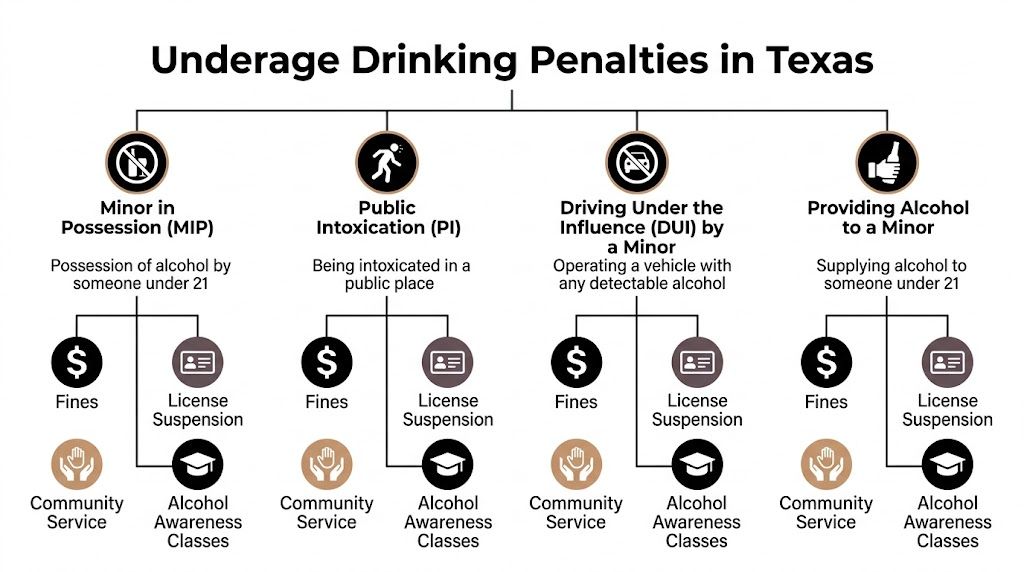
If a car was involved, this guide to DWI penalties in Texas helps explain how an underage alcohol case can expand into license problems, higher fines, and a more serious criminal record.
The offenses that appear most often
Texas underage drinking cases usually fall into a few repeat categories:
Minor in Possession
Police do not have to catch a young person actively drinking. Possession allegations often turn on where the alcohol was found, who had control over it, and what statements were made at the scene.Consumption by a Minor
This charge focuses on use. It often comes from an admission, witness statement, smell of alcohol, or observations by an officer.Purchase or Attempt to Purchase
These cases commonly arise at stores, bars, restaurants, concerts, and sporting events where ID checks happen.Misrepresentation of Age
A fake ID, borrowed ID, or false statement about age can create a separate case with its own consequences.DUI by a Minor or another under-21 alcohol driving charge
Texas applies a zero-tolerance rule to underage drivers. Even a small amount of alcohol can trigger a charge.Providing alcohol to a minor
Adults are often caught off guard by this one, especially after house parties, graduation parties, and gatherings where several teenagers had access to alcohol.
A quick penalty map
This chart gives the general framework. The actual outcome depends on the county, prior history, the officer’s report, and whether more than one charge was filed.
| Offense | Texas Code Section | Classification | Typical Penalties for First Offense |
|---|---|---|---|
| Minor in Possession | Texas Alcoholic Beverage Code Chapter 106 | Class C misdemeanor | Often includes a fine, alcohol awareness requirements, community service, and possible driver’s license consequences |
| Consumption by a Minor | Texas Alcoholic Beverage Code Chapter 106 | Class C misdemeanor | Often similar to Minor in Possession, depending on court and prior history |
| Purchase or Attempt to Purchase by a Minor | Texas Alcoholic Beverage Code Chapter 106 | Misdemeanor-level under Chapter 106 | Can include a fine, alcohol education terms, and license-related consequences |
| Misrepresentation of Age | Texas Alcoholic Beverage Code Chapter 106 | Misdemeanor-level offense | May involve fines, court supervision, and complications beyond the alcohol charge |
| DUI by a Minor | Texas Penal Code §49.045 | Alcohol-related offense for under-21 drivers | Can include a fine, license suspension, community service, and alcohol awareness terms |
| Providing Alcohol to a Minor | Texas law on furnishing alcohol to underage persons | Class A misdemeanor in many cases | Can include jail exposure and a significant fine |
What many first-time cases actually carry
For many first-offense Chapter 106 cases involving minors, the penalties are often more burdensome than families expect, even when jail is not on the table. Courts commonly impose a fine, alcohol awareness education, community service, and driver’s license consequences. A first case may look minor on paper, but it can still affect school discipline, scholarships, insurance, and future background checks if it is not handled carefully.
Repeat allegations raise the stakes. So do cases involving a car, an accident, a fake ID, or multiple minors at the same location.
For under-21 drivers, Texas Penal Code §49.045 creates a zero-tolerance structure. In practice, that means a young driver can end up in court based on alcohol use that would be evaluated differently if the driver were over 21.
The charge adults overlook most
Parents usually focus on the citation handed to their son or daughter. They should also examine whether an adult is being investigated.
As explained in this Texas guide on adults providing alcohol to minors, giving alcohol to someone under 21 outside a lawful exception can be charged as a Class A misdemeanor, with up to 1 year in jail and a $4,000 fine under Texas misdemeanor punishment law.
That is why house-party cases become expensive and stressful fast. Officers may issue a citation to the minor, refer charges against the adult host, and create a record that follows everyone into court.
A home party can produce more than one defendant, more than one court date, and more than one long-term record problem.
What helps and what makes the case worse
The right early decisions matter.
What helps
Keep every paper you received, write down the facts while they are fresh, save texts and social media posts, identify witnesses, and get legal advice before entering a plea.What hurts
Mailing in payment, assuming a Class C case is harmless, letting a teenager explain the facts to police again, or treating a fake ID allegation like a side issue.What needs close review right away
Any case involving a car, injury, another minor, a school report, or an adult who may have furnished alcohol needs prompt analysis.
I tell families this all the time. The citation is only the start of the problem. The key question is how to contain the damage now and whether the case can later be cleared from the record.
What to Expect After an Underage Drinking Charge
The court process feels intimidating because many individuals have never been through it before. Once you know the sequence, the situation gets easier to manage. Underage alcohol cases are often less mysterious than people fear, but you do need to take each stage seriously.

Right after the citation or arrest
Start by finding out exactly what happened procedurally. Was your child issued a citation and released, or formally arrested? Is there a court date on the paperwork? Was a driver’s license taken? Were there multiple charges?
Then do three things quickly:
Read every document carefully
The court date, charge name, and instructions matter.Preserve the facts
Save screenshots, receipts, ride-share records, party invitations, and names of witnesses.Stop talking about the case casually
Friends, school staff, and social media are not protected conversations.
The first court appearance
Many people call this the arraignment, though local practice can differ by court. This is usually where the court addresses the charge, confirms identity information, and deals with pleas or settings. If you appear without a lawyer, the judge won’t act as your advisor.
Your plea options usually include guilty, not guilty, and no contest.
Guilty
You admit the charge. That may feel like the fastest way out, but it can create a criminal record and trigger consequences you could have negotiated around.Not guilty
This preserves your right to challenge the case, review evidence, and negotiate from a stronger position.No contest
This does not contest the charge, but it often functions much like a guilty plea for case outcome purposes.
The biggest early mistake is pleading first and asking questions later.
What happens between court dates
Most cases do not go straight from first appearance to trial. There is usually a middle stage where the defense gets information, evaluates the proof, and negotiates with the prosecutor. That may include reviewing:
Police reports
These often contain the officer’s version of possession, statements, or observations.Body camera or dash camera footage
Video may support the state, or it may reveal gaps in the case.Witness information
Friends, hosts, and bystanders can matter, especially in party cases.
Deferred adjudication and similar resolutions
In many first-time, lower-level cases, the best result is not a rushed plea. It is often some form of court supervision that leads to dismissal if the person completes certain conditions. People often refer to this broadly as deferred adjudication or deferred disposition, depending on the court and charge.
Typical conditions may include alcohol awareness classes, community service, staying out of trouble, and completing all court requirements on time. If handled correctly, that kind of result may put you in a much better position later for clearing the record.
If the case doesn’t settle
Some cases should not be pleaded out early. If the stop was weak, the search was questionable, the alcohol was not yours, or an exception may apply, the defense may push for dismissal, suppression of evidence, or trial.
That path depends on the facts. It also depends on the county, the judge, the prosecutor, and the client’s long-term goals. For a student or young professional, avoiding a permanent record may matter more than wrapping the case up quickly.
Defending Your Rights and Protecting Your Future
A lot of parents call my office after the court date is set and ask the same question. “How do we keep this from following my child for years?” That is the right question.
An underage alcohol case can reach far beyond the ticket itself. College applications, campus housing, internships, professional licensing, and jobs can all be affected by a record that looked minor at the time. The defense goal is to protect both the case and the future attached to it.
Defense starts with the long view
A good defense does more than argue about what happened that night. It asks what result leaves the least damage six months from now and five years from now.
That may mean fighting the charge hard. It may mean getting a dismissal-focused resolution that keeps expunction available. The right approach depends on the facts, the court, and what is at stake for the student or young adult involved.
Several issues come up often in these cases:
Unlawful stop or detention
If the officer lacked a legal basis to stop the car or hold the person, the defense may be able to challenge what happened afterward.Weak proof of possession
Standing near alcohol, riding in a car where alcohol is present, or being at a party does not automatically prove legal possession.Problematic statements
Teenagers and college students often answer police questions in ways that fill gaps in the case. Those statements deserve close review.Family-supervision exception
Some cases turn on whether the drinking fell within a narrow statutory exception. Details matter.Search issues
Cars, bags, phones, and bedrooms raise different constitutional questions. A search that felt routine can still be legally flawed.
Record cleanup is often the most important step
Families often focus on the citation and miss the part that matters most later. A case that ends favorably still may leave a public record unless someone takes the next step.
For many first-time cases, the ultimate win is setting up eligibility to clear the record after the case ends. That is why I look closely at the final disposition before anyone agrees to it. A quick plea can solve the short-term stress and create a longer-term problem.
If your family is dealing with a youth case, this guide to juvenile record expungement in Texas explains the cleanup process in more detail.
Expunction and nondisclosure do different jobs
These terms get mixed together all the time, but they are not interchangeable.
Expunction
This removes qualifying records from ordinary public access. In the right case, it is the strongest form of cleanup.Nondisclosure
This seals certain records from public view, but some government agencies may still see them.
Which remedy is available depends on the charge, how the case ended, the person’s age, and prior history. In practical terms, a dismissal or qualifying Class C outcome may put someone in a far better position than a conviction that seemed convenient at the time.
A favorable court result is only part of the job. Record clearance finishes it.
Steps that actually protect the future
The families who get the best long-term results usually do four things well.
They ask about record consequences before entering any plea
Fast is not always smart.They complete every court condition exactly as ordered
One missed class, late payment, or failed deadline can cost a dismissal-based result.They request a record review after the case is over
Dismissed does not mean erased.They file the right petition if cleanup is available
Courts do not automatically clear every eligible case.
That last step is where many good outcomes get wasted. A parent or student walks out relieved, assumes the matter is over, and learns later that the record is still showing up. In underage drinking cases, protecting the future usually requires one more legal step after court ends.
Your Questions Answered About Texas Drinking Laws
Can my child drink at home if I say it’s okay
Sometimes, but only within the narrow family-supervision exception discussed earlier. The safest approach is not to rely on broad assumptions about permission. The law is much tighter than family rumor makes it sound.
What if my child was only holding the drink
That can still lead to a possession case. Whether the state can prove legal possession depends on control, knowledge, and the surrounding facts. This is one reason witness statements and video can matter.
Is a fake ID a small mistake
No. Misrepresentation of age can complicate the case and make prosecutors less flexible. A fake ID allegation also creates credibility problems that can affect negotiations on the alcohol charge itself.
Can a parent get charged for hosting a party
Yes. If alcohol is furnished to underage guests outside the narrow legal exception, the adult host may face criminal exposure. This is one of the most common ways a family gathering turns into a multi-person case.
Will this affect college or financial aid
It can. Schools may ask about criminal history, disciplinary history, or both. Housing programs, internships, and professional schools may do the same. Even if the immediate penalty seems low, the record can cause the bigger problem later.
What if my child has an out-of-state license
Texas courts and agencies may still report driving-related consequences in a way that affects the home state. These cases often require checking both Texas court consequences and the driver’s home-state license rules.
Should we just pay the ticket and move on
Usually not until you know exactly what that payment means. In many courts, paying a ticket is the same as resolving the case against you. That may close off options that could have protected the record.
Does every case go to trial
No. Many underage alcohol cases resolve through dismissal, negotiated pleas, or deferred outcomes. Trial is one option, not the default. The right path depends on the strength of the evidence and the importance of avoiding a conviction.
What should we do first
Keep the paperwork, calendar every deadline, stop discussing the facts casually, and get legal advice before entering any plea. Early decisions shape everything that comes after.
If you’ve been charged with a crime in Texas, call Law Office of Bryan Fagan PLLC for a free and confidential consultation. Our defense team is ready to protect your rights.