A false accusation can wreck your peace in a single afternoon. One social media post says you stole money. An ex sends messages claiming you abused someone. A coworker emails others that you were arrested for a crime you didn't commit. In a criminal case or custody fight, that kind of lie doesn't just feel insulting. It can affect your job, your family, and how police, prosecutors, judges, or neighbors see you.
If you're living through that right now, you're not overreacting. Your reputation matters. In many cases, libel defamation of character gives you a civil path to push back when someone publishes false statements that damage your name. The hard part is knowing which statements are legally actionable, which are protected, and what steps help instead of making things worse.
Your Reputation Is Under Attack What Now
A lot of Texans first look into defamation during another legal crisis. Maybe you're under investigation for assault, and someone posts online that you're a “known abuser.” Maybe you're in a custody dispute, and your ex tells school staff and relatives that you're on drugs or that you endangered your child. Maybe a former business partner starts emailing clients that you committed fraud.
That kind of attack can feel paralyzing. You may want to respond publicly, post screenshots, or fire back with your own accusations. Usually, that isn't the best first move.

When false statements hit during criminal or family disputes
In real life, these cases are messy. The same lie can affect more than one area of your life at once.
- Criminal pressure: A false public accusation can shape how witnesses talk, how employers react, and how people in your community treat you.
- Family fallout: In divorce or custody litigation, lies can influence parenting disputes, protective order requests, and informal decisions by relatives, teachers, or counselors.
- Professional damage: If someone says you committed a crime or lied in your work, clients and employers may back away fast.
A defamatory statement isn't just “something mean.” It has to be a false statement of fact that harms your reputation.
If you're also dealing with a criminal allegation, it helps to understand how to respond to false accusations without creating new problems for yourself.
The first legal question
The first question usually isn't, “Can I sue right now?” It's narrower.
Ask this instead: Did someone communicate a false factual claim about me to other people in a way the law recognizes as defamation?
That question leads to the difference between defamation, libel, and slander. Once you know those terms, the situation starts to feel less chaotic and more manageable.
Understanding Defamation Libel and Slander in Texas
Defamation is the broad category. It means a false statement of fact harms someone's reputation. Within that category, the law usually separates the claim by how the statement was communicated.
Libel is written or otherwise recorded defamation.
Slander is spoken defamation.
That distinction sounds technical, but it matters because written statements often leave a clearer trail. Text messages, Facebook posts, emails, Google reviews, screenshots, and online comments can all become important evidence in a libel case.
Libel vs. Slander at a glance
| Aspect | Libel | Slander |
|---|---|---|
| Form | Written, posted, printed, or otherwise recorded | Spoken words |
| Common examples | Social media post, email, review, article, text message screenshot | Verbal accusation at work, in a meeting, or to neighbors |
| Proof issues | Often easier to preserve because there's a record | Harder if no recording or witnesses exist |
| Typical setting | Online disputes, published accusations, shared messages | Arguments, conversations, rumors spread by word of mouth |
Why false crime accusations matter so much
Some statements are so damaging that the law treats them differently. According to this explanation of libel per se and per quod, libel per se includes statements that are harmful by their nature, such as falsely accusing someone of committing a crime or of professional incompetence. In those situations, courts may presume reputational harm. By contrast, libel per quod requires proof of special damages because the harmful meaning isn't obvious on its face.
That idea matters a lot in Texas disputes tied to criminal or family law.
If someone posts, “He embezzled from his employer,” or “She abuses prescription drugs around the children,” that can carry very different legal weight than a vague insult like, “He's a terrible person.” One is a factual claim that may be provably false. The other may be opinion, exaggeration, or nonactionable name-calling.
Where people often get confused
Many readers mix up three very different things:
- An opinion
“I think he's rude.” - A false statement of fact
“He was arrested for theft last week,” when that never happened. - A true statement that is embarrassing
Truth can still hurt, but truth generally isn't defamation.
Plain-English rule: Defamation law doesn't punish every ugly statement. It targets false factual claims that damage reputation.
In criminal defense and family law settings, that distinction becomes critical. A false accusation can be both emotionally devastating and legally significant. But before any lawsuit can succeed, the claim has to fit the legal elements.
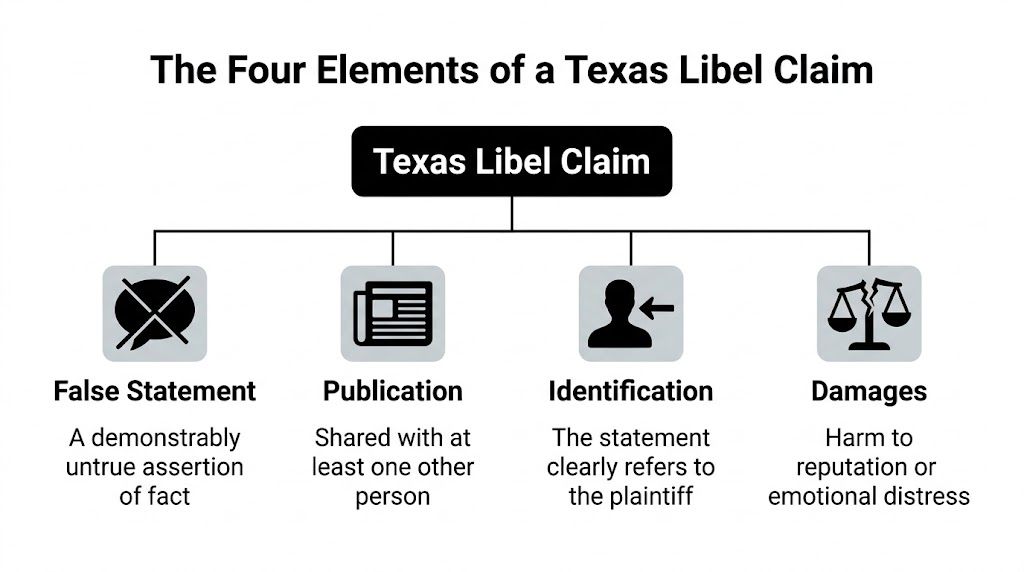
The Four Elements of a Texas Libel Claim
Courts don't decide libel cases based on who sounds more upset. They look for specific elements. In practical terms, a person bringing a libel claim usually has to prove four core points: a false statement, publication, identification, and damages. Fault also matters, and it often becomes the hardest fight in the case.
False statement
The statement must be false. Not misleading in a general sense. Not unfair. False.
If someone says, “You were charged with DWI,” and that really happened, the statement may be damaging but not defamatory. If someone says, “You confessed to drug trafficking,” and that never happened, you're in a different position.
Evidence matters. Screenshots, court records, phone logs, employment files, and witness testimony can all help show what was said and why it was false. In many disputes, proving falsity depends on the same kind of careful proof analysis lawyers use when comparing direct and circumstantial evidence.
Publication and identification
A statement isn't actionable as libel if it never reached anyone else. The law requires publication, which means the statement was shared with at least one third party.
Publication can happen through:
- A social media post: Facebook, Instagram, X, TikTok captions, or neighborhood forums
- An email blast: Messages to coworkers, clients, church members, or school staff
- A review platform: Google, Yelp, Avvo, or industry-specific sites
- A shared screenshot: Forwarded texts or copied messages sent around a group
The statement also has to be about you. Your name doesn't always have to appear if readers can clearly tell who the post refers to.
Fault and why status matters
The law asks what level of blame the speaker had when publishing the false statement. Many people are often blindsided by this concept.
The landmark 1964 case New York Times Co. v. Sullivan changed American libel law by creating the actual malice standard for public officials, later applied to public figures. Under that rule, a public figure must prove the publisher knew the statement was false or acted with “reckless disregard of whether it was false or not.” Private individuals face a lower standard, commonly described as negligence.
So if you're a private person dragged into a custody fight or falsely accused online by an ex, your burden may be lower than a politician, celebrity, or highly public-facing figure.
The same lie can be easier or harder to prove in court depending on who you are and what role you play in public life.
Damages
A libel claim also requires harm. Sometimes the harm is obvious. You lose customers. A school volunteer role disappears. Friends stop talking to you. A job offer gets rescinded. In highly damaging categories, the law may treat harm differently, but damages still matter in the practical value of a case.
Here are common forms of damage people should document:
| Type of harm | Real-world example |
|---|---|
| Workplace harm | Lost clients, discipline at work, missed promotion |
| Family harm | Damage to custody position, loss of trust with relatives |
| Community harm | Social exclusion, church or school fallout |
| Emotional harm | Anxiety, humiliation, loss of sleep, stress treatment |
Keep in mind that criminal and family law issues can overlap with these damages. A false accusation might not only injure your name. It can shape bail decisions, protective order disputes, or plea discussions if the broader narrative around you gets polluted.
Navigating Texas-Specific Defamation Statutes
A common Texas scenario looks like this. You are trying to protect yourself in a criminal investigation or custody dispute, and at the same time a false written accusation is spreading by text, email, or social media. Your first instinct is usually to focus on the immediate fire. The criminal case. The temporary orders hearing. The CPS interview. But civil defamation law runs on its own clock, and that clock can expire while you are dealing with everything else.
Texas law adds deadlines and procedural rules that general online articles often gloss over. In a case tied to a false accusation, those rules matter because the same statement may affect more than your feelings. It may affect your job, your standing with the court, your parenting case, or how police and prosecutors view you.
The one-year filing deadline
Texas generally gives you one year to file a defamation lawsuit after the statement is published, as explained in this overview of libel and slander law.
One year sounds like enough time until real life gets in the way.
A parent in a custody fight may spend months trying to stop the immediate damage. A person accused of assault may put every ounce of energy into the criminal defense first. Someone defamed online may hope the post will fade away. Meanwhile, the filing deadline keeps running. Civil courts do not pause that deadline just because another case feels more urgent.
The Defamation Mitigation Act
Texas also has the Defamation Mitigation Act. In plain English, the law can require a timely request for a correction, clarification, or retraction if you want to pursue certain damages later.
That step confuses people, especially when emotions are high. They want to file suit immediately or respond publicly with equal force. In many cases, the smarter opening move is more controlled. A formal written request can identify the exact statement, explain why it is false, and demand a correction or removal.
That request works like a legal receipt. It shows what was said, who was told, and whether the speaker had a chance to fix the problem.
A proper request can help in several practical ways:
- It puts the speaker on notice. They cannot easily claim they did not know the statement was false or disputed.
- It creates a record. That record matters if the other side edits posts, deletes messages, or changes their story.
- It may slow the spread. Some false accusations stop once a lawyer sends a precise demand.
- It can affect damages. Texas law ties part of the damages analysis to whether this step was handled correctly.
If the statement is still circulating, speed matters. Delay can cost you evidence, options, and negotiating strength.
Why court statements may be treated differently
This part surprises many Texans. A false statement made during a legal dispute is not always treated the same way as a false post on Facebook or a rumor sent to your employer.
Some statements connected to judicial proceedings may be protected by privilege. That protection can apply to things said in pleadings, testimony, or other litigation-related communications. So if an ex-spouse files a custody pleading full of accusations, or a witness makes a damaging claim in court, a defamation lawsuit may not be the first or best remedy.
That does not mean you have to absorb the damage and do nothing. It means you may need to fight on the field where the statement was made.
In practice, that often means:
- Attacking credibility inside the underlying case
- Using discovery to pin down dates, documents, and contradictions
- Asking the court for sanctions or other relief when the conduct justifies it
- Coordinating any public response with criminal defense counsel so you do not create new problems
A good way to understand the difference is this: a false Facebook post is one kind of problem, and a false allegation inside active litigation is another. Both can hurt your reputation. The legal tools are not always the same.
That is why Texas-specific advice matters so much in defamation cases tied to arrests, protective orders, CPS reports, or custody battles. Context changes the analysis, the timing, and the safest next step.
Common Defenses to Libel and How to Overcome Them
People who publish damaging statements rarely admit, “I lied.” They usually defend the case from day one. Knowing those defenses helps you evaluate whether a claim is strong or whether it only feels strong.

Truth, opinion, and privilege
The most common defense is truth. If the statement is true, that usually ends the defamation claim.
Another frequent defense is opinion. A person may argue they were expressing a viewpoint, not stating an actual fact. Courts look past labels. Saying “in my opinion” doesn't automatically protect a speaker if the statement implies a false factual basis.
Then there's privilege, which can apply in certain legal or official contexts. That defense often appears in cases tied to criminal complaints, family litigation, and witness statements.
The fault fight
Fault is often where the battle gets serious. According to this discussion of defamation fault standards, public figures must prove actual malice with clear and convincing evidence, and 70-80% of such claims are dismissed before trial. Private individuals generally need to prove negligence instead.
That difference shapes strategy. If you're a private person, the focus may be on showing the speaker failed to verify basic facts. If you're a public-facing professional, the question becomes harder. You may need evidence showing the speaker knew the statement was false or acted with reckless disregard.
How a plaintiff pushes back
Strong plaintiffs' cases often answer defense arguments before the defense fully develops them.
Against “it was true”
Gather records that directly contradict the statement. Arrest records, dismissal paperwork, payroll records, licensing files, school records, and messages can all matter.Against “it was just opinion”
Show how the speaker presented the statement as a fact. Specific accusations usually look more factual than loose insults.Against “I didn't act recklessly”
Identify what the person ignored. Did they have documents showing the truth? Did they refuse to contact you? Did they repeat a rumor after being corrected?
“I was only repeating what I heard” isn't a magic shield. Repeating a false factual claim can still create legal exposure.
In criminal and family law intersections, this matters because the person spreading the accusation often has a motive. Maybe they're trying to influence a custody outcome, pressure a plea, damage your business, or isolate you socially. Motive alone doesn't prove defamation, but it can help explain why the statement was made and why verification was ignored.
Practical Steps to Take If You Are a Victim
When someone attacks your reputation, your instincts may tell you to respond immediately and everywhere. Resist that urge. A measured response usually protects you better than a loud one.

Step one, preserve everything
Start by collecting evidence before posts are deleted or changed.
Save:
- Screenshots with visible dates and usernames
- Full web pages as PDFs
- Emails with headers
- Text messages and call logs
- Names of witnesses who saw or heard the statement
- Links to reviews, posts, comments, or videos
If the content is digital, pay attention to authenticity. Good documentation can become important later, especially if the other side claims the post was altered or taken out of context. Resources on documenting digital evidence with a proper chain of custody can help you organize files in a way that's more useful for legal review.
Step two, stop yourself from making it worse
Don't argue in the comments. Don't threaten the other person publicly. Don't post private evidence out of anger if a criminal, custody, or protective-order issue is already active.
A public back-and-forth creates problems:
- It gives the other side fresh material to use against you.
- It may reveal facts your lawyer would rather present strategically.
- It can inflame a judge's view in a family or criminal case.
Step three, build your damages file
Open a folder and start documenting consequences. Think broadly.
| What to track | Useful examples |
|---|---|
| Income loss | Lost customers, canceled contracts, missed interviews |
| Professional harm | Suspension, discipline, licensing trouble, bad reviews |
| Personal fallout | Child exchange problems, school concerns, social exclusion |
| Emotional impact | Counseling records, sleep disruption, anxiety symptoms |
A short written timeline helps too. Note when you learned about the statement, who saw it, what changed afterward, and what records support that timeline.
Step four, use formal communication carefully
Sometimes a cease-and-desist letter, demand letter, or retraction request is the right move. Sometimes it isn't, especially when it could escalate an already dangerous criminal or family law conflict.
If your issue overlaps with an arrest, pending charge, DWI allegation, assault investigation, theft accusation, or drug possession case, your civil response should fit the criminal strategy. For example, a person considering an eventual cleanup of public records may also want to understand how a future Texas order of nondisclosure can affect what appears in background checks after the underlying matter is resolved.
Here is a short explainer that may help you think through early response choices:
Step five, get legal advice before choosing the battlefield
Not every ugly statement should become a lawsuit. Some should be handled through the criminal case. Some should be addressed inside the family court matter. Some require an immediate preservation and retraction strategy. Others may justify a full defamation suit.
That decision depends on facts, timing, proof, privilege issues, and your larger goals. If your priority is avoiding jail, protecting custody rights, or keeping a professional license, the right move may be different than if your only concern is getting a post removed.
Frequently Asked Questions About Defamation in Texas
Your phone lights up with screenshots. An ex has posted that you are abusive. A former friend claims you committed a crime. A reviewer says you stole money from clients. In Texas, these situations rarely stay confined to the internet. They can spill into a custody case, a criminal investigation, a licensing problem, or a job loss. That is why the right question is often not just, "Can I sue?" It is, "What solves the underlying problem without making the bigger case worse?"
Can you sue over a false online review
Yes, sometimes. The first issue is whether the review states a verifiable fact or merely gives an opinion.
"I would never hire him again" is usually opinion. "He stole my money" or "She was arrested for fraud" can support a libel claim if those statements are false and unprivileged. That distinction matters because Texas defamation law protects people from false factual accusations, not from every harsh or unfair comment.
Online reviews hit hard in trust-based professions. Doctors, lawyers, contractors, and small business owners often feel the damage quickly because one false statement can influence patients, clients, employers, and even opposing parties in a divorce or criminal case. If you want to understand the business side of repairing digital harm, resources on online reputation management for doctors show how reputation problems can affect professional credibility well beyond a courtroom.
What if your ex lies about you on social media during a custody case
That is common, and it is dangerous.
A public Facebook post accusing you of abuse, drug use, or child endangerment may support a defamation claim if it is false. But if the same accusation appears in a pleading, affidavit, or courtroom testimony, privilege may block a libel suit even if the statement is very unfair. Family court has its own rules about how false claims get exposed and punished.
For that reason, your response has to be coordinated. Preserve the post. Do not argue in the comments. Tell your family law lawyer and, if there is any chance of a police report or arrest, tell your criminal defense lawyer too. A custody fight is like a house with several rooms. One bad statement may belong in the family courtroom, another may create a civil claim, and a third may require an immediate criminal defense response.
Is a false police report the same thing as defamation
Usually, no.
A false police report can lead to an investigation, arrest, bond conditions, and public embarrassment, but the legal analysis is not identical to an ordinary libel case. Statements made to law enforcement can raise immunity or privilege questions, which means the person who lied may not fit neatly into a standard defamation lawsuit.
The practical point is more urgent than the label. If a false report put you under investigation for assault, DWI, theft, or drug possession, your first job is protecting your freedom and your record. The civil case may come later. Right now, the priority is preserving evidence, avoiding damaging statements, and building the defense that keeps a false accusation from hardening into a charge or conviction.
Does Texas law treat false crime accusations differently
Yes, in an important way.
A false statement accusing someone of criminal conduct may qualify as defamation per se. That is a legal shortcut on damages. The law recognizes that some accusations are so serious that harm to reputation can be presumed rather than proved line by line. Telling others that you committed domestic violence, sexual assault, theft, or fraud can fall into that category.
Still, "per se" does not mean "automatic win." You still need to show the statement was false, was communicated to others, was not protected by privilege, and caused a legally recognized injury. In cases tied to criminal or family disputes, timing and forum often matter as much as the words themselves.
How much does a defamation case cost
The honest answer is that cost depends on the fight.
A straightforward demand and retraction effort may cost far less than a lawsuit involving multiple speakers, subpoenas to social media companies, forensic preservation, and contested privilege issues. Expenses also rise when the same facts are being litigated in two places, such as a custody case and a civil libel suit, or a criminal case and a later reputation claim.
For many Texans, the first valuable step is not filing suit. It is getting advice on which problem should be handled first. Spending money on the wrong court can drain resources that you may need for a custody hearing, a bond condition problem, or a criminal defense strategy.
Can this affect your future even if the statement comes down
Yes.
Deletion does not erase the impact. People take screenshots. Employers and relatives repeat what they saw. Investigators, school officials, licensing boards, and judges may hear the accusation long after the original post is gone. That is why early documentation matters so much, especially if the lie triggered a police report, CPS involvement, a protective order request, or a custody restriction.
The post may disappear. The consequences often do not.
If you’ve been charged with a crime in Texas, call The Law Office of Bryan Fagan, PLLC for a free and confidential consultation. Our defense team is ready to protect your rights.