Being pulled over is stressful, but the moment an officer tells you, "Your license is suspended," that stress can turn into fear. It’s a terrifying and confusing experience, but you are not alone, and it doesn't automatically make you a criminal. Many Texans lose their driving privileges for reasons that have nothing to do with dangerous driving, but a charge for getting caught behind the wheel is always serious. Facing a criminal charge can be terrifying—but you don’t have to face it alone.
Understanding The Charge And Your Next Steps

What you do during and immediately after that traffic stop is critical. While most people call it "driving with a suspended license," the official legal term in Texas is Driving While License Invalid (DWLI). This offense is outlined in the Texas Transportation Code § 521.457. Depending on your specific situation, it can range from a simple traffic ticket to a misdemeanor charge with potential jail time.
Getting arrested is a very real possibility, especially if you have prior convictions or your suspension is tied to something serious like a DWI. If you are pulled over and placed in handcuffs, understanding the immediate steps to take can feel overwhelming. This helpful guide explains what to do when someone gets arrested and can bring some clarity to a very stressful time.
Common Reasons For The Traffic Stop
Think back to why the officer pulled you over in the first place. It was probably for something simple and completely unrelated to your license status. Officers run your information as a routine part of any stop, and it's often at that moment that both you and the officer discover the suspension.
Common reasons for the initial stop include things like:
- An expired registration or inspection sticker
- A minor moving violation like speeding or an improper lane change
- A non-moving issue, such as a broken taillight
The reason for the stop is more than just a minor detail; it can become the foundation of your entire defense. An officer needs a valid reason—what the law calls "reasonable suspicion"—to pull you over. If they didn't have one, the entire case against you could be challenged. Our team can help you understand your protections against an illegal search and seizure during a traffic stop.
The most important thing to remember is that you have rights. You have the right to remain silent and the right to an attorney. Politely inform the officer that you will not answer questions without your lawyer present.
Knowing your rights and options from the very start is the first step toward building a solid defense. At The Law Office of Bryan Fagan, PLLC, our experienced criminal defense team is here to guide you through the complexities of the Texas legal system. We'll fight to protect your freedom, challenge the charges, and help you get back on the road—legally.
Understanding Why Your Texas License Was Suspended
It’s a scenario that plays out all the time: a police officer tells you your license is suspended, and you’re left completely blindsided. Most people think a suspension only comes after something major, like a DWI conviction. But in Texas, the truth is far more complicated. Your driving privileges can be yanked for a whole host of reasons, and many of them have nothing to do with what happens behind the wheel.
Figuring out the "why" is the first, most critical step. Think of it like being a detective in your own case—you and your attorney need to trace the problem back to its source. Only then can you start building a defense against the DWLI charge and work on getting your license back. A simple unpaid ticket or a forgotten court date can easily snowball into a legal nightmare if you don't tackle it head-on.
The Obvious Culprits: Driving-Related Suspensions
Certain on-the-road offenses are almost guaranteed to trigger a license suspension. These are the issues that usually come to mind when someone mentions a "suspended license," and they are often tied directly to a specific traffic stop or conviction.
The most common driving-related reasons in Texas include:
- A DWI Conviction: Being convicted of Driving While Intoxicated comes with a mandatory license suspension. Depending on your past record, this can last anywhere from 90 days to two years.
- Refusing a Breath or Blood Test: Texas has an "implied consent" law. If you're lawfully arrested for DWI and refuse to provide a breath or blood sample, the state will automatically suspend your license through a process called an Administrative License Revocation (ALR). This happens on a separate track from the criminal DWI case.
- Getting Too Many Tickets: If you rack up too many moving violations in a short time, the state can label you a "habitual violator" under the Texas Driver Responsibility Program. This is a quick way to earn a suspension.
- Driving Without Insurance: If you cause an accident and don't have the state-required liability insurance, the Texas Department of Public Safety (DPS) can suspend your license until you prove you're covered.
The Hidden Traps: Non-Driving Reasons for Suspension
This is where things get tricky and where countless Texans get caught in a frustrating loop. The State can—and will—suspend your license for failing to handle legal and financial obligations that are completely separate from your driving record. It's best to think of your driver's license as a privilege tied to your general good standing with the state, not just its traffic laws.
These non-driving issues are surprisingly frequent. Research has shown that in many places, the majority of license suspensions are tied to unpaid fines and administrative issues, not dangerous driving. It creates a cycle that can be incredibly hard to break, which you can read more about how these issues create a poverty trap for everyday people.
The DPS is required to mail a suspension notice to the last address they have on file for you. If you moved and forgot to update your address, that notice could go to an old apartment. You might never even know your license is suspended until it's too late.
Some of the most common non-driving reasons for a suspension in Texas are:
- Unpaid Traffic Fines: That speeding ticket you forgot about can come back to haunt you. The court notifies the DPS of the failure to pay, and a hold is placed on your license until you settle the debt.
- Failure to Pay Child Support: If you fall significantly behind on your court-ordered child support, the Texas Attorney General's Office can request the suspension of your driver's license and any professional licenses you hold.
- Missing a Court Date: If you get a ticket and fail to appear in court as required, a judge can issue a warrant for your arrest and order your license to be suspended for "Failure to Appear."
- Medical or Vision Problems: In some cases, a doctor might report a medical condition that could make it unsafe for you to drive. The DPS may suspend your license until you can provide proof that you are medically fit to operate a vehicle.
Once we pinpoint exactly why your license was suspended, we can get to work. The team at The Law Office of Bryan Fagan, PLLC knows how to untangle these issues, create a clear plan to resolve the original problem, and build a strong defense against the DWLI charge you're now facing.
Navigating The Legal Process After A DWLI Arrest
Facing an arrest for Driving While License Invalid (DWLI) can feel like the ground has been pulled out from under you. The flashing lights, the handcuffs, the sheer confusion—it's an experience that leaves most people shaken. But take a deep breath and remember this: an arrest is not a conviction. You have rights, and the first step toward taking back control is understanding the road ahead.
The legal process can feel like a tangled maze, but once you have a clear roadmap, you can see the path forward. From the moment of your arrest to the final outcome of your case, there are distinct stages, each with its own set of rules and opportunities. Knowing what to expect will help you make smart decisions and work with your attorney to protect your future.
What Happens Immediately After The Arrest
Once you are arrested for DWLI, a very specific chain of events kicks off. You’ll be taken to a local jail for booking. This is the administrative process where an officer records your personal information, takes your fingerprints and photograph (mugshot), and holds onto your personal belongings for safekeeping.
After booking, you will be brought before a judge or magistrate for your arraignment. This is your first official court appearance, and it's a critical moment. At the arraignment, the judge will:
- Formally tell you what charge you are facing.
- Advise you of your constitutional rights, including your right to an attorney.
- Ask you to enter a plea (guilty, not guilty, or no contest).
- Set your bail amount, which is the money you must pay to get out of jail while your case moves forward.
It is almost always in your best interest to plead not guilty at this stage. This isn't about being dishonest; it’s about preserving all your legal rights and giving your lawyer the time needed to actually investigate your case and build a defense.
Gathering The Evidence And Building Your Case
Once you're released from jail, your case moves into what's known as the "discovery" phase. This is where your attorney formally requests and receives all the evidence the prosecutor has against you. Think of this evidence packet as the playbook for your defense.
The discovery phase isn't just about seeing what the state has on you; it's about finding what they don't have. A missing piece of evidence—like proof that the DPS properly notified you of your suspension—can be just as powerful as evidence that works in your favor.
An experienced lawyer will comb through every single document, looking for holes in the state's case. This includes the officer's report, any dashcam or bodycam footage from the traffic stop, and the official records from the Texas Department of Public Safety (DPS) detailing your suspension. If the initial traffic stop itself was illegal, for example, your attorney might file a motion to suppress the evidence. If successful, this can get the entire case thrown out. For a closer look at this powerful legal tool, you can learn more about how a motion to suppress evidence can protect your rights.
This infographic shows some of the most common—and often surprising—reasons a license gets suspended in Texas.
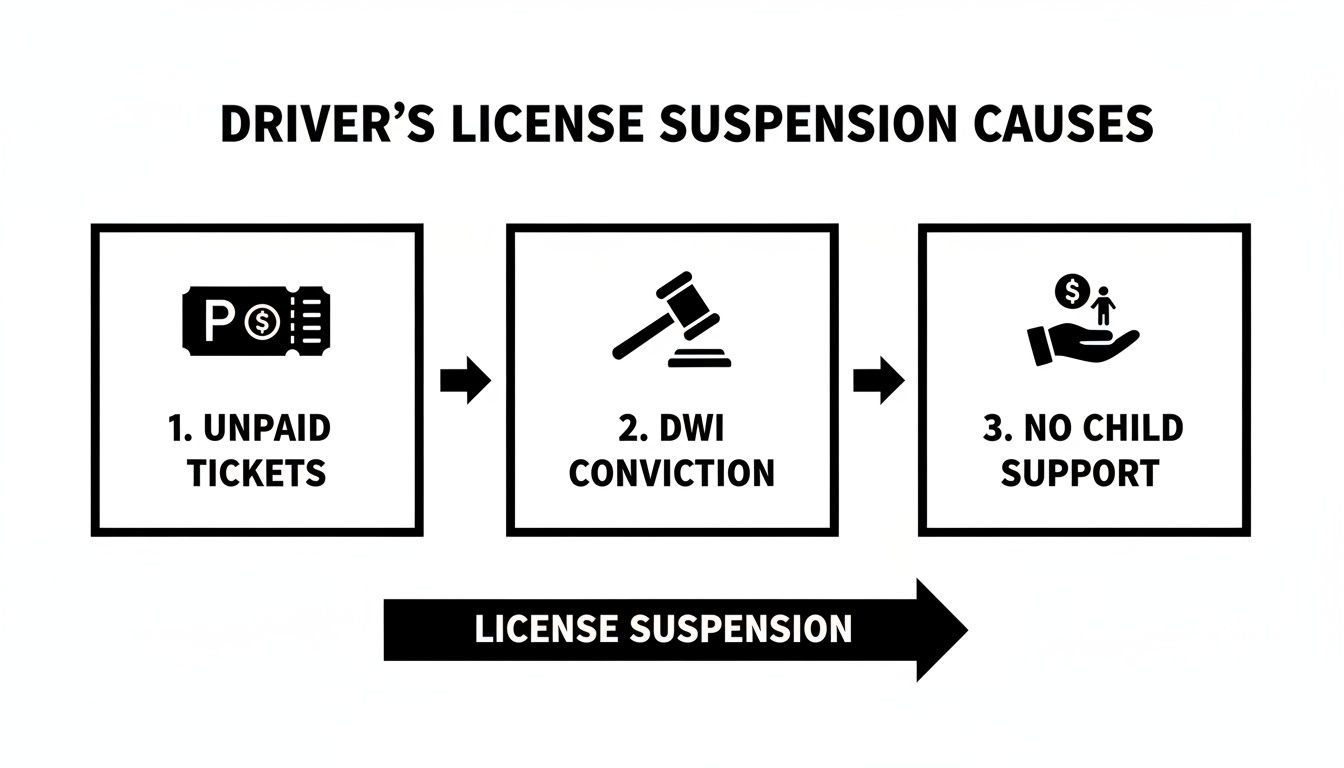
As you can see, many suspensions have nothing to do with dangerous driving and are rooted in administrative or financial issues instead.
Throughout this entire process, our team at The Law Office of Bryan Fagan, PLLC, will be your guide and your defender. We cut through the legal jargon and keep you informed every step of the way, empowering you to face what's next with confidence.
How to Build a Strong Defense Against Your DWLI Charge
Getting pulled over and handed a ticket for Driving While License Invalid (DWLI) can feel like a dead end, but it doesn't have to result in a conviction. With the right legal game plan, you have a real shot at challenging the state's case, keeping your record clean, and getting your driving privileges back. A good defense lawyer doesn't just take the police report at face value; they dig into every single detail to find cracks in the prosecutor's argument.
Think of it like this: building a defense is like checking the foundation of a house. If you can show that the very reason for the traffic stop was shaky or illegal, the entire case built on top of it can crumble. An experienced attorney knows exactly where to look for those weak spots.
Challenging the State's Case
For a prosecutor to convict you, they have to prove two things beyond a reasonable doubt: first, that you were actually driving a car, and second, that you knew your license was suspended. That "knowledge" element is often the biggest hurdle for the state and the best opportunity for your defense.
Here are some of the most common and effective ways to fight a DWLI charge:
- Lack of Notice: The Texas Department of Public Safety (DPS) is required by law to tell you about your suspension. What if they mailed the notice to an old address you haven't lived at for years? If you never actually got the letter, your attorney can argue you had no idea your license was invalid. This happens all the time and can be a complete defense.
- Driving Due to a Genuine Emergency: Texas law carves out an exception for true emergencies. If you can prove you were only on the road to prevent something worse from happening—like rushing a family member to the ER for a life-threatening injury—it can be a valid defense. Keep in mind, driving to work or the grocery store won't cut it.
- Challenging the Traffic Stop: A police officer can't just pull you over on a whim. They need a valid reason, known as "reasonable suspicion." If the stop was based on a hunch, a guess, or an illegal reason, any evidence they found—including the fact that your license was suspended—can be thrown out of court.
A DWLI case often comes down to paperwork and procedure. Proving that the state failed to properly notify you can be the key that gets your entire case dismissed.
Your attorney's job is to go through all the evidence with a fine-tooth comb, from the officer's report to the DPS records, searching for these kinds of procedural mistakes. When putting together a strong defense, the support of experienced legal staff is priceless; specialized Paralegal Assistants can be instrumental in the research, documentation, and case preparation that reinforces your position.
Negotiating for a Better Outcome
Not every case needs a full-blown trial. In many situations, especially if it’s your first offense or the reason for the suspension was something minor, a skilled negotiation can lead to a great result. An attorney with a good reputation can often work with the prosecutor to land on a much more favorable outcome.
Practical advice for people facing charges often involves negotiation. These strategies might include:
- Seeking a Dismissal: If you can quickly fix the problem that led to the suspension (like paying off old fines) and get your license fully reinstated, a prosecutor is often willing to just dismiss the DWLI charge.
- Plea to a Lesser Charge: Your lawyer might be able to negotiate a plea down to a simple non-moving violation or another offense that doesn't come with jail time and won't hammer your driving record or insurance rates.
- Deferred Adjudication: This is a type of probation where you plead "guilty" or "no contest," and after successfully completing a probationary period, the charge is dismissed. This is a fantastic way to keep a conviction off your permanent record.
The ultimate goal is always to protect your future. A DWLI charge can have long-lasting effects, but it doesn't have to ruin your life. By being proactive and teaming up with a dedicated Houston criminal lawyer, you can fight for a positive result and get back on the road, legally and with confidence.
Getting Your License Reinstated And Moving Forward

While we’re fighting the DWLI charge in court, your ultimate goal is simple: to get back on the road, legally and for good. A license suspension can feel like your life has been put on hold, but it's almost always a temporary roadblock, not a permanent dead end.
Think of it like this: you’re fighting a battle on two fronts. One is the criminal case for the DWLI charge itself. The other is the administrative process with the Texas Department of Public Safety (DPS) to get your license back. Our team guides you through both, making sure you have a clear plan to put this entire chapter behind you.
Clearing The Path To Reinstatement
First things first: you have to fix the original problem that got your license suspended. Whether it was an old ticket you forgot about, a missed court date, or a DWI-related issue, you must resolve it before the DPS will even talk about reinstatement. We’ll help you pinpoint that root cause and create a strategy to clear it.
Once that underlying issue is handled, you’ll need to work through the DPS checklist:
- Pay All Reinstatement Fees: The DPS charges fees to restore a suspended license. The amount varies based on why it was suspended, but paying them is non-negotiable.
- File an SR-22 if Required: An SR-22 isn't insurance. It’s a certificate your insurer files to prove you have at least the minimum liability coverage Texas requires. It’s often mandatory after serious offenses like a DWI.
- Submit All Necessary Paperwork: You may also need to show proof that you’ve completed specific programs, like a required drug or alcohol education course, before your license is officially restored.
There’s a reason Texas takes this so seriously. National data from 2021 showed that drivers with suspended or revoked licenses were involved in nearly 11,000 fatal crashes. It’s a huge public safety concern, and it’s why getting your license status cleared legally is so critical for everyone.
The Occupational Driver's License: A Lifeline
So, what are you supposed to do in the meantime? How do you get to work or take your kids to school? A suspension doesn't have to mean losing your job. In Texas, you may be able to get an Occupational Driver's License (ODL).
An ODL, sometimes called an "essential needs license," is a special, restricted license granted by a judge. It allows you to drive legally for specific, court-approved reasons.
An ODL can give you the freedom to handle essential daily tasks, like:
- Driving to and from your job
- Traveling to and from school or vocational training
- Taking your children to school, daycare, or doctor’s appointments
- Running essential household errands, like going to the grocery store or pharmacy
Getting an ODL involves petitioning a court, filing detailed paperwork, and proving that you have an essential need to drive. Our attorneys can handle this entire process for you, from gathering the right documents to arguing your case before a judge. For those dealing with a DWI-related suspension, the process can feel even more complicated, but there are always options. Learn more about DWI license help and see how we can keep you on the road.
Wiping The Slate Clean For Your Future
Once your case is resolved, you might have a chance to clear your record entirely. This is a crucial final step toward truly moving on.
If your DWLI charge was dismissed or you were found not guilty at trial, you can petition for an expunction. This legal process completely destroys all records of the arrest as if it never happened.
If you successfully completed deferred adjudication probation, you may be eligible for an order of nondisclosure. This seals the record from the public, preventing it from showing up on most background checks for jobs and housing. Our firm is dedicated to helping clients rebuild their lives, and guiding you through these post-conviction relief options is a key part of what we do for our rehabilitation-focused readers.
Frequently Asked Questions About DWLI Charges in Texas
When you're staring down a charge for Driving While License Invalid (DWLI), the uncertainty can be overwhelming. A flood of questions about fines, jail, and your future is completely normal. To help cut through the confusion, we’ve put together answers to the most common questions our defense attorneys hear from people in your exact situation.
Can I Go to Jail for a First-Time DWLI Offense in Texas?
It's a question we get all the time, and the answer is yes, jail time is a possibility even for a first offense. A simple, first-time DWLI is usually a Class C misdemeanor. The good news is that this level of offense is only punishable by a fine of up to $500, with no jail time.
However, things can get serious fast. The charge gets bumped up to a Class B misdemeanor if you were driving without car insurance or if you've been convicted of DWLI before. A Class B carries much heavier penalties, including up to 180 days in county jail and a fine of up to $2,000. An experienced attorney can often find ways to negotiate for alternatives, like probation, to keep you out of jail.
How Can I Check if My Texas Driver's License Is Suspended?
The Texas Department of Public Safety (DPS) is required to mail a suspension notice to the last address they have on file for you. But here’s a common pitfall: people move, forget to update their address with the DPS, and the notice gets lost in the mail. You can’t rely on just waiting for a letter.
The most direct way to know for sure is by using the official Texas DPS "License Eligibility" website. You’ll need your driver's license number, date of birth, and the last four digits of your Social Security number. It costs a small fee, but it gives you an immediate, official answer on whether you are legally cleared to drive.
Not knowing your license was suspended can be a powerful defense in court. To make this argument work, your attorney has to prove that the DPS never properly notified you of the suspension.
What Is an SR-22 and Will I Need One?
An SR-22 isn't actually an insurance policy. It's better to think of it as a special certificate your insurance company files with the DPS. It essentially acts as a guarantee to the state, proving that you're carrying the minimum liability coverage Texas requires.
You’ll typically need to get an SR-22 to get your license back after it’s been suspended for a serious offense. This often includes suspensions for:
- DWI convictions
- Driving without insurance
- Having too many traffic violations on your record
Most of the time, you'll have to keep that SR-22 on file for two years from the date of your conviction. Our office can look at the specifics of your case and tell you if an SR-22 will be required, then walk you through getting one.
Can a DWLI Charge Be Removed From My Record?
Yes, it is possible to wipe a DWLI charge off your record, but it depends entirely on the outcome of your case. If your case gets dismissed or you’re found not guilty at trial, you may qualify for an expunction. This is the best-case scenario, as it’s a legal process that completely destroys all records of the arrest—as if it never happened.
Another option is available if you complete deferred adjudication probation for a Class B or Class C misdemeanor DWLI. After a waiting period, you can petition the court for an order of nondisclosure. This seals your record from public view, meaning most private employers won't see it on a background check. A good Texas criminal defense attorney can explain which path makes the most sense for you and build a strategy to protect your future.
If you’ve been charged with a crime in Texas, call The Law Office of Bryan Fagan, PLLC for a free and confidential consultation. Our defense team is ready to protect your rights. https://texascriminallawyer.net