Skip to content
Being arrested in Texas can be terrifying — but you don’t have to face it alone. The moments after being pulled over for a suspected DWI can be a blur, but understanding your rights and what comes next is the first critical step toward protecting your future.
What Happens Immediately After a Texas DWI Arrest
The time immediately following a DWI arrest can feel like pure chaos. From the flashing lights on the side of the road to the cold reality of a police station, everything moves at a dizzying pace. The most important thing you can do is stay as calm as possible and avoid making costly mistakes. Remember, you have the right to remain silent, and you should use it—politely but firmly.
After the arrest, you’ll be taken for booking. This is an administrative process where officers take your fingerprints, photograph you for a mugshot, and record your personal information. They will also inventory your personal property, which will be returned to you upon release.
The Critical First 24-48 Hours
Once you are booked, you will be brought before a magistrate judge for an arraignment. This is usually a quick hearing where the judge formally reads the charges against you, explains your rights, and sets your bail amount along with any conditions for your release. For most people, getting out of jail means navigating the bail bond system. If you're new to this, understanding the bail bond process can give you a general idea of how it works, though specifics can vary.
This flowchart lays out the key stages that kick off right after a DWI arrest, from that initial stop to your first court appearance.
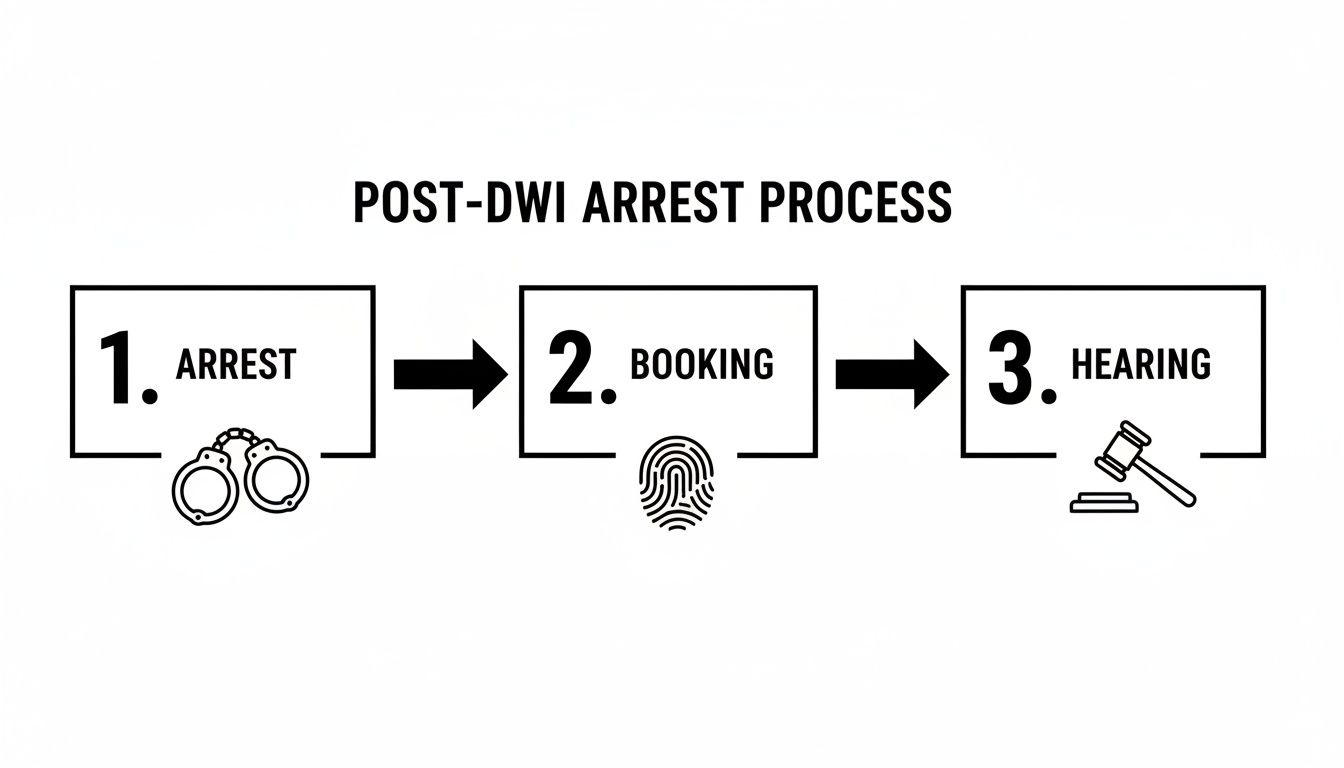
As you can see, the legal process immediately splits into two separate tracks—the criminal case and the administrative one—and both have their own urgent deadlines.
The 15-Day Countdown for Your Driver's License
One of the most pressing issues you face is the threat to your driver's license. This isn't part of your criminal case; it's a separate administrative battle with the Texas Department of Public Safety (DPS).
You have only 15 days from the date of your arrest to request an Administrative License Revocation (ALR) hearing. If you miss this deadline, your license will be suspended automatically. There are no exceptions.
This hearing is your only opportunity to fight the automatic suspension of your driving privileges. It’s a complex process, and our Harris County ALR hearing guide offers crucial information on how to navigate it. The consequences of a DWI arrest start piling up immediately, with potential license suspensions ranging from six months to two years, depending on your history.
These penalties create massive headaches long before your criminal trial ever begins. This is why having a skilled Houston criminal lawyer in your corner from day one is so vital—to protect both your freedom and your ability to drive.
Breaking Down DWI Penalties by Offense Level
After a DWI arrest, the first question on your mind is probably, "What happens now?" In Texas, the answer isn't simple. The law uses a tiered system, meaning the penalties get harsher with each conviction. What starts as a misdemeanor can quickly spiral into a life-changing felony.
It’s absolutely critical to understand what you're up against. This isn't just about a fine or a slap on the wrist; we're talking about consequences that can impact your freedom, your finances, and your future for years to come. Let's break down exactly what that looks like, starting with a first offense.

First DWI Offense Penalties
For most people, a first-time DWI is charged as a Class B Misdemeanor, assuming there are no "aggravating factors" like an accident or a child in the car. While it’s the lowest-level DWI, the penalties are still serious and designed to make an impression.
Here’s what a conviction for a first DWI in Texas typically involves:
- Jail Time: A mandatory minimum of 72 hours and up to 180 days in the county jail.
- Fines: A fine of up to $2,000.
- License Suspension: Your driver's license can be suspended for anywhere from 90 days to one year.
- Community Service: A judge can order between 24 and 100 hours of community service.
- DWI Education Program: You will almost certainly have to complete a 12-hour DWI education course.
Keep in mind, these are just the direct criminal penalties. A conviction also triggers thousands of dollars in state fees and surcharges, not to mention a massive spike in your car insurance rates. The financial hit is often much bigger than just the fine.
Second DWI Offense: A Serious Escalation
If you're facing a second DWI, the state's attitude changes dramatically. A second offense is elevated to a Class A Misdemeanor, which essentially doubles the maximum jail time and fines. The courts show far less leniency to someone they see as a repeat offender.
For a second DWI, the potential consequences ramp up significantly:
- Jail Time: The range jumps to between 30 days and one year in county jail.
- Fines: The maximum fine increases to $4,000.
- License Suspension: You're looking at a much longer suspension, from 180 days to two years.
- Ignition Interlock Device (IID): It is highly likely you will be required to install an IID in your vehicle just to be able to drive at all.
This jump from a first to a second offense is a major turning point. Prosecutors get more aggressive, and judges are far less willing to offer deals that don't include some amount of jail time.
Third DWI Offense: A Felony Conviction
A third DWI charge is where the entire legal landscape shifts beneath your feet. In Texas, a third or subsequent DWI is a third-degree felony. This isn't just another misdemeanor; a felony conviction comes with devastating, lifelong consequences, including the loss of your right to vote and own a firearm.
The punishment for a felony DWI is severe:
- Prison Time: You face anywhere from two to 10 years in a Texas state prison, not county jail.
- Fines: A crippling fine of up to $10,000.
- License Suspension: Your license can be suspended for up to two years.
- Permanent Criminal Record: A felony conviction follows you forever, creating huge barriers to employment, housing, and getting professional licenses.
Recent laws have made these penalties even tougher, and that $10,000 fine doesn't include the thousands more in mandatory state fees. As outlined by the state itself, the penalties increase sharply. A first DWI can mean up to 180 days in jail and a $2,000 fine. A second means up to a year in jail and a $4,000 fine. A third, a felony, means 2 to 10 years in prison and a fine up to $10,000. You can find more details about these penalties directly on the official TxDOT site.
To make this crystal clear, let's lay it all out in a table.
Texas DWI Penalties at a Glance
This table breaks down the standard criminal penalties for first, second, and third DWI offenses in Texas. Remember, these are the baseline punishments and don't include extra penalties from aggravating factors.
| Offense Level | Classification | Potential Jail Time | Maximum Fine | License Suspension |
|---|---|---|---|---|
| First DWI | Class B Misdemeanor | 72 hours to 180 days | $2,000 | 90 days to 1 year |
| Second DWI | Class A Misdemeanor | 30 days to 1 year | $4,000 | 180 days to 2 years |
| Third DWI | 3rd Degree Felony | 2 to 10 years | $10,000 | 180 days to 2 years |
It's crucial to understand that these are the standard ranges. As we'll cover next, certain circumstances can make these penalties even worse.
How Aggravating Factors Can Increase DWI Penalties
The standard penalties for a first, second, or third DWI are already tough, but Texas law has specific rules that can make them much worse. These are known as aggravating factors or enhancements. Think of them as penalty multipliers. If certain conditions were present during your arrest, what might have been a misdemeanor can quickly spiral into a far more serious charge.
Understanding these factors is critical because they dramatically change the potential punishment you face. Prosecutors look for these elements to increase pressure, so knowing what they are is the first step in building a defense. A basic DWI charge can be elevated based on your blood alcohol level, who was in the car, or if an accident happened.
High BAC of 0.15 or More
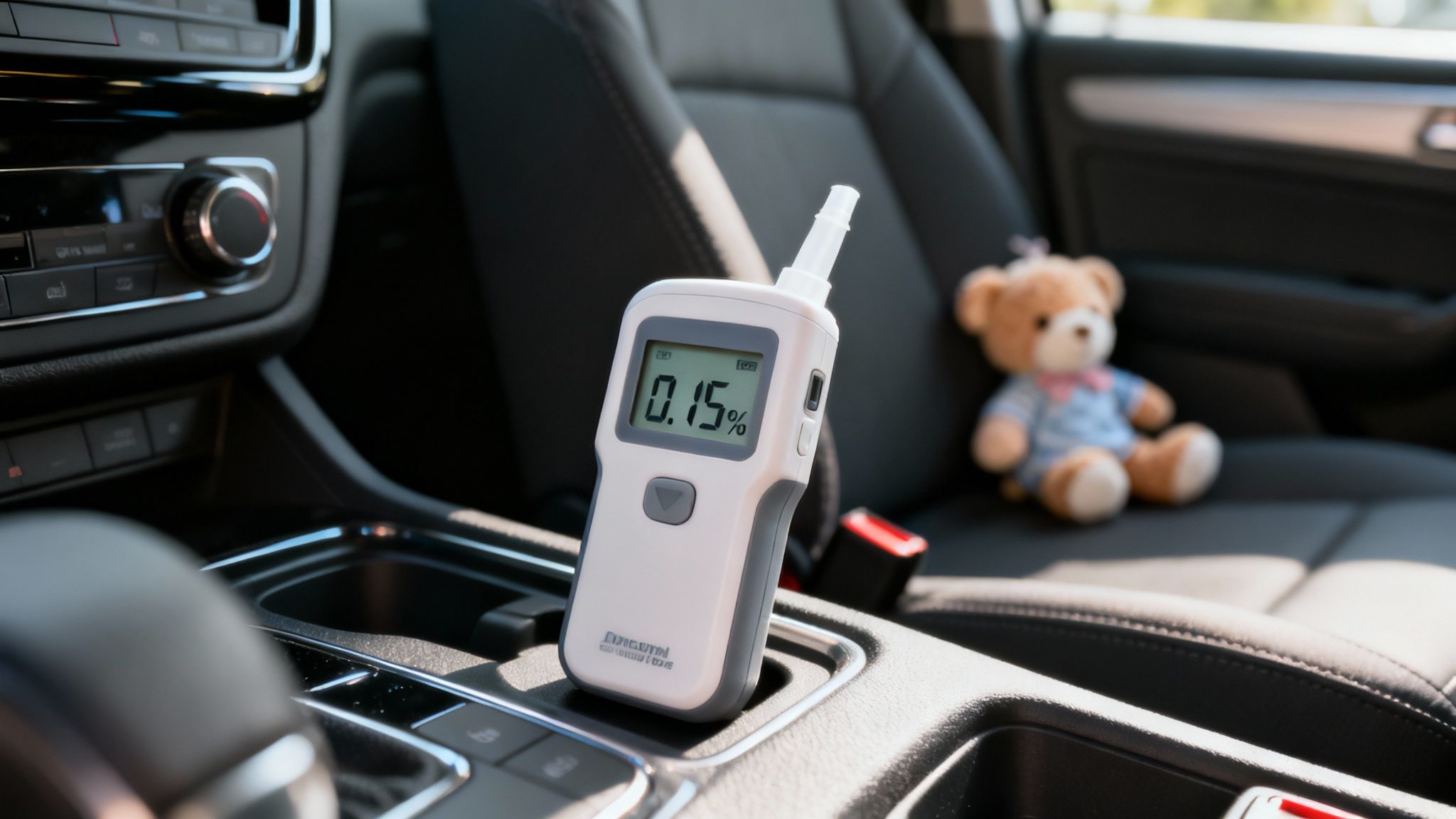
The legal limit for intoxication in Texas is a Blood Alcohol Concentration (BAC) of 0.08. But if your BAC is nearly double that, at 0.15 or higher, the law treats the offense much more severely. This single factor automatically elevates a first-time DWI from a Class B Misdemeanor to a Class A Misdemeanor.
So, what does that jump really mean for you?
- More Jail Time: The potential jail sentence skyrockets from a maximum of 180 days to up to one year.
- Higher Fines: The maximum fine doubles, jumping from $2,000 to $4,000.
- Mandatory IID: You will almost certainly be required to install an ignition interlock device on your vehicle as a condition of getting out on bond or as part of probation.
This enhancement applies even if it’s your very first offense. The state views a high BAC as a sign of extreme impairment and a greater danger to the public, and the harsher penalties reflect that.
DWI with a Child Passenger
Driving while intoxicated with a child in the vehicle is one of the most serious aggravating factors you can face. Under Texas Penal Code Section 49.045, if you're arrested for DWI with a passenger under the age of 15, the charge is automatically enhanced to a state jail felony.
That’s a huge leap, completely bypassing misdemeanor charges, even for a first-time offender. The consequences of a state jail felony conviction are severe and will follow you for the rest of your life.
A state jail felony conviction means you could face between 180 days and two years in a state jail facility, along with a fine of up to $10,000. It also saddles you with a permanent felony record, which can impact your right to vote, own a firearm, and secure future employment.
Causing an Accident with Injury or Death
When a DWI leads to an accident, the legal stakes become terrifyingly high. If your actions cause serious bodily injury to another person, you can be charged with Intoxication Assault. If the accident results in someone's death, the charge becomes Intoxication Manslaughter.
These are not simple DWI cases; they are severe felony offenses that carry life-altering prison sentences.
- Intoxication Assault: This is typically a third-degree felony, punishable by 2 to 10 years in prison. If the person injured is a first responder, it can be enhanced to a second-degree felony.
- Intoxication Manslaughter: This is a second-degree felony, carrying a prison sentence of 2 to 20 years. If the victim is a first responder, it becomes a first-degree felony, with a potential sentence of up to life in prison.
These charges show just how seriously Texas treats situations where impaired driving leads to harm. The focus of the case shifts from your intoxication level to the tragic outcome of your actions, and you can be sure prosecutors will pursue the maximum punishment possible.
The Hidden Costs of a DWI Conviction
When people talk about DWI penalties in Texas, the conversation usually sticks to the obvious: fines and jail time. And while those are definitely serious, they're really just the tip of the iceberg. The true cost of a DWI conviction is a long-term problem that can ripple through your finances, your career, and your personal life for years to come.
These are what we call collateral consequences—the "hidden" penalties that don't show up on a sentencing sheet but often hit the hardest. From mandatory fees and insane insurance hikes to professional fallout, the financial and emotional weight can be crushing. Understanding these long-term impacts is the only way to grasp the true gravity of a DWI conviction.
The Financial Aftermath
The financial hit from a DWI goes way beyond the fine a judge orders you to pay. It’s more like a cascade of expenses that can easily pile up into the thousands, putting a massive strain on your budget for years. These costs aren't optional; they're mandatory parts of your sentence and probation.
You’ll find yourself on the hook for a whole range of fees, including:
- Court Costs and Fees: These are separate from your fine and cover the court's administrative expenses.
- Probation Fees: If you get probation, you'll be paying a monthly supervision fee just to stay out of jail.
- Mandatory DWI Education Classes: Every single person convicted of a DWI in Texas has to complete an approved 12-hour DWI education course, and you foot the bill.
- Ignition Interlock Device (IID): If the court orders an IID, you have to pay for the installation, monthly leasing, and regular calibration. This alone can run you over $100 per month.
On top of all that, your auto insurance premiums will go through the roof. After a DWI, the state will require you to file an SR-22 certificate, which is basically a flag that tells insurance companies you're a high-risk driver. Just filing that certificate can cause your rates to double or even triple, a painful expense you'll have to carry for at least two years. For a deeper look at how these numbers add up, our detailed DWI cost breakdown and consequences gives you the full picture.
Professional and Personal Fallout
A DWI conviction doesn’t just drain your bank account; it can create roadblocks in your career and personal life that can feel permanent. Once convicted, you have a criminal record that’s visible to anyone who runs a background check—think employers, landlords, and professional licensing boards.
For people in licensed professions, the stakes are incredibly high.
- Nurses and Healthcare Workers: A DWI can trigger an investigation by the Texas Board of Nursing, putting your license at risk of suspension or revocation.
- Pilots: The FAA has zero tolerance. A DWI has strict reporting requirements and can easily ground your career for good.
- Teachers and Educators: A conviction could violate your contract's "morality clause" and jeopardize your teaching certificate.
- Commercial Drivers: A DWI means an automatic disqualification of your Commercial Driver's License (CDL) for at least a year.
A DWI conviction never has a positive impact on a person's career. While some professions face steeper consequences than others, a conviction could cost you your job or even your professional license.
The damage doesn't stop with your job. Trying to find a place to live can become a nightmare, as many landlords run background checks and won't hesitate to deny your application. For non-U.S. citizens, a DWI can be classified as a crime of moral turpitude, which can lead to devastating immigration consequences, including deportation.
And if your DWI involved a crash, you've got another layer of stress. It's crucial to understand how an accident impacts your vehicle’s value and figure out how to recover some of that loss, adding even more financial and personal strain to an already overwhelming situation.
Strategies for Building a Strong DWI Defense
Getting arrested for a DWI in Texas can feel like the end of the road. It’s easy to assume the case is already lost. But it’s critical to remember one simple fact: an arrest is not a conviction. The prosecutor has the burden of proving every single element of their case beyond a reasonable doubt, and a skilled Texas DWI attorney knows exactly where to find the weak spots in their argument.
Every DWI case is like a chain made of individual links of evidence—from the reason for the traffic stop all the way to the chemical test results. If even one of those links is weak, the entire case against you can fall apart. An experienced lawyer will meticulously go through every detail to build a powerful defense strategy that fits your unique situation.

Challenging the Initial Traffic Stop
The whole investigation starts with a single moment: the traffic stop. For a police officer to legally pull you over, they must have reasonable suspicion that you broke a law. This can’t just be a hunch or a gut feeling; they need a specific, concrete reason they can explain in court.
Common reasons officers use for a stop include:
- Speeding, swerving, or failing to stay in a single lane.
- Running a stop sign or a red light.
- Driving with a broken taillight or an expired registration sticker.
If the officer can't provide a valid legal reason for pulling you over, any evidence they gathered after that point—including sobriety tests and breath or blood results—can potentially be thrown out. This is often the first and most powerful line of defense available.
Scrutinizing Field Sobriety Tests
Standardized Field Sobriety Tests (SFSTs) are a set of physical and mental exercises officers use to look for signs of impairment. The problem? These tests are notoriously unreliable and frequently administered incorrectly. They're designed to be tricky even for someone who is completely sober.
A strong defense involves digging into the validity of these tests by looking at factors like:
- Improper Instructions: Did the officer give you the clear, correct instructions required by official protocol? Most of the time, they don't.
- Environmental Conditions: Were the tests done on an uneven road, in poor lighting, or during bad weather?
- Your Physical Condition: Do you have medical issues, old injuries, or physical limitations that could have impacted your performance?
These tests are incredibly subjective. An experienced attorney knows how to show a judge or jury just how flawed and unreliable they truly are.
Questioning the Chemical Test Results
Breath and blood tests seem scientific and final, but they are far from perfect. The machines used for breath tests, like the Intoxilyzer 9000 used in Texas, need precise calibration and regular maintenance to work correctly. The procedures for drawing blood must be followed perfectly to prevent contamination or other errors.
An experienced DWI attorney will investigate every single aspect of the chemical testing process. This includes digging into the maintenance logs for the breathalyzer, checking the credentials of the person who drew your blood, and verifying the "chain of custody" for the sample to make sure it wasn't mishandled.
Any mistake in procedure or sign that a machine wasn't working right can be grounds to have the results suppressed. That means the prosecutor can't use them against you. Exploring your options with a lawyer who provides DWI license help is a crucial step in taking on the state’s evidence.
Ultimately, a good defense might also involve presenting other explanations for any signs of intoxication. Things like fatigue, allergies, or certain medical conditions can easily mimic the effects of alcohol. By presenting these possibilities, we can create reasonable doubt and fight for a much better outcome, whether that’s getting the charges reduced, dismissed entirely, or winning a "not guilty" verdict at trial.
Common Questions About DWI Punishment in Texas
When you’re staring down a DWI charge, it’s completely normal to feel like your world is spinning. The legal system is a maze, and the uncertainty can be overwhelming. We hear the same questions time and again from people just like you, so let’s cut through the noise and get you some straight answers.
Can I Still Drive After a DWI Arrest?
This is almost always the first thing people ask, and for good reason—you have a life to live. The short answer is yes, but you have to move incredibly fast.
When you're arrested for DWI, you’re actually facing two separate battles to keep your license. The first is an immediate administrative suspension from the Texas Department of Public Safety (DPS). The second is a criminal suspension that happens later if you’re convicted.
To fight that first suspension, you have only 15 days from the date of your arrest to request an Administrative License Revocation (ALR) hearing. If you miss that deadline, your license is automatically suspended for 90 days or more. Winning the ALR hearing is your first and best chance to protect your driving privileges while your criminal case proceeds.
Will I Definitely Go to Jail for a First DWI?
Not automatically, but it is a very real possibility. A first-time DWI in Texas is a Class B Misdemeanor, which carries a potential jail sentence of 72 hours to 180 days. While many first-time offenders end up with probation instead of jail, that decision is ultimately up to the judge.
Several factors will weigh heavily on the judge’s mind:
- Your Blood Alcohol Concentration (BAC) when you were arrested.
- Whether there was an accident involved.
- Your attitude and behavior during the stop.
- The quality of your legal defense.
A sharp Texas DWI attorney can often negotiate a sentence that prioritizes probation and treatment over jail time, but there are never any guarantees.
What Is the Difference Between DUI and DWI in Texas?
In Texas, these terms are not the same and apply to different age groups. It's a common point of confusion.
DWI (Driving While Intoxicated) is the charge for adults 21 and over caught driving with a BAC of 0.08% or higher. It also applies if you’ve lost the normal use of your mental or physical faculties due to alcohol or drugs, regardless of your BAC.
DUI (Driving Under the Influence), on the other hand, is a charge strictly for minors under 21 who operate a vehicle with any detectable amount of alcohol in their system. It's a Class C Misdemeanor, but a conviction can still lead to a suspended license, fines, and a criminal record that follows them into adulthood.
Can a DWI Be Removed from My Record?
Getting a DWI wiped from your record in Texas is tough, but not impossible. The two main legal tools for this are an expunction and an order of nondisclosure.
An expunction is the ideal outcome—it completely erases the arrest from your record, as if it never even happened. You’re typically only eligible for an expunction if your case was dismissed, you were found not guilty, or you completed a pretrial diversion program.
An order of nondisclosure seals your record from public view, though law enforcement can still see it. You might be eligible after completing your sentence and probation, but DWI convictions often don't qualify, and there are strict waiting periods.
Do I Have to Get an Ignition Interlock Device?
An Ignition Interlock Device (IID) is essentially a breathalyzer for your car that stops it from starting if it detects alcohol. Their use is becoming more and more common in Texas, and in many situations, they are mandatory.
You can almost count on having to install an IID if:
- You have a previous DWI conviction.
- Your BAC was 0.15% or higher.
- You are sentenced to probation.
- You get an occupational license to drive while your regular license is suspended.
Keep in mind, you are on the hook for all installation and monthly monitoring fees, which can become a serious financial strain.
Why Do I Need a Lawyer if I Plan to Plead Guilty?
Walking into court to plead guilty without a lawyer is one of the costliest mistakes you can make. A DWI conviction carries consequences that ripple far beyond the courtroom, affecting your job, your insurance rates, and your reputation for years.
When you plead guilty, you’re giving up the right to challenge the state's evidence—evidence that might be shaky, improperly collected, or flat-out inadmissible.
An experienced lawyer does so much more than just stand next to you in court. They will scrutinize every detail of your case, from the traffic stop to the breathalyzer calibration, looking for weaknesses. They negotiate with prosecutors to get charges reduced or penalties softened. Even when the evidence looks damning, a good attorney can often secure a far better outcome than you ever could on your own.
The state takes these charges incredibly seriously. Recent data shows that from 2014 to 2023, impaired driving was a factor in roughly 14,389 traffic fatalities in Texas, making up about 37% of all traffic deaths in that time. You can read more about the Texas Department of Transportation's traffic safety findings to see why prosecutors are under so much pressure to secure convictions. You need someone in your corner who is just as serious about defending you.
If you’ve been charged with a crime in Texas, call The Law Office of Bryan Fagan, PLLC for a free and confidential consultation. Our defense team is ready to protect your rights. https://texascriminallawyer.net