Being arrested for a DWI in Texas can be terrifying — but you don’t have to face it alone. One minute you're driving, the next you're in handcuffs, your mind racing with questions about what comes next. It’s disorienting, and it's perfectly normal to feel overwhelmed and scared for your future. This guide is here to cut through the confusion and give you clear, straightforward answers.
We’re going to walk through the system of DWI Texas penalties, explaining everything from fines and potential jail time to the long-term impact on your driver's license and career. Think of this as your roadmap for the challenging journey ahead. Our goal is to replace your uncertainty with knowledge, so you can feel empowered to make the best decisions for your case.
The Two Fights You're Facing
A DWI charge in Texas isn't just one legal battle; it's two, and they happen at the same time:
- The Criminal Case: This is what most people think of—the court case where the state tries to prove you are guilty. A conviction can mean hefty fines, jail time, and a permanent criminal record. The penalties increase with each offense, starting with a Class B Misdemeanor for a first offense (fines up to $2,000 and 72 hours to 180 days in jail) and escalating to a Third-Degree Felony for a third offense, which carries 2 to 10 years in prison and fines up to $10,000.
- The Administrative Case: This is a separate, civil fight with the Texas Department of Public Safety (DPS) over your driver's license. From the moment of your arrest, a clock starts ticking. You have only 15 days to request a special hearing, called an Administrative License Revocation (ALR) hearing, to challenge the automatic suspension of your license. If you miss that deadline, your license will be suspended.
Facing this two-front war can feel isolating, but you don't have to go through it alone. A compassionate and skilled legal team can guide you through every step, making sure your rights are protected from the very beginning.
At The Law Office of Bryan Fagan, PLLC, we believe everyone deserves a clear explanation of their rights and a strong, nonjudgmental defense. Understanding the process is the first step toward protecting yourself. Knowing what to do immediately after a DUI arrest can make a critical difference, helping you avoid common mistakes that could seriously damage your case. Our team is here to provide that guidance when you need it most.
Decoding Texas DWI Penalties by Offense Level
If you're facing a DWI arrest in Texas, the first step is to understand what you're up against. The law isn't designed to be forgiving; it's built to escalate penalties with each conviction. What starts as a serious misdemeanor can quickly spiral into a life-altering felony. The stakes get higher every single time.
This escalating structure is precisely why a strong defense from day one is so critical. The prosecution will look into your history to build their case, so knowing the specific penalties for a first, second, or third offense gives you a clear picture of what lies ahead.
It's completely normal to feel a tidal wave of emotions after an arrest. Most people move from feeling overwhelmed and confused to feeling empowered once they have knowledge and the right legal support on their side.
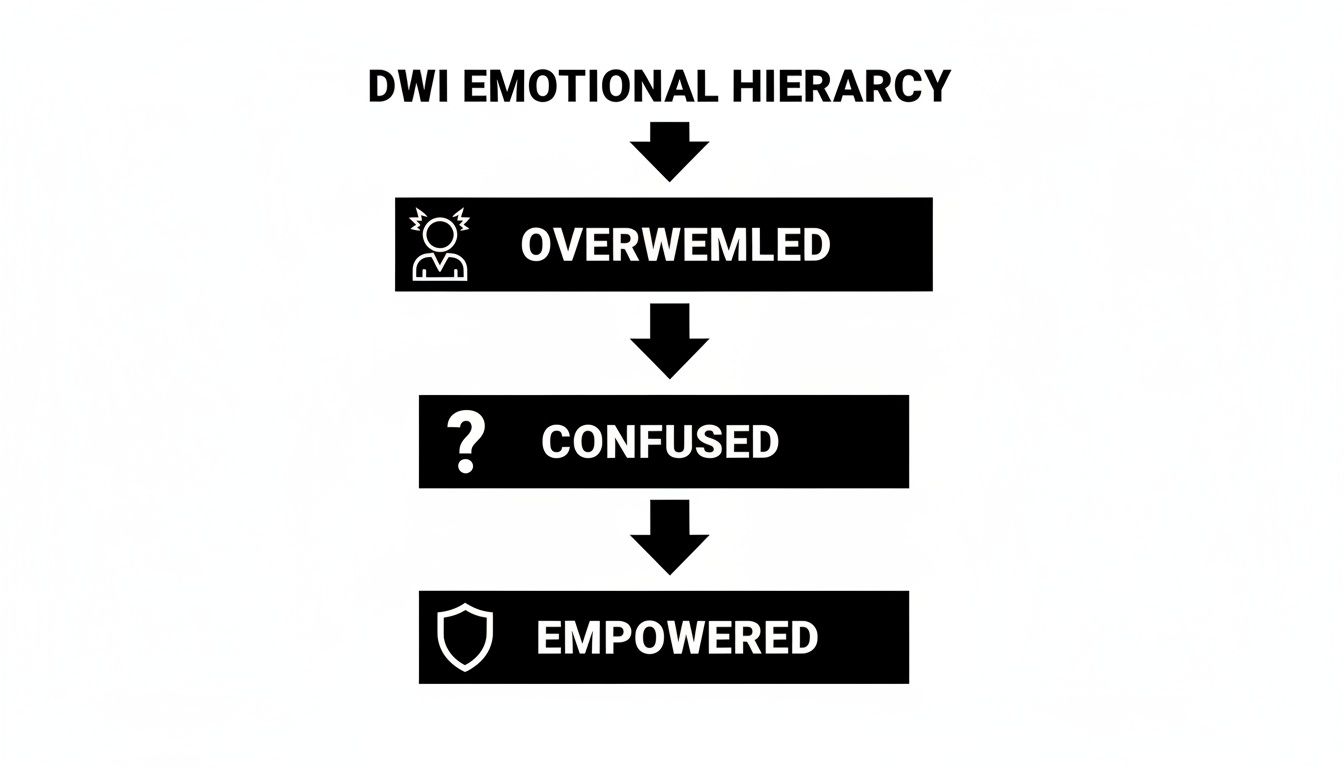
The key takeaway here? While the initial arrest is terrifying, taking control by understanding the law and your options is the first step toward getting your life back on track.
First DWI Offense: A Serious Wake-Up Call
A first-time DWI charge in Texas is usually a Class B Misdemeanor, as long as there are no "aggravating factors" like a car accident or a very high Blood Alcohol Concentration (BAC). But don't let the word "misdemeanor" fool you. The consequences are designed to be a harsh wake-up call.
For a first offense, the potential criminal penalties include:
- Fines: Up to $2,000.
- Jail Time: A mandatory minimum of 72 hours in county jail, with a maximum of 180 days.
- License Suspension: Anywhere from 90 days to one year.
- Annual Surcharges: An additional annual state fee of $1,000 for three years, just to keep your license.
And that's just the start. These numbers don't even include court costs, probation fees, or the price of mandatory alcohol education classes. Even for a first offense, the financial and personal costs pile up fast.
Second DWI Offense: The Penalties Get Sharply Steeper
If you're arrested for a second DWI, the state's attitude changes dramatically. A second offense is elevated to a Class A Misdemeanor—the most severe misdemeanor charge in Texas. The penalties jump significantly to reflect the repeat nature of the offense.
A conviction for a second DWI carries:
- Fines: Up to $4,000.
- Jail Time: A mandatory minimum of 30 days in county jail, with a maximum of up to one year.
- License Suspension: From 180 days to two years.
- Annual Surcharges: An increased annual state fee of $1,500 for three years.
- Ignition Interlock Device (IID): You can expect that an IID will be required as a condition of your bond and for any potential probation.
Under Texas Penal Code Section 49.09(a), a second DWI is automatically a Class A misdemeanor. This law signals that the court's patience has worn thin, and the chance of spending serious time in jail goes way up.
Third DWI Offense: A Life-Changing Felony
A third DWI conviction is where everything changes. This is the critical line where the charge crosses from a misdemeanor to a Third-Degree Felony, regardless of how long ago your prior convictions were. A felony charge brings the threat of state prison and the permanent loss of fundamental civil rights.
The consequences of a third DWI are devastating:
- Fines: Up to $10,000.
- Prison Time: From 2 to 10 years in a Texas state prison—not county jail.
- License Suspension: Up to two years.
- Annual Surcharges: An annual state fee of $2,000 for three years.
- Permanent Criminal Record: As a convicted felon, you lose your right to vote and own firearms. It can also permanently bar you from certain jobs and professional licenses.
The legal landscape for these offenses has changed drastically over the years. Texas DWI penalties have become much tougher since the 1990s when the state first standardized the BAC limit at 0.08%. In 2019, Texas did away with its old Driver Responsibility Program, and the state surcharges were set at the current levels. You can learn more about how Texas DWI laws have changed to better understand today’s strict environment.
What Happens to Your Driver's License After a DWI Arrest
Beyond the criminal charges and potential jail time, a DWI arrest triggers a second, entirely separate legal battle. This one isn't fought in a criminal court; it’s an administrative process with the Texas Department of Public Safety (DPS), and it’s all about your right to drive. It's called an Administrative License Revocation (ALR), and it moves fast.
From the second you're arrested, a clock starts ticking. You have only 15 days to officially request an ALR hearing to fight the automatic suspension of your driver’s license. If you miss this deadline, your license gets suspended automatically, no questions asked, regardless of what happens in your criminal case.

This administrative process is one of the most immediate and disruptive penalties of a Texas DWI. Taking swift action to protect your driving privileges is a critical first step.
Failing vs. Refusing a Chemical Test
The choice you make at the station—whether to take a breath or blood test—has a direct and immediate impact on how long your license will be suspended. Texas has an "implied consent" law, which means that by getting a driver's license, you've already agreed to provide a sample if an officer lawfully asks for one.
Your decision leads to two very different outcomes:
- Failing the Test: If you take the test and your BAC is 0.08% or higher, the standard suspension for a first offense is 90 days.
- Refusing the Test: If you refuse to give a breath or blood sample, the penalty is much steeper. The suspension period doubles to 180 days for a first-time refusal.
The harsh penalty for refusal is designed to pressure drivers into complying. However, refusing also means the prosecutor in your criminal case won't have that BAC number to use against you, which can sometimes be a strategic advantage. It's a complex decision, and you can learn more in our detailed Harris County ALR hearing guide that breaks down the steps and strategies.
Keeping Your Life Moving With an Occupational License
Losing your license for months can make it nearly impossible to get to work, go to school, or handle family responsibilities. Fortunately, Texas law provides a path forward: the Occupational Driver's License (ODL), sometimes called an essential need license.
An ODL is a special, restricted license that lets you drive for specific, pre-approved reasons during your suspension.
An Occupational Driver's License isn't a "get out of jail free" card for your driving privileges. It comes with strict limitations on when and where you can drive, usually limited to a 4 to 12-hour window each day for necessary travel.
To get an ODL, your attorney has to file a petition with the court, proving you have an essential need to drive. This usually means providing proof of your job, school schedule, or other critical obligations.
The Ignition Interlock Device Requirement
Another common consequence tied to your license is the Ignition Interlock Device (IID). Think of it as a mini-breathalyzer wired directly into your car's ignition. Before you can start the engine, you have to blow into the device to prove you haven't been drinking.
A judge can order an IID in several situations:
- As a condition of getting an ODL.
- As a condition of your bond while the criminal case is active.
- As a condition of probation if you are eventually convicted.
For anyone with a prior DWI, an IID is almost always mandatory. You'll be responsible for all the costs, including installation (typically $70-$150) and monthly monitoring fees (around $60-$90). These devices are a constant, expensive reminder of the penalties that come with a Texas DWI.
When a DWI Charge Becomes a Serious Felony
Most DWI charges in Texas start as misdemeanors, but certain situations can instantly rocket the charge into felony territory, even if it's your first time being arrested. These are called "aggravating factors," and they tell the court that the circumstances of your arrest were especially dangerous.
When these factors are in play, the potential DWI Texas penalties don't just go up—they explode.
It’s critical to understand these enhancements because they can turn a terrible mistake into a life-derailing event. A felony conviction isn't just about facing longer prison sentences and crippling fines. It's about losing fundamental rights, like your right to own a firearm or even vote. It means a lifetime of explaining yourself on job applications and housing forms.
DWI with a Child Passenger
One of the quickest ways a DWI becomes a felony is by having a child in the car. Under Texas Penal Code Section 49.045, if you're arrested for DWI with a passenger under 15 years old, the charge is automatically bumped up to a State Jail Felony.
That’s true even if you have a perfectly clean record. The law is designed to protect children, and the penalties are severe to match that priority.
A conviction for DWI with a Child Passenger means facing:
- State Jail Time: A sentence of 180 days to two years in a state jail facility.
- Fines: A fine hitting a maximum of $10,000.
- License Suspension: Your driver's license will be suspended.
- Permanent Felony Record: This follows you forever, plain and simple.
Intoxication Assault
Things get even more serious when a DWI leads to an accident that causes "serious bodily injury" to another person. At that point, the charge becomes Intoxication Assault. The law is very clear about what this means: an injury that creates a substantial risk of death, causes serious permanent disfigurement, or results in the long-term loss of a body part or organ.
This charge is a Third-Degree Felony under Texas Penal Code Section 49.07. The penalties are harsh, reflecting the devastating harm done to the victim.
A conviction for Intoxication Assault includes:
- Prison Time: A sentence of two to ten years in a Texas state prison.
- Fines: A fine of up to $10,000.
This is a life-altering charge that can stem from a single, catastrophic moment of impaired driving. The consequences are designed not just to punish the driver but to acknowledge the profound and often permanent impact on the victim's life.
Intoxication Manslaughter
The gravest DWI-related charge you can face in Texas is Intoxication Manslaughter. This happens when an intoxicated driver causes an accident that results in someone's death. As defined in Texas Penal Code Section 49.08, this offense is a Second-Degree Felony.
The penalties for Intoxication Manslaughter are staggering, carrying a potential prison sentence of two to twenty years and fines up to $10,000. The situation gets even worse if the victim was a first responder—like a firefighter or police officer. In that case, the charge can be elevated to a First-Degree Felony, putting a sentence of up to life in prison on the table.
These tragic outcomes highlight the immense responsibility that comes with getting behind the wheel. The statistics paint a sobering picture of just how high the stakes are. In 2016 alone, the Texas Department of Transportation reported 987 drunk driving fatalities. For more on these numbers and the evolution of Texas law, you can learn about drunk driving statistics in Texas.
When facing charges of this magnitude, having an experienced criminal defense attorney isn’t just an option—it’s an absolute necessity.
The Hidden Costs and Long-Term Impact of a DWI
The penalties a judge hands down in court—fines, probation, and even jail time—are really just the tip of the iceberg. A DWI conviction sends ripples through every part of your life, creating hidden costs and long-term consequences that can stick around for years. Understanding these challenges is the first step in realizing why fighting the charge from day one is so critical.

The financial hit goes way beyond the initial court fines. If your DWI involved an accident, for example, you could be facing major losses on your vehicle's resale value; this is where understanding diminished value in Texas becomes painfully relevant. Preparing for these hurdles is a huge part of moving forward after an arrest.
Your Career and Professional Life
A DWI conviction can absolutely put your entire career in jeopardy. For many professions, having a criminal record triggers immediate and severe consequences.
- Professional Licenses: If you're a nurse, pilot, teacher, lawyer, or hold any other state-issued professional license, a DWI conviction will likely need to be reported to your licensing board. This can quickly spiral into a suspension, revocation, or a nightmare scenario when it's time to renew.
- Commercial Drivers: For anyone with a Commercial Driver's License (CDL), a DWI is often a career-ending event. The standards are incredibly strict, and your livelihood is hanging by a thread.
- Security Clearances: Jobs requiring a government security clearance will be at risk. A DWI raises serious red flags about your judgment and reliability, making it extremely difficult to get or keep that clearance.
Skyrocketing Insurance Rates
After a DWI, your car insurance company will waste no time reclassifying you as a high-risk driver. This isn't a small bump in your bill—it's a dramatic and sustained increase in your premiums that can last for several years.
You'll also almost certainly be required to file an SR-22 certificate with the state. This isn't an insurance policy itself. Instead, it’s a document from your insurer that proves you're carrying the minimum required liability coverage. Maintaining an SR-22 is often mandatory to keep your license, and it’s a clear signal of your high-risk status to any insurer you deal with in the future.
Immigration and International Travel
For non-U.S. citizens, the stakes get even higher. A DWI conviction can create a tangled mess of complications for your immigration status.
While a single misdemeanor DWI isn't always a deportable offense on its own, it’s viewed as a significant negative factor in immigration proceedings. It could sabotage your ability to renew a visa, apply for a green card, or pursue naturalization down the road.
On top of that, some countries, like Canada, can and will deny entry to anyone with a DWI conviction on their record. This can instantly limit your ability to travel internationally for work or even a family vacation.
These long-term impacts show that the fight against a DWI charge is about protecting so much more than just your freedom—it’s about safeguarding your entire future. To learn more, check out our guide on how long a DWI stays on your record in Texas.
How a Skilled DWI Attorney Can Defend Your Case
Knowing the tough DWI penalties in Texas is one thing; building a defense strong enough to protect your future is another. This is where an experienced DWI attorney becomes your most critical partner. A conviction is never a given, and a sharp lawyer knows how to pick apart the prosecution's case, piece by piece.
A powerful defense starts by examining every detail of your arrest, starting with the traffic stop itself. Did the officer have a legitimate, legal reason to pull you over in the first place? If the stop was unlawful, any evidence they gathered—from field sobriety tests to a breath or blood sample—could be thrown out of court.
This initial challenge to the stop is a crucial first step. A violation of your constitutional rights can bring a weak case to a dead stop before it ever gets going.
Challenging the Evidence Against You
Even if the traffic stop was valid, the evidence used to prove you were intoxicated is often flawed. A good attorney will put every step of the arrest process under a microscope.
This includes scrutinizing:
- Field Sobriety Tests: Were these tests administered exactly according to the strict national standards? Factors like bad weather, your physical condition, or even the officer giving improper instructions can make these tests totally unreliable.
- Breath and Blood Tests: Breathalyzer machines can malfunction or be calibrated incorrectly, giving skewed results. Blood samples can be contaminated, mixed up, or stored improperly, destroying the integrity of the test.
Finding these procedural mistakes or equipment failures can create the reasonable doubt needed to win.
Negotiating for Better Outcomes
Fighting the charges in a trial isn't the only path forward. A skilled lawyer can often negotiate with prosecutors for a much better result by pointing out all the weak spots in their case.
For many people facing a first-time DWI, a strategic negotiation can lead to the charge being reduced to something less severe, like Obstruction of a Highway. This helps you sidestep the harshest DWI penalties and avoid the stigma of an alcohol-related conviction on your record.
Another powerful option is deferred adjudication. This is a type of probation that, if you complete it successfully, allows you to avoid a final conviction entirely. It also opens the door to getting your record sealed down the road. Facing a DWI can be financially stressful, but many attorneys offer flexible payment options to help you manage the cost.
Securing a Fresh Start
If you're worried about this charge following you forever, an attorney can help you explore ways to clear your name. After a successful defense or completing certain programs, you might be eligible for a clean slate.
- Expunction: This legal process completely destroys the records of your arrest, as if it never happened. This is usually an option if your case was dismissed or if you were found not guilty at trial.
- Order of Nondisclosure: Often called "record sealing," this order hides your record from public view. This is a massive help when it comes to background checks for jobs and housing.
These legal tools are essential for truly moving on with your life. Hiring a skilled DWI attorney isn’t just about dealing with a single charge—it’s about protecting your rights, minimizing the damage, and fighting for your future.
Common Questions About Texas DWI Penalties
When you're staring down a DWI charge, your mind is probably racing with questions. It’s a confusing process, and feeling uncertain about what’s next is completely normal. To help you find clarity, here are answers to some of the most common questions we hear from people in your exact situation.
Can I Go to Jail for My First DWI in Texas?
Yes, jail time is a possibility, even for a first-time DWI. In Texas, a first offense is a Class B Misdemeanor, which carries a mandatory minimum of 72 hours in jail and can go up to 180 days.
However, for most first-time offenses without aggravating factors (like a high BAC or an accident), an experienced attorney can often negotiate for probation instead. Known as "community supervision," this allows you to serve your sentence outside of jail as long as you follow a strict set of court-ordered rules. This can often make actual jail time avoidable.
What Happens If I Refused the Breathalyzer Test?
Refusing a breath or blood test after a lawful DWI arrest in Texas triggers immediate, separate consequences for your driver's license. The state’s Administrative License Revocation (ALR) program kicks in, and a first-time refusal means an automatic 180-day license suspension.
This is an administrative penalty, completely separate from your criminal case. To fight it, you must request an ALR hearing within 15 days of your arrest. While the prosecutor can use your refusal against you in court as evidence that you knew you were intoxicated, it also means they don't have a BAC number to use as evidence. This can be a major strategic advantage for your defense attorney.
Will a DWI Conviction Stay on My Record Forever?
In many cases, a DWI conviction in Texas is permanent and will follow you for the rest of your life. However, there are powerful legal options that can clear your record under specific circumstances, offering you a genuine fresh start.
Getting your record cleared isn't automatic. It requires taking specific legal action, and you'll need an attorney to determine if you're eligible and to navigate the complex court process.
Here's how it generally works:
- Expunction: If your case was dismissed or you were found not guilty at trial, you can file for an expunction. This powerful tool completely destroys all records of the arrest as if it never happened.
- Order of Nondisclosure: If you successfully completed a special kind of probation called deferred adjudication for a first-time DWI, you may be eligible for an order of nondisclosure. This seals the record from public view, hiding it from most employers and background checks.
If you’ve been charged with a crime in Texas, call The Law Office of Bryan Fagan, PLLC for a free and confidential consultation. Our defense team is ready to protect your rights. https://texascriminallawyer.net