Being arrested in Texas can be terrifying — but you don’t have to face it alone. When you see those flashing lights in your rearview mirror, your mind starts racing. The legal terms thrown around afterward—like DWI and DUI—only add to the confusion and anxiety. Let's clear things up right away.
In Texas, if you're an adult aged 21 or older accused of driving while impaired, the charge you're facing is Driving While Intoxicated (DWI). The term Driving Under the Influence (DUI) is a completely separate offense reserved specifically for minors (under 21) who are caught driving with any detectable amount of alcohol in their system. Understanding this distinction is the first step in protecting your rights.
Understanding The Core Differences Between DWI And DUI

After an arrest in Texas, you may feel disoriented and unsure of what to do next. You are not alone in this, and the very first step toward building a strong defense is understanding the exact charge the state has brought against you. While people often use DWI and DUI interchangeably in casual conversation, Texas law draws a sharp line between them, and that line is almost always based on your age.
This isn't just a matter of semantics. The distinction dictates everything that comes next: the legal standard the prosecutor must meet, the potential penalties you face, and the specific defense strategies that will be most effective in your case. For adults, the state has to prove "intoxication"—a high bar. For minors, it's a "zero tolerance" policy, which is a much lower hurdle for the prosecution.
Texas DWI vs DUI At a Glance
The easiest way to see the difference is to lay it out side-by-side. The table below breaks down the fundamental criteria separating a DWI from a DUI charge in Texas.
| Criteria | DWI (Driving While Intoxicated) | DUI (Driving Under the Influence) |
|---|---|---|
| Applicable Age Group | Primarily adults 21 years of age and older. | Exclusively for minors under 21 years of age. |
| Legal Standard | Intoxication (BAC of 0.08% or loss of normal faculties). | Any detectable amount of alcohol in their system. |
| Governing Law | Texas Penal Code § 49.04 | Texas Alcoholic Beverage Code |
| Typical Initial Charge | Class B Misdemeanor (can be enhanced). | Class C Misdemeanor. |
As you can see, the core difference is straightforward: DWI is about being legally intoxicated, while DUI is about a minor having any alcohol in their system at all.
It's easy to get lost in legal jargon, but an arrest is just the beginning of a long process. Remember, the prosecution carries the entire burden of proving its case beyond a reasonable doubt, and a skilled defense attorney knows how to challenge the evidence at every single turn.
Unfortunately, many people facing these charges operate on bad information. It's vital to separate fact from fiction, as there are many misconceptions about drunk and drive offenses that can seriously damage your case. This guide is designed to give you the clarity you need to understand what you're up against and how to start building a strong defense.
What Constitutes a DWI Charge for Adults
If you’re 21 or older in Texas, the term you need to know is Driving While Intoxicated (DWI). This is the primary charge police use when they pull over an adult they suspect is impaired. Understanding exactly what the state must prove to convict you is the first and most critical step in building a defense.
Under Texas Penal Code § 49.04, the legal definition of "intoxicated" is specific, but it’s also surprisingly broad. This means a prosecutor doesn’t just get one shot at proving their case; they get three different angles to argue you were intoxicated in court.
The Three Definitions of Intoxication
To get a DWI conviction, the State of Texas has to prove, beyond a reasonable doubt, that you were intoxicated while operating a motor vehicle in a public place. They can do this by showing just one of the following is true:
- You lost the normal use of your mental faculties. This is all about impairment to your judgment, concentration, or memory.
- You lost the normal use of your physical faculties. This refers to your coordination and balance—things police try to test with tasks like walking a straight line.
- You had a Blood Alcohol Concentration (BAC) of 0.08% or higher. This is the "per se" rule. If your BAC hits that number, you are considered legally intoxicated, period. It doesn’t matter if you felt fine to drive.
The first two definitions are subjective and often hinge on the arresting officer’s opinions and how you performed on the Standardized Field Sobriety Tests (SFSTs). The third is a hard number based on a breath or blood test. To learn more about the specific elements of a DWI stop, check out this DWI criminal charge basics guide.
How Different BAC Levels Impact Your Case
While 0.08% is the magic number for a standard DWI, Texas law comes down much harder on drivers with higher BAC levels. This is a crucial detail that can instantly elevate the seriousness of your charge.
If your BAC is found to be 0.15% or higher, the charge is automatically bumped up from a Class B Misdemeanor to a more severe Class A Misdemeanor. This enhancement is a big deal, doubling the maximum potential jail time from 180 days to a full year.
This means the results of a single breath or blood test can completely change the trajectory of your case, even if it’s your first offense.
Stricter Standards for Commercial Drivers
The law holds people with a Commercial Driver's License (CDL) to a much higher standard. For professional truck drivers and others operating a commercial vehicle, the rules are far less forgiving.
The BAC limit for a CDL holder is just 0.04%—exactly half the limit for everyone else. A DWI conviction can trigger an immediate disqualification of their CDL, putting their entire career on the line before the criminal penalties even begin.
A DWI charge is not just a traffic ticket. It’s a serious accusation with complex definitions and consequences that can alter your life.
What is a DUI Charge for Minors?
When it comes to drinking and driving, the rules change dramatically if you or your child is under 21. For adults, the charge is DWI. For minors, Texas law created a separate offense: Driving Under the Influence (DUI). This isn’t just a different name; it’s a completely different legal standard built on a strict “zero-tolerance” policy.
Forget everything you know about adult DWI. A minor doesn’t have to be "impaired" or have a 0.08% BAC to be in serious trouble. A DUI charge can be triggered by any detectable amount of alcohol in their system. This is the single most important distinction in the DWI vs. DUI Texas conversation. A single sip of beer at a party could be enough.
This law isn't even in the Texas Penal Code with DWI. It’s located in the Texas Alcoholic Beverage Code, sending a clear message: for anyone under 21, there is no gray area.
The Legal Standard for a Minor DUI
The bar for proving a minor DUI is incredibly low. A prosecutor doesn’t need to show that the young driver lost their mental or physical faculties. All they need to prove is two things: you were under 21, and you had consumed alcohol.
That proof can come from a breathalyzer, a blood test, or even your own admission. Because the standard is "any detectable amount," a BAC reading of just 0.01% is all it takes to file a DUI charge.
A DUI charge for a minor isn't about proving impairment; it's about proving the presence of alcohol. This zero-tolerance approach makes defending these cases uniquely challenging and requires a different strategy than a typical adult DWI.
Penalties for a First-Time DUI Offense
On paper, a first-offense DUI is a Class C Misdemeanor—the lowest-level criminal charge in Texas. But don't let that fool you. The consequences are designed to leave a lasting impression on a young person's life.
A conviction for a first-time DUI usually includes:
- A fine of up to $500.
- A driver's license suspension for 60 days.
- 20 to 40 hours of mandatory community service.
- Required completion of an alcohol awareness course.
These penalties might seem mild compared to an adult DWI, but the real damage isn't what happens in the courtroom.
Long-Term Consequences Beyond the Courtroom
Here’s what many families don’t realize: a DUI conviction creates a permanent criminal record. It's not like a traffic ticket you pay and forget. This record follows a young person for years, often popping up at the worst possible moments and creating serious roadblocks to their future.
The fallout can include:
- College Admissions: Many universities require applicants to disclose criminal convictions, potentially jeopardizing your chances of getting into your dream school.
- Scholarship Opportunities: A DUI can disqualify you from receiving academic or athletic scholarships you’ve worked hard to earn.
- Future Employment: Background checks are now standard for most jobs. A criminal record can make it much harder to get hired, especially in licensed professions.
- Increased Insurance Rates: A DUI conviction can cause your entire family’s car insurance premiums to skyrocket for years.
For a minor and their parents, facing a DUI charge is overwhelming. It’s a serious legal problem with consequences that can derail a young person's future before it even starts. Getting experienced legal help right away is the only way to protect what's at stake.
Comparing Criminal vs Administrative Penalties
When you’re arrested for a DWI or DUI in Texas, you aren’t just facing one legal battle—you’re facing two at the same time. This is a critical point that many people miss. The state immediately kicks off two completely separate cases against you: a criminal case in court and an administrative case with the Texas Department of Public Safety (DPS).
These two processes have different goals, different rules, and very different consequences. The criminal case is all about whether you broke the law and could face penalties like fines or jail time. The administrative case is only about your privilege to drive in the state of Texas.
The Criminal Case: Your Day in Court
The criminal case is what most people picture when they think of a DWI charge. This is the part that plays out in a criminal courtroom, where a prosecutor from the District Attorney's office has to prove your guilt "beyond a reasonable doubt."
The potential penalties handed down by the court are severe and can absolutely alter your life. They are designed to punish the offense and, hopefully, deter it from happening again.
Potential Criminal Penalties Include:
- Jail Time: This can range from a few days for a first offense to years in a state prison for a felony DWI.
- Significant Fines: Expect fines up to $2,000 for a first-time DWI, but they can climb to $10,000 or more for repeat or aggravated offenses.
- Probation: A period of community supervision comes with strict conditions you must follow to the letter.
- Mandatory Courses: You’ll likely be ordered to complete DWI education or intervention programs on your own dime.
Beyond these penalties, a judge may also order mandatory participation in substance abuse treatment. It’s smart to get ahead of this by understanding outpatient rehab timelines and what that commitment looks like.
This criminal process can be a long one, often taking months or even more than a year to resolve through plea bargaining or a full-blown trial. The final outcome is decided by a judge or jury.
The Administrative Case: Protecting Your License
The second battle starts the moment you're arrested. The Administrative License Revocation (ALR) process is handled entirely by the DPS and moves much, much faster than the criminal case. Its sole purpose is to decide whether your driver’s license should be suspended.
This case gets triggered if you either refuse a breath or blood test or if you provide a sample that's over the legal limit (0.08% BAC for most adults).
Crucial Deadline: You have only 15 days from the date of your arrest to request an ALR hearing and challenge the automatic suspension of your license. If you miss this deadline, your license will be suspended, no matter what happens in your criminal case.
This is where so many people make a critical mistake. They get caught up focusing on the criminal charges and blow right past the administrative deadline, losing their driving privileges before their case even makes it to a courtroom.
Winning an ALR hearing is a separate victory. It can help you keep your license, and it often provides your criminal defense lawyer with valuable information to use in your court case.
The infographic below shows just how quickly things can escalate for a minor, leading to a DUI arrest that kicks off both the criminal and administrative processes.
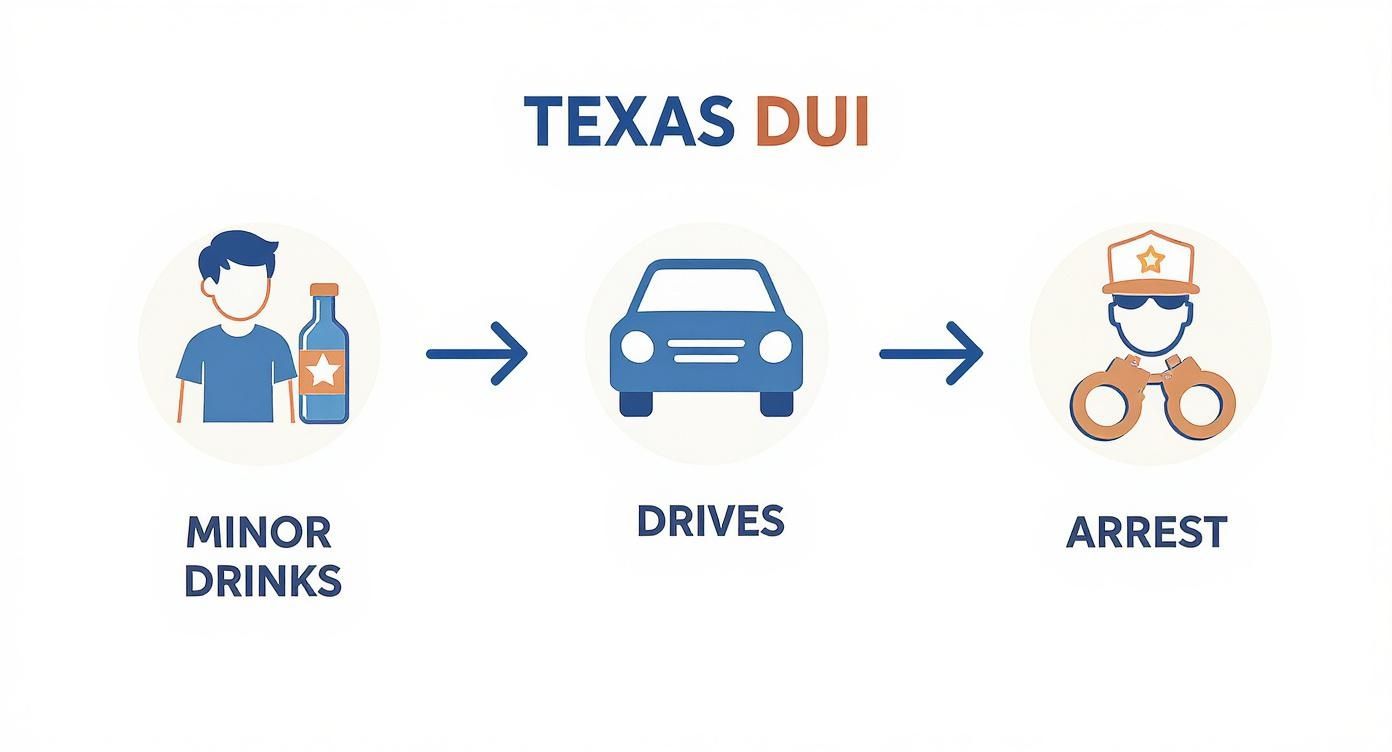
This visual is a good reminder of how a single bad decision can spiral into serious legal trouble, underscoring why it’s so important to address both the criminal charges and the DPS actions immediately.
How to Build a Strong DWI Defense Strategy

A DWI arrest in Texas can make you feel like the case is already over and the state has won. Nothing could be further from the truth. Here's a critical point to remember: an arrest is not a conviction. The state carries the entire burden of proving its case beyond a reasonable doubt, and a skilled defense attorney knows how to challenge their evidence from every possible angle.
Building a powerful defense is a meticulous process. It involves scrutinizing every detail of your arrest, from the second an officer first noticed your car until the moment you were booked into jail. Every step the officer took is governed by strict legal standards, and any misstep can become the cornerstone of your entire defense strategy.
Challenging the Initial Traffic Stop
The whole case against you rests on the legality of that initial traffic stop. An officer can't just pull you over on a hunch or because they "felt" something was off. They must have reasonable suspicion that you committed a specific traffic violation—something concrete, like speeding, running a stop sign, or weaving out of your lane.
If the officer can't clearly articulate a legitimate reason for the stop, any evidence gathered after that moment could be thrown out of court. This includes field sobriety tests, breath or blood results, and even their own observations. Attacking the stop is often the first and most effective way to dismantle the prosecution's case.
Scrutinizing Field Sobriety Tests
The Standardized Field Sobriety Tests (SFSTs) are notoriously subjective. They are incredibly difficult for anyone to perform perfectly, even when completely sober. Things like medical conditions, being tired, bad weather, or just plain nervousness can easily cause someone to "fail."
Your attorney will pull the dashcam and bodycam footage to see exactly how the officer administered those tests. They have to follow the National Highway Traffic Safety Administration (NHTSA) guidelines to the letter. Any improper instructions or incorrect scoring can make the results unreliable and give your lawyer grounds to get them suppressed.
Questioning Breath and Blood Test Results
Breath and blood tests might seem like hard science, but they are far from foolproof. The machines used for breath tests, like the Intoxilyzer 9000, need constant maintenance and precise calibration to work correctly. A good defense attorney will subpoena the machine's service records to hunt for a history of errors or malfunctions.
On top of that, problems with the blood draw itself or a breakdown in the chain of custody—the documented paper trail of everyone who handled the sample—can destroy the integrity of the evidence. If the sample was improperly stored or handled, its reliability is shot.
Texas tragically led the nation in drunk driving fatalities in 2019, with 1,332 deaths. In those incidents, 25% of drivers had a BAC over 0.15%, and drivers with alcohol in their system were four times more likely to have prior DWI convictions. To see more on these sobering statistics, you can read the full report here. These numbers often push prosecutors to be extra aggressive, making a strong, proactive defense more critical than ever. To dig deeper into specific defense tactics, you can also check out our guide on how to fight a DWI in Texas.
Tough Questions About Texas DWI and DUI Charges
When you're dealing with a DWI or DUI charge, the questions come fast and furious. The uncertainty can feel paralyzing, but getting straight answers is the first step toward taking back control. This section tackles some of the most urgent concerns we hear from clients every single day.
We're going to cut through the legal jargon and give you the practical insights you need to understand your rights and what comes next.
Should I Refuse a Breathalyzer or Blood Test?
This is one of the hardest and most immediate decisions you’ll ever have to make during a traffic stop. Here’s the catch: under Texas’s implied consent law, you’ve already agreed to provide a breath or blood sample just by getting behind the wheel on a public road.
Refusing the test isn't a get-out-of-jail-free card. The state will automatically suspend your license through the Administrative License Revocation (ALR) process for 180 days on a first refusal. However, refusing also denies the prosecutor their single best piece of evidence against you—that specific BAC number. It forces them to build their case on more subjective evidence, like the officer's observations or how you performed on field sobriety tests. This is a complex decision with significant consequences, and it's best discussed with an experienced Texas DWI attorney.
How Long Does a DWI Stay on My Record?
This is the one that shocks most people. In Texas, a DWI conviction stays on your criminal record forever. It doesn't just disappear after a few years. That permanent mark can create lifelong roadblocks, making it harder to get a job, secure a loan, or even rent an apartment.
This is exactly why fighting the charge from day one is so critical. A conviction isn't just about fines and probation; it's about protecting your future.
Can I Ever Get a DWI Off My Record?
While a conviction is permanent, there are a few narrow paths to clearing your name. If your case was dismissed, you were found not guilty at trial, or you completed a specific pre-trial diversion program, you might be eligible for an expunction. An expunction is the gold standard—it legally destroys all records of the arrest as if it never happened.
In other situations, you might qualify for an order of non-disclosure, which essentially seals the record from the public. This is often an option for first-time offenders who successfully finish probation after a deferred adjudication plea. Figuring out if you're eligible for either of these requires a close look at the specific facts of your case with a knowledgeable criminal defense lawyer.
If you’ve been charged with a crime in Texas, call The Law Office of Bryan Fagan, PLLC for a free and confidential consultation. Our defense team is ready to protect your rights. https://texascriminallawyer.net