Being arrested in Texas can be terrifying—but you don’t have to face it alone. An arrest can cast a long, dark shadow over your life, but it does not have to define your future. Many people ask us what it means to expunge a record in Texas, and the answer is simple but powerful: it means to legally and permanently destroy it. This isn't just hiding something away; it's a court-ordered process to wipe the slate clean, removing the arrest from public view as if it never even happened.
This is a critical distinction. An expunction offers a true fresh start, a legal tool far more powerful than record sealing, which merely limits who can see your record.

Your Path to a Clean Slate in Texas
Being arrested is a disorienting, often terrifying experience. What's worse is that the mark it leaves can follow you for years. Even if your case was dismissed or you were found not guilty, the record of that arrest lingers. It can pop up on background checks, creating serious roadblocks when you’re applying for a job, trying to rent an apartment, or pursuing your education.
This is precisely where the power of a Texas expunction comes into play.
An expunction is more than just a piece of paper; it’s a court order compelling every agency involved—from the police department to the prosecutor's office—to destroy all files and documents tied to your arrest. It is, without a doubt, the most complete form of record clearing available under Texas law.
Understanding the Real-World Impact of a Clean Record
Imagine walking into a job interview without that knot in your stomach, confident that an old arrest won't sabotage your chances. An expunction makes that a reality. Once a judge grants your petition, you can legally and honestly deny that the arrest ever occurred. It’s a genuine fresh start that restores your peace of mind.
The benefits are immediate and life-changing:
- Better Job Prospects: You can pass employment background checks without the stigma of a past arrest holding you back.
- More Housing Opportunities: Landlords are far less likely to deny your rental application over a criminal record that no longer exists.
- Professional Licensing: Overcome hurdles when applying for or renewing professional licenses in fields like nursing, teaching, or real estate.
- Personal Freedom: Finally move forward without the constant anxiety that your past will be discovered.
An expunction doesn't just clear your name—it completely erases the event from your public record. It grants you the legal right to say the arrest never happened, freeing you from a past that, in the eyes of the law, no longer exists.
Community initiatives across Texas underscore just how vital this relief is. Take the "Fresh Start" program in Harris County, which helps everyday people navigate this exact process. At a recent event, they screened 300 individuals and found that a staggering 75% were eligible for some form of record clearing. This shows just how many Texans can benefit when they get access to these important legal tools.
Of course, navigating the legal requirements to expunge a record in Texas can feel overwhelming. Understanding your eligibility and the specific steps involved is the first, most critical move toward reclaiming your future.
Do You Qualify for an Expunction in Texas?
Figuring out if you’re eligible to expunge a record in Texas is the absolute first step, and it’s the most important one. The rules are spelled out in the Texas Code of Criminal Procedure, but you don’t need a law degree to understand the basics. At its heart, an expunction is reserved for cases where the justice system ultimately found you were not at fault.
Think of it this way: an expunction is the law’s way of saying an arrest shouldn't follow you for life when the case went nowhere or you were cleared of wrongdoing. It's for arrests that never turned into a conviction.
The Most Common Paths to Expunction
Your eligibility is tied directly to how your criminal case ended. While every situation has its own unique details, most people who qualify for an expunction find their case fits into one of these common scenarios.
You most likely qualify for an expunction if:
- You Were Arrested but Never Formally Charged. This happens frequently. If a prosecutor reviewed your case after an arrest and decided not to file charges, you have a strong chance at expunction once the waiting period—the statute of limitations—is over.
- Your Case Was Dismissed. This is another major category. If the prosecutor dropped the charges against you for any reason, like lack of evidence or a key witness changing their story, your record can likely be wiped clean.
- You Were Found Not Guilty at Trial. An acquittal is the clearest path forward. Whether a judge or a jury found you "not guilty," you were proven innocent in court, and the law agrees your record should reflect that.
- You Received a Pardon. While less common, if you were convicted and later received a pardon from the Governor of Texas or the U.S. President, that conviction becomes eligible for destruction.
These are the main routes to a clean slate. For a closer look at the specific waiting periods and other details, you can learn more about Texas expungement law and eligibility on our site.
Expunction vs. Record Sealing: What's Right for You?
One of the biggest points of confusion for people is the difference between an expunction and an order of nondisclosure, which is what most people call "record sealing." They are not the same thing, and knowing which one applies to your case is critical. An expunction destroys the record. Record sealing just hides it from the public.
Let’s walk through a real-world example. Imagine you were arrested for shoplifting, a Class B misdemeanor. The prosecutor reviews the file and decides to dismiss the case entirely. Because the case was dismissed without any kind of probation or plea deal, you would almost certainly qualify for a full expunction after the required waiting period.
Now, let's change the scenario. Say you were arrested for a first-time DWI and you successfully completed deferred adjudication probation. Because you had to plead "guilty" or "no contest" to get that deferred deal, you are not eligible for an expunction. But the good news is you would likely be eligible to have your record sealed with an order of nondisclosure.
The key takeaway is this: Deferred adjudication probation, a common outcome for many first-time offenses, will prevent you from getting an expunction. It typically leads to record sealing instead.
To make it even clearer, let’s break down the fundamental differences between the two legal remedies.
| Feature | Expunction (Record Destruction) | Order of Nondisclosure (Record Sealing) |
|---|---|---|
| Case Outcome | Arrested but not charged, case dismissed, acquitted at trial, or pardoned. | Successfully completed deferred adjudication probation for a qualifying offense. |
| What Happens to the Record? | All records related to the arrest are physically destroyed by all agencies. | Records are sealed and hidden from the public, but law enforcement and certain state agencies can still see them. |
| Legal Right to Deny | You can legally deny the arrest ever occurred in almost all circumstances. | You generally do not have to disclose the arrest on job or housing applications, but there are more exceptions. |
| Typical Offenses | Applies to any level of offense (misdemeanor or felony) as long as the outcome qualifies. | Limited to certain offenses; many serious felonies and offenses involving family violence are not eligible. |
Understanding these distinctions is the first step toward getting your life back on track. An expunction is the gold standard, offering the most complete relief possible. However, an order of nondisclosure is still an incredibly powerful tool for those who qualify. A skilled attorney can look at your case history and give you straight advice on the best path forward for you.
Navigating the Texas Expunction Process
Once you’ve confirmed you're likely eligible, it’s time to start the formal legal process to expunge your record in Texas. Think of it as filing a civil lawsuit against the State of Texas, where the end goal is a court order forcing government agencies to destroy every last trace of your arrest.
This isn’t something you can handle casually. Filing for an expunction is a precise, multi-step journey. A single mistake—like a missed deadline, an incomplete form, or failing to notify the right agency—can get your case denied, forcing you to start all over again.
Gathering Your Essential Documents
Before any paperwork is filed with the court, you have to do your homework. That means collecting all the necessary documents that form the foundation of a successful petition. Missing information here can cause serious delays later.
You'll need to pull together:
- A Complete Copy of Your Criminal History: This provides the full picture and helps confirm the exact details of the arrest you want erased.
- Arrest Records and Offense Reports: These documents come from the arresting police department and contain crucial facts like the date, time, location, and the specific offense.
- The Final Disposition of Your Case: This is perhaps the single most important document. It's the official court record proving your case was dismissed, you were acquitted, or that charges were never formally filed.
With these documents in hand, your attorney can draft an accurate and legally solid Petition for Expunction. This is the formal legal document that officially begins the process.
The path to eligibility can feel complicated, but this chart breaks it down simply.
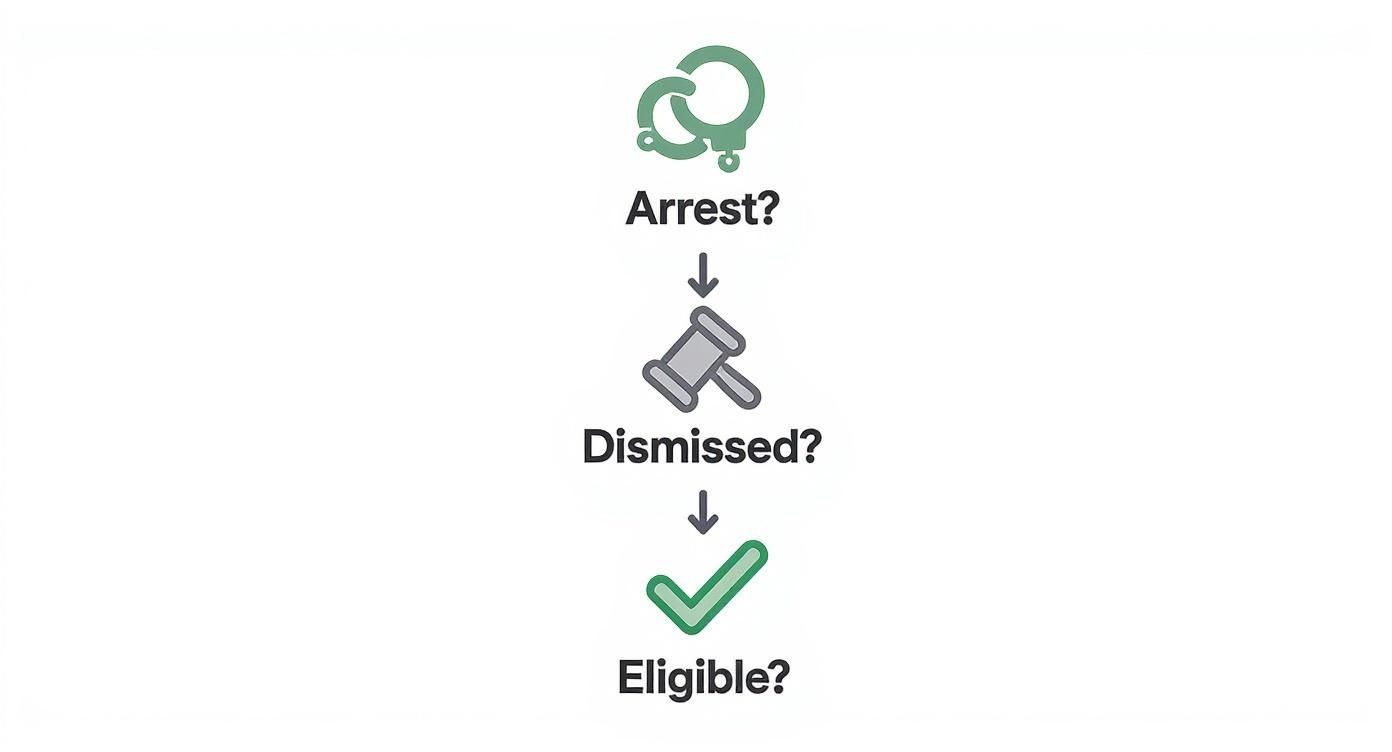
As you can see, an arrest that ends in a dismissal is often the most direct route to qualifying for an expunction.
Filing the Petition and Notifying Agencies
Once the petition is drafted, it must be filed in the right court—almost always the district court in the county where the arrest happened. This involves more than just dropping off a form; it requires paying a filing fee and getting a case number assigned.
After filing, the next critical phase begins: serving notice. Every single government agency that might have a record of your arrest must be formally notified that you've filed a petition to have it destroyed.
A common and costly mistake is failing to identify and serve every required agency. If even one entity is missed, your expunction could be deemed invalid later on.
This list of agencies is often longer than people realize and can include:
- The District Attorney or County Attorney’s office that handled the original case.
- The arresting law enforcement agency (like the Houston Police Department or Travis County Sheriff's Office).
- The Texas Department of Public Safety (DPS).
- Any other local or municipal agencies that might have copies of your records.
These agencies get a specific amount of time, typically 30 days, to review your petition and decide if they want to object. An objection is rare if you clearly meet the eligibility requirements, but it can happen. This is exactly why having an experienced attorney is so valuable—we can anticipate potential objections and be ready to argue on your behalf at a hearing if needed.
What to Expect During the Process
The timeline for an expunction can vary quite a bit depending on the county and how complex the case is. Once the petition is filed and all agencies are served, the court might schedule a hearing. However, in many straightforward cases where nobody objects, a hearing may not even be necessary. The judge can simply review the petition and sign the Final Order of Expunction.
That order is the legal document that makes your fresh start official. It directs every single agency to physically destroy their records of your arrest. Once signed, the court clerk sends a certified copy of the order to each agency you listed in your petition.
It’s important to have realistic expectations. The whole process, from filing the petition to getting that final signed order, often takes several months. For a detailed breakdown of what to expect, check out our guide on the Texas expungement process timeline.
Recent data shows just how many Texans are successfully using this legal tool. Between September 2018 and February 2025, Dallas County alone processed 9,555 expungements. The numbers jumped significantly in 2021, when 2,782 records were cleared, highlighting how vital expunction is for overcoming the long-term consequences of a criminal record.
Texas Expungement Laws Aren't Set in Stone
The laws that govern who can and can't expunge a record in Texas are constantly evolving. The Texas Legislature meets regularly to update the Code of Criminal Procedure, and sometimes, those updates create brand-new opportunities for people who were previously told they had no options for a second chance.
Keeping up with these changes is a crucial part of our job. A small change in the law could be the key needed to unlock a clean record for you.
When lawmakers decide to expand eligibility or make the process less complicated, it has a direct impact on our clients' futures. It can open doors that have been slammed shut for years.
Who Qualifies Now? More People Than Ever Before
One of the biggest recent developments is the expansion of eligibility for both expunctions and record sealing (nondisclosure). There's a growing recognition that a past mistake, especially a minor, non-violent one, shouldn't turn into a life sentence of blocked opportunities. These reforms are all about making relief more accessible for everyday Texans.
For example, in 2025, Texas passed several key updates that broadened access to expungement. The new laws expanded the kinds of misdemeanor offenses that can be cleared and even created paths for sealing certain non-violent felonies under specific circumstances. To get a better sense of how these legislative changes work, you can read about the recent changes to Texas criminal record expungement and see if they apply to your situation.
The Move Toward "Automatic" Expunctions
Perhaps the most significant change we've seen is the introduction of so-called "automatic" expunctions for certain cases. In the past, the burden was always on you to file a formal petition—even if your case was dismissed or you were found not guilty at trial. This meant many eligible people never got their records cleared simply because they didn't know how or couldn't afford the process.
The new framework is designed to fix that system. Now, certain cases that end in a dismissal or an acquittal can be automatically cleared without you having to file a formal lawsuit. This streamlines everything, ensuring that a clear-cut case of innocence or dropped charges actually results in a clean record by default.
Here’s what makes these automatic expunctions so important:
- Less Work for You: In many cases, you may not need to file a civil lawsuit to get your record wiped clean.
- Quicker Relief: The process can move much faster without the need for formal court hearings.
- Broader Access: It ensures that more Texans who are entitled to relief under the law actually receive it.
This shift toward automatic relief is a true game-changer. It’s a practical acknowledgment that if the justice system decides not to pursue a case against you, the record of that interaction shouldn't follow you around forever. It’s simply a more just and efficient way to handle second chances.
Making a Clean Slate More Accessible for Everyone
Beyond just expanding who qualifies, recent reforms have also targeted the practical hurdles that keep people from clearing their records. This includes tackling the costs. Lawmakers have started looking at filing fees and creating more straightforward ways for people facing financial hardship to get fee waivers.
The ultimate goal is to make sure a person's ability to get a fresh start isn't dictated by their income. By making the process more affordable and less complex, Texas is taking real steps to help people move on after a brush with the law. If you looked into an expunction before and thought it was out of reach, it might be time to take another look.
Why an Attorney Is Your Strongest Ally

Technically, you can file the paperwork to expunge a record in Texas on your own. But it’s a move loaded with risk. The legal system demands absolute precision, and when it comes to expunctions, there is zero room for error.
One small mistake on your petition or one missed deadline, and the court can deny your request outright. That forces you to start the entire process over again, wasting valuable time and money. It’s a painful lesson many learn the hard way.
An experienced criminal defense attorney acts as your guide, navigating the complex rules of the Texas Code of Criminal Procedure with the skill and care your future deserves.
Avoiding Costly and Common Pitfalls
Filing for an expunction isn’t just about filling out forms. It’s a formal civil lawsuit against the State of Texas, and every step must be perfect. People who try to go it alone often fall into common traps that a seasoned attorney knows how to avoid.
Some of the most frequent mistakes include:
- Incorrectly Identifying and Notifying Agencies: You must formally serve every single government agency that has a copy of your arrest record. If you miss just one, the entire expunction can be invalidated.
- Errors in the Petition: The legal language in a Petition for Expunction must be exact. A simple mistake in how you list the offense, the dates, or the case outcome can get your case thrown out.
- Misunderstanding Eligibility Rules: The laws are tricky. You might think you qualify for an expunction when you actually need a nondisclosure, or you might not have met the strict waiting period. These mistakes will stop your case before it even starts.
An attorney from The Law Office of Bryan Fagan, PLLC, starts by doing a deep dive into your case history to confirm your eligibility beyond a shadow of a doubt. We then draft the petition meticulously, making sure it’s legally airtight and factually flawless. We know exactly which agencies to notify and handle all the legal communication for you.
Having a legal professional manage your case isn't just about convenience; it's about maximizing your chances of success. A clean, professionally prepared petition signals to the court and opposing counsel that your request is serious and legally valid.
Advocating for You When It Matters Most
What happens if a prosecutor or a law enforcement agency objects to your expunction? It’s rare in straightforward cases, but objections do happen. If one is filed, the court will schedule a formal hearing where you’ll have to argue why your record deserves to be destroyed.
This is where having an attorney becomes indispensable. We will stand up for you in court, presenting the legal arguments and evidence needed to overcome the objection and convince the judge to grant your petition. Trying to take on a seasoned government lawyer in a contested hearing is a battle you should never have to face alone.
Choosing the right advocate is one of the most important decisions you'll make. For more on what to look for, you can learn about how to choose a criminal defense attorney who truly fits your needs. Our team handles the entire process, from the initial analysis to the final signed order, so you can focus on your future while we get to work securing your clean slate.
Common Questions About Texas Expunctions
Trying to navigate the legal system can feel overwhelming, especially when you’re just trying to move on with your life. You deserve clear, straightforward answers. Here are the answers to some of the most common questions we hear from people looking to expunge a record in Texas.
How Long Does the Expunction Process Take in Texas?
This is usually the first thing everyone asks, and the honest answer is: it depends. There’s no exact timeline, but most expunction cases take somewhere between three to six months from the day we file the petition until a judge signs the final order. The biggest factors are the court’s caseload in that county and how quickly the government agencies involved respond.
The timeline usually unfolds in a few key phases:
- Filing the Petition: First, your attorney will draft and file all the necessary legal documents in the correct district court.
- Waiting for a Response: Once served, every agency involved gets at least 30 days to respond or raise an objection.
- Setting a Hearing: If nobody objects, a hearing might not even be necessary. But if an agency does object, a court date will be scheduled, which can add several weeks to the process.
- Getting the Final Order: After the judge grants the expunction, they sign the Final Order of Expunction.
- Scrubbing the Records: It doesn't end there. It can take several more months for that order to make its way to all the state and local agencies so they can completely destroy your records from their systems.
Hiring an experienced attorney helps keep the process moving efficiently. We make sure the paperwork is perfect from the start and are ready to respond to any court requests to avoid unnecessary delays.
Is a Case Dismissal the Same as an Expunction?
No, and this is a critical point that trips up many people. Getting your case dismissed is a fantastic outcome—it means the prosecutor dropped the charges. But a dismissal does not automatically wipe the arrest from your record.
The record of the arrest itself—the mugshot, the fingerprint card, the police report—still exists and will absolutely show up on a background check. It will simply show that the case was later dismissed.
Think of it this way: a dismissal is what makes you eligible for an expunction. But you still have to take the next step. An expunction is a completely separate civil lawsuit you file after the dismissal to get a court order forcing all agencies to destroy the arrest records for good.
Can I Say I Have Never Been Arrested After an Expunction?
Yes. This is the single most powerful benefit of getting an expunction. Under Texas Code of Criminal Procedure Article 55.03, once a judge signs that expunction order, you are legally allowed to deny the arrest ever happened. You can even deny the existence of the expunction itself.
So, when you're filling out an application for a job, an apartment, or a professional license, and you see that dreaded question, "Have you ever been arrested?" you can legally and truthfully check "no."
There are a few very rare exceptions, like if you're testifying as a witness in a separate criminal trial. But for all practical purposes in your day-to-day life, the law treats the arrest as if it never occurred.
What Is the Average Cost to Expunge a Record in Texas?
The total cost is an investment in your future, and it’s typically broken down into three parts: court filing fees, service fees, and attorney fees.
- Court Filing Fees: This is what the court charges just to file the lawsuit. It usually runs between $300 and $500, depending on the county.
- Service Fees: Every government agency involved has to be formally served with the lawsuit. The cost for a process server or certified mail can add up.
- Attorney Fees: This covers the legal expertise to draft the petition correctly, deal with the agencies, and see your case through to the end. The fee will depend on the complexity of your situation. A single arrest in one county is much more straightforward than clearing up multiple arrests in different jurisdictions.
While there's an upfront cost, the long-term return on investment is often immeasurable. A clean slate opens doors to better jobs, higher earning potential, and the kind of peace of mind you can't put a price on.
If you’ve been charged with a crime in Texas, call The Law Office of Bryan Fagan, PLLC for a free and confidential consultation. Our defense team is ready to protect your rights. https://texascriminallawyer.net