Being arrested in Texas can be terrifying. Even if your case was dismissed, even if you were never convicted, that record can still keep showing up when you apply for a job, an apartment, or a professional license in Dallas.
You may be reading this after a background check cost you an opportunity you thought was yours. Maybe it was a DWI arrest that never led to a conviction. Maybe it was a theft case that got dismissed. Maybe you completed deferred adjudication and now you're trying to figure out whether you can finally move forward. The good news is that Texas law gives many people a path toward a cleaner record. The hard part is knowing which path fits your case.
A Past Mistake Should Not Define Your Future
A lot of people start looking for an expungement lawyer dallas tx after a frustrating moment that feels unfair. You answer every interview question candidly, explain that your case was dismissed, and still get silence. Or you find the perfect apartment in Uptown, pass every screening except the background check, and the old arrest comes back to haunt you.
That kind of stress is real. It also doesn't mean you're stuck forever.

Dallas has a large and active market for record-clearing help. According to Avvo's Dallas expungement attorney listings, 53 specialized expungement attorneys serve the area, backed by 1,198 client reviews. That matters for one simple reason. You are not the only person in Dallas trying to fix an old record and get a fair shot.
Two different tools can help
Texas gives you two main forms of relief:
- Expunction
- Order of nondisclosure
People often use those terms as if they mean the same thing. They don't. One can completely erase qualifying records. The other can seal records from public view while still allowing certain government agencies to see them.
If you've dealt with charges involving DWI, assault, theft, or drug possession, this difference matters. It can affect how you answer job applications, what employers can see, and whether licensing boards have access to your file.
Practical rule: A dismissed case doesn't automatically disappear in Texas. You usually have to ask a court for relief.
Why this matters beyond embarrassment
A criminal record isn't just a legal issue. It's a life issue.
It can affect:
- Employment opportunities when a company runs a standard background check
- Housing applications with private landlords or apartment complexes
- Professional licensing in fields that review criminal history
- Peace of mind when you worry every old record search will bring the past back again
Texas law offers a way forward, but the details matter. What happened at arrest isn't the whole story. What matters most is how the case ended, whether there was a conviction, and whether your outcome fits the rules in the Texas Code of Criminal Procedure.
Expunction vs Nondisclosure What is the Difference
If you've been searching online, you've probably seen both words over and over. The easiest way to think about them is this:
An expunction is like shredding a document so it no longer exists for public and government record purposes tied to the order. An order of nondisclosure is like putting that document in a locked safe. Most of the public can't see it, but some agencies still can.
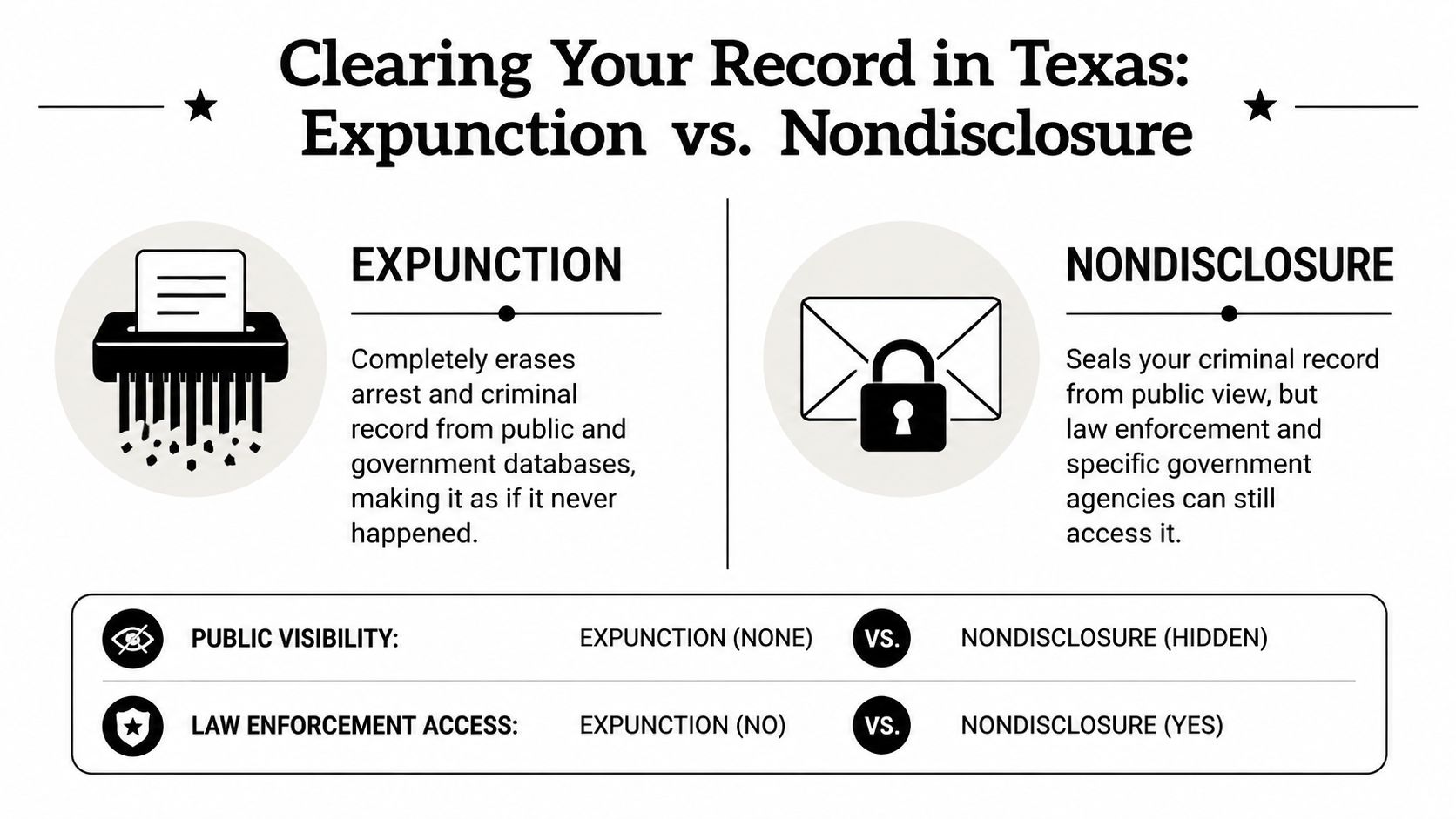
What expunction does
Under Texas law, expunction is the stronger remedy. It applies only in specific situations, usually when the case did not result in a conviction. Texas law on expunction comes from Article 55.01 and related procedures in Chapter 55 of the Texas Code of Criminal Procedure.
When a court grants an expunction, the goal is to remove the qualifying arrest and case records from public and government databases covered by the order. In many situations, you can legally deny that the arrest happened.
This is why people with dismissed DWI charges, no-billed felony cases, or acquittals often ask whether they qualify.
What nondisclosure does
Nondisclosure is different. It doesn't destroy the record. It seals it from the public.
That means private employers, landlords, and many ordinary background checks may no longer see it. But law enforcement and certain government bodies can still access it. Nondisclosure often comes up after deferred adjudication, which is a form of probation where the judge delays a finding of guilt if you successfully complete the terms.
For many Texans, especially those who don't qualify for expunction, nondisclosure is the practical way to regain privacy.
Texas Expunction vs Nondisclosure at a Glance
| Feature | Expunction (Record Destruction) | Order of Nondisclosure (Record Sealing) |
|---|---|---|
| Basic effect | Erases qualifying records | Seals qualifying records from public view |
| Public access | Public shouldn't see the record | Public generally can't see the record |
| Government access | Agencies covered by the order must remove records | Certain agencies may still access the record |
| Typical case outcome | Dismissal, acquittal, no-bill, some other qualifying non-conviction outcomes | Often tied to successful deferred adjudication |
| What you may say later | In many situations, you can deny the arrest occurred | You may still need to disclose it in some settings |
| Who should ask about it | People whose case ended without conviction | People who completed deferred adjudication and want records sealed |
For a deeper side-by-side discussion, see this guide on Texas expungement vs. nondisclosure.
A lot of confusion starts when someone finishes probation and assumes the record is gone. In Texas, completing probation often means you need to ask whether nondisclosure is available, not expunction.
Why people mix them up
The confusion usually comes from three places:
Same goal, different tools
Both aim to help you move on, but they work in different ways.Similar language online
Many websites use “clear your record” as a broad phrase even when the legal result is only sealing.Deferred adjudication confusion
People hear “case dismissed after probation” and assume that's the same as a full erasure. Usually it isn't.
If you remember only one thing, remember this. Expunction destroys. Nondisclosure hides.
Are You Eligible for a Clean Slate in Texas
A Dallas nurse applies for a new job, or a software engineer renews a professional license, and an old arrest appears on a background check even though the case never ended in a conviction. That is often the moment people start asking the right question. Do I qualify to clear this record under Texas law?
Eligibility turns on the legal ending of the case, not on how stressful the arrest was or how long ago it happened. In Texas, expunction is available only in specific situations. The law is narrower than many people expect, which is why a careful review of the final paperwork matters so much.

Start with the final outcome
The simplest way to understand eligibility is to treat the case outcome like a fork in the road. One path may lead to expunction. Another may lead only to nondisclosure. A third may not allow either form of relief yet.
These are the first questions I would want a Dallas client to answer:
Was your case dismissed?
A dismissal can support expunction, but the reason for the dismissal and the surrounding facts still matter.Did a grand jury no-bill your case?
If no indictment was returned, that may support eligibility.Were you found not guilty at trial?
An acquittal often supports expunction.Did you complete deferred adjudication?
Here, the path often changes. Deferred adjudication usually points toward nondisclosure rather than full expunction.
If you want a fuller case-by-case explanation, this guide on Texas expungement eligibility under current law gives a useful starting point.
Deferred adjudication causes the most confusion
This is the part that trips up many people in Dallas. They hear that the case was "dismissed after probation" and assume the record disappears. In many Texas cases, that is not how the law works.
Deferred adjudication often functions like a conditional second chance, not a legal eraser. You completed the court's requirements, which is important. But for record-clearing purposes, Texas often treats that result as a possible fit for sealing through nondisclosure, not destroying the record through expunction.
That issue comes up often in cases involving:
- DWI-related allegations if the resolution does not qualify for full expunction
- Theft and shoplifting charges resolved through deferred adjudication
- Drug possession cases that ended with community supervision instead of a qualifying dismissal
- Assault allegations where eligibility depends heavily on the exact charge and final disposition
The charge itself also matters because the way a case is resolved at the beginning can shape record-clearing options later. A strong defense result can preserve better options. A plea structure that sounds favorable in the moment may limit what can be cleared years later.
Here is a helpful walkthrough if you'd rather hear the issue explained out loud:
Why eligibility matters in real life
For Dallas residents, this is not just about paperwork. A record that qualifies for expunction can affect job applications, housing screenings, and professional licensing reviews. That is especially true in fields such as healthcare, education, finance, transportation, and jobs that require state credentials or routine background checks.
Post-2025 changes in Texas record-clearing law have made timing and case classification even more important in some situations. Small details can change whether someone qualifies now, must wait, or should pursue nondisclosure instead. Dallas professionals often come in believing they have no option, when the actual problem is that they have been looking at the wrong form of relief.
Private background check companies can also create confusion. Even after relief is granted, old information may still need to be corrected with screening companies or reporting agencies. That follow-up issue does not mean the court order failed. It means the legal relief and the reporting cleanup are sometimes two separate tasks.
If an old case still appears after relief is granted, the next question may be how to correct reporting errors, not whether you were eligible in the first place.
What if you're still not sure
That is normal.
Court records use words that sound familiar but carry very different legal meanings. "Dismissed," "probation," "time served," and "deferred adjudication" can lead to very different outcomes under Texas law. One word on a judgment or docket sheet can change the answer.
A lawyer usually starts by reading the arrest information, the charging documents, and the final disposition together. That approach replaces guesswork with a clear answer about whether expunction is available, whether nondisclosure is the better fit, or whether another step has to happen first.
The Texas Expungement Process Step-by-Step
The process sounds straightforward when someone summarizes it in one sentence. In real life, it involves court records, agency notice, filing rules, and patience.
In Texas, expunction doesn't happen automatically. You must file for it.
Step one means gathering the right records
Start with the documents tied to the arrest and case outcome. That may include the cause number, court records, arrest date, arresting agency, and the final disposition showing what happened.
Expunction orders must identify the right agencies and the right event, as a small error at the beginning can slow everything down later.

Step two is filing the petition in the correct court
A formal Petition for Expunction is filed in the proper court. The petition has to identify the case clearly and explain why you qualify under Article 55.01.
According to Patrick J. McLain's discussion of Texas expunction timing and eligibility, the Texas expungement process typically takes three to six months from the date the petition is filed, and eligibility for full expunction is strictly defined under Article 55.01, primarily for cases that did not result in a conviction.
For a closer look at timing, see this guide on how long expungement takes in Texas.
Step three requires notice to multiple agencies
This is the part many people underestimate. An expunction petition must go to all of the agencies that may hold records connected to your case.
That can include:
- The prosecutor's office that handled the charge
- The arresting law enforcement agency such as a city police department or sheriff's office
- State record holders such as the Texas Department of Public Safety
- Other agencies listed in the petition if they may have records tied to the event
Each one needs proper notice because the judge's order is meant to reach every place where the record lives.
Step four is waiting for responses and a hearing
After filing and service, the case usually sits for a period while agencies review the petition and decide whether to object. Some cases move smoothly. Others draw questions about eligibility, dates, or whether the petition names the right parties.
A hearing may be required. In that hearing, the judge looks at whether your case meets the statute.
Courts don't grant expunctions because a record feels unfair. They grant them when the petition fits the statute and procedure.
Step five is the court hearing
Hearings are often brief, but they matter. If the state objects, you may need to address why the dismissal qualifies, whether waiting periods were met, or whether the arrest and case information are accurate.
At this stage, details matter more than emotion. Judges want clear records, accurate law, and a clean paper trail.
Step six is follow-through after the order
Winning the order is not the end. Agencies still have to act on it.
A proper expunction order tells agencies to destroy or remove covered records. After that, it may still take time before background systems reflect the change. If a private screening company continues reporting the record, you may need to dispute the report separately.
What people should expect emotionally
Many people think filing the petition will bring instant relief. It usually doesn't. There is paperwork, waiting, and often a period where the old record still appears.
That can feel discouraging, but it's normal. The process has moving parts, and each one has to be handled correctly.
How a Dallas Expungement Lawyer Maximizes Your Success
A lot of legal problems don't come from bad facts. They come from avoidable mistakes.
Expunction is one of those areas. You can have a case that qualifies and still get denied because the paperwork, service, or filing details were wrong.
Procedure can sink a good case
Dallas expunction practice is technical. The petition must identify the right agencies, use the correct case information, and meet the court's procedural rules. If any part is off, the state can object or the court can deny the request.
According to MC Criminal Law's discussion of Dallas expunction procedure, improperly serving the required government agencies causes an estimated 25% of initial expungement denials in Dallas County, while law firms that follow the procedure carefully can achieve approval rates of 90% or higher for eligible cases.
That's a big difference, and it shows why legal help matters.
What lawyers do that self-filed petitions often miss
A skilled lawyer doesn't just “fill out forms.” Good representation usually includes several layers of protection.
Eligibility analysis
Lawyers look at the exact disposition, not just your memory of the case. That matters if your charge was dismissed after a waiting period, no-billed, or resolved through deferred adjudication.Agency mapping
A lawyer identifies every government entity that should receive notice so the order reaches the full record trail.Petition drafting
The petition needs to match the facts and the statute. Sloppy drafting invites objections.Hearing preparation
If the state pushes back, your lawyer can explain why the case qualifies and answer legal concerns in court.Post-order follow-up
Even after the judge signs the order, someone should track whether agencies comply and whether old records still surface.
Why legal strategy starts before expunction
This is easy to miss. The best expunction cases often begin with strong criminal defense at the start of the case.
If you're currently facing charges for DWI, assault, theft, or drug possession, what happens now can shape your options later. A dismissal can create a path to expunction. A deferred adjudication outcome may create a path to nondisclosure. A conviction can sharply limit your relief.
That means your defense decisions during arrest, arraignment, plea bargaining, trial, and sentencing all matter.
Here is how those stages usually connect:
| Stage | Why it matters for your future record |
|---|---|
| After arrest | Statements, bond conditions, and early case strategy can affect the whole case |
| Arraignment or first court appearance | Charges are clarified and your defense starts taking shape |
| Plea negotiations | A negotiated dismissal or deferred outcome can change future eligibility |
| Trial | A not-guilty result may support expunction |
| Sentencing or probation terms | The final judgment often determines whether expunction or nondisclosure is possible |
The clean-record strategy often begins the day the criminal case begins, not the day you start searching for expungement.
Why this matters for professionals and first-time offenders
First-time offenders often assume the system will “clear things up” once they stay out of trouble. It usually doesn't. Employers, landlords, and licensing boards often care less about your explanation than they do about what their screen shows.
A lawyer's job is to make sure the legal record says what it should say, and then to use the right remedy to reduce or remove the damage.
Recent Changes to Texas Expungement and Nondisclosure Laws
Texas record-clearing law doesn't stand still. That creates opportunity for some people and confusion for many others.
If you looked into expunction or nondisclosure a while ago and were told to wait, it may be worth revisiting your case under newer rules.
Why recent law changes matter
A key change discussed in Dallas-area legal analysis is a 2025 legislative change identified as HB 134. According to this review of recent Texas expungement developments, that change shortened waiting periods for certain misdemeanor deferred adjudications, and Dallas County saw a 28% increase in approved petitions as more residents became eligible sooner.
That kind of update can change legal strategy in a real way.
The practical effect for Dallas residents
For many people, newer law changes may do one of two things:
Open earlier access to relief
Someone who previously had to wait longer may now be able to file sooner.Make nondisclosure the better option
In some misdemeanor cases, sealing the record may be more realistic than seeking full expunction.
This is especially important if your case involved a lower-level offense and successful completion of deferred adjudication. Rules tied to waiting periods and eligibility can shift over time, and old advice may no longer be current.
Why old internet advice causes problems
A lot of online content about expungement was written before newer legislative developments. That's risky because Texas relief statutes are highly technical. A small statutory change can affect whether someone qualifies now, whether they qualify later, or whether they should ask for a different form of relief entirely.
If your case is from years ago, that doesn't mean you're out of luck. It means your file should be reviewed under current law, not under assumptions from the past.
A person can be ineligible one year and eligible later because the law changed or the waiting period passed.
Keep your expectations grounded
Not every law change means every old record can disappear. Texas still keeps expunction narrow, and many outcomes still point toward nondisclosure instead. But staying current matters. The best answer is always tied to the present version of the statute and the exact way your case ended.
Your Checklist for a Fresh Start and Next Steps
By now, the big picture should be clearer. A criminal record in Dallas doesn't vanish on its own, but many people do have a way to reduce or erase the damage.
The right first step is not guessing. It's getting organized.
Your practical checklist
Find your final court paperwork
You need the actual disposition, not just your memory of what happened.Write down the basic case details
Include the arrest date, charge, county, and arresting agency if you know them.Figure out how the case ended
Dismissed, no-billed, acquitted, deferred adjudication, conviction, and probation all lead to different outcomes.Check whether your issue is expunction or nondisclosure
If the case did not end in conviction, expunction may be possible. If you completed deferred adjudication, nondisclosure may be the better fit.Think about your real-world goal
Are you trying to pass an employment screen, protect a professional license, qualify for housing, or all of the above? Your goal helps shape the strategy.Don't ignore active criminal charges
If you're still facing a DWI, assault, theft, or drug possession case, your future record-clearing options may depend on what happens next in that case.
A final word of reassurance
People often wait too long because they feel embarrassed, overwhelmed, or confused by legal language. That's understandable. But this process is manageable when you get clear answers tied to your actual case.
A past arrest doesn't always have to control your future. Texas law gives many people a second chance. The key is using the right legal remedy, at the right time, with the right paperwork.
If you’ve been charged with a crime in Texas, call Law Office of Bryan Fagan PLLC for a free and confidential consultation. Our defense team is ready to protect your rights.