Being convicted in Texas can feel like the floor dropped out from under you. One day you're trying to survive court dates, jail calls, and paperwork. The next, you're asking harder questions. Can my loved one get out early? Can this record ever stop following us? Is there any real second chance?
For many families, the worst part is not knowing where to start. That confusion is common. Texas Defender Service notes that a major problem in Texas is the lack of practical guidance for parole packets, even though about half of the prison population is parole-eligible. Rules exist, but step-by-step help often doesn't.
That gap matters if you're trying to understand pardon and parole texas options. Parole and pardon sound similar, but they are very different. One may allow someone to serve the rest of a sentence in the community under supervision. The other is a request for official forgiveness from the state. Both can affect a person's future, but they don't work the same way, and they don't fit the same cases.
If you're reading this after a DWI, assault, theft, drug possession, robbery, or another Texas conviction, you need plain language, not legal fog. You also need practical steps. Families often lose time because they focus on rumors, outdated advice, or forms that don't answer the essential question, which is what helps.
This guide is built for that moment. It explains how Texas parole works, how pardons differ, what the Board looks at, what families can do now, and what life may look like after release. It also places these issues in the larger Texas criminal process, because post-conviction relief makes more sense when you understand how you got here in the first place.
Your Guide Through the Texas Justice System
You often don't start learning criminal procedure until forced to. Maybe you were arrested for DWI after a traffic stop. Maybe a family argument led to an assault charge. Maybe a drug possession case started with a search you still don't think was fair. At first, everything revolves around the front end of the case.
That front end usually follows a familiar path. There is an arrest, booking, and a bail decision. Then comes arraignment or the first court appearance, plea discussions, possible motions, and either a negotiated resolution or trial. If the case ends in a conviction, sentencing follows. That's when post-conviction questions become urgent.
The road from arrest to post-conviction relief
Texas criminal cases often move through these stages:
Arrest and booking
Police take you into custody, gather identifying information, and list charges. In a DWI or drug case, this may also involve testing, property seizure, or bond conditions.First appearance and bond issues
The court addresses release conditions. Some people can go home while the case is pending. Others remain in custody.Plea bargaining or trial preparation
Many cases resolve through a plea agreement. Others go to trial if the facts, defenses, or penalties make that the better choice.Sentencing
A sentence may include jail, prison, probation, fines, treatment, or other conditions. For prison cases, questions about parole may start here.Post-conviction options
Depending on the case, this might include appeal, habeas relief, parole review, clemency, expunction, nondisclosure, or a pardon application.
Texas law also uses different codes for different parts of the process. The Texas Penal Code defines crimes such as assault, theft, and drug-related offenses. The Texas Government Code, including Chapter 508, governs many parole rules and Board procedures. That's why people often get confused. The crime is in one place. The release process is in another.
Practical rule: You don't need to memorize every statute. You do need to know which stage of the system you're in, because parole, pardon, appeal, and record clearing are not interchangeable.
Why families get stuck
Families often think the hardest part is the conviction itself. In reality, the system after conviction can feel even harder because there is less direct court contact and less explanation. Prison cases involve deadlines, classifications, eligibility rules, support letters, program records, and Board review procedures that are unfamiliar to many.
That is why step-by-step planning matters. If your loved one is already serving a sentence, the focus may be parole preparation. If the sentence is complete and the goal is official forgiveness, the focus may be a pardon. If there was no conviction or the case qualifies for relief, expunction or nondisclosure may be the better path.
Parole vs Pardon Understanding the Core Differences
Your family gets a call from prison. A loved one says, "My parole review is coming up." Then someone else says, "Maybe we should apply for a pardon instead." Those sound similar when you are stressed and trying to help. In Texas, they solve very different problems.
Parole is a form of release from prison before the full sentence is served in custody. The person is still serving the sentence, just outside prison walls and under rules and supervision. Pardon is an act of clemency. It is formal forgiveness by the state in limited circumstances, and it does not work like release supervision.
A simple comparison helps. Parole changes the location and conditions of the sentence. A pardon addresses the legal consequences of the conviction.
Parole means supervised release
Parole is usually a question for people who are still in prison. The Texas Board of Pardons and Paroles reviews the case and decides whether release should happen. Approval is discretionary in ordinary parole cases, which means eligibility for review is not the same as release.
Families also hear another phrase, discretionary mandatory supervision, and that can cause confusion fast. It is a separate release path that may apply in some cases based on sentence credits and the type of offense. The key point is practical: if your loved one is still serving time, the first question is usually about which release process applies, not whether a pardon would be faster.
If you are sorting out release terms generally, this guide on the difference between parole and probation clears up another common misunderstanding.
Pardon means clemency, not early release planning
A pardon is part of the clemency system. In Texas, the Board investigates and makes recommendations, and the Governor is involved in the final action depending on the type of pardon requested. Families often look at pardon as a way to fix a conviction, restore rights, or seek official forgiveness after the sentence is over.
That timing matters.
If parole is the question "Can my loved one come home before the sentence ends in prison?" a pardon is closer to "Can the state grant forgiveness or recognize innocence after a conviction?" Those are different goals, different standards, and different paperwork.
A quick way to tell which path fits
Use this checklist first:
- Is the person still in prison? Start by examining parole or another release mechanism.
- Is the sentence already finished? A pardon may be the better question.
- Is the goal to remove or limit public record access? Expunction or nondisclosure may fit better than either parole or pardon.
- Is the goal to restore rights or seek official forgiveness? That points more toward clemency than parole.
- Is the family trying to prepare for a Board review date? Focus on parole preparation, records, programs, and support materials.
Parole vs Pardon in Texas at a Glance
| Feature | Parole | Pardon |
|---|---|---|
| Main purpose | Early release from prison under conditions | Official forgiveness or clemency |
| Who usually seeks it | Someone still serving a prison sentence | Someone convicted and seeking extraordinary relief |
| Primary decision-maker | Texas Board of Pardons and Paroles | Board investigates and recommends, Governor involved in final clemency action depending on type |
| Effect on sentence | Remaining sentence continues under supervision | Does not function like ordinary release supervision |
| Effect on record | Does not erase the conviction | May improve rights or consequences depending on the form of pardon |
| Automatic right? | No. It is discretionary in parole cases | No. It is extraordinary relief |
| Common confusion | People mistake it for probation | People mistake it for expunction |
Start with the problem you need to solve
Families often ask which option is better. A better question is, what result are we trying to get?
- If your loved one wants a chance to leave prison sooner, you are likely dealing with parole.
- If the sentence is complete and the goal is forgiveness, restoration of rights, or recognition of innocence, you may be dealing with a pardon.
- If the goal is cleaning up the record after a qualifying result, you may need expunction or nondisclosure instead.
Getting this first step right saves time, lowers confusion, and helps your family gather the right documents from the start.
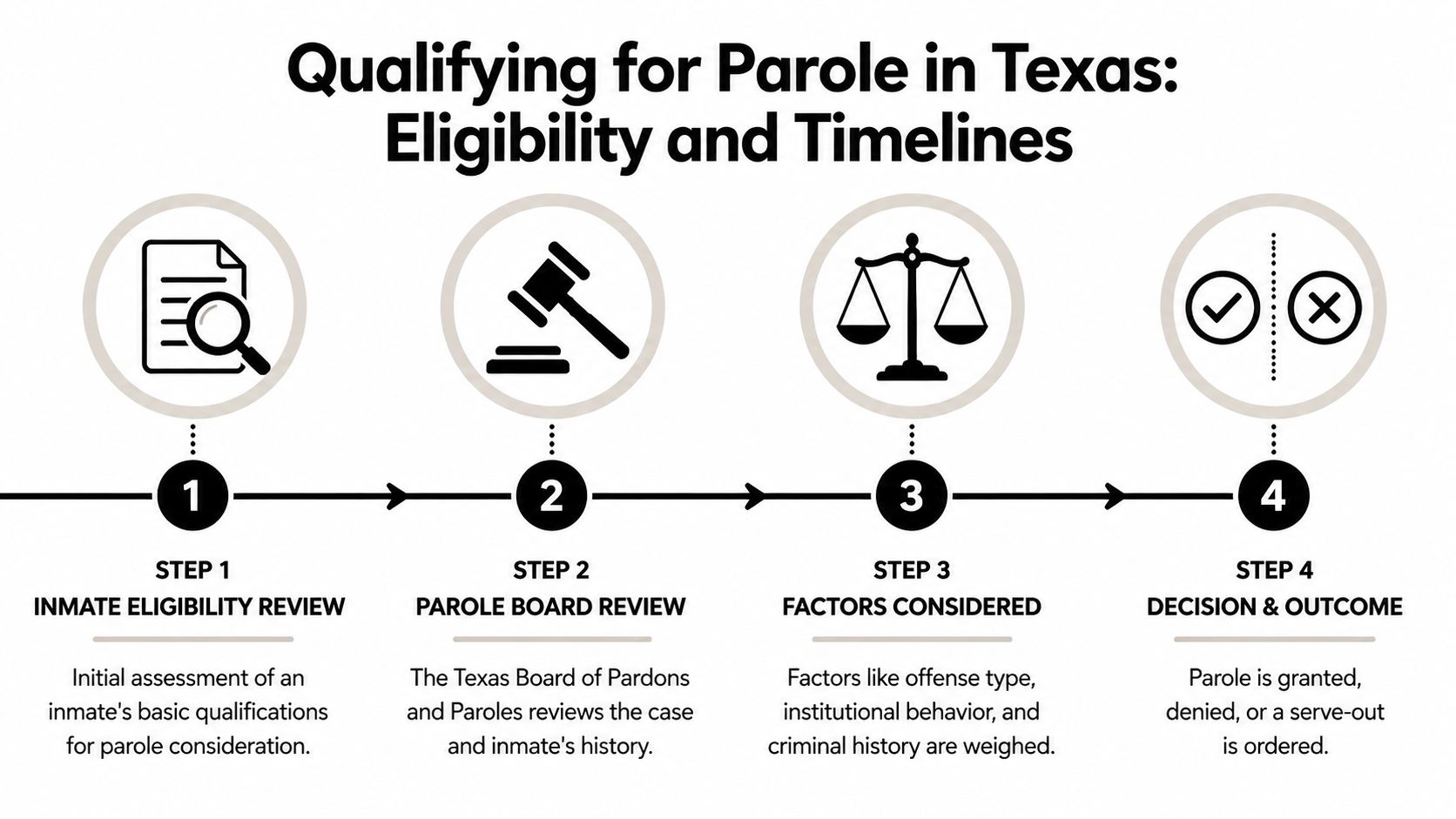
Qualifying for Parole in Texas Eligibility and Timelines
Your family gets a call from prison. Someone says, "I think I hit parole." Then the questions start piling up. Does that mean a release date is coming, or does it only mean the case can finally be reviewed?
In Texas, parole works a lot like reaching the front of a line. Reaching the line does not mean the door opens that day. It means the Board can begin looking at the case.
That distinction matters because many families lose time chasing the wrong problem. The first job is to figure out two separate dates or events: when a person becomes eligible for parole review, and what will make the Board more likely to approve release once that review happens.
Start with eligibility, not hope
Parole eligibility depends on the offense, the sentence, and the statute that applies to that conviction. Families often hear phrases like "3g offense" or references to Texas Government Code § 508.145 and feel lost. The simpler version is this: some convictions allow review sooner, and some require much more time served before the Board can even consider release.
Good time and work time can matter in some cases. In others, they do not move the eligibility date the way families expect. Two people can each have a ten-year sentence and still reach parole review on very different schedules because Texas law treats certain offenses more harshly.
So the practical question is not, "How long is the sentence?" The better question is, "What rule controls eligibility for this specific conviction?"
A simple family checklist for checking eligibility
Use this checklist before you assume a review is near:
Get the exact offense of conviction.
The offense label matters. Small wording differences can change parole timing.Get the sentence length and date the sentence began.
You need both to make sense of any projected review date.Ask whether the case falls under a rule that delays parole eligibility.
In this regard, serious violent offenses often create confusion.Confirm the eligibility date with prison records, not rumor.
Families often hear projected dates secondhand. Verify them.Ask whether good conduct time affects this case.
It helps in some cases and has limited effect in others.
If you do only one thing this week, do this checklist first. It gives you the map before you start the trip.
Eligibility opens the file. Approval depends on the full picture
A person may become eligible and still be denied parole. That is painful, but it is common. The Board is not deciding only whether enough time has passed. It is deciding whether release is a reasonable public safety decision.
The Board uses a parole guidelines system that considers both fixed facts and changeable ones. Fixed facts include criminal history and offense severity. Changeable factors include disciplinary record, program participation, and institutional adjustment. Pullan & Young explains that the Texas parole guidelines score combines these factors and still leaves room for board discretion, with offense severity continuing to carry major weight.
Families often ask whether a good score should settle the case. It does not. The score matters, but it is only one part of the file.
Here is the plain-English version:
- The past still matters. Criminal history and the offense itself stay in the file.
- The present matters too. Disciplinary cases, treatment, classes, and work history inside prison can help or hurt.
- Serious offenses keep heavy weight. Real growth may be present and still not overcome the facts of the crime in the Board's view.
That is why parole review can feel unpredictable. It is partly structured and partly discretionary.
How Texas parole decisions are made
Parole decisions in Texas are usually made by a three-person voting process. One voter reviews the file. Another reviews it next. If those two agree, that result usually controls. If they disagree, a third voter breaks the tie.
For families, the practical lesson is clear. Every document in the file needs to do a job. The Board members are reviewing records, conduct history, and release planning. They are not meeting your family around the dinner table. If the file does not explain progress, support, and preparation, those points may never land.
Timing after a denial can vary more than families expect
The review date is only the first timeline issue. The second is what happens after a denial.
Texas rules updated effective May 16, 2025, and HB 4937 allows more individualized set-off periods in some serious cases, with review windows that may range from 1 to 10 years under the 2025 Board rules update. In practical terms, a denial does not always mean another review is coming soon. Some families expect a quick retry and are shocked to learn the next vote may be much farther out.
That makes preparation before the first meaningful review especially important.
Five questions to answer right now
If you are trying to help a loved one, work through these in order:
What is the exact conviction and statute?
That tells you which parole eligibility rule likely applies.What eligibility date has TDCJ calculated?
Ask for the official calculation if possible.What does the institutional record show?
Disciplinary cases, program completion, and work history all matter.What risk factors can still be improved before review?
Classes, treatment, housing plans, and support letters can change the picture.If parole is denied, what is the next review date or review window?
Families should know this early so they can plan, not guess.
The parole process gets less overwhelming once you break it into parts. First confirm eligibility. Then study the file the Board will see. Then build for the next decision point with dates, documents, and a realistic timeline in hand.
How to Build a Compelling Parole Packet A Practical Checklist
Your family may get only a limited chance to put real context in front of the parole panel. If all the Board sees is the prison file, the picture can feel flat and incomplete. A parole packet gives you a way to show change, structure, and a realistic plan for release.
That packet works like a case binder. It should help a reviewer answer three practical questions quickly. Who is this person now. What has changed. Why is release manageable and safe at this stage.

Start with the missing part of the record
The institutional file usually covers charges, dates, custody history, and disciplinary information. Families often assume the Board will somehow infer the rest. It usually will not.
Your packet should fill in what the file does not show well. Remorse. Maturity. Support at home. Treatment progress. A stable place to live. A clear plan for work and supervision.
Keep the goal simple. Make it easy for a reviewer to understand the person and the plan without hunting through a stack of papers.
A practical parole packet checklist
Use this checklist in order. If you build it one piece at a time, the process feels far less overwhelming.
1. Cover letter
Start with a short cover letter that identifies the inmate, lists the enclosed documents, and explains what you want the panel to see.
Include:
- Full name
- TDCJ number
- Unit, if known
- Brief reason the packet deserves review
- Table of contents or document list
Keep it calm and factual. One page is usually enough.
2. Personal statement from the inmate
This is often the heart of the packet. The tone matters as much as the content.
A strong statement usually does four things:
- Accepts responsibility, when appropriate
- Shows insight into the harm caused
- Describes specific changes during incarceration
- Explains the release plan in concrete terms
Specific facts carry more weight than broad promises. "I completed treatment, stayed discipline free for a significant period, and plan to live with my sister at this address" is stronger than "I have changed and will do better."
If the person still has related legal issues to protect, get legal advice before drafting. In some cases, families also confuse parole with record clearing. They are different forms of relief, and this guide on expunging a criminal record in Texas explains that difference.
3. Letters of support
Support letters should answer a practical question. Who will help this person remain stable after release?
Ask each writer to cover:
- How they know the inmate
- How long they have known the inmate
- What changes they have personally observed
- What support they can provide
- Why they believe the release plan is realistic
The best letters come from people with direct knowledge. Family members can help. So can pastors, mentors, employers, teachers, sponsors, and community leaders. A brief, honest letter is far better than a dramatic one filled with opinions and no facts.
4. Proof of institutional progress
This section shows that the inmate used time in custody in a productive way.
Helpful documents may include:
- Program completion certificates
- GED, college, or vocational records
- Work assignments and job evaluations
- Counseling or treatment participation
- Chaplaincy, mentoring, or service involvement
- Records showing improved disciplinary history, if available
You are building a timeline of growth. The Board does not ignore the offense, but it also looks at what the person has done since entering custody.
5. A reentry plan with real details
At this stage, many packets fall apart. Families say, "He can stay with me" or "She will find work." Those statements are a start, but they do not give the panel much to rely on.
A good reentry plan answers everyday questions before the Board has to ask them.
| Reentry issue | What to include |
|---|---|
| Housing | Full address, who lives there, whether the home is stable, and why the placement works |
| Employment | Job skills, possible employers, family business support, or a realistic work search plan |
| Treatment | Substance use counseling, mental health care, medication continuity, or other needed services |
| Transportation and routine | How the person will get to work, report as required, attend treatment, and maintain a daily schedule |
A useful rule is this. If a reviewer can picture the first 30 days after release, your plan is probably getting stronger.
Organize the packet so it reads clearly
Presentation matters. A reviewer should be able to move through the packet in a logical order without guessing what each document is.
Use a clean structure:
- Cover letter
- Personal statement
- Support letters
- Program and work records
- Reentry plan
- Other supporting documents
Label every item. Put the inmate's name and TDCJ number where appropriate. Remove duplicates. If a letter is handwritten and hard to read, provide a typed version with the original attached.
A short video explanation may also help families understand how to present a clearer packet and avoid common mistakes.
Mistakes families make, and how to fix them
Families often lead with pain. That is understandable. Children miss a parent. Parents are aging. Bills pile up. Those facts are real, but hardship alone usually does not answer the Board's public safety concerns.
A stronger packet connects compassion to structure. Show where the person will live, who will support them, what treatment is lined up, and how daily life will be supervised.
Watch for these common problems:
- Angry letters attacking the system
- Generic statements with no examples
- Conflicting dates or names
- Unrealistic job or housing claims
- Too many pages with no organization
- Excuses that minimize the offense
If you spot one of those problems, fix it before submission. Do not hope the panel will sort it out for you.
Final submission check
Before sending the packet, read it as if you know nothing about the case.
Ask:
- Is every document consistent with the others?
- Are names, dates, and identifying numbers correct?
- Does the packet show accountability as well as planning?
- Can a reviewer quickly understand why release is a reasonable option now?
That last question is the test. If the answer is unclear, revise until the packet tells a steady, credible story.
Seeking a Texas Pardon The Path to Official Forgiveness

Your family may reach a point where parole is no longer the question. The person has finished the sentence, stayed out of trouble, built a stable life, and still carries the weight of the conviction every time a job application or housing form asks about criminal history. That is often when people start asking about a pardon.
A Texas pardon is a formal act of clemency. It is rare, discretionary, and fact-specific. The process asks the state to recognize rehabilitation, correct an injustice, or grant mercy for a strong reason supported by records.
Types of pardon-related relief in Texas
Texas clemency can take several forms, and the right category matters. Filing under the wrong theory is like bringing the right documents to the wrong office. You may have good facts and still miss the mark.
Depending on the case, relief may involve:
- A full pardon after conviction
- A pardon based on innocence
- A commutation, which reduces a sentence or changes the punishment
- A conditional pardon
- A medical reprieve
The Board of Pardons and Paroles plays a central role in reviewing clemency matters and making recommendations. The Governor's role depends on the type of relief requested.
What a pardon request usually needs to prove
A pardon application usually turns on two questions. First, why should the state grant this relief in this case? Second, what reliable proof supports that answer?
Regret matters, but proof carries the file. A strong application usually shows a long pattern of law-abiding conduct, responsibility, and a clear public-interest reason for relief. For some applicants, that reason may be extraordinary rehabilitation. For others, it may be innocence, a severe collateral consequence, or a record that no longer reflects who the person is.
Families often ask what to gather first. Start with the basics, then build outward.
Practical pardon file checklist
- Sentence completion records showing the case is fully resolved
- Court documents that accurately identify the offense, cause number, and outcome
- A personal statement that accepts responsibility if appropriate and explains why clemency is justified now
- Character letters from people who know the applicant well and can give concrete examples
- Work and community records showing steady employment, service, education, or leadership
- Treatment or counseling records if recovery or rehabilitation is part of the story
- Any documents supporting special circumstances, including innocence-related materials where applicable
Specificity matters. A letter saying "he is a good person" does little. A letter explaining that the applicant has worked reliably for years, mentors younger employees, volunteers at church, and supports family members gives the reviewer something concrete to trust.
Pardon is different from record clearing
This point causes a lot of confusion. A pardon and an expunction solve different problems. A pardon is clemency. An expunction is record clearing in cases that qualify under Texas law. Some people need one. Some need the other. A few may need to examine both.
If your main goal is to remove eligible records from public view, review this guide to expunging a criminal record in Texas. That process has its own rules and does not automatically follow from a pardon request.
How families can organize the application
The best pardon files read like a well-ordered binder, not a stack of loose papers. A reviewer should be able to understand the story without hunting for missing pages or guessing why the request deserves serious attention.
A clear order often helps:
Relief requested
State exactly what type of clemency is being sought.Reason for the request
Explain the strongest legal and human reason in plain language.Core records
Include court papers, proof of sentence completion, and any supporting official records.Life since the case
Show work history, family support, treatment, education, and community involvement.Reference letters
Put the strongest and most detailed letters first.Final review
Check names, dates, cause numbers, and consistency across every page.
One more point often gets overlooked. Do not let the application sound defensive or inflated. A respectful, steady tone usually helps more than dramatic language. The goal is credibility.
A pardon request can be worth pursuing, but only after an honest review of the facts, the available proof, and the reason relief is being sought. Families who treat the process like a checklist, not a wish, usually put themselves in a better position.
Life After Release What a Pardon or Parole Really Means
Your family gets the release date you have been waiting for. Relief hits first. Then important questions start. What happens on day one? What rules apply? What changes if the person was paroled, and what changes if the person received a pardon?
Those questions matter because release is a legal change, not a full reset. Parole usually means the person is out of prison but still under supervision. A pardon can remove or reduce some consequences of a conviction, but the effect depends on the type of pardon and the person’s full record. The safest approach is to treat release like the start of a new case file, with a new checklist.

Living on parole in Texas
Parole works a lot like probation after prison. The person has more freedom than they had inside, but that freedom comes with rules, reporting, and close attention to compliance. Families often help most in the first 90 days, when appointments, housing, work, treatment, and transportation all have to line up at once.
A practical first-week parole checklist often includes:
- Confirm the reporting date, time, and office location
- Save the supervising officer’s contact information
- Review every condition of release, line by line
- Set up reliable transportation for reporting and treatment
- Gather identification, discharge paperwork, and medication records
- Create a calendar for testing, classes, work hours, and curfew rules
Small mistakes can turn into serious problems. A missed appointment may be treated very differently from a documented emergency, so families should keep records, names, dates, and receipts.
What supervision often looks like
Parole conditions vary, but many people deal with the same core requirements:
- Regular reporting to a supervising officer
- Drug or alcohol testing
- Employment or program requirements
- Travel restrictions
- Special conditions tied to the offense or treatment needs
The best habit is simple. Follow the written rules, not hallway advice from other people on supervision. If a condition is unclear, ask for clarification early and keep a copy of any instructions.
What a pardon changes, and what it does not
A pardon is different. It is not day-to-day supervision. It is official clemency, and its effect depends on the kind of relief granted. Some people hear the word "pardon" and assume every consequence disappears at once. Texas law is rarely that simple.
A pardon may help with civil rights, reputation, and future opportunities. It does not always erase every public trace of the case, and it does not automatically solve every licensing, federal, or immigration issue. The better question is not "Am I cleared?" The better question is "Which problems does this pardon fix, and which ones still need separate action?"
That is the question families should answer in writing.
Civil rights and practical life questions
These are usually the first issues to sort out after release or clemency.
Can I vote
Voting rights depend on whether the sentence has been fully discharged and whether any other legal barrier applies. Families should verify status before registration instead of guessing.
Can I possess a firearm
Firearm rights are complicated under both Texas and federal law. A pardon can affect the analysis, but it does not make every firearms issue automatic. If that is your concern, this guide on firearm rights restoration is a useful starting point.
What about immigration
Parole and pardon do not automatically fix immigration consequences. Non-citizens should get case-specific advice because even old convictions can trigger severe immigration problems.
What will employers see
That depends on the record, the relief granted, and the background check company involved. A pardon may improve the situation, but online databases and copied public records can keep circulating unless someone addresses them directly. Families dealing with that problem should also review ContentRemoval.com's online privacy solutions.
Release changes legal status. Rebuilding work options, housing stability, and public reputation usually takes separate steps.
A good reentry file can help. Keep one folder with supervision papers, proof of employment, treatment records, identification documents, and any paperwork showing the person has completed requirements. That folder becomes your proof if a question comes up later.
You Don't Have to Face This Alone
Texas post-conviction law can feel cold and mechanical. But every file belongs to a real person, and every family is trying to answer very human questions. How do we bring someone home? How do we show change? How do we protect a future after a mistake or a conviction?
The most important takeaway is this. Parole and pardon are different tools for different problems. Parole is usually about supervised release from prison. Pardon is a clemency request for official forgiveness or related relief. Neither process rewards guesswork. Preparation matters.
If you're dealing with a prison sentence, focus on the record that exists now. Program completion, discipline history, support letters, housing, and treatment planning all matter. If you're dealing with an old conviction after the sentence is over, look carefully at whether pardon, expunction, or nondisclosure is the better fit. Those remedies serve different purposes.
There is also the issue many people don't think about until much later. Online public records can keep old criminal information visible long after a case is legally finished. If privacy and reputation are part of your recovery plan, resources on ContentRemoval.com's online privacy solutions can help you understand the separate challenge of reducing harmful public-record exposure online.
You don't need to solve everything at once. Start with the right category of relief. Then gather the right documents. Then get guidance specific to the exact offense, sentence, and goal. That's how overwhelming situations become manageable.
Post-conviction relief is only one part of rebuilding. Some people also need help understanding whether they qualify for expunction, record sealing, or other rehabilitation-focused remedies after a DWI, assault, theft, or drug possession case. The right path depends on what happened in court, what the sentence was, and what the law allows now.
If you’ve been charged with a crime in Texas, call Law Office of Bryan Fagan PLLC for a free and confidential consultation. Our defense team is ready to protect your rights.