Being arrested in Texas can be terrifying—but you don’t have to face it alone. An arrest, even for a minor mistake, can feel like a life sentence, but it doesn't have to define your future. The expungement process in Texas is a powerful legal path designed to permanently destroy certain criminal records, giving you the legal right to deny the arrest ever happened. This guide will give you a clear map to follow, showing you how to achieve a true clean slate and take back control of your life.
Your Path to a Clean Slate in Texas

Being arrested or charged with a crime casts a long shadow. It can creep into every corner of your life, making it tough to get a job, find a decent place to live, or even get a professional license.
The good news is that Texas law offers a way to leave that past behind you for good. Knowing what your options are is the first, most critical step toward reclaiming your future and your peace of mind.
Think of this guide as your trusted resource. We're here to give you the straightforward, no-nonsense advice you need to navigate the legal system with confidence. We'll break down the entire expungement process, from figuring out if you even qualify to making sure your record has been completely wiped clean.
Expungement vs. Nondisclosure: What's the Difference?
Before we jump into the "how-to," you need to understand the two main ways to clear a criminal record in Texas. People often confuse them, but an expunction and an order of nondisclosure lead to very different outcomes.
Here’s a quick breakdown in plain English to help you see which path might be the right one for you.
Expunction vs Nondisclosure in Texas
| Feature | Expunction (Record Destruction) | Nondisclosure (Record Sealing) |
|---|---|---|
| What Happens | All records are physically destroyed and deleted. | Records are sealed from public view. |
| Legal Status | It’s as if the arrest never happened. | The arrest still legally exists but is hidden. |
| Who Can See It | Virtually no one. | Law enforcement and certain government agencies. |
| Your Rights | You can legally deny the arrest ever occurred. | You generally don't have to disclose it to employers. |
| Eligibility | Stricter; usually for dismissed or acquitted cases. | Broader; often for cases ending in deferred adjudication. |
At the end of the day, an expunction is the gold standard because it completely erases the event. A nondisclosure just puts it under lock and key, out of sight from most people.
The most significant benefit of an expunction is the right to deny. Under Chapter 55 of the Texas Code of Criminal Procedure, a successful expunction allows you to state you were never arrested, providing complete closure.
Recent legislative changes in Texas, particularly those taking effect in 2025, have opened the door for many more people to clear their records. The updates have expanded eligibility for certain misdemeanor convictions, especially for non-violent, first-time offenses. On top of that, reduced waiting periods for nondisclosure petitions mean you can get records sealed much faster after finishing probation or deferred adjudication. You can learn more about how to navigate the new expunction rules in Texas.
Deciding which path is right for you depends entirely on the specific outcome of your case. An expunction is what everyone wants, but it has tougher eligibility rules. Nondisclosure provides relief for many who don't qualify for a full record destruction.
Understanding Your Eligibility for Expungement
Before you can even start the process of clearing your name, the first and most critical step is figuring out if you're legally eligible for an expungement in Texas. Not every criminal record qualifies, and the rules—laid out in Chapter 55 of the Texas Code of Criminal Procedure—are incredibly specific.
Think of it like this: an expunction is the single most powerful tool for wiping a criminal record clean. Because of that, the law reserves it for situations where the justice system either found you not guilty or decided not to move forward with the case in the first place.
Who Qualifies for an Expunction
Your path to a truly clean slate usually opens up if your case ended in one of the following ways. From our experience, these are the most common scenarios that make someone eligible for an expunction.
- You were arrested, but charges were never formally filed. This is more common than people realize. If a prosecutor looked at your case and decided not to pursue it, you can likely seek an expunction after the statute of limitations for that offense runs out.
- Your case was dismissed by the prosecutor. If you were formally charged but the D.A. later dropped the case for any reason—maybe because of weak evidence or a witness problem—you're almost certainly eligible.
- You were found "not guilty" at trial. An acquittal is the most direct route to an expungement. If a judge or jury cleared your name, you have an absolute right to have every record of that ordeal destroyed.
- You received a pardon from the Governor of Texas. While rare, if you were pardoned based on actual innocence, you become immediately eligible to have the entire record wiped clean.
It’s crucial to understand that a final conviction for a crime, whether it’s a misdemeanor or a felony, will almost always disqualify you from getting that specific offense expunged. The system is designed to help people who were ultimately not found guilty, not those who were convicted.
Special Circumstances for Eligibility
Beyond those straightforward scenarios, Texas law has a few other specific pathways for eligibility. These situations often involve unique legal outcomes or programs built to give people a second chance.
For instance, successfully completing a pretrial diversion program can make you eligible. These are special programs offered by a prosecutor's office where you agree to complete certain conditions (like classes or community service) in exchange for having your case dismissed. Once it's dismissed, the door to expunction opens.
Another key area is deferred adjudication. For the most part, finishing deferred adjudication for a standard misdemeanor or felony will lead you to an order of nondisclosure (which seals your record), not an expunction. But there is one very important exception.
If you successfully completed deferred adjudication for a Class C misdemeanor—the lowest level of offense, like a traffic ticket or petty theft—you may be eligible to have that record completely expunged. This is a critical distinction that offers a full-circle remedy for very minor mistakes. Our attorneys can help you understand more about what is deferred adjudication in Texas and how it could apply to your case.
It's also worth noting that Texas law is constantly changing to make this process easier for those who deserve it. Recent legislative updates have created automatic or mandatory expunctions in certain clear-cut cases, like acquittals at trial or pardons for actual innocence. This helps streamline things for people who are undeniably eligible.
This is exactly why having a knowledgeable attorney on your side is so valuable. We can dig into the specific details of your case, figure out your eligibility with certainty, and map out the best path forward to clear your name for good.
How To File Your Petition For Expunction
Alright, you've done the hard part and confirmed you’re eligible for an expunction. Now it’s time to take action and file the official legal request with the court. This is where your journey toward a clean slate really gets moving, but be warned: filing the Petition for Expunction correctly is absolutely critical. Even a small mistake can set you back with delays or, worse, lead to a flat-out denial.
This infographic gives you a bird's-eye view of the path from arrest to a cleared record.
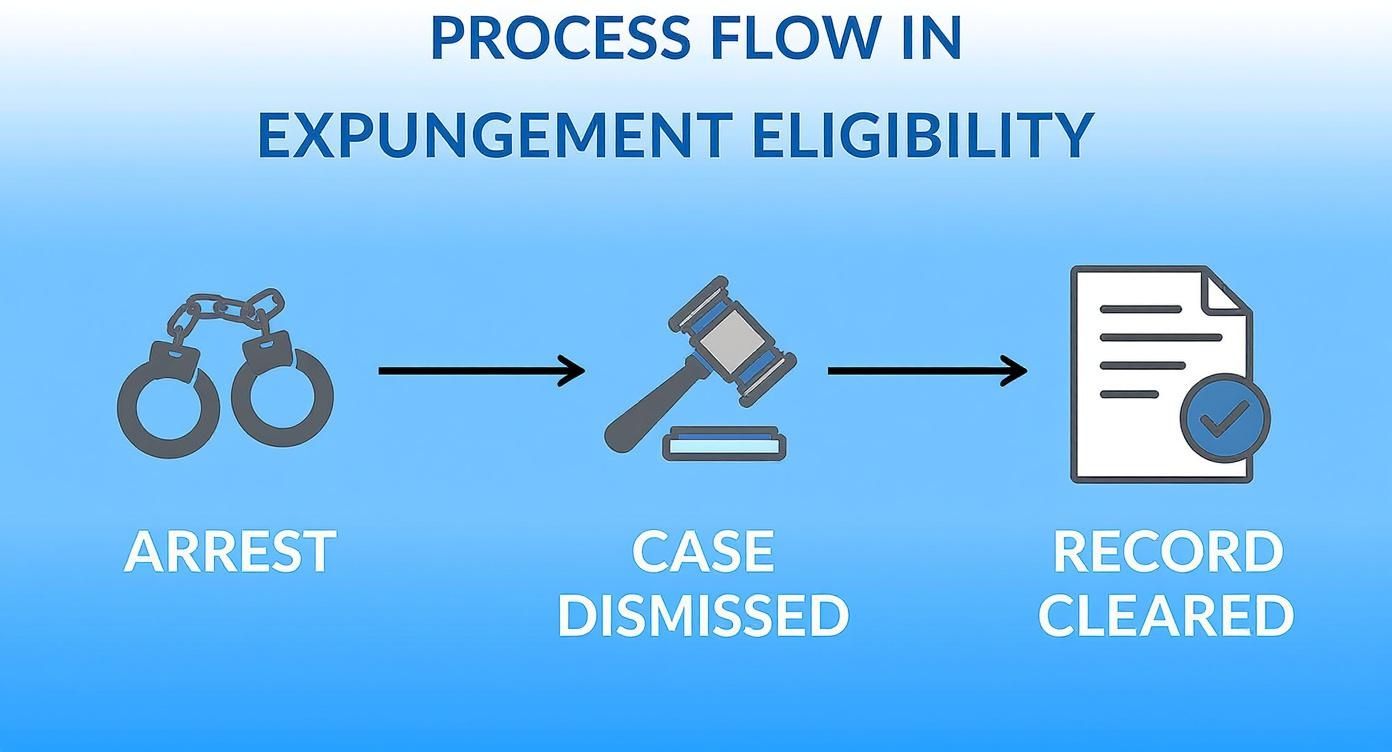
As you can see, the goal is to get from that initial arrest to a final outcome—like a dismissal—that legally paves the way for your record to be wiped clean.
Gathering Your Essential Documents
Before a single page of your petition is drafted, you need to collect all the documents related to your case. Think of it like assembling the pieces of a puzzle. Each document is vital for painting a complete and accurate picture for the judge.
You’ll need to get your hands on a few key items:
- Arrest Records: This is the offense report from the police department that arrested you. It contains the foundational details of your case—the date, time, and location of the arrest.
- Court Disposition Papers: This is the official court document that shows how your case ended. It will clearly state whether the charges were dismissed, you were found not guilty at trial, or another qualifying outcome was reached.
- Personal Identification: You'll need all your basic identifying information ready, including your full legal name, date of birth, driver's license number, and Social Security number.
Honestly, tracking down these documents can be a hassle. You might have to make a trip to the district clerk’s office in the county where the arrest happened or send a formal request to the law enforcement agency involved. This is often the first hurdle where having an experienced attorney can save you a ton of time and frustration.
Drafting a Flawless Petition
The Petition for Expunction isn't just a form; it's a formal legal document that has to include very specific information required by Texas law. It’s your official application to the court, and it needs to be perfect. For legal professionals handling these cases, tools for managing legal client intake documents are a game-changer, helping ensure no crucial detail gets missed.
At a minimum, your petition must include:
- Your complete personal information.
- Specific details about your arrest, like the offense, date, and arresting agency.
- The cause number and the specific court that handled your case.
- A list of every single government agency that might have records of your arrest.
That last point is a big one. You have to identify and list every state and local agency that could possibly have a copy of your records. We're talking about everyone from the local police department that arrested you all the way up to the Texas Department of Public Safety (DPS). If you forget even one, your record might not be fully destroyed.
For more complex situations, like trying to clear a more serious charge, you can learn more by exploring the complexities and requirements of expunging felony convictions in Texas in our detailed guide.
To help you get organized, here’s a quick checklist of what you'll need to prepare your petition.
Checklist For Your Expungement Petition
This table summarizes the essential documents and information you'll need to gather before filing your petition with the court.
| Document/Information | Purpose | Where to Obtain |
|---|---|---|
| Offense Report | Provides specific details of the arrest. | The arresting law enforcement agency. |
| Court Disposition | Officially proves the case outcome (e.g., dismissal). | The District or County Clerk's office. |
| Personal Identifiers | Your full name, DOB, SSN, and driver's license number. | Your personal records. |
| List of Agencies | Identifies all entities that hold your records. | Research or with an attorney's help. |
| Cause Number | Links the petition to your specific court case. | Found on your court disposition documents. |
Having all these items ready before you start drafting will make the process much smoother and reduce the risk of errors.
A common reason petitions get rejected is the failure to properly name and notify all relevant agencies. This is a highly technical requirement that an experienced attorney will handle meticulously to protect your case.
The Logistics of Filing and Notification
Once your petition is drafted and all your supporting documents are attached, it’s time to file it with the district clerk in the county where the arrest took place. Filing isn’t free, so be prepared to pay a filing fee. This typically runs anywhere from $250 to $400, depending on the county.
But filing the petition is far from the last step. Next, you have to formally "serve"—or notify—every single agency you listed. This gives them a legal heads-up about your request and provides an opportunity to contest it if they believe you aren't eligible. It’s a formal legal step that demands precision.
The court will then schedule a hearing, usually 30 to 60 days after you file. This hearing is your chance—or your attorney's—to stand before the judge and officially ask for the Expunction Order. By navigating the filing and notification process correctly, you set the stage for a successful hearing and, ultimately, the clean record you deserve.
What Happens at the Expungement Hearing
Once your Petition for Expunction is filed, the next big step on the calendar is the court hearing. We know this part can feel intimidating, but knowing what to expect can take a lot of the anxiety out of the process. Think of the hearing as a formal, structured meeting where a judge reviews your request and gives it the final stamp of approval.
Let's be clear: this isn't a trial. You won't see a jury, and the atmosphere is usually much calmer. In most cases, if your petition was filed correctly and you squarely meet the eligibility requirements, the hearing is a pretty straightforward final step.
Who Is in the Courtroom
Walking into the courtroom, you’ll see a few key people, and understanding their roles helps demystify the whole experience.
- The Judge: This is the decision-maker. The judge presides over the hearing, reviews all the paperwork, listens to any arguments, and ultimately grants or denies your expunction.
- Your Attorney: Your lawyer is your advocate, standing by your side to present your case, field any questions from the judge, and push back against any objections raised by the state.
- The State's Attorney: A prosecutor from the District Attorney's office will be there to represent the state's interests. Their job is to make sure only people who are truly eligible get their records destroyed.
- The Court Clerk and Bailiff: These are the court officials who manage the courtroom's logistics, handle the paperwork, and keep everything running smoothly.
You almost certainly won't need to speak unless the judge has a direct question for you. That's what your attorney is there for—to handle the legal arguments and do the talking.
Why the Prosecutor Might Object
The biggest worry we hear from clients is the possibility of the state objecting to their petition. While it doesn’t happen in every case, it's something we always prepare for. The prosecutor isn’t there to be difficult; they're there to uphold the law.
An objection is just a formal challenge to your request. Most of the time, these objections aren't personal attacks—they’re based on technical or legal grounds.
A common reason for an objection is a simple procedural error in the petition itself, like forgetting to notify a required state agency or getting a detail wrong about the original case. This is exactly why having an experienced attorney is so valuable—we work to prevent these kinds of mistakes from happening in the first place.
Other reasons a prosecutor might raise an objection include:
- Questionable Eligibility: The state might argue that the specific outcome of your case doesn’t technically qualify for an expunction under Chapter 55 of the Texas Code of Criminal Procedure.
- Statute of Limitations: If your case was dismissed before charges were ever filed, the prosecutor could argue that the required waiting period hasn't passed yet.
- Incomplete Information: The state could object if they feel your petition is missing key details they need to confirm you're eligible.
If an objection comes up, your attorney will respond with legal arguments and evidence to defend your right to an expunction. Having a strong, prepared defense is the key to overcoming any challenges and getting the judge's signature on that order for your clean slate.
Recent data on Texas expungements really highlights how effective they are. The numbers show an impressively low 2.6% rearrest rate within five years for people who get their records cleared, and a violent crime reconviction rate of less than 1%. You can discover more insights about Texas expungement data and see the positive impact for yourself.
Finalizing Your Expunction and Clearing Your Name

When the judge signs your Expunction Order, it’s a moment of incredible relief. That signature is your official ticket to a clean slate, but the journey isn't quite over yet. You've won the legal battle, but now you have to make sure the administrative gears turn to erase your record completely.
Leaving the courtroom with that signed order is a monumental achievement. Think of it as a legally binding "delete all" command sent to every government agency holding your arrest records.
Distributing the Order to All Agencies
Your attorney's next job is to get that signed Expunction Order into the hands of every agency listed in your original petition. This is a critical step in the expungement process in Texas, and the distribution list is often longer than people realize. It’s not just the police department that arrested you.
The order typically goes out to agencies such as:
- The arresting law enforcement agency (e.g., Houston Police Department, Harris County Sheriff’s Office)
- The county or district clerk's office
- The prosecuting attorney’s office
- The Texas Department of Public Safety (DPS)
- Any other state or local agency that might have a copy of your records
Once these agencies receive the court order, they are legally obligated to comply. This isn't a suggestion; it's a command. They must physically destroy paper files and permanently delete any digital entries related to your arrest.
The Timeline for a Truly Cleared Record
After the order is sent out, the waiting game begins. Government agencies don't erase records overnight. Under Texas law, they generally have up to 180 days from the date they receive the order to complete the destruction. In some cases, it can take up to a year for every last trace to be wiped clean.
This is why patience is key. It takes time for the order to work its way through the bureaucracy of each agency. While you can celebrate the legal victory, your name isn't officially cleared until every one of these entities has followed the judge's command. Restoring your reputation is the end goal, which ties into broader efforts like online reputation management.
It's essential to understand that this waiting period is a normal part of the process. Your attorney will monitor the situation, but the administrative gears of government move at their own pace.
How to Verify Your Record Is Gone for Good
So, how do you know for certain that your record has been completely destroyed? You can’t just take their word for it. The best way to get total peace of mind is to verify it yourself after the waiting period has passed.
A straightforward way to do this is to run a comprehensive, official background check on yourself. We always recommend using the same kind of service that a potential employer would use. If that background check comes back clean and shows no record of the arrest, you can finally be confident the expunction was a success.
This final check is what allows you to move forward without constantly looking over your shoulder. It confirms you can legally and confidently deny the arrest ever happened on job applications, housing forms, and in just about every other part of your life. It’s the final proof that your past is truly in the past, allowing you to build your future on a genuinely clean foundation.
Common Questions About the Expungement Process
The path to a clean slate can feel complicated, and it's natural to have questions. After guiding countless Texans through the expungement process, we've heard them all. Here are clear, straightforward answers to some of the most common questions we get.
How Long Does the Texas Expungement Process Usually Take?
This is almost always the first thing people want to know, and the honest answer is: it depends. On average, you can expect the entire process to take anywhere from three to six months, from the day you file the petition to the day the judge signs the final order.
But that timeline isn't set in stone. A few key factors can really change how long it takes. The specific county where you file plays a big role, as some court dockets are just more crowded than others. A straightforward case where the prosecutor doesn't object will almost always move faster than one with legal complexities.
The best way to keep your case on track is to make sure your petition is filed perfectly from the start. Any mistakes or missing information can cause major setbacks, which is exactly why working with an experienced attorney helps make the process as efficient as possible.
Can I Legally Say I Was Never Arrested After an Expungement?
Yes, and this is the single most powerful benefit of getting your record expunged. Once the judge signs that Expunction Order, Texas law gives you the right to deny the arrest—and the existence of any related records—in almost every situation.
This means you can confidently and legally answer "no" on applications for:
- Employment
- Housing or apartment rentals
- Professional licenses
- Educational programs
There is one major exception to this rule. If you are ever called to testify under oath in a separate criminal proceeding, you cannot deny the arrest. But for nearly every other aspect of your life, it's as if it never happened.
This legal right to deny is what truly separates an expunction from an order of nondisclosure. Nondisclosure only seals your record from the public; it doesn't give you the legal power to say the arrest never occurred.
What If I Was Convicted of the Crime?
This is a crucial point that trips a lot of people up. In Texas, a final conviction for a crime generally makes you ineligible for an expunction for that specific offense. The expungement process is reserved for cases that did not result in a finding of guilt—things like dismissals, no-bills from a grand jury, or a "not guilty" verdict at trial.
But a conviction doesn't mean you're out of options. You might still be able to get relief through a different legal tool.
Many people in this situation qualify for an Order of Nondisclosure. This process seals your criminal record, preventing it from being seen by the general public, including most employers and landlords. While law enforcement can still access sealed records, nondisclosure provides a huge layer of privacy and can open doors that were previously closed. If you're unsure about the differences, you can find a detailed breakdown in our article comparing expungement vs. nondisclosure in Texas.
Do I Need a Lawyer to Get My Record Expunged?
While you are legally allowed to represent yourself (this is known as "pro se"), the expungement process is far from a simple DIY project. It's a highly technical legal proceeding with very strict rules and paperwork requirements laid out in the Texas Code of Criminal Procedure.
A small, seemingly minor mistake on your petition—like failing to list a single government agency that holds your records or misstating a date—can be enough for a judge to deny your request. If that happens, you lose your filing fee and have to start the entire process over from scratch.
An experienced Houston criminal defense attorney adds value at every step:
- Ensuring Eligibility: First, we confirm you absolutely qualify under the law, so you don't waste time and money.
- Drafting a Perfect Petition: We prepare and file all the paperwork correctly, identifying every single agency that needs to be notified.
- Representing You in Court: We attend the hearing on your behalf, ready to make legal arguments and shut down any objections the prosecutor might raise.
Ultimately, hiring a lawyer significantly increases your chances of a successful outcome and gives you peace of mind that your case is being handled right. It's an investment in getting your clean slate for good.
If you’ve been charged with a crime in Texas, call The Law Office of Bryan Fagan, PLLC for a free and confidential consultation. Our defense team is ready to protect your rights. https://texascriminallawyer.net