Being arrested for a DWI in Texas can be terrifying—but you don’t have to face it alone. The thought of a DWI charge haunting your record forever is a heavy burden, and you’re likely wondering if you can ever truly move past it. So, can you get a DWI expunged in Texas? The short answer is yes, but the path is very specific. An expunction is only an option if your case ended without a final conviction.
This means your best shot at a clean slate comes if your case was dismissed, you were found not guilty at trial, or you were arrested but prosecutors never formally filed charges. Understanding your rights and options is the first step toward taking back control of your future.
Understanding What Expunction Really Means
When lawyers talk about "expunction," it’s important to understand what that legally means here in Texas. An expunction isn't just about hiding a record; it's about wiping it out completely, as if it never happened.
Under the Texas Code of Criminal Procedure, if a judge grants your Petition for Expunction, every government agency—from the local police department to the Texas Department of Public Safety (DPS)—is legally ordered to destroy all physical and digital files connected to your DWI arrest. From that point on, you can legally deny the arrest ever occurred.
Expunction vs. Record Sealing at a Glance
It’s easy to confuse expunction with another legal option called an Order of Nondisclosure, which is often called "record sealing." Both offer a second chance, but they work in fundamentally different ways.
Think of it this way: expunction is destruction, while nondisclosure is concealment. One makes the record vanish, and the other just hides it from public view.
This table breaks down the key differences to help you see which path might be available for you.
| Feature | Expunction (Record Destruction) | Order of Nondisclosure (Record Sealing) |
|---|---|---|
| Record Status | All records are physically and digitally destroyed. | Records still exist but are hidden from the public. |
| Who Can See It | No one. The incident is legally treated as if it never happened. | Law enforcement, government agencies, and certain licensing boards. |
| Job Applications | You can legally deny the arrest ever occurred. | You must disclose it if asked directly by a government agency. |
| Eligibility | Only for cases that did not result in a conviction (e.g., dismissal, acquittal). | Available for some first-time DWI convictions after completing probation. |
| Legal Effect | Wipes the slate completely clean. | Limits public access but does not erase the event. |
Understanding this distinction is the first step in figuring out your next move. There's a lot of misinformation out there, but our guide on DWI expungement myths can help you sort fact from fiction.
Why Expunction Is So Powerful
The whole point of expunging a DWI in Texas is to give you a genuine fresh start. A public DWI arrest record, even one without a conviction, can throw up major roadblocks in your life. It can appear on background checks, making it harder to get a job, rent an apartment, or even volunteer at your child's school.
An expunction removes those obstacles for good.
In Texas, the process of expunging a DWI record is exceptionally rare and narrowly tailored. Unlike many states where a DWI conviction might eventually be removed from public record, Texas generally considers a DWI conviction permanent on a person's record unless the case was dismissed or acquitted. For this reason, pursuing an expunction when you qualify is not just an option—it's a critical step toward protecting your future.
Because the rules are so strict, it’s vital to determine if this path is open to you. If your DWI arrest didn't lead to a conviction, you might have the opportunity to wipe the slate clean and move on without that mistake holding you back. This process restores your name and lets you pursue your goals without judgment.
The Strict Eligibility Rules for a DWI Expunction
Before you can file the paperwork to expunge a DWI in Texas, you have to answer one critical question: do you actually qualify? The law here is incredibly specific and leaves zero room for error. An expunction is a powerful legal remedy, but it’s reserved for a very narrow set of circumstances where a DWI arrest did not result in a final conviction.
The single most important factor is how your case ended. Put simply, if you were convicted of the DWI or any related offense that stemmed from that same arrest, an expunction is off the table. This is true even if your lawyer negotiated the charge down to something less serious, like reckless driving. If it ends in a conviction, the original DWI arrest cannot be wiped clean.
This infographic breaks down the most fundamental question in DWI expunction eligibility into a simple decision tree.
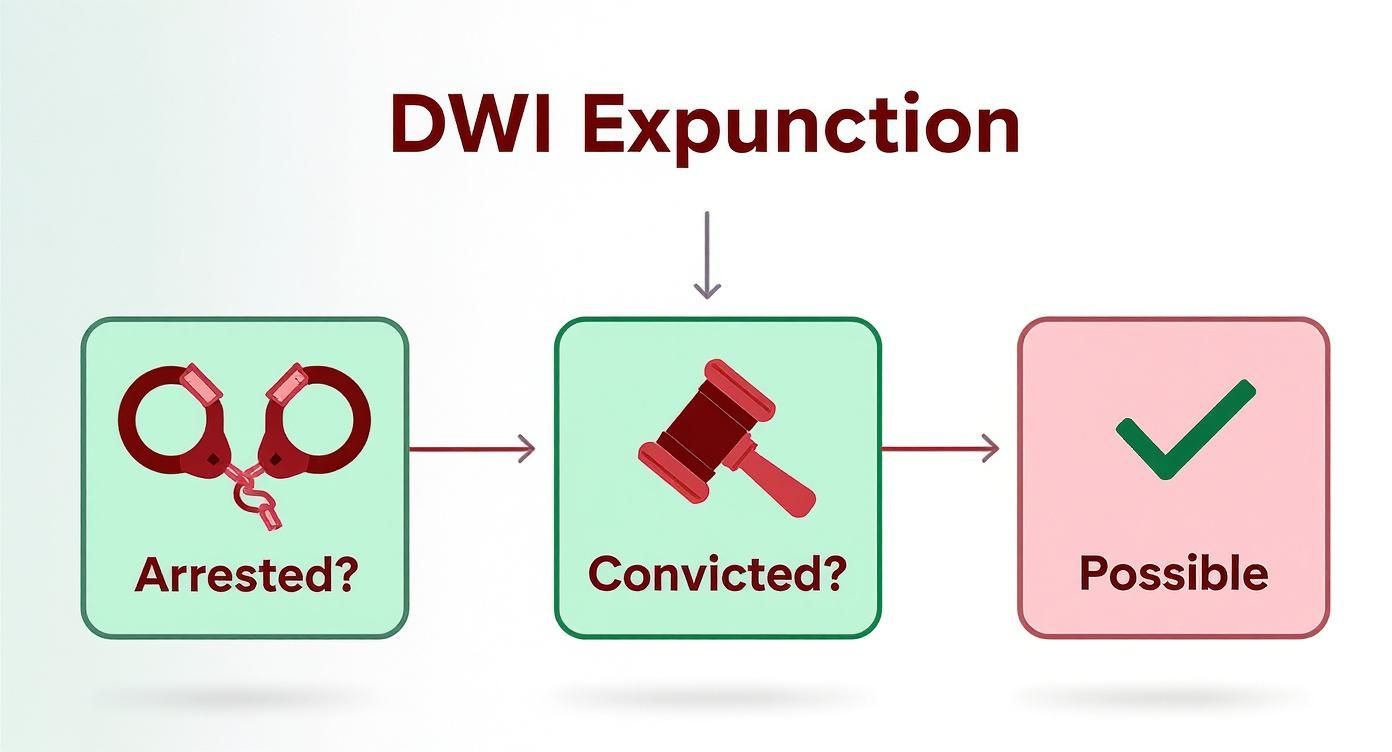
As you can see, the path to a potential expunction only opens up if the DWI arrest never led to a final conviction.
The Main Pathways to Eligibility
So, what does a non-conviction outcome actually look like in practice? Texas law spells out a few distinct scenarios that make you eligible to file a Petition for Expunction. Your situation generally needs to match one of these four pathways.
- Your Case Was Dismissed: This is the most common route. A prosecutor might drop your DWI charge for many reasons—insufficient evidence, a faulty breathalyzer test, or a violation of your rights during the traffic stop. Once the case is officially dismissed, the door to expunging the arrest record opens.
- You Were Found "Not Guilty" at Trial: If you took your DWI charge to court and a judge or jury acquitted you, you become immediately eligible for an expunction. A "not guilty" verdict is a definitive end to the criminal case, and you don’t have to wait for any statutes of limitations to expire before filing your petition.
- You Were Arrested but Never Formally Charged: Sometimes, a district attorney’s office reviews an arrest and decides against filing formal charges. If the statute of limitations—which is typically two years for a misdemeanor DWI—runs out without charges ever being filed, you can then move to expunge the arrest record.
- You Completed a Pre-Trial Intervention Program: Certain Texas counties offer a Pre-Trial Intervention (PTI) program. If you successfully complete all the requirements of a PTI program, the result is a case dismissal, which then makes you eligible for an expunction.
Common Reasons You Might Be Disqualified
Even if your case seems to fit into one of those categories, certain factors can be absolute deal-breakers. Understanding these disqualifiers is crucial for honestly assessing your chances. Navigating the law’s nuances is complex, and our in-depth guide on Texas expungement law and eligibility provides even more detail.
The bottom line is that Texas expunction law is unforgiving. You typically get one clean shot, and any misstep or disqualifying factor can close the door permanently. For instance, if you were convicted of another offense that arose from the same DWI arrest, such as resisting arrest, you would be disqualified from expunging the DWI.
Here are a few other common roadblocks we see:
- Receiving Deferred Adjudication: While deferred adjudication can lead to a dismissal, it does not qualify you for an expunction for a DWI. That said, this outcome might make you eligible for an Order of Nondisclosure (record sealing), which is a completely different legal process.
- Probation or Community Supervision: If a court placed you on any form of community supervision for the offense, you are generally barred from expunction, even if you completed it successfully.
- Pending Criminal Charges: You cannot have any other criminal charges pending against you when you file for an expunction. The legal system requires you to resolve all outstanding matters first.
Knowing exactly where you stand is the most important first step. If you believe your case was dismissed or you were found not guilty, you may be on the right track to clearing your name for good.
How the DWI Expunction Process Actually Works
So, you've confirmed you meet the strict eligibility rules. The next question is, "What does this legal journey actually look like?" Getting a DWI expunged in Texas is a formal legal process, but knowing the roadmap ahead of time makes it feel far less intimidating.
This isn't just about filling out a form and sending it in. You're actually initiating a civil lawsuit designed to legally erase your arrest record for good. Here is a step-by-step guide on what to expect.
Step 1: Filing the Petition for Expunction
It all starts with a critical legal document. Your attorney will draft and file what’s known as a Petition for Expunction. This isn't filed in the criminal court that handled your DWI case, but rather in a civil district court in the county where the arrest happened.
The Petition for Expunction is the foundation of your entire case. It must be flawless. Even a simple mistake or missing information can cause major delays or, worse, get your case denied. This is where an experienced Texas DWI attorney is invaluable.
The petition needs to be precise, including details like:
- Your full legal name, date of birth, and other personal identifiers.
- The exact date of the DWI arrest and the specific offense you were charged with.
- The name of the law enforcement agency that arrested you.
- The case number and the court that handled the original criminal charge.
- A clear statement explaining exactly why you are eligible for the expunction (for instance, the case was dismissed or you were acquitted).
This document tells the court your story and lays out the legal argument for why you are entitled to have the record destroyed under Texas law.
Step 2: Notifying Government Agencies
Once the petition is filed, the work is far from over. You can't just ask a judge to erase a record without telling all the agencies that are holding onto it. Texas law is very clear: all relevant government entities must receive formal notice of your expunction lawsuit.
This means your lawyer will officially "serve" a copy of the petition to every single agency that might have a record of your arrest.
This step is non-negotiable. If an agency isn't properly notified, it has no legal obligation to destroy your records, even if a judge signs the order. It’s a procedural detail that can make or break the entire process.
Typically, the list of agencies includes:
- The District Attorney’s office that prosecuted your case.
- The county or district clerk.
- The arresting police department or sheriff’s office.
- The Texas Department of Public Safety (DPS).
Each of these agencies has the right to show up and contest your expunction. This is another reason why having a legally sound, professionally drafted petition is so critical.
Step 3: The Court Hearing and Final Order
After every agency has been served, the court will set a hearing date. The good news is that in many straightforward expunction cases where eligibility is clear, this hearing is just a formality. The District Attorney’s office might even agree to the expunction beforehand, meaning you may not have to appear in court at all.
However, if the state objects, your attorney must be ready to argue your case before the judge. The prosecutor might claim you aren't eligible for a technical reason, and your lawyer will present evidence and legal arguments to counter their objection.
If the judge agrees that you meet all legal requirements, they will sign the Final Order of Expunction. This is a powerful court order that legally commands every agency you notified to track down and destroy all records related to your DWI arrest—fingerprints, mugshots, official reports, and more.
While every case is unique, you can learn more about what to expect by reading our overview of the Texas expunction process timeline.
From that point on, the agencies have a deadline to comply, and you are legally allowed to deny the arrest ever happened. It’s the final step in closing this chapter for good.
What to Do When Expunction Is Not an Option
Hearing that you don’t qualify for a full expunction can feel devastating. It's a tough pill to swallow after everything you've already been through. But this is not the end of the road.
For many first-time DWI offenders in Texas, there's a powerful alternative that can still give you a fresh start: an Order of Nondisclosure. Think of it as "record sealing." It’s a meaningful second chance to protect your future from a past mistake.
Nondisclosure vs. Expunction: What’s the Real Difference?
It’s important to understand the distinction between these two legal tools. An expunction literally destroys the record, making it as if the arrest never happened. A nondisclosure, on the other hand, hides it from public view.
Here’s an easy way to think about it: expunction is like shredding a document, while nondisclosure is like locking that same document in a private safe. The record still exists, but only a very limited group of people can ever see it.
So, what does that mean for your practical, everyday life?
- Public Background Checks: Once your record is sealed, private employers, landlords, and credit agencies will not see the DWI on a standard background check.
- Government and Law Enforcement: The record remains visible to law enforcement, prosecutors, and certain state licensing agencies (like those for teaching, medicine, or law).
- Job Applications: You can legally deny the offense ever occurred on most job applications for private companies.
For the vast majority of people, sealing a record provides all the relief they need to move forward with their lives and careers without an old mistake holding them back.
Do You Qualify for a DWI Nondisclosure?
The rules for sealing a first-time DWI are specific. They were designed to give a break to people who’ve shown they learned from their mistake. You’re likely eligible if you meet a few key criteria.
First, you must have successfully completed your probation, also called community supervision. That means you paid all fines, finished required classes, and checked every other box the court ordered.
This must also be your first—and only—DWI offense. If you have any other convictions on your record, you likely won't qualify for this specific type of relief.
The Texas Second Chance Law, also known as House Bill 3016, created this path to seal a first-time DWI conviction. While it isn't an expunction, sealing the record restricts public access, especially from employers. The whole point is to lessen the collateral damage a conviction can cause. You can find more insights on how this law works on Guzman.law.
The Waiting Game: BAC and Timelines
Your Blood Alcohol Concentration (BAC) at the time of your arrest is the biggest factor in determining how long you have to wait to file. Texas law splits first-time DWI cases into two groups for nondisclosure.
Cases with a BAC under 0.15:
If your BAC was below this threshold, you have a shorter wait. Once you've finished probation and had an ignition interlock device (IID) on your car for at least six months, you can petition for nondisclosure after a two-year waiting period.
Cases with a BAC of 0.15 or higher:
If your BAC was 0.15 or above, the path is similar, but the timeline is longer. You still have to complete probation and all its conditions, but the waiting period before you can file your petition stretches to five years.
To be clear, these waiting periods don't start until after you've successfully completed your probation. It’s a structured timeline meant to ensure you've stayed on the right track before the court grants you this powerful legal relief.
The Real-World Impact of a Public DWI Record
The legal process is only half the story. The real reason pursuing an expunction or nondisclosure is so critical is because a public DWI record casts a long shadow over your everyday life. It's about so much more than the initial fines and court dates; it's about the doors that can quietly close right in front of you for years to come.

Employment and Professional Licensing Hurdles
One of the most immediate and damaging consequences is the impact on your career. Many employers run background checks as a standard part of their hiring process, and an arrest or conviction—even for a first-time offense—can be enough to get your application moved to the bottom of the pile.
This is especially true for jobs that involve driving, operating machinery, or working with vulnerable people. If you hold or are seeking a professional license—like a nurse, teacher, real estate agent, or commercial driver—a DWI can trigger a review by your licensing board. This could lead to a suspension or even a full revocation of the license you worked so hard to earn.
Financial and Housing Roadblocks
Beyond your career, the financial fallout can be steep and long-lasting. A DWI conviction almost always leads to a massive hike in your auto insurance premiums. Insurers may classify you as a "high-risk" driver, and those high rates can follow you for years, costing you thousands of extra dollars.
Securing housing can also become a challenge. Landlords and property management companies frequently run background checks on potential tenants. A DWI record might cause them to see you as an unnecessary risk, making it much harder to get approved for an apartment or rental home. Similarly, lenders may be more hesitant to approve you for a mortgage or personal loan with a recent conviction on your record.
The consequences of a DWI conviction in Texas are profound and long-lasting, influencing not only criminal records but also driving and insurance records. A DWI permanently remains on the criminal record unless sealed or expunged. Critically, driving records related to the offense are reported for 75 years—effectively a lifetime. You can discover more insights about how a DWI impacts your Texas records on robuckmorgan.com.
Broader Life Opportunities
Even your educational and personal goals can be affected. Some colleges and universities, particularly for graduate programs or specific fields of study, may ask about your criminal history on their applications. A DWI record could potentially complicate your admission process.
Pursuing an expunction or nondisclosure is a powerful investment in your future. It’s about taking back control and ensuring that one mistake doesn’t define the rest of your life.
The table below breaks down just a few of the ways a public DWI record can create ongoing problems.
How a DWI Record Can Impact Your Life
| Area of Life | Potential Impact of a Public DWI Record |
|---|---|
| Employment | Being passed over for jobs; difficulty obtaining professional licenses (nursing, teaching, CDL). |
| Insurance | Drastically increased auto insurance premiums, sometimes for up to a decade or longer. |
| Housing | Denial of rental applications by landlords and property management companies. |
| Financial | Difficulty securing mortgages, personal loans, or other lines of credit. |
| Education | Potential complications with college or graduate school admissions. |
| Personal | Ineligibility for certain volunteer positions or international travel restrictions. |
Each of these roadblocks highlights why getting a clean slate is about more than just peace of mind—it's about reclaiming your opportunities.
Common Questions About DWI Expunction in Texas
Even after you understand the legal path forward, it’s normal to have practical questions. Going through the process of expunging a DWI in Texas naturally brings up concerns about the cost, how long it will take, and what happens once a judge finally signs that order.
Let’s provide some direct, plain-English answers to the questions we hear most often.
How Much Does a DWI Expunction Typically Cost?
This is usually the first question people ask, and for good reason. The total cost is a big factor in deciding whether to move forward. Generally, the price tag for an expunction is split into two main buckets: attorney fees and court costs.
- Attorney Fees: This is what you pay your lawyer to manage the entire process. It covers everything—drafting the Petition for Expunction, filing it correctly, serving notice to all required government agencies, and representing you at the court hearing. Attorney fees vary depending on the complexity of your case, but think of it as an investment in getting it done right the first time.
- Court Costs and Filing Fees: Every county charges its own fee just to file a civil lawsuit, which is what an expunction is. These fees are separate from your lawyer's and usually fall somewhere between $300 and $500, depending on the Texas county where you file.
When you put it all together, the total cost for a DWI expunction in Texas typically ranges from $1,500 to $3,000, sometimes more. While that’s a significant amount, it’s critical to see it as a long-term investment in your future. The hidden costs of a public arrest record—lost job opportunities, higher insurance premiums, and rental application denials—can easily add up to far more than the one-time cost of clearing your name.
How Long Does the Entire Process Take?
When it comes to the legal system, patience is key. From the day you file the Petition for Expunction to the moment the judge signs the final order, the whole process usually takes between three and six months.
Several things can affect this timeline. The first step involves filing the petition and ensuring every required government agency is properly served notice. That part alone can take a few weeks. After that, you're waiting on the court to schedule a hearing, which depends entirely on the court's calendar.
The most common reason for a delay is an objection from the District Attorney's office. If the DA contests your eligibility, it adds another legal hurdle. Your attorney will then need to prepare a formal response and argue your case in court. A smooth, uncontested expunction will always be faster.
But once the judge signs the Final Order of Expunction, you're not quite at the finish line. The agencies still need time to comply with the order and actually destroy your records.
What Happens After the Judge Grants the Expunction Order?
Getting that signed Final Order of Expunction is a huge victory, but it isn't the final step. Think of the court order as a set of instructions sent to every government agency that has a record of your arrest. The order legally commands them to find and destroy all files tied to your case.
This includes agencies like:
- The arresting police department or sheriff’s office
- The Texas Department of Public Safety (DPS)
- The county clerk’s office
- The District Attorney’s office
- Any other agency that was notified of your lawsuit
These agencies are given a specific timeframe—usually between 30 and 180 days—to follow the court's order. They must physically and digitally destroy everything from your mugshot and fingerprints to the official police report. Once they've done it, they are required to send a confirmation to your attorney.
Your legal team will track these confirmations to make sure every single agency has followed the judge's order. This final verification is what guarantees your record is truly gone, allowing you to legally deny the arrest ever happened.
Can a DWI with Deferred Adjudication Be Expunged?
This is one of the most frequent points of confusion, and the answer is a firm no. Under the Texas Code of Criminal Procedure, if you received deferred adjudication for a DWI charge, you are not eligible for an expunction—even if you successfully completed your probation and the case was dismissed.
The law specifically carves out DWI deferred adjudication from expunction eligibility. While this can feel frustrating, it's a hard and fast rule in Texas.
However, this is exactly where the other legal tool, an Order of Nondisclosure, comes into play. If your DWI case was dismissed after you completed deferred adjudication, you may be eligible to have your record sealed from public view. As we’ve discussed, sealing a record isn't the same as destroying it, but it provides many of the same practical benefits by hiding it from employers, landlords, and the general public.
If you’ve been charged with a crime in Texas, call The Law Office of Bryan Fagan, PLLC for a free and confidential consultation. Our defense team is ready to protect your rights. https://texascriminallawyer.net