Skip to content
Being arrested in Texas can be terrifying—but you don’t have to face it alone. Getting accused of theft is scary enough, but when the word "felony" gets thrown into the mix, that fear can quickly become overwhelming. In Texas, the line between a simple theft charge and a life-altering felony often comes down to one thing: the dollar value of the property involved. The higher the value, the more serious the charge, and the deeper the trouble you could be in.
Our team at The Law Office of Bryan Fagan, PLLC, is here to explain your rights and options in clear, plain English. We want to help you understand the charges you're facing and guide you through the steps ahead with confidence and compassion.
What Turns a Theft Charge into a Felony in Texas?
The first step toward building a solid defense is understanding exactly what you're up against. At the heart of any theft charge—misdemeanor or felony—is a legal concept called "unlawful appropriation."
Under Texas Penal Code § 31.03, theft is defined as taking someone's property without their permission and with the intent to permanently deprive them of it. That word, "intent," is everything. It's not just about what happened; it's about what you were thinking. A simple mistake or a misunderstanding isn't a crime, and it's the prosecutor's job to prove your intent beyond a reasonable doubt.
The Dividing Line Between Misdemeanor and Felony
So what pushes a theft case across the line from a misdemeanor to a felony? It almost always boils down to the value of the property. While taking something of low value might lead to misdemeanor charges, the penalties ramp up dramatically once the alleged value hits a certain number.
The flowchart below gives you a clear picture of how Texas law categorizes theft offenses.
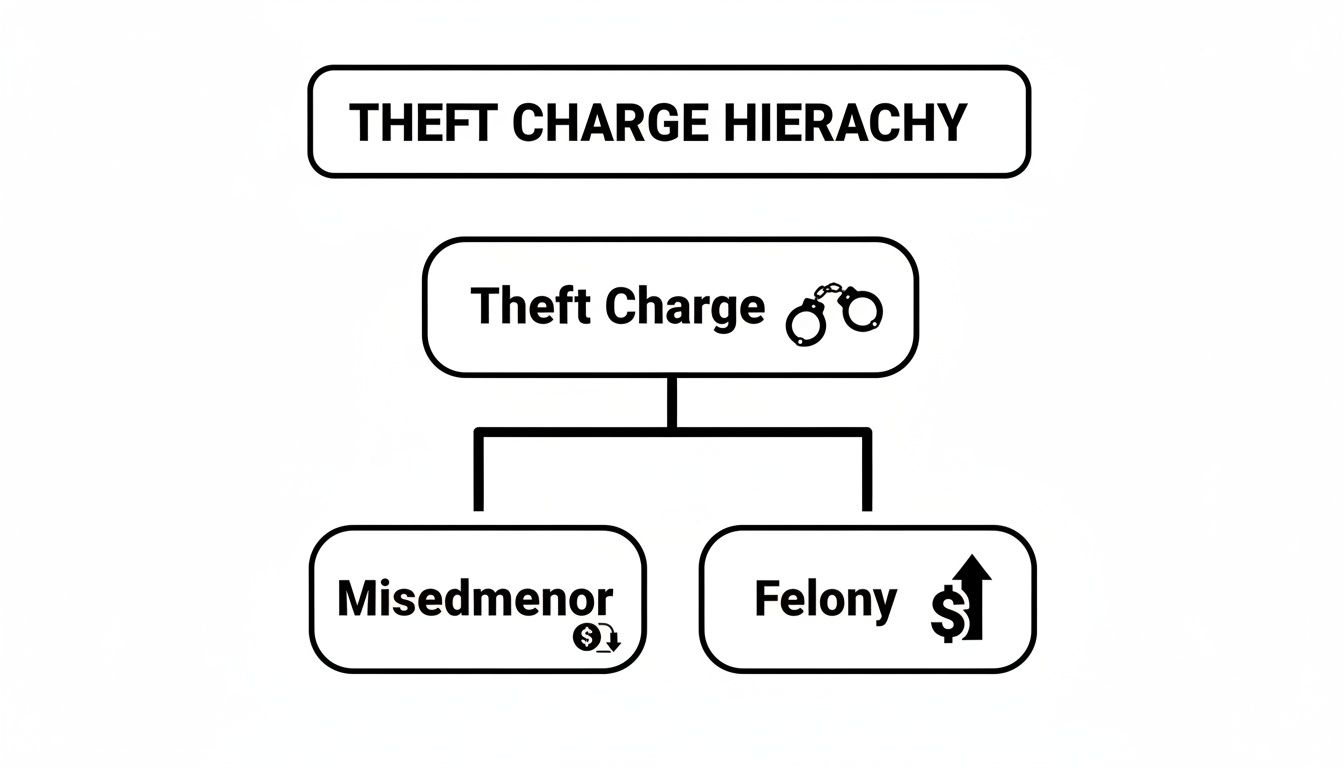
As you can see, the legal system has a clear ladder. The financial value is the key that unlocks the much more severe felony rungs.
Texas Felony Theft Value Thresholds and Penalties
In Texas, a theft charge officially becomes a felony when the value of the stolen property reaches $2,500. Anything less than that is typically a misdemeanor, which is still a serious matter but doesn't carry the same devastating long-term consequences.
To give you a clearer idea, here’s a breakdown of the felony theft levels and what they mean for you.
| Value of Stolen Property | Offense Level | Potential Prison Time |
|---|---|---|
| $2,500 to < $30,000 | State Jail Felony | 180 days to 2 years in a state jail facility |
| $30,000 to < $150,000 | Third-Degree Felony | 2 to 10 years in prison |
| $150,000 to < $300,000 | Second-Degree Felony | 2 to 20 years in prison |
| $300,000 or more | First-Degree Felony | 5 to 99 years (or life) in prison |
These penalties show just how quickly the stakes get higher. It's crucial to understand what a felony in Texas means for your future, as a conviction can affect your right to vote, own a firearm, and secure employment for the rest of your life.
Remember, the value assigned by the police or prosecutor isn’t the final word. A skilled defense attorney knows how to challenge these valuations. Was the property new or used? Is there proof of its market value, or is the number just an estimate? Poking holes in the state’s valuation is often one of the most effective ways to fight a felony theft charge. Successfully lowering the value can get a felony knocked down to a misdemeanor—or even lead to a full dismissal.
Understanding Felony Theft Levels and Penalties in Texas

So, you know the value of the property is what pushes a theft charge from a misdemeanor into the felony zone. But what does that really mean for you? This is where Texas law gets specific, breaking down felony theft into different levels, or “tiers,” based on those dollar amounts.
Each tier comes with its own set of penalties, and the jumps between them are steep. You could be looking at anything from a few months in a state jail to decades—or even life—in prison. It's an intimidating system, no doubt. But understanding exactly what you're up against is the first step toward building a smart defense. Let's break down these levels in plain English.
State Jail Felony Theft
This is the entry point for felony theft charges in Texas. A theft case becomes a State Jail Felony when the value of the allegedly stolen property is $2,500 or more but less than $30,000.
What does a state jail felony conviction mean?
- Jail Time: You could face 180 days to two years in a state jail facility. It’s important to know that state jail is a different system from county jail or prison, with its own rules and programs.
- Fines: The court can also impose a fine of up to $10,000.
This charge often covers things like stealing a used car, high-end electronics, or expensive jewelry. Even if the act was non-violent and no one got hurt, the dollar value alone is enough to trigger these serious felony consequences.
Third-Degree Felony Theft
The stakes get much higher when a charge is elevated to a Third-Degree Felony. This happens when the value of the stolen property is between $30,000 and $150,000.
A Third-Degree Felony conviction carries a prison sentence of two to 10 years in a Texas Department of Criminal Justice (TDCJ) facility, plus a potential fine of up to $10,000.
We often see this charge in cases involving embezzlement from a company over several months, the theft of a high-end vehicle, or stealing valuable construction equipment. That jump from a maximum of two years for a state jail felony to a potential ten-year prison sentence shows just how seriously Texas treats higher-value theft.
Second-Degree Felony Theft
A Second-Degree Felony theft charge is extremely serious, involving property valued between $150,000 and $300,000. The penalties at this level are truly life-altering and reflect the massive financial loss the state will claim you caused.
A conviction for a second-degree felony can lead to:
- Prison Time: A sentence ranging from two to 20 years in a state prison.
- Fines: A fine of up to $10,000.
These cases typically involve major fraud schemes, sophisticated embezzlement operations, or the theft of incredibly valuable assets. With two decades of your life on the line, you need an aggressive, detail-oriented defense from the moment you're charged.
First-Degree Felony Theft
This is the most severe theft charge under Texas law. A First-Degree Felony is charged when the value of the stolen property is $300,000 or more. If you're facing this allegation, you need to understand that a conviction carries the harshest penalties possible for theft. You can learn more about what a first-degree felony in Texas truly means and why a powerful defense is so critical.
A conviction can result in a prison sentence of five to 99 years (or life) and a fine of up to $10,000. These charges are reserved for huge, complex criminal operations, major white-collar crimes, or the theft of priceless assets. Facing a first-degree felony isn't just a court case; it's a fight for your entire future. Having an experienced legal team in your corner isn't just a good idea—it's non-negotiable.
Common Examples of Felony Theft in Texas
Knowing the dollar amounts and legal tiers is one thing, but how does a felony theft charge actually play out in the real world? It’s not just about a number on a price tag. A prosecutor’s case is built on specific actions they believe fit the crime.
Let's connect the dots between the legal definitions and the common situations that land people in court. Seeing how these accusations take shape is the first step in understanding how to defend against them. Felony theft in Texas can range from complex white-collar schemes to something as simple as taking a single, high-value item. You might be surprised at what qualifies.
Motor Vehicle Theft a Major Issue
One of the most common felony theft charges in Texas is motor vehicle theft. Think about it: the value of most cars, trucks, or SUVs easily blows past the $2,500 minimum for a felony. That means taking a vehicle without permission will almost always lead to a State Jail Felony charge, if not something more serious.
This isn't a small problem—it's a massive issue across the state. Texas now ranks second in the nation for stolen vehicles, trailing only California. The Houston-The Woodlands-Sugar Land metro area has the fourth-highest car theft rate in the U.S., with thefts jumping 7% from 2022 to 2023. In the Dallas-Fort Worth-Arlington area, over 34,000 vehicles were stolen, a 13% spike. You can dig deeper into these numbers by reviewing the latest car theft reports.
Theft of a Firearm
Another charge that prosecutors and judges take very seriously is the theft of a firearm. Under the Texas Penal Code, stealing a gun is automatically a State Jail Felony, no matter its dollar value. It doesn't matter if it's a rusty hunting rifle from a pawn shop or a top-of-the-line pistol.
The law treats firearm theft with special severity due to the inherent danger associated with a stolen weapon. A conviction carries a sentence of 180 days to two years in a state jail facility, even for a first-time offender.
Embezzlement and White-Collar Crimes
Felony theft isn’t always a quick grab-and-go. Many cases are built on a breach of trust, falling under the wide umbrella of white-collar crime. These often involve theft that occurs over a long period.
Practical advice for people facing these charges includes:
- Embezzlement: An accountant or bookkeeper in a trusted position slowly siphons company funds into their own bank account.
- Theft by a Public Servant: A government official abuses their position to steal public money or property, which can trigger even tougher penalties.
- Contractor Fraud: A classic scenario where a contractor takes a huge down payment for a big project, like a home remodel, then vanishes without doing the work.
In these cases, the total value stolen might accumulate over months or even years. Prosecutors will often add up the amounts from every single transaction to push the charge into a higher felony category.
Understanding Important Legal Distinctions
It’s also critical to understand how felony theft is different from other, similar-sounding property crimes. A common point of confusion is the line between theft and burglary.
- Theft is the act of actually taking someone's property without permission.
- Burglary is the act of entering a building or home without permission with the intent to commit a felony, theft, or assault inside.
You can be charged with burglary even if you don't end up stealing anything. The crime is the illegal entry combined with your intent. If you break in and steal something, you could easily be facing charges for both burglary and theft.
Finally, prosecutors can use "enhancements" to turn a minor charge into a major one. For instance, if you have two or more prior theft convictions on your record, even a simple misdemeanor shoplifting case can be enhanced to a State Jail Felony. Your criminal history plays a massive role in how your case is handled, which is why having an experienced defense attorney in your corner is non-negotiable.
What Happens After a Felony Theft Arrest: A Step-by-Step Guide
An arrest for felony theft can make your world spin out of control. One minute, things are normal; the next, you're in handcuffs, and your future feels uncertain. This section is designed to cut through the chaos and give you a clear, step-by-step roadmap of the Texas legal process.
Knowing what to expect won't make the charges disappear, but it can give you back a sense of control. You have rights at every stage, and understanding them is the first step toward building a strong defense.
The First 48 Hours: From Arrest to Booking
The clock starts ticking the second you're arrested. You’ll be transported to a local jail for booking, which involves taking your fingerprints, photo, and personal details. It’s an intimidating process, but there’s one thing you absolutely must remember: you have the right to remain silent.
Police are trained to ask questions designed to get you to incriminate yourself. You only have to provide basic identifying information like your name, address, and date of birth. Beyond that, politely but firmly state that you want to speak with an attorney and say nothing else.
Under Texas law, you must be brought before a magistrate judge within 48 hours of your arrest. Until then, you will be held in jail.
Your First Court Appearance: Arraignment and Bail
That initial hearing before the magistrate is called an arraignment. This is not your trial. The judge's job here is strictly to:
- Formally read the felony theft charges filed against you.
- Inform you of your constitutional rights, especially your right to a lawyer.
- Set your bail amount.
Bail is money you pay to the court to secure your release from jail while the case moves forward. A judge sets bail based on the charge's severity, your criminal history, and whether you're considered a flight risk. This is the first opportunity for a defense attorney to make a real difference by arguing for a lower bail amount or even a personal recognizance (PR) bond, which lets you out with just a promise to return to court.
The Path Forward: Plea Bargaining, Trial, and Sentencing
Once you’re out on bail, the real work of your defense begins. Most people assume every criminal case ends in a dramatic trial, but the overwhelming majority of cases, including felony theft charges in Texas, are resolved through plea bargaining.
In fact, new felony theft filings hit 37,521 in fiscal year 2020. With court clearance rates reaching 114% that same year, the system is built to resolve cases quickly, often through pleas or dismissals. You can dig into these numbers yourself in the state's official court statistics.
A plea bargain is a negotiation between your lawyer and the prosecutor. Here’s how it generally plays out:
- Investigation and Discovery: Your attorney will file a formal request for all the evidence the State has against you. This process, called "discovery," includes everything from police reports and witness statements to surveillance footage and documents used to calculate the property's value.
- Finding the Weaknesses: A good defense lawyer pores over this evidence, looking for holes in the prosecutor's case. Was the property value exaggerated? Can they actually prove you intended to steal it? Were there constitutional violations, like an illegal search and seizure?
- Negotiation: Armed with these weaknesses, your attorney goes to the negotiating table. The goal might be a full dismissal, a reduction from a felony to a misdemeanor, or a sentence that involves probation instead of prison time.
If you and your attorney can't reach a fair plea deal, your case will be set for trial. This is where your lawyer will stand up in court and fight to show a judge or jury that the State cannot prove its case beyond a reasonable doubt. If a conviction occurs, the final step is sentencing, where the judge determines the penalty.
How to Build a Strong Defense Against Your Charges

When you’re facing a felony theft charge, it can feel like the entire weight of the state is against you. An accusation is not a conviction. Many cases that seem airtight at first are actually full of holes.
Your future depends on poking those holes and building a defense that tells your side of the story. The burden of proof is always on the prosecutor, and an experienced attorney knows exactly how to dismantle their narrative, piece by piece.
Challenging the Prosecutor’s Case
Every strong defense starts with one simple question: can the state actually prove its case? A prosecutor has to convince a jury of every single element of the crime, and there are several key areas where their arguments can unravel.
- Lack of Intent: The state has to prove you intended to steal. Maybe you borrowed something fully planning to give it back. Perhaps you were distracted and genuinely forgot to pay for an item. If there was no criminal intent, there’s no crime.
- Consent from the Owner: You can't be guilty of theft if the owner gave you permission to have the property. This defense is common in messy disputes between former business partners, friends, or family members where the lines of ownership got blurry.
- Mistaken Identity: Was it really you? Grainy security footage or a bad description from an eyewitness can lead to a false accusation. A good lawyer will immediately challenge the identification process and fight to show you weren’t involved.
These are just a handful of the angles a skilled defense attorney can pursue. Your case is unique, and a deep investigation is the only way to find the strategy that will protect you.
The Critical Role of Property Valuation
Since the severity of a Texas theft charge comes down to the property’s value, attacking that number is often the most powerful defense you have. Prosecutors will almost always use an inflated retail price or a biased estimate to try and push a case into a higher felony category.
An attorney can fight back by arguing for the property's fair market value. For example, if you’re accused of stealing a five-year-old piece of equipment, its value isn't what it cost when it was new—it's what someone would have paid for it at the time of the alleged theft.
We can hire an expert appraiser to provide an independent, professional opinion on the item's true worth. If we can prove the value is below the $2,500 felony threshold, the entire case can change. A felony charge could be reduced to a misdemeanor or thrown out completely.
Texas courts are flooded with property crime cases—there were 690,660 incidents in 2022 alone. With prosecutors under pressure to close cases, an attorney who knows how to challenge the state’s evidence can give you a significant advantage. To see these trends yourself, you can explore crime data from the Texas Department of Public Safety. A smart defense leverages every tool available to protect your future.
Protecting Your Record and Your Future: Post-Conviction Relief
A criminal charge doesn't end when you walk out of the courtroom. A public record of your arrest or conviction can follow you everywhere, creating roadblocks to jobs, housing, and education.
But one mistake shouldn't define your entire future. In Texas, the law provides powerful tools to help you move on and clear your name. We don't just fight for you in court; our goal is to help you protect the life you've worked so hard to build. After a felony theft arrest, understanding your options for removing arrest records online is a critical step in safeguarding your reputation.
Expunctions vs. Orders of Nondisclosure
Texas law offers two main paths to clean up a criminal record: expunctions and orders of nondisclosure. They might sound similar, but they do very different things and apply to completely different outcomes. Knowing which one you might qualify for is the key to reclaiming your life.
Expunction: Think of an expunction as hitting the "delete" button on your arrest record. If a judge grants an expunction, all records of the case are physically destroyed. You can then legally deny the arrest ever happened. It's the most complete way to clear your name.
Order of Nondisclosure: This is more like sealing the record away from public view. The records still exist, but they are no longer accessible to the public, including most employers and landlords. However, law enforcement and certain state agencies can still access it.
Who Is Eligible for Post-Conviction Relief?
Here’s the thing: eligibility for an expunction is very specific and narrow. It’s generally only an option if your case was dismissed, you were found not guilty at trial, or you successfully completed a pretrial diversion program. You might also be eligible if you were arrested but never formally charged with a crime.
An order of nondisclosure is the path for people who successfully completed a special kind of probation called deferred adjudication. Once you finish your probation and the mandatory waiting period passes, you can petition the court to have your record sealed.
Figuring out these post-conviction remedies can be just as tricky as fighting the original criminal charge. An experienced attorney can analyze your case, determine if you're eligible, and guide you through the complex process of filing the right petition.
To get a deeper look at how this works, check out our guide on expunging a felony in Texas. Taking this step is critical to making sure a felony theft charge doesn't cast a long shadow over the rest of your life.
Common Questions About Felony Theft Charges

When you're facing a felony theft charge, your mind is probably racing with questions. It’s a scary and confusing time. My goal here is to give you some clear, straightforward answers to the questions I hear most often from clients in your shoes.
I Returned the Property, So Can They Still Charge Me?
Yes, they absolutely can. Returning stolen property doesn't undo the crime in the eyes of the law. The theft was complete the second the property was taken without permission.
Giving the items back is a good thing, and it can definitely help your case. A prosecutor might see it as a sign of remorse, which could lead to a better plea offer or a more lenient sentence. But it is not a get-out-of-jail-free card, and it won’t make the charge disappear on its own. It's a piece of the puzzle your attorney will use to build a defense, not a magic eraser.
Can I Really Go to Jail for a First-Time Felony Theft?
Unfortunately, yes. Any felony theft charge in Texas—from a State Jail Felony all the way up—comes with the possibility of time behind bars, even if you have a perfectly clean record.
For instance, the lowest-level felony theft is a State Jail Felony, which carries 180 days to two years in a state jail facility. However, a good defense attorney can often negotiate for alternatives, especially for first-time offenders. Probation is a common goal, and it's much more achievable with a strong legal strategy.
A proactive defense is your best shot at avoiding jail. An experienced attorney can fight to get the charges reduced, negotiate for a type of probation that keeps a conviction off your record, or even get the case thrown out entirely.
How Will My Prior Record Impact This New Theft Charge?
A prior criminal record makes everything more difficult. Prosecutors and judges look at your history when they set bail, decide what kind of plea deal to offer, and determine a sentence.
Texas law also has specific "enhancement" statutes that can turn a small problem into a huge one. If you have two or more prior theft convictions on your record, even a new, low-value shoplifting case can be automatically bumped up to a State Jail Felony. This is why fighting every single charge is so important—what seems like a minor conviction today can create major headaches down the road.
What Happens if I Can’t Afford to Pay Restitution?
Restitution—paying the victim back for the value of what was stolen—is almost always a condition of probation. If you genuinely can't afford to pay it, it’s crucial that your lawyer makes that clear to the judge.
The court can't just throw you in jail because you're poor. A judge is required to hold a hearing to determine if you have the ability to pay. Your attorney can present your financial situation and work to negotiate a payment plan you can actually manage or find other ways to satisfy the requirement. Don’t just ignore it; let your lawyer handle it.
If you’ve been charged with a crime in Texas, call The Law Office of Bryan Fagan, PLLC for a free and confidential consultation. Our defense team is ready to protect your rights. https://texascriminallawyer.net