Being arrested or facing threats of family violence can be terrifying — but you don’t have to face it alone. The Texas legal system offers a powerful tool to help you reclaim your safety: the protective order. Understanding your rights and options is the first step toward taking back control.
While many people use the term "restraining order," in Texas, the correct legal tool for protection against violence, stalking, or harassment is a protective order. Getting one hinges on a key requirement: you must show a judge that family violence, stalking, or sexual assault has already occurred and is likely to happen again. While this is a high bar, it provides a legally enforceable shield for those who need it most.

Your First Step Towards Safety in Texas
Navigating the legal world while under threat is daunting. We understand. A protective order is not just a piece of paper; it’s a direct command from a judge that creates a legal boundary. If the other person crosses that line, they can be arrested on the spot and face serious criminal penalties, including jail time.
Our goal is to strip away the legal jargon and give you a clear, compassionate roadmap. In this guide, we'll explain the exact requirements for a protective order in Texas, the different types available, and the evidence you'll need to build a strong case. We're here to empower you with the knowledge to act decisively and protect yourself and your family.
Understanding the Purpose of a Protective Order
Think of a protective order as a legal forcefield. The court customizes it to your specific situation, but its core purpose is always to prevent future harm by setting firm, non-negotiable rules for the other person.
These rules often include:
- No Contact: Prohibiting any communication, whether by phone, text, email, or social media.
- Stay Away: Ordering the person to keep a specific distance from your home, workplace, and your children's school or daycare.
- No Firearms: Forbidding the person from legally possessing a gun while the order is in effect.
- Kick-Out Orders: In some cases, temporarily removing the person from a home you share.
The Emotional Toll and Finding Support
Taking legal action is a huge step, but it’s often just one piece of the puzzle. The emotional and psychological weight of harassment, violence, or stalking is immense. A true safety plan addresses both your legal needs and your personal well-being.
That’s why, in addition to seeking legal protection, looking into private counselling options can be a game-changer. Having a professional to guide you through the emotional fallout provides a crucial layer of support as you navigate this process and begin to heal.
A protective order is more than just a piece of paper; it's a declaration that you have the right to be safe. The Texas legal system provides this path to protect you and your family from further harm.
To help you get started, here's a quick look at the main types of protective orders available in Texas.
Texas Protective Orders at a Glance
This table gives you a snapshot of the different orders, what they're for, and how long they typically last.
| Type of Order | Primary Purpose | Typical Duration |
|---|---|---|
| Temporary Ex Parte Order | Immediate, emergency protection before a full hearing. | Up to 20 days, can be extended. |
| Final Protective Order | Long-term protection granted after a court hearing with both sides present. | Up to 2 years; can be longer for serious felonies. |
| Magistrate's Order (MEPO) | Issued by a judge after a family violence arrest to protect the victim. | Between 31 and 91 days, depending on the case. |
Understanding these distinctions is the first step. Next, we’ll dive into who qualifies for an order, the specific evidence you'll need, and the exact steps for filing. Remember, you have every right to feel safe, and our team is here to help you get there.
Do You Qualify for a Protective Order in Texas?
Before you can file for a protective order, you must be sure your situation meets the legal standards set by Texas law. The courts don’t hand these out lightly. You have to provide evidence that a specific type of harm has already happened and is likely to happen again.
Let's break down exactly what the restraining order requirements Texas courts are looking for.
What Is Family Violence in Texas?
The main reason most protective orders are granted in Texas is family violence. This isn't just about physical fights—the legal definition is much broader.
Under Chapter 71 of the Texas Family Code, family violence is defined as an act against a family member intended to cause physical harm, injury, assault, or sexual assault. Crucially, it also includes a threat that places that family member in fear of imminent harm.
This is a critical point. Even if you haven't been physically hurt, a credible threat that makes you genuinely fear for your safety can be enough to qualify. A judge's primary goal is to prevent future violence, not just to punish past acts.
To get a family violence protective order, you must also meet a key relationship requirement. Texas law is very specific about who qualifies as a "family member."
You generally qualify if the person you need protection from is:
- Your current or former spouse.
- Someone with whom you have a child, whether you were married or not.
- A blood relative (like a parent, child, or sibling) or a relative by marriage (like a father-in-law).
- A current or former roommate or someone living in the same household.
- Someone you are in, or were previously in, a dating relationship with.
The term 'dating relationship' isn't just a casual label. The Texas Family Code defines it as a continuing relationship of a romantic or intimate nature. A judge will consider the length of the relationship, its nature, and how often you interacted to determine if it qualifies.
Protection Beyond Family Violence
What happens if the person threatening you isn't a family member or someone you dated? The Texas Code of Criminal Procedure provides other options for protection in cases of stalking, sexual assault, and human trafficking.
If you are a victim of one of these crimes, you can seek a protective order regardless of your relationship with the offender. This is a crucial safeguard for people being harassed or threatened by strangers, acquaintances, or coworkers.
Key Grounds for Seeking a Protective Order
- Stalking: This is a pattern of conduct directed at you that would cause a reasonable person to feel frightened, intimidated, or threatened. It could involve someone repeatedly following you, watching your home, or sending a stream of unwanted messages.
- Sexual Assault or Abuse: If you are the victim of a sexual offense, you can apply for a protective order to stop the offender from contacting you or causing any more harm.
- Human Trafficking: Texas law gives victims of trafficking specific rights to protection, and a protective order is one of the most powerful tools available to ensure their safety.
Understanding these requirements is the first step. For example, if an ex-partner you never lived with starts showing up at your work and sending threatening texts, you could qualify for an order based on stalking, even if your relationship doesn't meet the legal definition of "dating." However, a neighbor who is merely a nuisance without making threats would likely not qualify. Proving a real, ongoing threat is key, and speaking with an experienced Houston criminal lawyer can clarify your options.
The Different Types of Texas Protective Orders
When you're facing a threat, knowing your legal options is the first step toward safety. The Texas legal system offers different kinds of protective orders, each designed for a specific situation and timeline. Choosing the right one is about matching the tool to your immediate needs and long-term goals.
Let's break down the three main types of protective orders available in Texas. Understanding how they work, and when to use them, will give you a clear path forward.
Temporary Ex Parte Protective Order: The Emergency Shield
Imagine you're in immediate danger and need protection right now, not in a few weeks. This is exactly what a Temporary Ex Parte Protective Order is for. It’s an emergency measure a judge can grant quickly, sometimes on the same day you file, based only on your side of the story. The other person—the Respondent—is not present for this initial decision.
To get one, you must convince the judge there is a “clear and present danger” of family violence. This order acts as an immediate shield, typically lasting for up to 20 days. Its sole purpose is to keep you safe until the court can schedule a full hearing where both sides can present their case.
Final Protective Order: The Long-Term Solution
After a temporary order is issued, the court sets a date for a formal hearing. This is your opportunity to request a Final Protective Order. Unlike the temporary order, this is a more permanent solution. It's granted only after a full court hearing where the Respondent has the chance to appear and defend themselves.
At this hearing, the burden is on you to prove that family violence has occurred and is likely to happen again. If the judge agrees, they can issue a Final Protective Order that lasts for up to two years. In certain serious felony cases, a judge can even make the order last for a lifetime, creating a permanent legal barrier.
Magistrate’s Emergency Protective Order (MEPO)
The third type is the Magistrate’s Emergency Protective Order, often called a MEPO. This is different because it comes from a criminal court judge, usually right after someone is arrested for a crime involving family violence, stalking, or sexual assault. You can learn more about the specific conditions for an Emergency Protective Order in our article.
A MEPO is typically requested by the police, the prosecutor, or the victim at the time of the arrest. It's designed to protect the victim while the criminal case moves forward. These orders are mandatory in some situations—like when an abuser causes serious bodily injury—and generally last between 31 and 91 days.
This flowchart maps out the typical journey from an emergency situation to a final, more durable order.
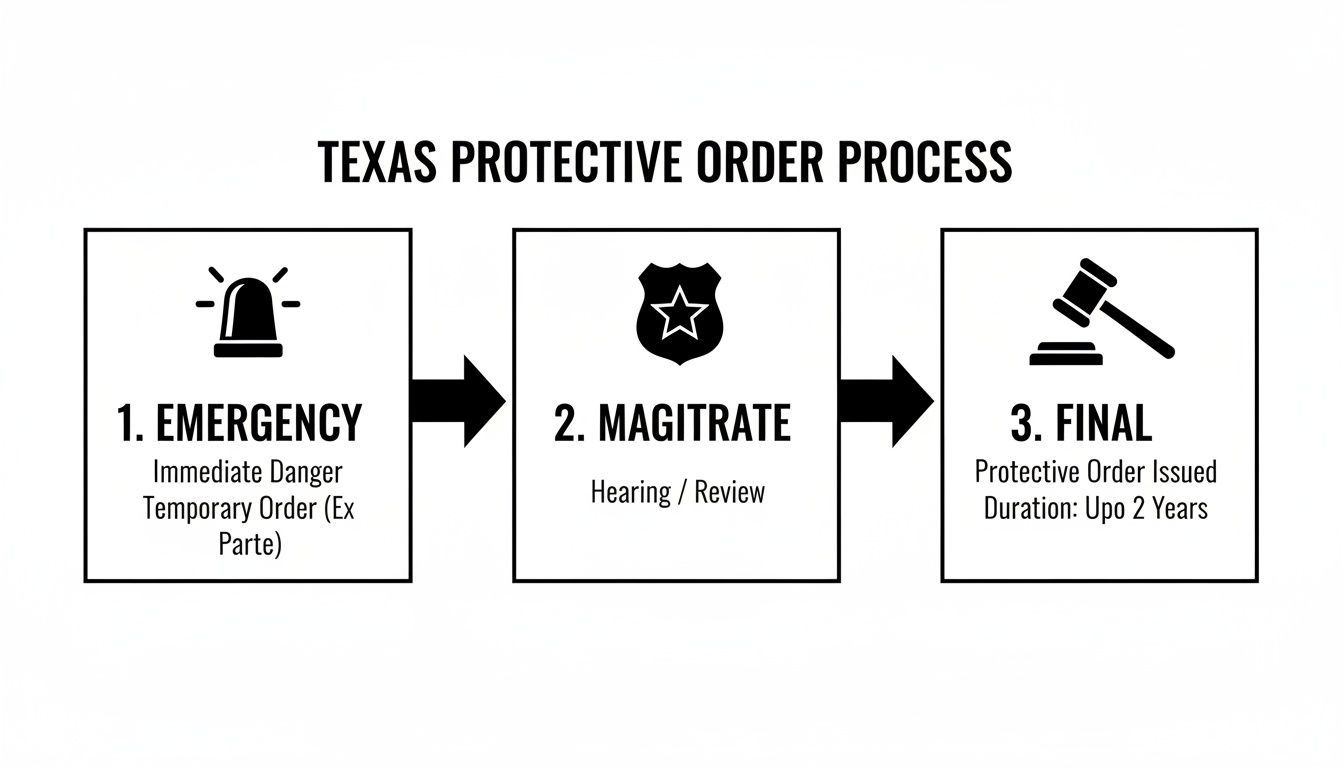
As you can see, the system provides both immediate and long-term tools to help ensure your safety. It starts with emergency measures and can lead to a more lasting solution after everyone has had their day in court.
How to File for a Protective Order Step by Step

When you're dealing with threats or violence, you need a clear, step-by-step path to safety, not a complicated legal maze. This practical advice outlines the roadmap for filing a protective order in Texas, from gathering evidence to your day in court.
It all starts long before you set foot in a courthouse. Your first move is to build the foundation of your case with solid proof.
Step 1: Gather Your Evidence
Before you fill out a single form, your job is to become a detective for your own safety. A judge needs clear evidence that family violence or stalking has occurred and is likely to happen again. Your evidence tells that story.
Collect anything that backs up your claims, such as:
- Police Reports: If you have called law enforcement, these official reports are crucial. Get copies.
- Photos and Videos: Pictures of injuries, damaged property, or videos of threatening behavior can be powerful.
- Threatening Messages: Save every text, email, voicemail, and social media message. Take screenshots and do not delete anything.
- A Detailed Journal: Log every incident with the date, time, location, what was said and done, and any witnesses. Details matter.
The more proof you document, the stronger your application becomes.
Step 2: Complete the Application and Affidavit
With your evidence organized, it’s time to complete the paperwork. The two most important documents are the Application for Protective Order and your Affidavit. The Application is the formal court document where you officially request protection.
Your affidavit is your sworn, written testimony.
Your Affidavit is the heart of your entire case. It's your opportunity to tell the judge, under oath, exactly what you've been through. Be specific, be honest, and leave nothing out.
Use your evidence here. Instead of saying, “He was mean,” you write, “On October 5, 2023, he sent me a text that said, ‘You’ll be sorry if you ever leave,’ and then showed up at my work an hour later.” Specifics make your story credible.
Step 3: File and Serve the Documents
Once your application and affidavit are ready, you’ll file them with the district or county court clerk where you or the other person lives. If you’re in a major metro area, knowing the local rules is a big help. For example, our guide to getting a Dallas County protective order breaks down the specifics for that jurisdiction.
The good news? There are no filing fees for protective orders involving family violence in Texas.
After filing, the other party—the Respondent—must be officially notified. This is a crucial legal step called service of process. You cannot just hand them the papers yourself. A constable, sheriff, or a licensed private process server must deliver the documents to ensure the Respondent is legally aware of the case and the court date.
Step 4: Prepare for Your Court Hearing
Once the Respondent is served, the court will schedule a hearing, typically within 14 days. This is your day in court—your chance to stand before the judge, present your evidence, and testify.
Use the time leading up to the hearing to prepare. Review your affidavit, organize your evidence, and think through how you will explain your story clearly and calmly. While you can represent yourself, having an experienced Texas criminal defense attorney who understands courtroom procedure can make all the difference in getting the protection you deserve.
What to Expect at Your Protective Order Hearing
The court hearing is the moment of truth. This is where a judge decides whether to grant a final protective order, and showing up prepared is essential. Walking into a courtroom can be intimidating, but understanding what to expect can help you feel more in control.
Your mission is to prove your case by a "preponderance of the evidence." This legal phrase simply means you have to show that it’s more likely than not that family violence occurred and is likely to happen again. Think of it as tipping the scales of justice just past the 50% mark in your favor.
The Flow of the Hearing
Courtrooms follow a specific script. Knowing the sequence of events can reduce anxiety.
As the person asking for the order, you're the Petitioner, and you will go first. You’ll need to do three main things:
- Give Your Testimony: You’ll be sworn in and then tell the judge what happened in your own words.
- Present Your Evidence: This is where you show the judge the proof you’ve gathered—such as threatening texts, photos, or police reports.
- Call Your Witnesses: If others saw the abuse or threats firsthand, they can take the stand and testify for you.
After you have presented your side, the other person, called the Respondent, gets their turn. They have the same rights: they can testify, present their own evidence, and call witnesses to try to disprove your claims.
The Judge’s Role and Evidence That Actually Works
The judge’s job is to be an impartial fact-finder. They will listen to both sides and may ask very direct questions to get a clear picture of the situation. It is absolutely critical to stick to the facts and answer every question honestly.
When it comes to evidence, specifics are everything. A detailed log of incidents, paired with screenshots of harassing messages, carries far more weight than simply saying "he threatened me a lot." This is why we advise clients to document everything.
The urgency can’t be overstated. Tragically, 76 percent of women murdered by an intimate partner were stalked first, according to the Texas Advocacy Project. This chilling data shows why it's so important to act immediately. Filing right after an incident reinforces the reality of the danger you're in.
A judge is looking for a clear, credible story backed by proof. The more organized and specific your evidence is, the more persuasive your case will be.
What Happens After the Judge's Decision
If the judge agrees with you and grants the final protective order, it will be written down, signed, and become legally binding. The order will spell out exactly what the Respondent is forbidden from doing.
This often includes:
- A total ban on contacting you in any way—no calls, texts, emails, or social media messages.
- A requirement to stay a certain distance from your home, job, and your kids' schools.
- A prohibition on possessing any firearms for the duration of the order.
If your request is denied, it means the judge felt there wasn't enough evidence to meet the "preponderance" standard. This can be deeply discouraging, but it’s not necessarily the end of the road. An experienced attorney can help you understand why the order was denied and explore other legal options to keep you safe.
Enforcing Your Protective Order After a Violation

Your protective order is more than a piece of paper—it's a legal shield, and its true strength comes from enforcement. This is a direct court order. If the other person ignores the judge's rules, you must act fast to hold them accountable. Your safety depends on it.
The most critical advice is also the most straightforward: if the order is violated, call 911 immediately. Do not hesitate or second-guess yourself. Let the police handle it. When they respond, they create an official report, which becomes undeniable evidence of the violation.
Penalties for Violating a Protective Order
Violating a protective order is a crime in Texas. The legal system has put serious consequences in place to ensure these orders have teeth.
Under the Texas Penal Code Section 25.07, a first-time violation is typically charged as a Class A Misdemeanor. This is a serious offense, punishable by up to one year in jail and a fine of up to $4,000. It also creates a criminal record that follows the person.
The goal behind these penalties is simple: to make the abuser understand that a court order is absolute. Every violation you report sends a clear message that you will not tolerate disrespect for the law or your safety.
When Violations Escalate to a Felony
Some abusers don't get the message after one offense. That's why Texas law increases the penalties for repeat offenders.
If someone violates the order two or more times within a 12-month period, the charge can be elevated to a third-degree felony. The punishment here is far more severe, carrying a sentence of two to ten years in state prison. This major escalation shows just how seriously the courts view a pattern of defiance.
In recent years, courts have sharpened their focus on victim safety. For a deeper dive, you can explore insights on protective order trends from Travis County criminal attorneys. This evolving understanding has led to stronger enforcement.
It is absolutely vital to report every single violation, no matter how small it seems. Each police report builds a legal paper trail that documents the abuser's continued pattern of behavior. This record is your best weapon in future court proceedings and is the key to holding them accountable under these escalating penalty laws.
Common Questions About Texas Protective Orders
When you're dealing with a protective order, the legal process can be overwhelming. Let's clear up some of the most common questions we hear, giving you straightforward answers so you know what to expect.
How Much Does It Cost to Get a Protective Order?
In Texas, it costs nothing to file for a protective order for family violence, stalking, or sexual assault. The law is designed to ensure that financial concerns never stop someone from seeking safety. You will not pay any filing fees or court costs for the application itself.
While you are not required to hire an attorney, trying to handle a hearing alone can be a challenge. An experienced Texas criminal defense lawyer ensures your story is heard, your evidence is presented correctly, and your application is solid. Many firms, including ours, offer a free consultation to discuss your case.
Can the Order Force Someone to Move Out of Our Home?
Yes. A judge can include a "kick-out" provision in the protective order. This is a powerful tool that legally forces the abusive party to leave a shared residence, giving you and any children immediate safety and space.
The order can also create a safety perimeter by forbidding the person from coming within a certain distance of your house, your workplace, or your children's school or daycare. These terms are designed to give you a buffer zone to live your life without fear.
Being served with a protective order is a serious matter with consequences for your reputation, firearm rights, and potential child custody issues. You must take it seriously and act quickly to protect your rights.
What if I Am Falsely Accused and Served with an Order?
Being served with a protective order based on false allegations can be a gut-wrenching experience. But you have the right to fight back. You are legally entitled to attend the hearing and present your side of the story. The first and most critical step is to call a Texas assault defense attorney who has experience with these exact situations.
Your lawyer will immediately start gathering evidence to challenge the claims—this could include text messages, emails, social media posts, or witness testimony that tells your side of the story. It is critical that you never contact the person who filed the order or violate any term of the temporary order. Doing so will only hurt your case and could result in your arrest.
How Is This Different from a Restraining Order in a Divorce?
This is a critical distinction. The core difference is their purpose and the consequences for a violation. A protective order is meant to stop violence, stalking, and harassment. Violating it is a criminal offense under the Texas Penal Code, which can lead to immediate arrest and jail time.
A Temporary Restraining Order (TRO), on the other hand, comes from a family court during a divorce. It sets ground rules for the proceedings, like preventing a spouse from draining a joint bank account. Violating a TRO is a civil issue (contempt of court), not an automatic criminal charge. For more details, you can learn about the differences between a protective order vs. a restraining order in Texas in our in-depth guide.
If you’ve been charged with a crime in Texas, call The Law Office of Bryan Fagan, PLLC for a free and confidential consultation at https://texascriminallawyer.net. Our defense team is ready to protect your rights.