Being arrested in Texas can be terrifying, especially when your first thought isn't jail time. It's your paycheck, your health insurance, your license, or the job interview you had next week. A common immediate question is: Can I lose my job even if I haven't been convicted?
The hard answer is yes, you can face work problems before your case is finished. That's one of the most misunderstood parts of how a criminal charge affects employment in Texas. Employers often learn about arrests and pending charges early, and they may treat that information as a risk issue long before a judge or jury decides the case.
If you're dealing with a DWI, assault allegation, theft accusation, or drug possession charge, panic won't help. A plan will. When you understand what employers can see, what rights you still have, and what steps can protect your record, you can make better decisions right away.
An Arrest Can Threaten Your Job Before Your Case Is Even Heard
You may have been released from jail, driven home in silence, and sat at your kitchen table wondering whether to call your boss in the morning. That fear is real. In many cases, the employment damage starts with the charge itself, not with a conviction months later.

A pending case can affect you in two directions at once. It can create risk with your current employer, and it can block future job opportunities if you're applying elsewhere. A U.S. Treasury and IRS study found that formal labor-sector engagement falls sharply and persistently after a criminal charge, not just a conviction, and that earnings and filing rates also decline after criminal-history events, including charges that do not lead to convictions, according to this Treasury and IRS employment study.
Why the timing feels so unfair
The criminal process moves slower than the typical pace of life. Your arraignment or first court setting may happen quickly, but your case can still take time to resolve through investigation, plea discussions, motions, trial preparation, or dismissal negotiations. Meanwhile, employers make decisions on their own timeline.
If you're new to the system, these stages often come in this order:
- Arrest and booking after an accusation or police investigation.
- Magistration or initial appearance, where issues like bond and basic rights are addressed.
- Arraignment or first formal court appearance, where the charge is presented and the case moves forward.
- Plea bargaining, where your lawyer and the prosecutor may discuss dismissal, reduction, diversion, or another resolution.
- Trial, if the case isn't resolved earlier.
- Sentencing, if there's a conviction or plea that requires punishment.
Common examples people worry about
Some charges create immediate work concerns because employers connect them to job duties:
- DWI or DUI-related arrest: If you drive for work, even a license issue can threaten your position.
- Assault charge: Employers may connect it to workplace safety policies.
- Theft allegation: Jobs involving money, inventory, cards, or customer property often become harder to keep.
- Drug possession case: Employers may worry about safety, reliability, or internal policy violations.
Practical rule: The earlier you start protecting the case, the better chance you have of protecting your livelihood too.
Texas Penal Code allegations carry different labels and penalties depending on the offense. For example, assault charges often arise under Texas Penal Code Section 22.01, theft charges under Section 31.03, and many drug cases are charged under the Texas Controlled Substances Act. The label matters because employers often react to the name of the charge before they understand the facts.
How Employers Discover Criminal Charges in Texas
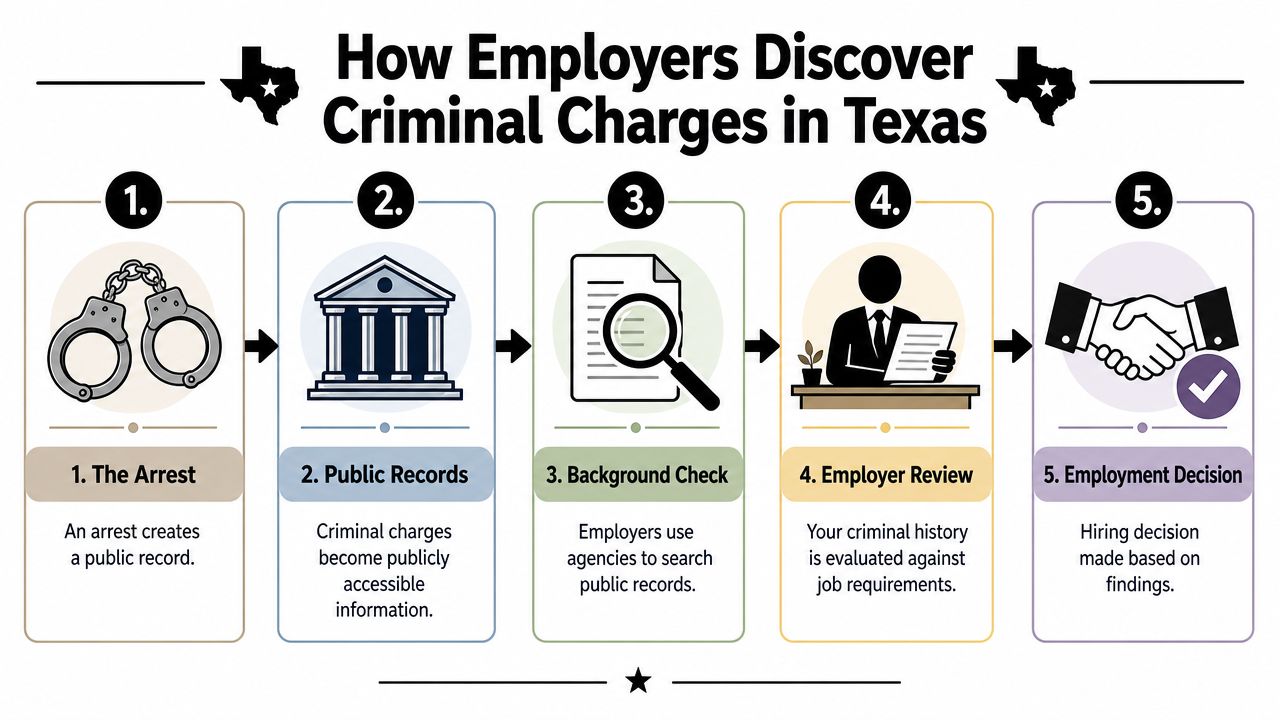
Most employers don't learn about a criminal charge from a courtroom. They usually learn about it through a background check, a public record search, or internal reporting after an arrest becomes known at work.
What the employer may actually see
A lot of people think, "I wasn't convicted, so this shouldn't show up." That's not how the system works in practice.
An employer may see different pieces of information depending on the timing:
| Record type | What it means | Why it matters to employers |
|---|---|---|
| Arrest record | You were taken into custody | It can signal legal trouble even without a conviction |
| Pending charge | The case is still open | Employers may treat it as an unresolved risk |
| Conviction | You were found guilty or pleaded guilty | This usually creates the longest-term background issue |
In Texas, private employers can legally consider arrests, pending charges, and convictions when making hiring decisions, and consumer reporting agencies can report non-conviction criminal history for up to 7 years in many contexts, which means an unresolved charge can disrupt job offers or even current employment long before a case concludes, as explained by this Texas employment background check overview.
How the information moves
The path is usually simple:
- Police create a record when an arrest happens.
- Court systems and public databases reflect the filed case or pending matter.
- Background screening companies pull that information for employers.
- HR or a hiring manager reviews it against the role.
If you want a plain-English look at why many smaller employers rely on screening vendors, this guide on quality background screening for SMBs helps explain the hiring side of the process.
The seven-year point that confuses people
Many Texans hear about a "seven-year rule" and assume old criminal history disappears automatically. It doesn't work that way.
What often confuses people is the difference between what a background-check company may report and what an employer may care about once it learns the information from another lawful source. Also, under federal law, convictions can be reported indefinitely in many situations. That means a charge that later becomes a conviction can create a much longer barrier than a temporary pending case.
If your charge involves violence, employers may pay even closer attention. This is especially true with assault allegations. For a deeper look at how that issue appears in hiring, see this guide on assault charges and Texas background checks.
Employers often don't wait for the criminal court system to finish. They make hiring decisions when they think they have enough information to assess risk.
Your Rights and Employer Limits During the Hiring Process
Texas employers have room to consider criminal history, but that doesn't mean there are no limits at all. The most important protection to understand is that employers are supposed to look at relevance, not just reject everyone with a record.
The EEOC's three-part lens
The Equal Employment Opportunity Commission advises employers to avoid blanket exclusions based on criminal records. Instead, they should assess whether the record is relevant by considering the nature of the job, the nature of the offense, and the time elapsed, as summarized in this Texas legal library background-check guide.
That matters because not every charge says the same thing about every applicant.
Here is how that analysis looks in real life:
- Nature of the job: A bank may react differently to a theft charge than a warehouse doing non-cash work.
- Nature of the offense: An assault allegation raises different concerns than a paperwork-related offense.
- Time elapsed: Recent conduct usually gets more attention than older conduct.
What this means for you in practice
This doesn't create a magic shield. It does mean an employer should think about whether the record connects to the work.
A few examples make that easier to see:
| Job | Charge | Likely employer concern |
|---|---|---|
| Cash-handling retail role | Theft | Trust with money and inventory |
| School or childcare position | Assault | Safety of children and staff |
| Delivery or commercial driving | DWI | Driving duties and insurance issues |
Key point: A criminal charge doesn't automatically make you unemployable. It usually becomes a problem when the employer thinks it fits the job risk.
Ban the Box is narrower than many people think
Some cities such as Austin, San Antonio, and Dallas have Ban the Box rules for city employers that delay criminal-history questions until later in the hiring process. Many people hear that phrase and assume private employers can't ask early. That's often not true.
These local rules generally delay the question. They don't erase the record, and they usually don't stop a later background check.
Check the report, not just the rejection
If an employer uses a consumer reporting agency, errors matter. Wrong dates, dismissed charges listed unclearly, or duplicate entries can all hurt you. If background problems are affecting more than your criminal case, some people also review other parts of their file, such as credit-related reporting, and resources like Superior Credit Repair Birmingham can help explain how reporting issues in other systems can affect applications and approvals generally.
Your lawyer can help you separate three different questions that people often mix together:
- What the report says
- What the employer may legally consider
- What the employer is likely to do anyway
Those are not always the same.
Impact on Professional Licenses and Regulated Jobs
If you hold a professional license, a criminal charge can hit harder and faster. The actual issue often isn't just "employment." It's whether a licensing board, insurer, bonding company, hospital system, school district, or transportation employer decides you're now too risky for that role.

Texas guidance notes that for licensed or regulated jobs, the impact of a charge is often more severe, and some agencies or employers use review windows such as 7 years for felonies in certain hiring contexts, which can trigger automatic review or exclusion from sensitive roles even when the law doesn't flatly bar employment, according to this University of Texas criminal history hiring guide.
Why regulated work is different
A private office may decide whether to hire you. A regulated profession has another decision-maker in the mix.
That can include:
- Licensing boards for nurses, teachers, and other professionals
- Insurance carriers that set risk rules
- Bonding requirements for employees handling funds or property
- Internal compliance departments in hospitals, schools, banks, and government contractors
Examples that often trigger review
Some charges line up closely with job duties:
- A nurse or doctor facing a drug-related charge may trigger safety and patient-care concerns.
- A teacher accused of assault may face review because of student safety issues.
- A commercial driver arrested for DWI may face immediate problems tied to driving duties.
- A real estate or finance professional with a theft or fraud-related allegation may face trust-based objections.
Texas Penal Code classifications and offense descriptions matter here. A misdemeanor may still create a licensing problem if the underlying conduct looks relevant to the profession. A felony allegation raises even more concern because boards and employers may read it as a sign of professional unfitness before the case is resolved.
If your case involves violence and a licensed career, this discussion of how assault allegations can affect a Texas professional license may help you see the overlap between the criminal case and the licensing process.
In regulated work, protecting your case means protecting more than a paycheck. It can mean protecting the license that supports your whole career.
What Happens to Your Current Job After an Arrest
Your current job raises a different problem from a future job search. You're not just filling out applications. You're deciding whether to report the arrest, how much to say, and whether your employer already knows.
Texas is generally an at-will employment state. That means employers often have broad power to make employment decisions for lawful reasons. A pending criminal charge can affect your current job because arrest records are often public, and employers may act on that information, especially when the alleged conduct is job-related or violates company policy, as discussed in this Texas open-case employment article.
Start with your handbook and your role
Before you call your supervisor, check your employee handbook, contract, union materials, or policy portal if you have access to them. Some employers require disclosure after an arrest. Others only require disclosure after a conviction. Some only care if the charge affects your duties.
Look closely at policies involving:
- Driving requirements
- Workplace violence
- Drug and alcohol compliance
- Professional ethics
- Security clearance or sensitive access
When disclosure may become unavoidable
A few situations often force the issue quickly.
If you have a DWI charge and your driver's license is suspended or restricted, you may not be able to do the job. If you're charged with assault, your employer may review workplace safety rules even if the incident happened off the clock. If you're accused of theft, your employer may limit access to cash, keys, inventory, or customer accounts while deciding what to do.
A careful approach usually works better than silence
You don't want to overshare, and you don't want to make admissions that hurt your defense. But hiding the issue until HR learns it from someone else can make things worse.
A practical approach often looks like this:
- Read the policy first so you know whether disclosure is required.
- Talk to your defense lawyer before making a statement to HR.
- Keep it short and factual if disclosure is necessary.
- Don't discuss evidence or guilt with coworkers or managers.
- Document every communication about leave, suspension, or restrictions.
If you've already been arrested, you're also moving through the criminal process itself. Your lawyer should prepare you for the early hearings, possible plea bargaining, trial risks, and sentencing exposure, because each stage can affect work scheduling, travel, and reporting duties.
Cleaning Your Record to Protect Your Livelihood
A lot of people focus on the court date and do not think about the record that follows them afterward. For employment, that record can matter almost as much as the case itself. A dismissed charge can still cause trouble if it stays visible during a background check.
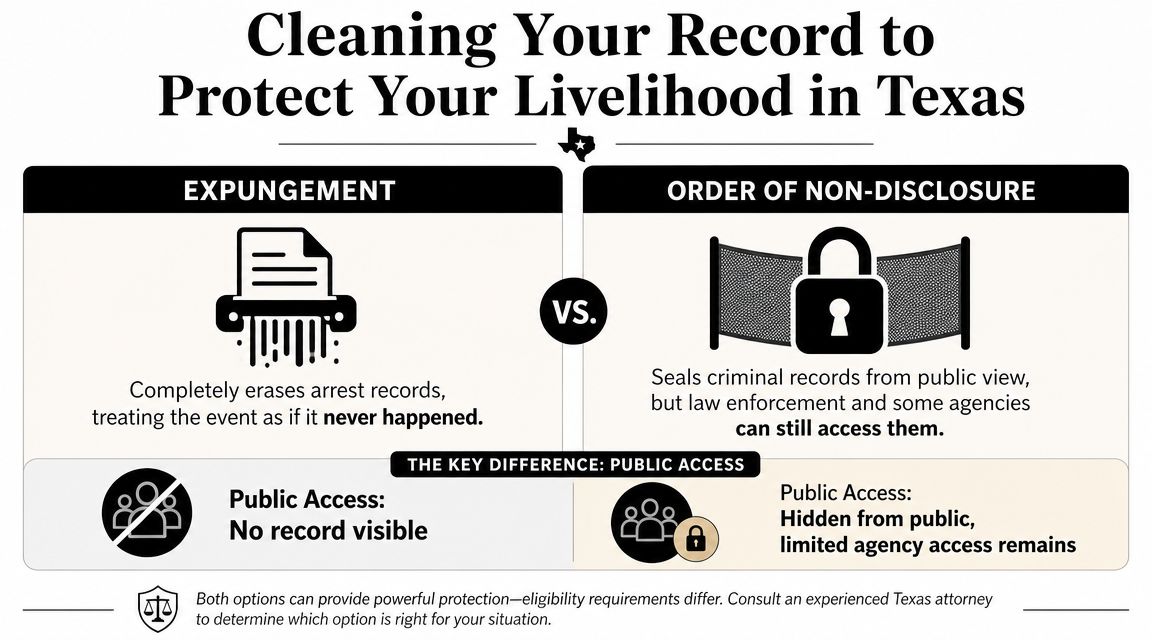
If your case ends in a way that qualifies for relief, Texas law may give you a way to limit what employers can see. The two remedies people ask about most are expunction and an order of nondisclosure. They sound similar, but they do different jobs.
The basic difference
An expunction removes qualifying arrest and case records from public access. An order of nondisclosure seals qualifying records from public view, but some government agencies and certain regulated entities can still see them.
A simple way to understand the difference is this. Expunction is usually the cleaner remedy. Nondisclosure is often a useful fallback when expunction is not available.
That distinction matters for job hunting. A private employer running a standard background check may not see a sealed record, while a licensing board, school district, hospital system, or law enforcement agency may still have access depending on the position and the law involved.
Expunction vs. Order of Nondisclosure in Texas
| Feature | Expunction (Expungement) | Order of Nondisclosure |
|---|---|---|
| Main effect | Removes qualifying records from public access | Seals qualifying records from public view |
| Best fit | Often used when a case was dismissed, you were acquitted, or the matter otherwise qualifies | Often used after certain deferred adjudication outcomes if the law allows it |
| Public background checks | Record generally should not appear once the process is completed | Record is hidden from many public-facing searches, but not all government access |
| Ability to move forward | Strongest option when available | Helpful option when expunction is not available |
Which one may apply
Eligibility depends on the charge, the result, and the path the case took through court. That is where people get tripped up. Two cases that look similar on the surface can lead to very different record-clearing options.
Common examples include:
- Dismissed case: You may be able to seek expunction if the legal requirements are met.
- Acquittal at trial: Expunction may be available.
- Deferred adjudication: In some cases, nondisclosure is the more realistic option.
- Conviction: Relief is narrower, though some post-conviction remedies may still exist.
Why timing matters
Timing can affect your work options more than many people realize. If you are applying for private-sector jobs, cleaning up an eligible record can reduce what appears in future screenings. If you work in a licensed field, the strategy may need to account for what a board can still review even after a case is sealed. If you want a public sector job, especially one involving trust, safety, or access to sensitive information, the exact form of relief matters.
Filing too early, choosing the wrong remedy, or misunderstanding the final outcome can slow the process and keep the record visible longer than necessary.
That is why record cleanup should be part of the legal strategy, not an afterthought. A good defense plan asks not only how to resolve the case, but which result gives you the strongest chance of keeping or getting work.
For Texans reviewing their options after a dismissal or other qualifying outcome, getting a record expunged in Texas is often the next practical step. The Law Office of Bryan Fagan PLLC handles criminal defense matters along with expunctions, nondisclosures, and related post-case relief.
If you are job searching while your case is pending or after it ends, it also helps to stay organized and targeted in your applications. Tools that streamline your job search with AI can make that process easier to manage while you work through the legal side.
The best time to think about clearing your record is often before the case ends, not after you've already accepted an outcome that limits your options.
Your Next Steps and When to Call an Attorney
When you're charged with a crime, small decisions can affect both your case and your career. You don't need to solve everything today. You do need to avoid mistakes that make the situation harder.
Start with these steps
- Stay silent about the facts of the case. Don't explain the incident to police, coworkers, or your employer without legal advice.
- Save every document. Keep bond paperwork, court notices, employer emails, and any notice of suspension or leave.
- Review your workplace policies. Look for reporting rules, driving requirements, and conduct standards.
- Stay off social media. Posts, jokes, screenshots, and comments can all create problems.
- Write down a timeline. Your lawyer will need names, dates, witnesses, and what happened before and after the arrest.
- Get legal help early. Early defense work can affect charging decisions, negotiations, evidence review, and long-term record options.
If you're job hunting while the case is pending
You may also need to think practically about your search. Keep your resume current, line up references, and apply carefully to roles that fit your situation. If you're trying to organize applications while dealing with court dates, tools that help streamline your job search with AI can make the process easier to manage.
A fast legal review matters whether you're facing a misdemeanor or felony. That includes DWI defense, Texas assault defense, theft allegations, drug possession charges, and cases that may affect a professional license. The sooner your attorney starts working, the sooner you can make informed decisions about arraignment, plea discussions, trial strategy, sentencing exposure, and possible post-case relief.
If you've been charged with a crime in Texas, call Law Office of Bryan Fagan PLLC for a free and confidential consultation. Our defense team is ready to protect your rights.