A housing denial can feel like punishment that never ends. You apply, pay the fee, wait for the screening report, and then get a short rejection with almost no explanation. If your case was dismissed, if the charge was old, or if you were arrested but never convicted, that can feel especially unfair.
This is one of the hardest parts of how a criminal record affects housing in Texas. A landlord may look at a record in seconds, but the effect on your family can last much longer. A rejected application can delay a move, separate you from support systems, and make it harder to get back to work, reunite with children, or keep probation and court obligations on track.
The good news is that you aren't powerless. Texas law, federal screening rules, fair housing principles, and record-clearing remedies can all matter here. The key is knowing what type of record you have, what a landlord is likely seeing, and what steps you can take now to reduce the damage.
Your Guide to Finding Housing with a Criminal Record in Texas
Navigating the search for a place to live after an arrest or conviction involves a system that often feels stacked against you. That feeling is real. National estimates show that more than 700,000 people are released from incarceration each year and seek housing, and the United States has more than 1,300 criminal record-related housing barriers. The same research notes that some Texas screening policies look back 10 or more years and may rely on arrest records alone, even without a conviction, as explained by the Legal Defense Fund's review of discriminatory criminal history checks in housing.
That means a housing problem in Texas often starts long before you meet a landlord. The issue isn't just whether you have a record. The issue is what kind of record, how old it is, whether the report is accurate, and whether the landlord uses a blanket rule instead of a fair review.
Start with the right questions
Before you fill out another application, slow the process down and ask:
- What appears on your record: Was it an arrest, a dismissal, deferred adjudication, a misdemeanor conviction, or a felony conviction?
- What housing are you applying for: A private apartment complex and public housing don't follow the same rules.
- What result are you trying to get: Immediate approval, a second-chance rental, or long-term record clearing through court action?
Those questions matter because each one changes your strategy.
Practical rule: Don't treat every denial as final proof that no landlord will rent to you. Often, it means you need a better target, better paperwork, or a legal fix to the record itself.
What actually helps
People usually make more progress when they do three things at the same time:
- Review the record for errors or old non-conviction data
- Apply more selectively so they don't waste money on likely denials
- Look into expunction or nondisclosure if the case qualifies
What doesn't work is guessing. If you don't know whether a landlord denied you for an arrest, conviction, or screening-company mistake, it's hard to challenge the decision or improve the next application.
Understanding Tenant Screening and Background Checks in Texas
A tenant background check isn't one simple file. It can pull from court records, private screening databases, credit history, eviction filings, and other consumer reporting sources. That's why two landlords may react very differently to the same applicant.

Arrest records and convictions are not the same thing
This is one of the most important distinctions in Texas housing cases. A person can be arrested and never convicted. Charges can be dropped. A case can be dismissed. You can complete deferred adjudication and avoid a final conviction in some situations. But screening systems and landlords don't always treat those outcomes with the care they should.
National housing research highlighted by Texas advocates notes that even an arrest record alone can be used as a basis for denial by some housing providers, despite HUD warnings about blanket bans. It also points out that many tenants don't know whether a denial came from an arrest-only report or a conviction record, as discussed by the Thurgood Marshall Institute on criminal background checks as a housing barrier.
That uncertainty matters. If you don't know what was used against you, you can't meaningfully respond.
What reporting rules mean for you
Federal consumer reporting rules matter in the housing context. In plain English, some old arrest information shouldn't keep following you forever in the same way a conviction can. But landlords also make their own decisions, and many screening reports don't explain the difference clearly.
Here is the practical breakdown:
| Record type | Why it matters in housing |
|---|---|
| Arrest only | This can still raise problems, but it should be reviewed carefully because an arrest is not a conviction |
| Dismissed case | You may have stronger grounds to challenge how the record is being used or seek record clearing |
| Conviction | Landlords often treat this as more serious, especially if the offense seems recent or related to safety |
| Deferred adjudication | It may help in criminal court, but it can still affect screening unless you qualify for nondisclosure |
Prepare before the landlord asks
A background check has a lot in common with employment screening. If you want a helpful comparison, see this explanation of how a criminal charge affects employment in Texas. The same lesson applies here. You need to know what others are likely to see before you walk into the conversation.
Use that approach when renting:
- Ask about criteria first: Texas landlords are supposed to disclose screening criteria before taking your fee.
- Request details after a denial: Try to learn whether the issue was an arrest, a conviction, or another record.
- Check for mismatched data: Screening errors happen, and a wrong record can sink an application fast.
A background check is only useful if it's accurate and read in context. Many housing denials happen without either.
Private Rentals vs Public Housing Rules in Texas
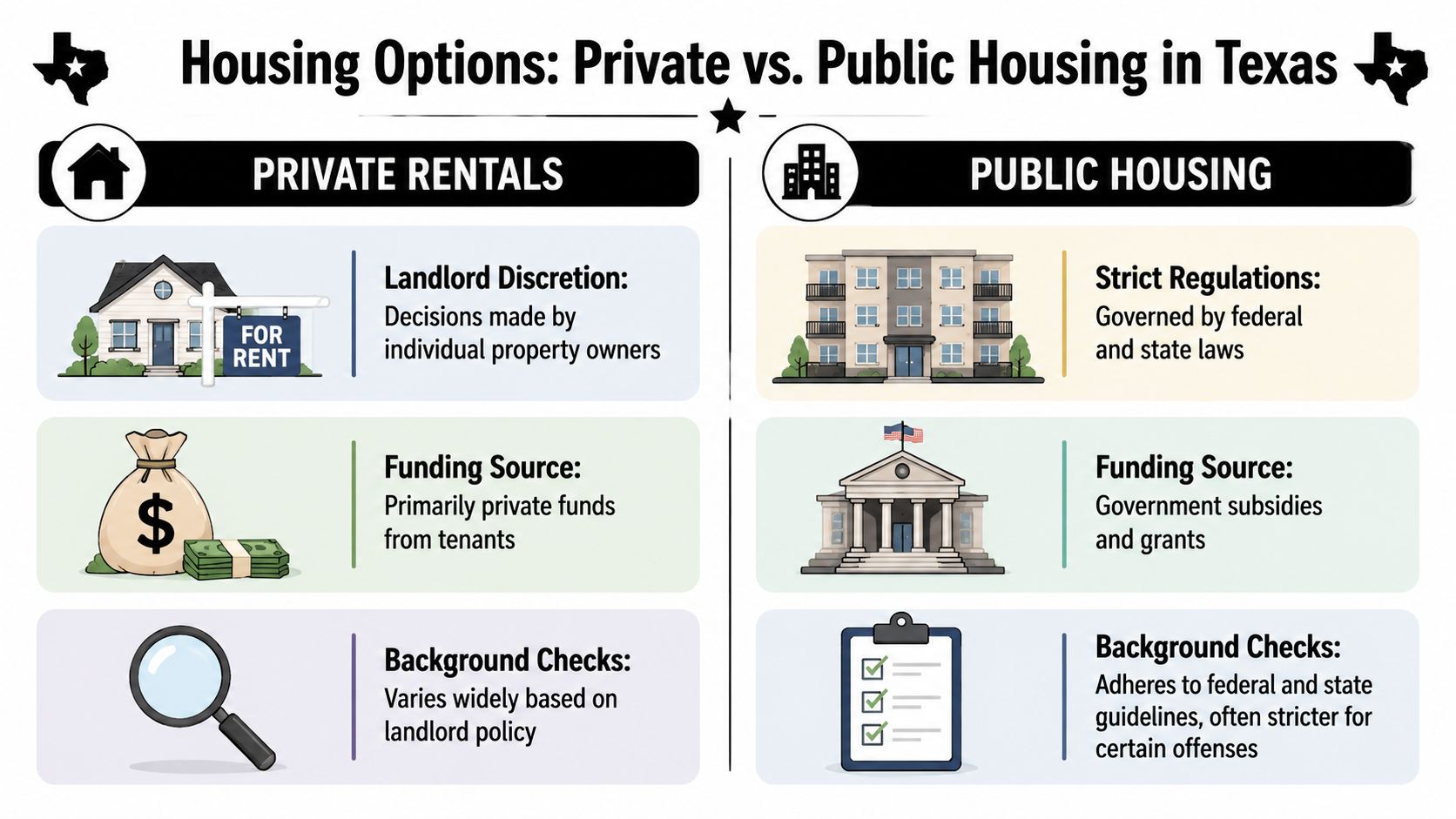
A lot of renters waste time and money because they apply to every opening they see. That's understandable, but it isn't efficient. The better move is to separate the market into private rentals and public or federally assisted housing, because the rules and decision-makers are different.
Private landlords have flexibility, but that cuts both ways
In Texas, private landlords often have broad discretion. Some use strict internal policies. Others will consider context if you speak to them early, provide documents, and show stability. That flexibility can help you if your record is old, limited, or misunderstood.
The risk is that tenant screening is described as largely unregulated in Texas, and renters with old or minor records can face repeated denials and nonrefundable fees. Texas reform advocates also note that state law requires landlords to disclose screening criteria before charging an application fee, though in practice many renters still report problems with that process, as described in this Texas Housers analysis of tenant screening barriers and reform.
For private rentals, the smartest question isn't just "Will they run a background check?" It is "What kind of policy do they apply after they see it?"
Public housing follows stricter program rules
Public housing and federally assisted housing aren't more formal versions of private apartments. They often involve categorical restrictions for certain convictions. That can make approval harder in some cases, even when a private landlord might listen.
Use this comparison when deciding where to focus your effort:
| Housing type | Main decision driver | What this means for you |
|---|---|---|
| Private rental | Individual landlord or property manager policy | More room for explanation, but also more variation |
| Public housing | Program rules plus local authority review | Less flexibility for some offenses, but more structure |
Where applicants usually lose ground
Three mistakes come up over and over:
- Applying blind: You pay a fee before learning the property's criminal-history policy.
- Using the wrong target: You focus on a housing type that is much less likely to accept your record.
- Giving no context: You let the report speak for itself, even when the report doesn't tell the full story.
If you're choosing between options, private rentals sometimes offer more room to negotiate. Public housing can be more rule-driven. Neither path is automatic. Each one requires a different plan.
How Different Offenses Impact Your Housing Search
Landlords don't view every record the same way. A recent felony assault charge is usually treated differently from an old misdemeanor theft case. A DWI may raise one kind of concern. A drug case may raise another. The same is true for charges under the Texas Penal Code involving assault, theft, burglary, or controlled substances.

Time matters more than many people think
The most useful practical point is this. The effect of a record often fades. A housing-policy summary cited by Texas stakeholders reported that the negative housing impact of certain records often faded after about 2 years for misdemeanors and 5 years for felonies, according to the National Low Income Housing Coalition summary on housing access for people with criminal records.
That doesn't mean every landlord will be fair. It does mean an old offense should not be treated as if it happened yesterday.
What landlords often focus on
In practice, housing decisions usually turn on a mix of these factors:
- Recency: A recent case gets more attention than an older one.
- Severity: Felonies usually create more resistance than misdemeanors.
- Perceived safety risk: Assaultive or violent allegations tend to draw stronger reactions.
- Pattern: Several entries can look worse than one isolated event.
- Case outcome: A dismissal, reduction, or deferred result may help if you explain it well.
Texas offense examples in plain English
If you're facing current charges, the type of accusation may affect future housing in different ways:
- A DWI case under the Texas Penal Code and related driving laws may still concern a landlord, but many private landlords care more about whether it was isolated and how long ago it happened.
- An assault allegation can trigger stronger safety concerns, especially if the report doesn't explain whether it was dismissed, reduced, or tied to a family dispute.
- Theft or fraud-related conduct may raise trust concerns in complexes that focus heavily on screening reports.
- Drug possession can create added barriers in housing tied to federal rules.
Older and lower-level cases are often easier to work around when you provide proof of stability, treatment, employment, or successful completion of court requirements.
If you must register as a sex offender, housing can become much more difficult. Location restrictions, landlord hesitation, and program rules can narrow your options quickly. In those cases, a targeted legal and practical plan matters even more.
Clearing Your Record with Expunctions and Nondisclosures
If you qualify to clear or seal your record, this is often the strongest long-term answer. You can keep explaining the past to landlords, or you can work toward making the record far less visible in the first place.
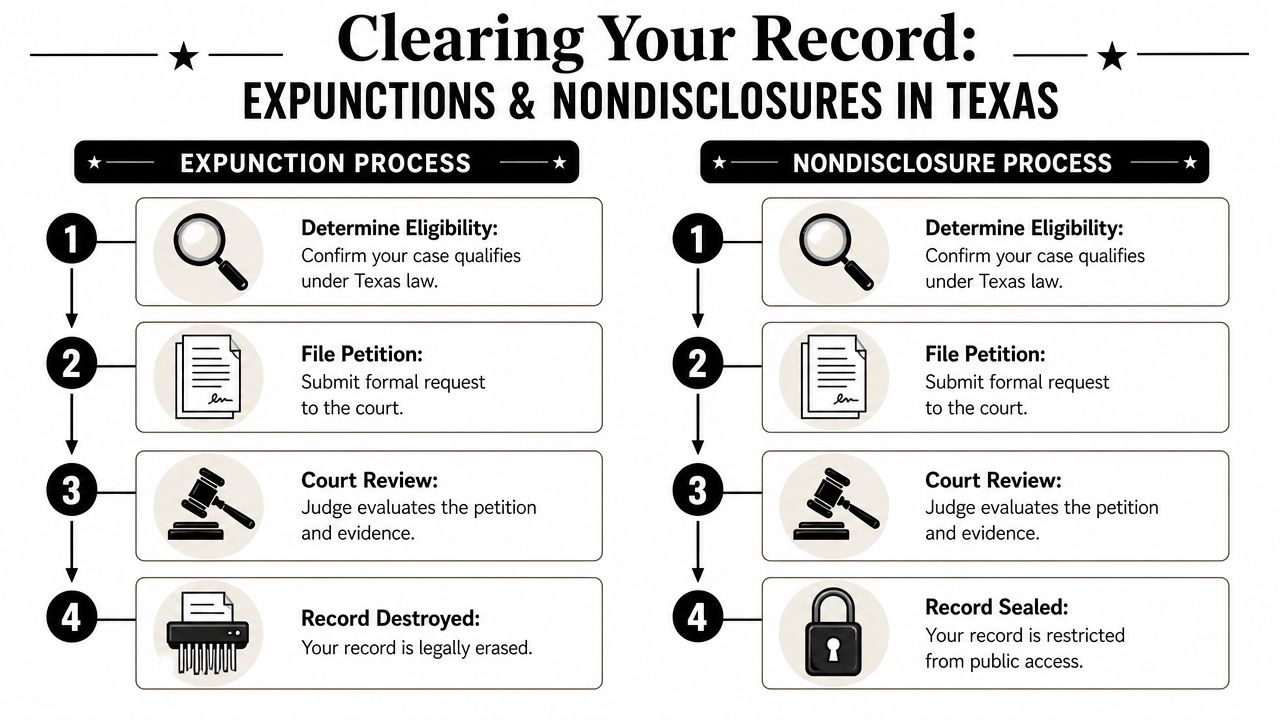
Expunction and nondisclosure are different tools
An expunction is the stronger remedy. In general terms, it is used to remove qualifying records from public access, often after a dismissal, acquittal, pardon, or certain other favorable outcomes. If your case qualifies, this can be the cleanest housing solution because the record should no longer appear the way it once did.
An order of nondisclosure is different. It does not destroy the record. It restricts public access to qualifying criminal history information. This often matters for people who successfully completed deferred adjudication and want to stop private landlords, employers, and screening companies from easily finding the case.
For many Texans, the right answer depends on the exact result in court.
Common criminal case paths that affect eligibility
The path your case took matters as much as the charge itself. In criminal defense practice, these stages often shape the future housing impact:
After arrest
Your case may be filed, rejected, reduced, or dismissed. A dismissal can create future expunction options in some situations.At arraignment or first court appearances
At this stage, charges are addressed and deadlines begin. Early legal decisions can influence whether your record later qualifies for relief.During plea bargaining
A plea may resolve the case faster, but not every plea leads to the same record consequences. Deferred adjudication can sometimes preserve a later nondisclosure option.At trial and sentencing
An acquittal or favorable ruling can change the record-clearing analysis completely. A conviction may narrow options, but it doesn't always end them.
Here is a helpful overview of getting a record expunged in Texas if you want to compare your case history to the available remedies.
This short video gives a basic visual overview of the process.
What usually works and what usually doesn't
What works is getting the paperwork reviewed by someone who understands both criminal procedure and collateral consequences like housing. That includes checking the charge, the disposition, waiting periods if they apply, and whether every agency holding the record is listed correctly.
What doesn't work is assuming a dismissed case automatically disappears on its own. It usually doesn't.
You can file on your own in some cases, but many people prefer legal help because one mistake in the petition can delay relief. Services from a defense firm such as the Law Office of Bryan Fagan, PLLC may include reviewing eligibility, preparing the petition, and pursuing expunctions or nondisclosures based on the case outcome.
Practical Strategies for a Successful Rental Application
Even if your record isn't cleared yet, you still have options. A careful rental strategy can save money, reduce denials, and improve your chances with the right landlord.
Build your application before you apply
Don't start with the online form. Start with the packet.
A stronger packet often includes:
- A short explanation letter: Keep it honest, direct, and calm. State what happened, how the case ended, and what has changed since then.
- Proof of income: Pay stubs, offer letters, or contract work records help show reliability.
- References: A current employer, pastor, counselor, or former landlord can add context.
- Compliance documents: If relevant, include proof that you completed probation, classes, treatment, or counseling.
If you need help with tone and structure, this guide on writing a character letter for court can help you think about what persuades decision-makers.
Key takeaway: Landlords are more likely to pause and reconsider when you answer the concern before they have to ask the question.
Challenge bad information quickly
Under federal FCRA rules, arrest records generally cannot be reported after seven years, but convictions can be reported indefinitely, as explained in the Texas State Law Library reentry housing guidance. If a denial appears tied to an old non-conviction arrest that should not have been reported, that may be worth disputing.
Ask for the reason for denial. Ask which screening company was used. Get a copy of the report if possible. Then compare the report to the actual court history.
Apply smarter, not wider
A rushed search gets expensive. Before paying another fee, ask about screening standards and your realistic chance of approval. Also make sure the rent fits your budget, because stable housing only helps if you can keep it. This tool can help you calculate your ideal rent before you commit to a lease you may struggle to maintain.
A smart application strategy usually looks like this:
- Call first: Ask whether the property considers applicants with older or nonviolent records.
- Target smaller landlords when appropriate: Some are more willing to review context than large automated systems.
- Disclose carefully: Be truthful, but don't volunteer vague statements that confuse the issue.
- Bring documents to show change: Employment, treatment, and community support can matter.
You Are Not Alone Let Us Help Protect Your Future
A criminal record can block housing in Texas. It can also distort the truth about your life. An arrest may look like a conviction. An old misdemeanor may be treated like a current threat. A dismissed case may still show up when it shouldn't. That's why this problem needs both legal knowledge and a practical plan.
You don't need to solve everything at once. Start by identifying the record type. Then focus on the housing type. Then decide whether your best move is to challenge a report, present a stronger application, or pursue expunction or nondisclosure.
The path forward is usually clearer than it feels
When people are overwhelmed, they often think they have only two choices. Keep getting denied, or give up. In reality, there are several ways to fight back:
- Correct the record if a screening report is wrong
- Narrow your search to landlords and properties that are a better fit
- Explain the case clearly instead of letting a database define you
- Seek record relief if your case qualifies under Texas law
Why early legal advice matters
If you're still facing charges now, the choices made early in the case can affect housing later. Charge reductions, dismissals, deferred adjudication, plea terms, trial strategy, and sentencing outcomes can all shape what landlords see in the future. That is true in cases involving DWI, assault, theft, drug possession, and other charges under Texas law.
If your case is already over, legal review still matters. The right attorney can evaluate whether the record can be cleared, whether a screening report appears improper, and whether a denial may deserve closer scrutiny under fair housing principles.
You deserve more than a generic answer and a shrug from a leasing office. You deserve a real plan.
If you've been charged with a crime in Texas, call Law Office of Bryan Fagan PLLC for a free and confidential consultation. Our defense team is ready to protect your rights.