Skip to content
Being arrested in Texas can be terrifying. One night, one traffic stop, one argument, or one bad decision can suddenly raise questions about your job, your housing, your license, and your future.
For many people, the fear doesn't end when they bond out of jail or leave court. It follows them into job applications, apartment searches, and professional licensing forms. They worry about what a background check will say, and whether a case that was reduced, dismissed, or completed through deferred adjudication will still show up anyway.
That worry is justified. In Texas, the legal outcome of your case and the information a background check shows are not always the same thing. A dismissal helps. So does deferred adjudication in the right case. But those outcomes don't automatically clear every database, every court index, or every private screening report.
That gap matters in DWI cases, assault allegations, theft charges, drug possession cases, and many other criminal matters under the Texas Penal Code. It also matters at every stage of the process, from arrest and arraignment to plea bargaining, trial, sentencing, and post-case record clearing. If you understand how background checks work in Texas criminal cases, you can make better decisions early and protect more than just the outcome in court.
An Arrest Is Not the End of Your Story
A client gets arrested for assault after a heated family argument. Another is charged with DWI after a late-night stop. Someone else is accused of theft after a misunderstanding at work. Different facts, different charges, same fear: "Will this follow me forever?"
That fear starts early. After an arrest, you're booked, photographed, fingerprinted, and given a court date. Then the criminal case begins moving through the system. In many Texas courts, that means first appearance or magistration, bond conditions, later arraignment settings, negotiations with the prosecutor, and sometimes motions, plea bargaining, trial, or sentencing. If the case ends well, people often assume the record problem is over too.
It usually isn't that simple.
What clients are really asking
For those involved, the question isn't just whether they'll be convicted. They're asking whether an employer, landlord, school, or licensing board will see the arrest in the first place. That's a different question.
A criminal case can end in several ways, including:
- Dismissal: The State drops the case or the court dismisses it.
- Deferred adjudication: You complete court-ordered conditions without a final conviction.
- Conviction: You plead guilty, no contest, or are found guilty.
- Acquittal: You go to trial and are found not guilty.
Each outcome matters. But none should be treated as the same thing as record clearance.
Practical rule: Winning the case in court and cleaning up what a background check shows are often two separate jobs.
Texas criminal defense isn't only about avoiding jail or reducing penalties. It's also about protecting your future before the record hardens in public databases. For a Houston criminal lawyer or Texas DWI attorney, that means looking past the next court date and thinking ahead about expunction, nondisclosure, and what kind of search another person is likely to run on you.
If you've been charged under statutes such as Texas Penal Code Chapter 22 for assault, Chapter 31 for theft, or Chapter 49 for DWI-related offenses, your next move matters now. A strong defense can improve the case outcome. The right follow-through can improve what the outside world sees later.
The Different Kinds of Texas Background Checks
A client clears a case in court, then loses a job offer anyway. I see that problem often. The reason is simple. Texas does not have one background check system, and a good case result does not automatically clean every place where the record may appear.
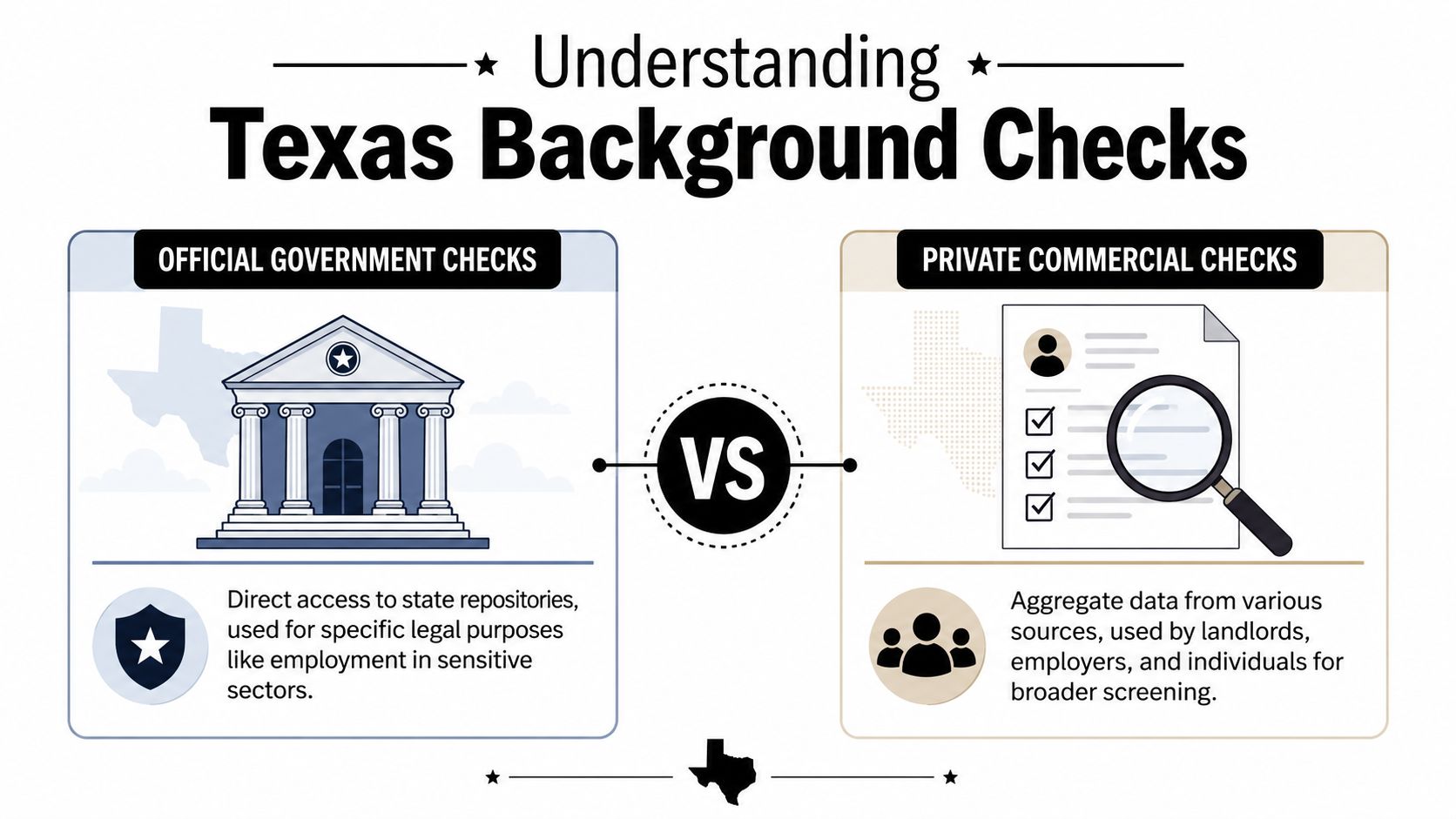
Official government checks
Some screenings pull straight from government-held criminal history records. In Texas, that often means records connected to the Department of Public Safety, and in some settings, fingerprint-based checks tied to state or federal databases. These checks tend to be more precise because they are tied to identity markers, not just a name and date of birth.
That difference matters in real life. A fingerprint-based return is less likely to miss a record because of a spelling variation, and less likely to confuse your file with someone else's.
These checks show up most often in licensed professions, regulated facilities, and other positions involving public trust. The state also uses tighter hiring rules in certain settings. As noted earlier, some regulated employers must use recent criminal history reports and follow offense-based restrictions tied to the job.
Private commercial checks
Private employers and landlords usually hire screening companies instead of running fingerprint checks. Those companies build reports from court records, county data, law enforcement submissions, and commercial databases. The final report depends on what sources the company searched, how often those sources update, and whether old information was removed after a case changed.
The Texas DPS crime records page gives a good overview of the public-record system behind many of these reports: Texas DPS crime records overview.
If you want to understand how criminal background checks work from a screening-company perspective, start there. Then ask the practical question. Was the report pulled from a live county search, a statewide repository, or a private database that may update on its own schedule?
That is why two background checks on the same person can look different on the same day.
Why the same case produces different results
A hospital, school, daycare, apartment complex, and warehouse employer may all check criminal history differently. They are not using the same tools, and they are not looking for the same things.
Here is the practical split:
- Government-based checks are usually closer to the official criminal history file.
- Private screening reports may be broader, faster, or cheaper, but they can also carry outdated entries or miss recent case updates.
- Regulated employers and licensing boards often apply stricter review standards than ordinary employers or landlords.
That is why a dismissed assault case may still create problems until the record is formally cleared. If that is your issue, this guide on an assault charge and a Texas background check explains how the record can keep surfacing after the court case ends.
The gap that surprises people
Court paperwork answers one question. What happened in the case?
A background check answers a different one. What information is still sitting in the database this screener searched?
Those are not always the same. A dismissal, no-bill, or completed deferred adjudication may improve your legal position without removing the record from every system an employer or landlord might use. That gap is the reason expunctions and nondisclosures matter. They are the tools Texas law gives you to close the distance between a better court outcome and what the outside world still sees.
What Actually Shows Up on Your Criminal Record
When people say "my record," they usually mean one simple file. In practice, a background check can show several pieces of a criminal event, not just the final outcome.
That may include the arrest, the charge, the court case, a pending status, a dismissal, deferred adjudication, or a conviction. In private screening, those pieces may come from different public-record sources.

The items that commonly appear
In Texas, a criminal background report may include:
- Arrests: The event that started the case.
- Pending charges: Cases that haven't been resolved yet.
- Filed offenses: Such as DWI, assault, theft, or drug possession charges.
- Deferred adjudication entries: Depending on the source and policy.
- Convictions: Misdemeanor or felony convictions.
- Case dispositions: Such as dismissed, reduced, or convicted.
If you've ever wondered how criminal background checks work from a screening-company perspective, it helps to see that reports are often summaries built from multiple records rather than a live copy of your courtroom result.
Why a dismissed case can still show
This is the point that frustrates people most. A dismissal ends the criminal prosecution. It does not automatically erase the arrest record or every public entry connected to it.
Private background checks in Texas usually compile public-record sources, and a dismissed case can remain visible if the arrest record and docket entry were never expunged or sealed, as explained in Checkr's Texas background check guide.
That means you can be legally cleared and still practically flagged.
A dismissal is a good legal result. It is not the same as deletion.
This issue comes up often in assault cases tied to family disputes, theft accusations that never should have been filed, and drug possession cases that were dismissed after review. It also comes up in DWI cases where the evidence was weaker than it first appeared.
For readers dealing with violence-related allegations, this more specific guide on Texas assault background checks may help you compare what employers may see with what the case file says.
What to do after the case ends
Once your case is over, don't assume the system fixed itself. Take these steps:
- Get the final disposition. Keep the signed dismissal, judgment, or deferred paperwork.
- Ask what record-clearing option fits. In Texas, that usually means expunction or nondisclosure.
- Think about where the problem is showing up. A government check and a vendor report may not behave the same way.
- Move early when you're eligible. Waiting often means more time for stale data to circulate.
A short overview of the record problem is worth watching before you decide what to file next.
How a Criminal Record Impacts Your Job and Livelihood
You apply for a job, the interview goes well, and then the employer says they need to "review something" on your background check. A week later, the offer disappears. In many Texas cases, the problem is not the final legal result. The problem is that the report still shows an arrest, a filed charge, or an old case entry that looks unresolved to someone reading fast.
That gap affects real life. It can cost a job offer, delay a license application, trigger extra questions from a landlord, or put your current position under review. I have seen dismissed cases create the same practical problem as open cases because the person running the check did not see, or did not understand, the outcome.
What employers and boards are actually weighing
Employers do not all use the same kind of screen, and they do not all read records the same way. A private employer using a consumer reporting company may see a narrower report than a licensing board, hospital system, school district, or government agency. Some decision-makers focus on how recent the record is. Others focus on whether the allegation relates to the job.
A theft allegation can hit harder for accounting or retail work. A DWI matters more for a driving job. An assault accusation raises more concern in healthcare, childcare, education, and jobs involving vulnerable people.
That is why a dismissal alone does not always solve the employment problem.
A background report may still display the arrest or charge even after the case ended in your favor. To the employer, that can read as risk, even when the court record tells a better story. The legal file and the hiring file are often not the same thing.
Why the same record hurts one person more than another
Context matters. A warehouse employer may view an old misdemeanor differently than a nursing board or a company that sends workers into customers' homes. Housing providers also make their own judgment calls, and those calls are not always careful or fair.
Some jobs require a current criminal history review close to the hiring date. In caregiving and similar regulated settings, timing and offense type can carry more weight than they would in an ordinary private-sector hire. That means an older case can still become a present problem if it appears on the wrong kind of report at the wrong time.
Professional licensing adds another layer. Boards often look beyond whether there was a conviction and ask whether the conduct reflects on honesty, safety, judgment, or fitness for the profession. A person can win the criminal case and still face career consequences if the record remains visible.
The practical problem is visibility
What hurts people most is often not the case outcome. It is the record's visibility.
If a case was dismissed, refused, or resolved through a result that may qualify for record clearing, leaving it untouched can keep the same obstacle in place. The report may continue to show enough information to trigger concern, even if the full legal story is favorable. That is the gap you want to close.
If employment is your main concern, this article on how a criminal charge affects employment in Texas gives a focused look at workplace consequences.
Employers and boards often look at severity, recency, and how closely the allegation relates to the role. They also react to what is easy to see on the report in front of them.
The practical response is to treat the background check as a separate problem from the court case. First, find out what is still showing. Then match the case outcome to the right remedy, usually expunction or nondisclosure if you qualify. That is how you stop a dismissed or old case from continuing to interfere with your paycheck, your housing, and your reputation.
Your Path to a Clean Slate Expunctions and Nondisclosures
A case can end well in court and still keep hurting you on paper.
That is the problem expunctions and nondisclosures are meant to solve. They do different jobs, and choosing the right one depends on how your case ended, what level of access you are trying to block, and whether Texas law makes you eligible.

Expunction erases and nondisclosure seals
An expunction is the stronger remedy. In plain language, it aims to remove the arrest and case from the records that usually feed background checks. An order of nondisclosure is narrower. It blocks public disclosure of eligible records, but government agencies and certain employers or licensing bodies may still see them.
That difference matters in real life. If your case was dismissed and the goal is to stop a private employer or landlord from seeing the arrest at all, expunction is often the better fit if you qualify. If you successfully completed deferred adjudication, expunction usually is not available, but nondisclosure may still keep the case out of many routine screenings.
Eligibility turns on the outcome, not your frustration with the record
Texas record clearing is outcome-driven. Lawyers start with the final result and work backward from there.
The first questions are usually these:
- Was the case dismissed or were you acquitted?
- Did you complete pretrial diversion?
- Did you receive deferred adjudication?
- Was there a final conviction?
- What offense was involved?
For expunction, the starting point is usually Chapter 55 of the Texas Code of Criminal Procedure. For nondisclosure, the analysis usually centers on Chapter 411 of the Texas Government Code. The label on the final disposition matters more than the informal story people tell about the case.
A few common patterns come up often:
- Dismissal: Often leads to an expunction review.
- Acquittal at trial: Often supports expunction.
- Successful deferred adjudication: Often points to nondisclosure.
- Final conviction: Usually leaves fewer options and may call for a different strategy.
Time does not automatically clean this up
Many people assume an old case will fade away on its own. Often, it does not.
If the record is still sitting in the systems that supply background reports, a favorable result can stay visible long after the court case is over. That is the gap between legal outcome and practical outcome. Closing that gap usually requires action.
Bottom line: A dismissal helps. An expunction or nondisclosure changes what other people can actually see.
A practical action plan
Start with the paperwork, not assumptions.
- Confirm the exact final disposition. A dismissal, acquittal, discharge, deferred adjudication, and conviction all lead to different remedies.
- Collect the key records. Get the dismissal order, judgment, discharge papers, and any documents showing the charge history and final result.
- Match the result to the right remedy. Expunction and nondisclosure are not interchangeable.
- File the correct petition in the right court. A good result in the criminal case does not clear the record by itself.
- Track compliance after the order is signed. Courts, agencies, and reporting services need time to process updates.
If your case may qualify for sealing instead of full removal, this guide to a Texas order of nondisclosure explains how that process works.
Do not treat plea negotiations and record clearing as separate problems
Many people are blindsided by pleas that, while seeming like a win in the moment, can limit what can be cleaned up later.
Sometimes deferred adjudication is the smartest available result. Sometimes fighting for a dismissal or reduction makes more sense because it preserves stronger record-clearing options. That call depends on the evidence, the charge, your history, and your priorities outside the courtroom, including work, housing, and professional licensing.
I tell clients to ask one practical question before any final deal is accepted: What will this look like on a background check six months from now? If nobody is asking that question, the analysis is incomplete.
The same issue comes up in assault, theft, drug possession, and DWI cases. The right defense strategy is not just about avoiding the harshest sentence. It is also about protecting future options to remove or seal the record if the law allows it.
One option for handling both the criminal case and later record-clearing work is the Law Office of Bryan Fagan PLLC, which represents Texans in criminal defense matters and related expunction and nondisclosure proceedings.
Take Control of Your Future Today
You can't always stop an arrest from happening. You can decide what happens next.
The strongest path usually has three parts. Fight for the best result in the criminal case. Identify whether expunction or nondisclosure fits the final outcome. Then act before the record keeps circulating through background-check systems.
The steps that give you leverage
If you've been arrested for DWI, assault, theft, drug possession, or another offense in Texas, focus on these priorities:
- Protect the case early: What happens after arrest matters. Bond conditions, arraignment, charging decisions, plea negotiations, trial preparation, and sentencing all affect your future options.
- Think beyond the courtroom: A dismissal is valuable, but it may not remove the arrest from public-facing reports by itself.
- Match the remedy to the result: Expunction and nondisclosure solve different problems.
- Keep your records organized: Save every court order and final disposition.
- Get legal guidance before assuming you're stuck: Many people live with a fixable record because nobody explained the next step clearly.
Texas law gives some people a real chance to move forward. But you usually have to claim that relief. It doesn't arrive automatically.

You have more options than you think
A criminal charge can feel like it stamped your future. It didn't.
A good defense can challenge the stop, the search, witness statements, identification, breath or blood testing, and weak assumptions by the State. A smart post-case strategy can address the separate problem of what employers, landlords, and licensing boards may still see later. That combination is often what helps people fully move on.
Regarding how background checks work in Texas criminal cases, the key point is simple. The case result matters, but record-clearing action often matters just as much.
If you've been charged with a crime in Texas, call Law Office of Bryan Fagan PLLC for a free and confidential consultation. Our defense team is ready to protect your rights.