Skip to content
Being arrested in Texas can be terrifying—but you don’t have to face it alone. A criminal record can feel like a heavy weight, limiting your opportunities for years to come. Thankfully, Texas law offers a way to lift that burden through expungement, which is a legal process that destroys the records of your arrest. But the process isn't instant, and knowing how long an expungement takes in Texas can help you set the right expectations for your journey to a fresh start.
From start to finish—including the mandatory waiting period all the way to the final confirmation—the entire process often takes several months to over a year.
Your Path to a Fresh Start in Texas
When you’re trying to move past a criminal charge, every day can feel like an eternity. The question of how long it takes to clear your name is one of the most common—and stressful—concerns we hear at The Law Office of Bryan Fagan, PLLC.
While there isn't a single, one-size-fits-all answer, the timeline follows a predictable path. It’s governed by a mix of Texas law and the local procedures of the court where your case was filed. Understanding this path is the first step toward regaining control of your future.
The total time hinges on a few key factors:
- The mandatory waiting period before you are legally allowed to file.
- The time it takes to prepare and file the official Petition for Expunction.
- The court's schedule and how quickly they can hear your case.
- The time government agencies need to comply with the court's order once it's signed.
A General Timeline for Texas Expungements
Once your attorney files the petition, the legal wheels start turning. Timelines can definitely vary between counties like Harris, Dallas, or Travis, but a typical case without major roadblocks follows a general pattern.
After a petition is filed, an expunction case usually takes about 3–6 months to get from the filing date to a signed court order. You can learn more about the factors that influence expungement timelines from other legal experts in the field. This period gives the court time to review the petition, notify all the relevant government agencies, and allow the District Attorney’s office to respond.
An expunction is more than just a legal procedure; it's a powerful tool that allows you to legally deny an arrest ever happened. It effectively erases the event from public record, opening doors to better jobs, housing, and peace of mind.
To give you a clearer picture, let's break down the major phases and their estimated durations. Remember, these are general estimates. An experienced criminal defense attorney can give you a much more precise forecast based on the specifics of your case and the county where the arrest occurred.
Estimated Texas Expungement Timeline At a Glance
This table provides a high-level overview of the major phases in the Texas expungement process and their typical timeframes. Note that these are estimates and can vary significantly by county.
| Phase | Typical Duration |
|---|---|
| Eligibility & Waiting Period | Varies (Immediate to 3+ years) |
| Petition Preparation & Filing | 1-2 weeks |
| Court Processing & Agency Notice | 3-6 months |
| Agency Compliance & Record Destruction | 1-6 months post-order |
| Total Process (Post-Filing) | 4-12+ months |
Your journey to a clean slate is much more manageable when you know what to expect. Knowing the steps and potential hurdles is half the battle.
Figuring Out Your Eligibility and Waiting Period
Before you can even start the paperwork to clear your record, Texas law requires a mandatory waiting period. This is often the longest and most confusing part of the whole journey. This isn't just a random delay; the law, specifically the Texas Code of Criminal Procedure, Chapter 55, sets these timelines to make sure a criminal case is completely finished.
Think of it as a mandatory cooling-off period for the justice system. The state needs to be 100% certain that the statute of limitations—the deadline for prosecutors to file charges—has officially passed. Only then can you move forward with an expungement.
How long you have to wait depends on two key things: how serious the alleged crime was and what happened with your case. For example, a simple Class C misdemeanor that was dismissed will have a much shorter wait time than a felony that was never formally charged.
Waiting Periods Based on the Offense Level
Knowing these timelines is the first real step to figuring out when you can file your petition. The clock starts ticking from the day you were arrested.
Here are the most common situations:
- Class C Misdemeanors: If your case was a Class C misdemeanor that ended in a dismissal or you were found "not guilty" (acquitted), you have to wait 180 days from the arrest date before you can file.
- Class A & B Misdemeanors: For these more serious misdemeanors, the waiting period is one year from the date of your arrest, as long as the case was dismissed and never refiled.
- Felonies: If you were arrested for a felony but the case was ultimately dismissed before charges were formally filed, you're looking at a three-year wait from the arrest date.
Getting this date right is absolutely critical. If you file your petition even one day too early, the court can deny it. That means you've wasted your time and money, and you have to start the entire process all over again.
Special Circumstances That Can Change the Timeline
While those timelines cover most cases, certain situations have their own set of rules. These exceptions can sometimes speed things up or create different requirements you need to meet. It's very important to see if your case falls into one of these special categories.
For instance, if you went to trial and were acquitted (found not guilty) or if you received a pardon from the Governor, there is no waiting period. You can file for an expungement right away. This makes sense because the legal system has officially cleared you, so there's no need to wait for any statutes of limitations to run out.
The most important thing to remember is this: you cannot start the legal process of expungement until your specific, legally required waiting period is over. A good lawyer can double-check your eligibility date to make sure your petition is filed at exactly the right time for the best shot at success.
On the other hand, if you completed a pretrial diversion program, your waiting period might be different. It often depends on the specific agreement you made with the prosecutor's office.
Pinpointing Your Exact Eligibility Date
Figuring out the precise day you can file is more than just glancing at a calendar. It requires a close look at your arrest records and the final paperwork from your court case. For a deep dive into all the rules and requirements, you can learn more about Texas expungement law and eligibility in our complete guide. This is one step you can't afford to guess on.
An attorney can get the official documents and interpret them correctly, giving you a firm date to aim for. This takes away the anxiety and stress of not knowing and gives you a clear, concrete goal for finally putting this chapter behind you.
Navigating the Texas Expungement Process
Once you’ve made it past the mandatory waiting period, the real legal legwork begins. This is where the journey to a clean slate shifts from a waiting game to actively taking back your future. The process can feel overwhelming, but it’s really just a series of clear, manageable steps that an experienced attorney handles for you.
The whole procedure is designed to be incredibly thorough. It makes sure every single government agency holding a record of your arrest is properly notified and ordered to destroy it. It all starts with gathering the right paperwork and ends with a judge's powerful signature on an Order of Expunction.
This infographic breaks down the different waiting periods you have to get through before this legal process can even kick off.
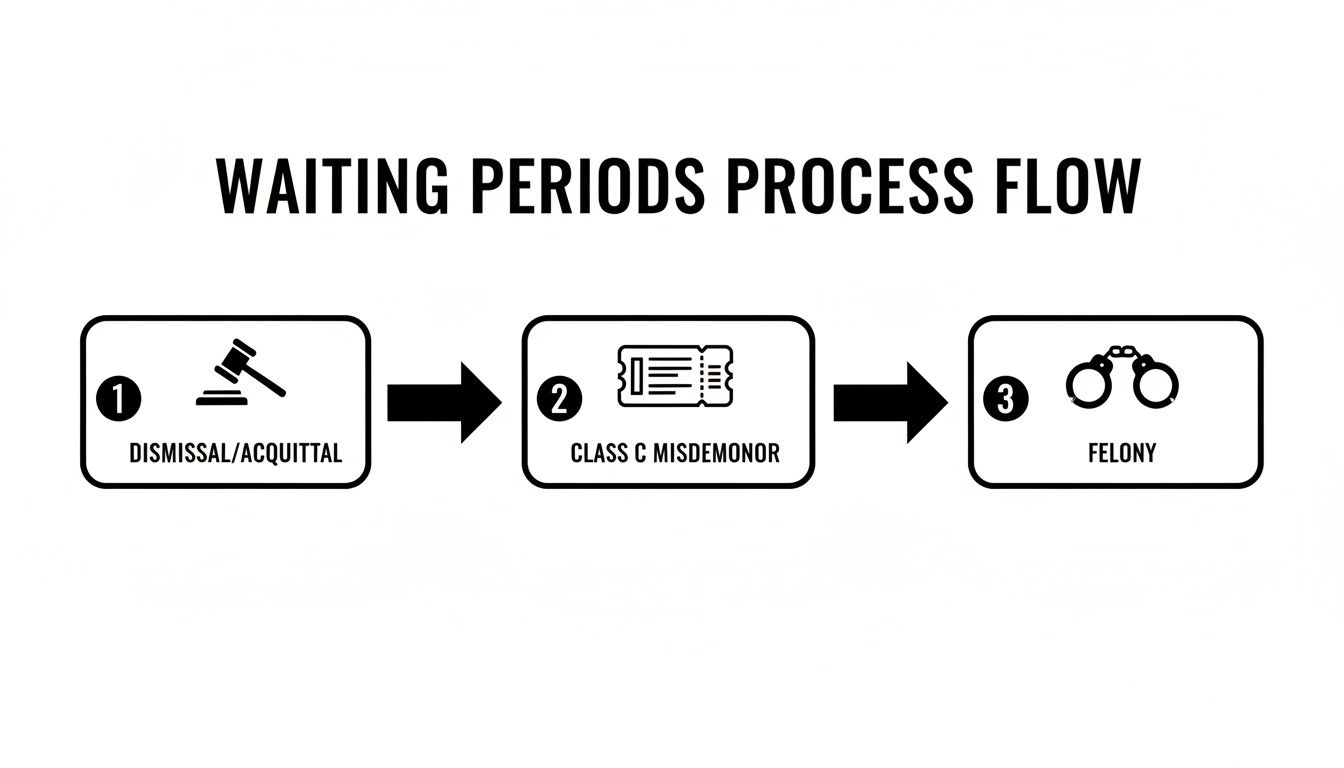
As you can see, the wait time is tied directly to how serious the original charge was and how it was resolved.
Step 1: Gathering Your Case Documents
Before your attorney can file anything with the court, they need to build a complete file on your case. This involves collecting the entire official history of your arrest and how it ended.
This first step is critical and involves obtaining:
- Arrest Records: The official report from the police department or sheriff's office that arrested you.
- Court Dispositions: The final paperwork from the court showing the case was dismissed, you were found not guilty, or the charges were otherwise resolved in your favor.
- Case Numbers and Dates: These precise details are essential for legal filings.
Gathering these documents can sometimes take a couple of weeks, but having complete and accurate information is the foundation of a successful expungement. Any mistakes here can cause major delays down the road.
Step 2: Drafting and Filing the Petition for Expunction
With all the documents in hand, your lawyer will draft the official Petition for Expunction. This isn't a simple form; it’s a formal legal document filed with the district court in the county of your arrest.
The petition lays out the facts of your case and explains to the judge exactly why you are legally entitled to have your record destroyed under the Texas Code of Criminal Procedure. It must also list every single government agency that has a copy of your arrest record.
A correctly drafted petition is your best tool for a smooth process. It needs to be legally precise and procedurally perfect to avoid being rejected by the court or challenged by the prosecutor's office.
Once filed, the court clerk officially "serves" a copy of the petition to each of those agencies, including local police, the county sheriff, the District Attorney’s office, the Texas Department of Public Safety (DPS), and even the FBI. This puts them on notice and gives them a window to object if they think you're not eligible. Our team has a detailed guide that further explains the expungement process in Texas and what each step involves.
Step 3: The Court Hearing and Final Order
After the petition is filed and every agency is notified, the court schedules a hearing. The good news? In many cases, if the petition is well-drafted and no one objects, this hearing is just a formality. Often, you may not even need to show up, as your attorney can appear for you.
However, if the District Attorney’s office decides to object, this hearing becomes much more important. This is when your lawyer will present arguments and evidence to the judge to counter the objection and prove you meet all the legal requirements. This is where having a sharp, experienced Houston criminal defense attorney really pays off.
If the judge agrees with your petition, they will sign the Order of Expunction. This is the official court command that directs every agency to find and destroy all records related to your arrest. That signed order marks the successful end of the legal process, and from there, the final phase of agency compliance begins.
Why Expungement Timelines Vary So Much Across Texas
You’ve probably heard stories that sound completely different. Someone in a quiet, rural county gets their record expunged in just a few months. Meanwhile, a similar case in Houston seems to drag on forever. This is the reality of a system where how long an expungement takes in Texas depends heavily on where you file.
Even though the legal rulebook, the Texas Code of Criminal Procedure, is the same for everyone, how it plays out in the real world looks very different from one courthouse to the next. Local factors create unique timelines for each of Texas's 254 counties.
Understanding these variables will help you set realistic expectations for your own case and take some of the anxiety out of an already stressful wait.
The Impact of County Size and Court Backlogs
One of the biggest factors slowing things down is the sheer volume of cases a court has to handle. A district court in a major metro area is dealing with a completely different reality than one in a less populated county.
-
Major Urban Counties: Think Harris (Houston), Dallas, Tarrant (Fort Worth), and Travis (Austin). These courts have dockets that are absolutely swamped. Judges and clerks are managing thousands of cases at the same time. Your expungement petition is just one more file in a massive pile, which naturally means longer waits for hearings and signed orders.
-
Smaller Rural Counties: In contrast, a court in a smaller county likely has a much lighter caseload. They can often schedule hearings faster and process paperwork more quickly, simply because there is less of it.
The same principle applies to our court systems as it does to waiting in line at the grocery store—the busier it is, the longer you'll wait.
The District Attorney’s Role in Your Timeline
The other key player who can affect your timeline is the District Attorney’s (DA) office in the county where the arrest happened. When your attorney files the Petition for Expunction, the DA’s office is one of the first to get a copy. Their response can either speed things up or bring the process to a halt.
If the prosecutor reviews your petition and agrees you meet all the legal requirements, they can sign what’s called an "agreed order." This tells the judge that the State has no objection. An agreed order is the fast track—it often lets the judge sign off on your expungement without needing a formal court hearing.
But if the DA’s office objects, the process will take longer. An objection doesn’t kill your case, but it does mean a contested hearing is now required. Your attorney will have to schedule time to argue your case before the judge and legally overcome the prosecutor’s issue.
This one step can add weeks or even months to the process, all spent waiting for an open slot on the court's calendar. This is where having a skilled attorney who can negotiate directly with the prosecutor becomes absolutely essential.
Avoiding Common Delays in Your Expungement Case

Even when you are clearly eligible for an expungement, the path to a clear record isn’t always a straight line. Unexpected issues can pop up, turning a relatively straightforward process into a frustrating ordeal.
Knowing these common pitfalls is the key to avoiding them. The question of how long an expungement takes in Texas often comes down to how well the initial petition is prepared. A small mistake at the beginning can easily spiral into a significant delay. Fortunately, nearly all of these problems are preventable with careful planning and professional guidance.
The Pitfall of an Incomplete or Inaccurate Petition
The single most common reason for a delay is a flawed Petition for Expunction. This legal document is the engine that drives your entire case, and if it's not perfect, the whole process can stall before it even gets started.
Common petition errors that grind cases to a halt include:
- Missing Information: Forgetting to include crucial details like the exact date of arrest, the specific charge, or the correct case number.
- Incorrect Agency List: Failing to list every single government entity that holds a record of your arrest, from the local police department to the Texas DPS.
- Filing Too Early: Submitting the petition before the mandatory waiting period has officially expired, which is an easy way to get an automatic denial.
These might seem like minor clerical issues, but to a court, they are grounds for rejection. Correcting and refiling a petition wastes valuable time and can be emotionally draining.
Failing to Properly Notify All Agencies
Once your petition is filed, Texas law requires that every agency listed must be officially "served" with a copy. This formal notification gives them a legal heads-up and an opportunity to respond. If even one agency is missed, the process stops.
For example, if the petition is sent to the county sheriff but not the specific city police department that made the arrest, the court cannot move forward. The judge needs confirmation that every single entity has been properly notified before they can sign the final order. An experienced attorney knows the exact list of agencies for your county and ensures each one is served according to strict legal procedures.
A successful expungement is built on precision. One missed agency or one incorrect date can derail the entire process. This is why having a legal professional manage your case is not just a convenience—it’s your best defense against avoidable delays.
Responding to a Prosecutor’s Objection
Sometimes, even with a perfect petition, the District Attorney’s office will file an objection. This isn't necessarily a final denial of your case, but it means the DA wants to challenge your eligibility in court. An objection immediately adds another step to the process: a contested hearing.
Without a lawyer, facing a prosecutor’s objection can be intimidating. For your attorney, however, it's a routine part of the job. They can proactively contact the prosecutor to understand the reason for the objection—which can sometimes be a simple misunderstanding—and work to resolve it. If a hearing is unavoidable, your lawyer will be prepared to argue on your behalf, presenting the legal facts that prove you are entitled to the expungement. This expert handling turns a potential crisis into a manageable next step.
Exploring an Order of Nondisclosure as an Alternative
What happens if you find out you don't meet the strict legal requirements for an expungement in Texas? It can be disheartening, but it’s important to know that this isn't the end of the road. Texas law has another powerful tool that can help you get your life back: an Order of Nondisclosure.
While an expungement completely destroys a criminal record, an Order of Nondisclosure seals it from the public. Here’s a simple way to think about it: expungement is like shredding a document, while nondisclosure is like locking that same document away in a secure vault.
Law enforcement and certain government agencies can still access the records, but they become completely invisible to the general public. That means potential employers, landlords, and anyone else running a standard background check won't see it. This gives you a vital layer of privacy and lets you move forward without a past mistake holding you back.
Who Qualifies for an Order of Nondisclosure?
The most common path to getting a nondisclosure is for people who have successfully finished a special kind of probation called deferred adjudication. This is a specific deal where you plead guilty or "no contest," but the judge defers finding you guilty and instead places you on community supervision.
If you complete your probation successfully, the judge dismisses the case. You were never formally convicted of the crime. After a mandatory waiting period, you can then ask the court to seal the records tied to that charge.
Generally, you might be eligible for a nondisclosure if you:
- Successfully completed deferred adjudication for certain misdemeanors and felonies.
- Waited out the required period for your specific offense.
- Do not have a history of certain disqualifying offenses.
The process and timelines for a nondisclosure are different from an expungement. To get a clear picture of how they differ, it's worth taking a moment to understand the nuances of expungement vs. nondisclosure in Texas and figure out which path makes the most sense for your situation.
An Order of Nondisclosure is a second chance. It’s the court’s way of acknowledging that you did everything asked of you, giving you the opportunity to rebuild your life without the public stigma of a criminal charge.
If an expungement isn't on the table for you, don’t give up hope. An Order of Nondisclosure offers a practical, reassuring way to protect your reputation and open up future opportunities. Talking to an attorney can clear up whether you qualify and walk you through the entire process.
Answering Your Top Questions About Texas Expungements
When you’re trying to clear your record, a lot of questions come up. The whole process can feel confusing, and that uncertainty often creates anxiety. Here are straightforward answers to the questions we hear most often.
Is My Record Wiped Clean the Second the Judge Signs the Order?
Not quite. The judge's signature is more like the starting gun than the finish line.
Once the Expunction Order is signed, it becomes a legal command sent out to every government agency that has a record of your arrest. The court clerk sends this order to places like the Texas Department of Public Safety (DPS), the local sheriff's office, and the police department that arrested you.
These agencies are then legally required to find and destroy every file connected to that arrest. This final compliance step can take anywhere from 30 to 180 days, depending on how busy each agency is. A dedicated attorney doesn't close your file until they've confirmed every single agency has complied.
Can I Legally Deny My Arrest After It’s Expunged?
Yes, absolutely. This is one of the most powerful benefits of getting an expungement in Texas.
Under Texas Code of Criminal Procedure Art. 55.03, a successful expungement gives you the legal right to deny the arrest ever happened. It’s as if it was erased from your history.
This applies to almost any situation, including job applications, apartment leases, and loan paperwork. The only real exception is if you are ever questioned under oath in a future criminal case. In that specific scenario, you would have to state that the matter was expunged.
What if the District Attorney Fights My Expungement Petition?
An objection from the District Attorney’s office doesn't kill your chances, but it does mean you’re heading to a contested hearing. It’s no longer a simple paperwork process; it’s a courtroom fight.
In the hearing, the judge will listen to both sides. Your attorney will present the legal arguments for why your case meets all the requirements for an expungement. The prosecutor will then explain why they believe it shouldn't be granted. This is precisely when having an experienced criminal defense lawyer becomes essential—you need someone who can effectively counter the state’s arguments and defend your right to a clean slate.
Will an Expungement Get My Arrest off Private Background Check Sites?
The court's order forces government agencies to destroy their records, but it doesn't automatically reach private data brokers and background check companies that might have already scraped that public information.
Think of it this way: the government has to throw out its copy of your file, but these private companies already have their own photocopies. While they aren't directly served with the court order, a proactive attorney will send them a copy. Reputable background check companies will remove the outdated information to avoid legal trouble, but it often takes a deliberate follow-up effort to make sure your record is scrubbed clean everywhere.
If you’ve been charged with a crime in Texas, call The Law Office of Bryan Fagan, PLLC for a free and confidential consultation. Our defense team is ready to protect your rights.