Being arrested for a misdemeanor in Texas can be terrifying, and the mark it leaves on your record can follow you long after the case is closed. It can pop up on background checks, making it harder to land a good job, get approved for an apartment, or even volunteer at your kid's school. The good news is, you don't have to face this alone, and Texas law provides a way forward. If your case ended in a dismissal, an acquittal, or a pardon, you may be able to get it expunged—a legal process that completely destroys the records of your arrest. It’s a true fresh start.
A Texas Misdemeanor Should Not Define Your Future

An arrest for a misdemeanor can put your entire life on hold. One bad decision, a simple misunderstanding, or even a wrongful accusation can create a public record that casts a long, unfair shadow over your personal and professional life. We understand how anxious this situation can make you feel.
This record is accessible to just about anyone—potential employers, landlords, and university admissions officers. It can slam doors shut before you even get a chance to prove yourself, creating barriers that hold you back for years. But Texas law provides a powerful tool to help you move forward and leave the past behind for good.
Reclaiming Your Narrative
Getting an expunction is more than just a legal procedure; it’s about taking back control of your story. When a judge grants your expunction, you can legally deny the arrest ever happened. All the records held by law enforcement, prosecutors, and the courts are ordered to be physically destroyed.
This isn't just symbolic—it has real-world, life-changing benefits:
- Employment Opportunities: You can confidently check "no" on job applications that ask about prior arrests, opening up career paths that were previously out of reach.
- Housing and Loans: Landlords and lenders will no longer see the arrest on background checks, dramatically improving your chances of securing a lease or loan.
- Personal Peace of Mind: You can finally stop looking over your shoulder, free from the constant worry that a past mistake will resurface at the worst possible moment.
Just as businesses work hard to manage their public image, understanding the importance of reputation is vital for anyone looking to rebuild their future. An expunction is the most definitive step you can take toward restoring your good name.
Your Path to a Clean Slate
Navigating the Texas legal system can feel overwhelming, but you don’t have to do it alone. This guide is designed to give you the clear, straightforward information you need to pursue an expunction. We'll break down the eligibility rules, explain the key differences between expunction and other options like record sealing, and walk you through the entire process. Your future is too important to leave to chance.
If you’ve been charged with a crime in Texas, call The Law Office of Bryan Fagan, PLLC for a free and confidential consultation. Our defense team is ready to protect your rights.
Expunction vs. Record Sealing: What Is the Difference?
When you start looking into how to clear your record in Texas, you'll run into two key legal terms: expunction and nondisclosure. They both aim to protect your future, but they work in fundamentally different ways. Grasping this distinction is the single most important first step you can take.

Here's the easiest way to think about it: an expunction is like shredding a document and then burning the shreds. It’s gone forever. A nondisclosure, on the other hand, is like locking that same document in a high-security vault. The public can't see it, but a few people with the right key still can.
The Power of a Full Expunction
An expunction, which is laid out in Chapter 55 of the Texas Code of Criminal Procedure, is the gold standard for clearing your name. It's the most complete relief you can get.
When a judge signs off on an expunction, they're ordering every single government agency involved—the arresting police department, the county clerk, the prosecutor’s office—to physically destroy every record tied to your arrest.
What does that mean for you? The charge is wiped off the books as if it never happened. After a successful expunction, you can legally deny the arrest ever occurred on job applications, housing forms, or loan documents. It gives you a true clean slate.
Understanding Orders of Nondisclosure
An order of nondisclosure, often called record sealing, offers a different level of relief. Instead of destroying your record, it seals it from public view. This is a huge deal because it means private background check companies, potential bosses, and landlords won't see the charge anymore.
But here’s the catch: the records don't disappear. A specific list of government and licensing agencies can still access them. This usually includes law enforcement, school districts, hospitals, and state licensing boards for professions like nursing or law.
Expunction vs. Nondisclosure at a Glance
To make it even clearer, let's break down the core differences between these two powerful legal tools.
| Feature | Expunction (Record Destruction) | Order of Nondisclosure (Record Sealing) |
|---|---|---|
| What Happens to the Record? | It is physically destroyed by all agencies. | It is sealed from the public but still exists. |
| Can You Legally Deny the Arrest? | Yes. It's as if it never happened. | No. You cannot deny the arrest to government agencies. |
| Who Can See the Record? | No one. | Law enforcement, state licensing boards, and certain government agencies. |
| Typical Eligibility | Cases that were dismissed, acquitted (found not guilty), or pardoned. | Cases where you successfully completed deferred adjudication probation. |
As you can see, while both options are valuable, an expunction offers a much more complete and final solution.
Which One Is Right for You?
So, how do you know which path to take? It all comes down to how your misdemeanor case ended.
- Expunction is for cases that did not end in a conviction. You're generally eligible for an expunction if your case was dismissed by the prosecutor, you were found "not guilty" at trial, or you received a pardon. For example, if you were arrested for misdemeanor theft but the state dropped the charges, you'd go for an expunction.
- Nondisclosure is for cases where you successfully finished deferred adjudication. This is a special kind of probation where you plead "guilty" or "no contest," but the judge puts off finding you guilty. If you complete all the probation requirements, the case is dismissed. However, it doesn't just vanish—you have to petition for an order of nondisclosure to seal it.
For a deeper look at these crucial differences, check out our detailed guide on expungement vs. nondisclosure in Texas.
Picking the right legal tool from the start is absolutely essential. Filing for the wrong one will get your petition denied, costing you valuable time and money. The most effective way to clear your name is to identify the correct path for your specific situation before you ever step foot in the courthouse.
Can You Expunge Your Misdemeanor in Texas?
Figuring out if you qualify for an expunction is the most important part of clearing your record. Not everyone gets this opportunity. The rules, laid out in the Texas Code of Criminal Procedure, Article 55.01, are strict and specific. An expunction is a powerful legal remedy, but it’s reserved for cases where the justice system either found you weren't at fault or decided not to move forward with the charges at all.
Think of it this way: the law only grants you a completely clean slate when the case resolves entirely in your favor. If you were arrested but never actually convicted, you probably have a strong shot at an expunction. This is your right to have the record of an unfair accusation permanently wiped out, as if it never happened.
The Golden Rules for Expunction Eligibility
In Texas, you're generally entitled to an expunction if your misdemeanor case ended in one of a few key ways. These aren’t just suggestions; they are firm legal requirements you absolutely must meet to get a judge to sign off on your petition.
You may be eligible if:
- You were acquitted at trial. This is the clearest path. It means a judge or jury heard the evidence and found you "not guilty" of the charge.
- You were pardoned. While this is pretty rare for misdemeanors, a formal pardon from the Governor of Texas makes you eligible.
- Your case was dismissed and the statute of limitations has passed. This is a very common scenario. If the prosecutor dropped your case and enough time has gone by that they can't legally refile the charges, you can file for an expunction.
- You were arrested but never formally charged. If the police arrested you but the District Attorney’s office decided not to pursue a case against you, you have a right to an expunction once the waiting period is over.
Essentially, if you were never convicted and the case can’t be brought against you again, you're on the right track. For a more detailed breakdown of these qualifications, our attorneys have put together an in-depth guide on Texas expungement law and eligibility.
Understanding Mandatory Waiting Periods
Even when your case gets dismissed, you can’t just run down to the courthouse the next day. Texas law makes you wait for the statute of limitations to run out for your specific misdemeanor offense. This waiting period exists to make sure the prosecutor can't change their mind and refile the charges against you.
These waiting periods are different depending on the severity of the misdemeanor:
- Class C Misdemeanors: The waiting period is 180 days from the date of your arrest.
- Class A & B Misdemeanors: The waiting period is two years from the date of the offense.
Crucial Takeaway: Getting this waiting period calculation right is non-negotiable. Filing your petition even one day too soon will cause the court to deny it. You'll have to start the whole process over and pay all the filing fees again.
What About Deferred Adjudication?
Deferred adjudication is a frequent outcome for misdemeanor cases, but it makes things a lot more complicated. As a general rule, successfully finishing deferred adjudication for a Class A or Class B misdemeanor does not make you eligible for an expunction. In that situation, you would typically look into an Order of Nondisclosure to seal the record from the public.
However, there is one very important exception.
If you successfully completed deferred adjudication for a Class C misdemeanor, you are eligible to have that record expunged. This is a huge benefit for people charged with low-level offenses like traffic tickets, public intoxication, or disorderly conduct. Once you finish your deferred probation for a Class C offense, you can file for an expunction right away—there’s no waiting period.
This is one of the few instances where deferred adjudication leads directly to the complete destruction of your criminal record. Getting your eligibility right from the very start is the key to successfully clearing your name.
Navigating the Texas Expunction Process
So, you’ve confirmed you’re eligible for an expunction in Texas. That’s a huge first step. Now, it’s time to actually get it done. The legal road ahead might look intimidating, but once you break it down, it's a manageable journey toward getting that clean slate you deserve.
The entire process really boils down to one critical legal document: the Petition for Expunction. This is your formal request to the court, where you lay out the facts of your old misdemeanor case and show the judge why Texas law says you have a right to have the record destroyed. Every single detail on this petition has to be perfect.
Gathering Your Essential Documents
Before you can even think about writing that petition, you have to do some legwork. You need to gather all the official paperwork related to your case. The court won’t just take your word for it; they need proof of everything, from the day you were arrested to how the case was ultimately resolved.
You'll need to hunt down a few key items:
- Arrest Records: These show the date, time, and the official reason for your arrest.
- Charging Documents: This is the formal complaint or "information" filed by the prosecutor's office.
- Court Disposition Papers: This is the most important piece of the puzzle. It's the official court document that spells out exactly how your case ended—whether it was dismissed, you were found not guilty, or something else.
You can usually get these records from the district or county clerk’s office in the county where the charge was filed. Just be prepared; they might charge a small fee for making copies.
Drafting and Filing the Petition for Expunction
Once you have your stack of documents, it’s time to prepare the Petition for Expunction. This isn’t a form you can fill out casually. It’s a formal legal document, and even tiny mistakes can get it rejected or cause major delays. When you're dealing with such sensitive personal information, it's also worth considering the importance of law firm data security to ensure your records are handled with the utmost confidentiality.
Your petition absolutely must include specific details, like:
- Your full legal name, date of birth, and other identifying information.
- The exact date of the arrest and the specific misdemeanor you were charged with.
- The name of the police department or sheriff's office that arrested you.
- The court and case number tied to your charge.
- The specific legal reason you're entitled to an expunction (like an acquittal or dismissal).
This petition gets filed in the district court of the county where the arrest happened. Procedures can vary slightly from county to county, but our guide on the expungement process in Harris County, Texas offers a great overview of the principles that apply across the state.
Notifying All Relevant State Agencies
Filing the petition with the court is a big step, but you're not done yet. You are legally required to give notice to every single government agency that might have a copy of your arrest record. This is a critical step that people trying to do this on their own often mess up.
The list of agencies is longer than you might think. It includes places like:
- The police department or sheriff's office that made the arrest
- The district or county attorney’s office that prosecuted the case
- The county and district clerks
- The Texas Department of Public Safety (DPS)
- The Texas Department of Criminal Justice
Each one of these agencies has to be formally "served" with a copy of your petition. This gives them a legal window to object, though honestly, objections are rare if your case clearly qualifies.
This flowchart shows the most common paths to getting an expunction. Your petition needs to prove one of these scenarios happened in your case.
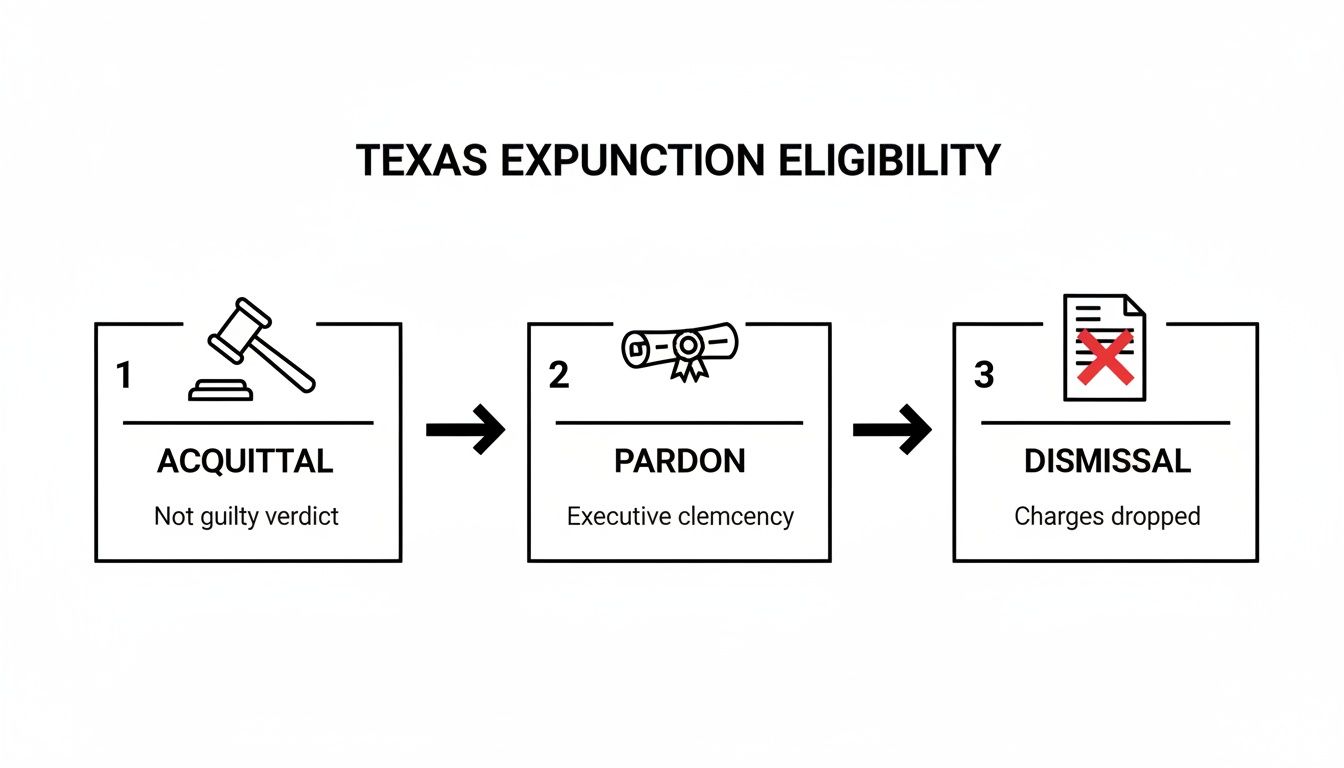
Successfully proving one of these outcomes is what convinces a judge to sign off on your request.
The Court Hearing and Final Order
After all the agencies are notified, the court will schedule a hearing, usually 30 to 60 days down the road. In many straightforward misdemeanor cases where no one objects, the prosecutor might just agree to the expunction, and you might not even have to show up for a formal hearing.
But if a hearing is required, a judge will review your petition and listen to the arguments. This is where having an experienced attorney really pays off. They can answer any tough questions from the judge or prosecutor and make sure your case is presented persuasively.
The Ultimate Goal: The Order of Expunction
If the judge agrees you meet the legal standard, they will sign the Order of Expunction. This is the official, legally binding document that commands all of those government agencies to search their files and destroy every record related to your arrest.
That signed order is your ticket to a fresh start. Once it’s issued, the agencies have a certain amount of time to comply. After that, you can legally deny the arrest ever happened, finally putting that mistake behind you for good.
Common Obstacles in the Expunction Process

While the path to an expunction seems clear once you know the rules, the reality is that the legal system is full of hidden traps. Filing a petition is one thing; getting it approved without hitting a snag is a whole different ballgame. Many people who try to handle this alone run into unexpected roadblocks that get their petition denied, forcing them to start all over again.
One of the most common issues is a prosecutor filing an objection. It’s rare when your eligibility is crystal clear, but it happens. The state might argue that you don’t technically meet the criteria or that some tiny detail in your case disqualifies you. When that happens, you’re suddenly in a contested legal battle you have to be prepared to win.
Missteps That Can Derail Your Petition
Beyond a direct challenge from the state, many expunctions fail because of simple but costly procedural errors. The law demands perfection in these filings, leaving very little room for mistakes.
Common errors that can stop your petition cold include:
- Filing in the Wrong County: Your Petition for Expunction must be filed in the district court of the county where you were arrested, not necessarily where you live now.
- Incorrectly Calculating Waiting Periods: Filing even one day before the statute of limitations has run for your misdemeanor will result in an automatic denial.
- Failing to Notify Every Agency: You are required to identify and properly serve notice to every single government entity holding your records—a list that is often much longer and more complex than people realize.
Practical advice matters. For example, if you were arrested for a Class C misdemeanor for Public Intoxication under Texas Penal Code § 49.02, but the case was ultimately dismissed, you are likely eligible for expunction. After a mandatory 180-day waiting period from the arrest date, you can petition to have the entire incident wiped from your record, preventing it from affecting future opportunities. You can learn more about how recent Texas legislation impacts criminal record expungement.
Why an Experienced Attorney Is Your Greatest Asset
This is where having an experienced criminal defense attorney becomes invaluable. Navigating these obstacles is our job. We don’t just fill out forms; we build a legal strategy to anticipate and shut down any challenges that might pop up during your expunction process.
An attorney acts as your advocate and your safety net, ensuring every legal requirement is met with precision. We verify your eligibility, draft an error-free petition, and manage all communications with the court and state agencies, protecting you from the costly mistakes that can jeopardize your future.
Think about a common scenario: a person is arrested for a Class A misdemeanor, and the charges are later dismissed. Excited to clear their name, they file the petition a year later, not realizing the statute of limitations for a Class A misdemeanor is two years. The petition is immediately denied, and they have to pay the filing fees all over again when they refile at the correct time.
Our team prevents these kinds of errors. We handle the complex details so you don't have to.
When you hire The Law Office of Bryan Fagan, PLLC, we take the burden off your shoulders by:
- Ensuring Flawless Paperwork: We meticulously prepare and review your petition to ensure it is 100% accurate and complete.
- Managing Objections: If the state files an objection, we are prepared to represent you in court and vigorously defend your right to an expunction.
- Navigating Notifications: We know exactly which agencies to notify and how to properly serve them, satisfying one of the most technical parts of the process.
Trying to secure an expunction on your own can feel like walking through a minefield. With our team by your side, you can move forward with confidence, knowing a skilled professional is clearing the path for you.
Your Top Questions About Misdemeanor Expunction, Answered
Even after you get the big picture, a lot of smaller, practical questions tend to pop up. It's completely normal to feel uncertain. Below, our team has put together straightforward answers to the questions we hear most often from Texans looking to clear their names. Our goal here is to give you the clarity and confidence you need to move forward.
How Much Does It Cost to Expunge a Misdemeanor in Texas?
The total cost for a misdemeanor expunction in Texas isn't a single flat fee; it’s a mix of a few different expenses. First, you have court filing fees, which usually land in the few-hundred-dollar range, though it varies by county. Then there are smaller costs for formally serving notice to all the state agencies involved.
The biggest variable is usually the attorney's fee. It’s tempting to try and save money by filing everything yourself. But here’s the reality: one small mistake on the paperwork can get your petition denied. If that happens, you’re out all the fees you already paid and have to start the entire process over. Investing in an experienced lawyer from the start is the surest way to get it done right the first time, which almost always saves you money and a massive headache in the long run.
How Long Does the Expungement Process Take?
Patience is key in this process. From the day your petition is officially filed with the court, you should realistically expect the whole thing to take somewhere between three to six months to complete.
This timeline includes a mandatory 30-day window where state agencies can respond or object. It also accounts for the time it takes to get a hearing on the judge's calendar, if one is needed. After the judge signs the final Order of Expunction, it can still take a few more months for every single agency to receive the order and physically destroy their records.
Do I Have to Disclose an Expunged Arrest?
No. This is the single most powerful benefit of an expunction, and it’s what makes the entire process worth it. Once a judge signs that order and your misdemeanor record is destroyed, you are legally allowed to deny the arrest ever happened. Period.
Under Texas Code of Criminal Procedure § 55.03, it is illegal for any state or local agency to release, maintain, or use an expunged record for any purpose. This means you can confidently check "no" when asked about prior arrests on applications for jobs, housing, loans, or college.
Think of it as a complete and total reset. The event is erased. The record won't show up on background checks run by employers, landlords, or anyone else.
What Happens If My Expunction Petition Is Denied?
If your petition is denied, the record of your arrest stays right where it is—publicly accessible. The most important thing to figure out is why it was denied. Sometimes, it’s a simple procedural error, like filing a few weeks too early or forgetting to notify one of the required agencies. In those cases, the mistake can often be fixed, and you can simply refile the petition.
However, a denial might also mean you don't legally meet the eligibility criteria for an expunction in the first place. If your petition is denied for any reason, it is absolutely essential to speak with a criminal defense attorney. An attorney can dig into the judge's decision, explain exactly what went wrong, and map out your next steps—whether that means correcting an error and refiling, appealing the decision, or looking into another option like an order of nondisclosure.
If you’ve been charged with a crime in Texas, call The Law Office of Bryan Fagan, PLLC for a free and confidential consultation. Our defense team is ready to protect your rights.