Being arrested in Texas can be terrifying — but you don’t have to face it alone. If you're dealing with a misdemeanor charge, one question is probably keeping you up at night: how long does this stay on my record?
The answer is simple, and honestly, a little unsettling. In Texas, a misdemeanor sticks to your record forever—unless you take specific legal action to get it off. There’s a common myth that criminal records just fade away after a few years. That’s dangerously false.
Your Record Doesn't Just Fade Away
Getting arrested for a misdemeanor in Texas can be a jarring experience, but the anxiety doesn’t stop when the court case ends. Many people think that once they pay a fine or finish probation, the whole ordeal is behind them.
Unfortunately, that’s not how it works in the digital age. From the moment you're arrested, a public record is created. It doesn't matter if it was for something minor; that file is now a permanent part of your history.

Think of it less like a temporary mark and more like a permanent digital footprint. This footprint is surprisingly easy for others to find whenever they run a background check. This includes:
- Potential employers
- Landlords and apartment leasing offices
- Banks and mortgage lenders
- Professional licensing boards (for nurses, teachers, real estate agents, and more)
What this means is that a single mistake from your past could block you from getting a job, signing a lease, or moving up in your career for years to come. The record of an arrest or charge doesn’t simply disappear with time.
Why Dismissals and Time Don't Erase the Record
Here’s where it gets tricky. Your criminal history is stored in multiple state and private databases. Once your information gets logged, it stays there indefinitely. Getting your case dismissed is a fantastic outcome in court, but it does not automatically wipe the slate clean.
To a background check company, the arrest still shows up. It can still look like you were in trouble with the law, even if you were ultimately cleared of wrongdoing.
The State of Texas does not automatically clear your record after a certain number of years. You have to be proactive and take the necessary legal steps to clear your name and protect your future.
To give you a clearer picture, here's a quick breakdown of how different outcomes typically play out on your public record by default.
Texas Misdemeanor Record Permanence at a Glance
This table summarizes the default status of various misdemeanor outcomes on your public record in Texas, before any legal action is taken to seal or expunge them.
| Case Outcome | Stays on Your Record? | Potential Remedy |
|---|---|---|
| Arrest Only (No Charges Filed) | Yes | Expunction |
| Case Dismissed | Yes | Expunction |
| Acquitted (Found "Not Guilty") | Yes | Expunction |
| Deferred Disposition (Completed) | Yes | Nondisclosure |
| Pled Guilty/No Contest & Convicted | Yes | Limited options, possible Nondisclosure |
As you can see, even the best possible outcomes in court don't automatically clear your name from public view. You have to take that next step yourself.
Your Path to a Clean Slate
Facing this reality can feel discouraging, but it’s actually the first step toward taking back control. The good news is that Texas law provides powerful legal tools to help you clean up your past. You just have to be the one to start the process.
The two main options are expunction (which completely destroys the record as if it never happened) and an order of nondisclosure (which seals it from public view).
Figuring out if you qualify for one of these remedies is the key to truly moving past a misdemeanor charge. Your eligibility hinges on the specific details of your case, like the type of offense and how it was resolved. A skilled Houston criminal lawyer can look at your situation and guide you through the complex process of clearing your record for good.
If you’re trying to clear your name after a misdemeanor charge in Texas, the first thing you need to get straight is what you're actually up against. The law doesn't treat all misdemeanors the same. Texas sorts them into three categories—Class A, B, and C—and which box your charge fits into changes everything.
The classification of your offense is the starting point for your entire legal journey. It directly impacts potential punishments, your chances of getting the record wiped clean later, and the timeline for making it happen. Figuring out where you stand is step one.
The Three Classes of Texas Misdemeanors
The Texas Penal Code lays out the punishment ranges for each class. Think of it like a ladder, where Class C is the bottom rung and Class A is the top before you get into felony territory.
Class C Misdemeanor: This is the lowest-level offense you can get. Most people know these as "ticketable" offenses because they don't come with jail time. Under the Texas Penal Code, the maximum penalty is a fine of up to $500. Things like public intoxication, disorderly conduct, or petty theft (under $100) usually fall in this bucket.
Class B Misdemeanor: Now we’re getting more serious. A conviction here can land you in county jail for up to 180 days, plus a fine of up to $2,000. A first-time DWI, criminal trespass, or stealing something worth between $100 and $750 are common examples.
Class A Misdemeanor: This is the most serious misdemeanor charge in Texas. If you're convicted, you could be looking at up to a full year in county jail and a fine as high as $4,000. A second DWI, assault causing bodily injury, or theft of property valued between $750 and $2,500 all fit here.
Understanding these differences is absolutely critical because the road to a clean record looks very different for each one. The law is more forgiving with lower-level offenses, but the rules get a lot stricter—and the waiting periods longer—as the charges get more serious. A good Texas assault defense attorney can break down exactly what a Class A charge means for your future.
How Severity Affects Your Record Clearing Options
So, why does the state make these distinctions? It all comes down to public safety. The law wants to offer second chances, but it's always weighing that against the perceived risk an offender poses.
For instance, someone who successfully completes deferred adjudication for a Class C ticket can often file to have their record sealed almost right away. But if you were on deferred for a Class A charge, you’ll likely have to wait a full two years after your case is over before you can even ask for an order of nondisclosure.
The classification of your misdemeanor is the starting point that determines the entire timeline and strategy for clearing your name. It dictates the waiting periods and the legal remedies available to you.
It's worth noting that holding onto criminal records isn't just a Texas thing. All over the world, countries grapple with how long to keep this information, balancing data privacy with crime severity. Some European nations, for example, have laws that allow minor offenses to be scrubbed after a few years, while serious crimes stay on the books much longer. You can learn more about the international legal frameworks governing criminal records on strasbourgobservers.com. This global context just goes to show why knowing the specific Texas rules is so vital for your case.
At the end of the day, the class of your misdemeanor charge is the legal map you have to follow. An experienced Houston criminal lawyer knows how to read that map and guide you to the best possible destination, whether that means fighting the charge upfront or setting you up for a clean slate down the road.
Erasing Your Record with an Expunction
When you're trying to put a past mistake behind you for good, you need the strongest legal tool available to clear your name. In Texas, that tool is an expunction. An expunction isn't about hiding your record; it's about destroying it completely. Think of it as hitting a legal reset button that erases an arrest and court case, allowing you to legally deny it ever happened.
For most people, this is the gold standard for a fresh start. Once a judge signs an expunction order, government agencies are mandated to physically destroy every file tied to your case. That means the arrest, the charge, and all the court documents are gone forever. You can confidently say "no" when asked if you've ever been arrested for that specific offense.
Who Qualifies for This Fresh Start
Because an expunction is so final, Texas law is incredibly strict about who gets one. You can't just get an expunction for any case. It's reserved for situations where the justice system either found you were not at fault or decided not to move forward with the prosecution in the first place.
You might be eligible for an expunction if your case ended in one of these ways:
- Your case was dismissed by the prosecutor. This often happens when there's not enough evidence, or you successfully finish a pretrial diversion program.
- You were acquitted at trial. This is a formal finding of "not guilty" by a judge or jury.
- You were arrested, but charges were never formally filed. If the prosecutor looks at your case and decides not to pursue it, you have the right to clear that arrest record.
- You received a pardon from the Governor of Texas or the President of the United States.
This infographic helps visualize how different Texas misdemeanor charges are categorized, which is the first step in figuring out your legal options.
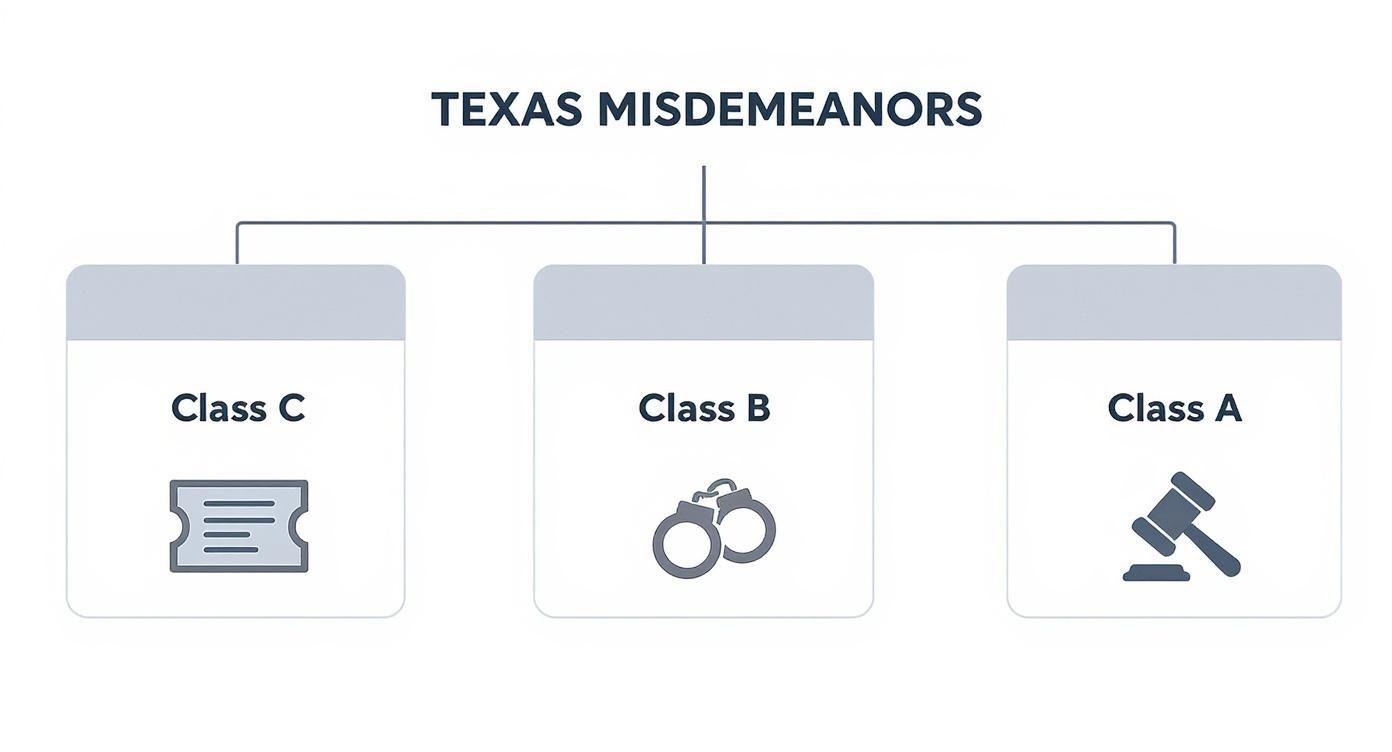
As you can see, the class of a misdemeanor doesn't just determine the potential penalties—it also directly shapes the path you'll need to take to clear your record.
Understanding the Mandatory Waiting Periods
Here's a catch: even if your case was dismissed or you were found not guilty, you can't file for an expunction the next day. The Texas Code of Criminal Procedure forces you to wait for a specific amount of time to make sure the statute of limitations has run out. This is a safeguard to prevent someone from erasing a record that could, in theory, still be prosecuted.
The waiting period is tied to the class of your misdemeanor:
- Class C Misdemeanor: You must wait 180 days from the date of your arrest.
- Class A and B Misdemeanors: You must wait one year from the date of your arrest.
It's absolutely crucial to get these waiting periods right. Filing your Petition for Expunction even one day too early will lead to an automatic denial, forcing you to start the entire frustrating process all over again.
This waiting period is a non-negotiable part of the law, ensuring the state has officially closed the book on your case before you can legally wipe it clean. The process can feel confusing, and meeting every single deadline and requirement is vital. For a deeper dive, you can explore the complete Texas expungement process and timeline in our comprehensive guide. An experienced criminal defense attorney can confirm your eligibility, calculate the exact filing date, and prepare the necessary legal documents to give you the best shot at a truly clean slate.
Sealing Your Record from Public View
What happens if your case doesn’t qualify for a full expunction? For a lot of Texans, this is a tough reality. But it doesn’t mean you’re completely out of options. There's another powerful legal tool called an order of nondisclosure, which acts like a privacy shield for your criminal record.
While an expunction literally destroys the record, a nondisclosure seals it from the public. Think of it this way: your record still exists, but it's locked away in a secure vault. Most private citizens and businesses—including potential employers, landlords, and background check companies—can no longer see it. This gives you a critical second chance to pass those background checks for jobs and housing.
Who Is Eligible to Seal Their Record
The most common path to getting a nondisclosure is by successfully completing a special type of probation called deferred adjudication. This is a specific kind of plea bargain where you plead "guilty" or "no contest," but the judge holds off on actually finding you guilty. Instead, you're placed on community supervision for a set period.
If you jump through all the hoops and complete every requirement of your probation—paying fines, attending classes, and staying out of trouble—the judge will dismiss your case. Because you were never officially convicted, you may then become eligible to seal the record of that charge. It's a huge benefit, preventing a one-time mistake from following you around forever.
Waiting Periods for Nondisclosure
Just like with expunctions, you can't file for a nondisclosure the day your case is dismissed. The law requires you to wait for a set period to prove you can stay on the right side of the law.
The waiting periods are based on how serious the charge was:
- Most Class A and Class B Misdemeanors: You’ll have to wait two years from the date your deferred adjudication probation is successfully discharged and the case is dismissed.
- Certain Class B Misdemeanors: Some specific offenses might let you file immediately upon dismissal.
- Class C Misdemeanors: You can often file for nondisclosure right away after successfully completing your deferred disposition.
Getting these dates right is absolutely vital. Filing too early is one of the most common reasons a petition for nondisclosure gets denied, forcing you to start the whole process over and wait even longer.
Which Offenses Cannot Be Sealed
Unfortunately, not every charge is eligible for nondisclosure, even if you completed deferred adjudication perfectly. The Texas legislature has specifically carved out certain offenses from being sealed due to public safety concerns. If you were charged with any of the following, a nondisclosure is likely off the table:
- Any offense requiring you to register as a sex offender.
- Offenses involving family violence, as defined by the Texas Family Code.
- Violating a protective order.
- Stalking or human trafficking.
- Murder or capital murder.
It's especially important to know that a standard DWI (Driving While Intoxicated) charge is almost never eligible for nondisclosure in Texas. The laws are incredibly strict on this point, making it one of the most difficult charges to get off your public record.
Navigating the complex rules of nondisclosure eligibility can be a real headache. An experienced criminal defense attorney can dive into the specifics of your case, figure out if you qualify, and make sure your petition is filed correctly and at the right time. For people who need to protect their career and housing opportunities but don't qualify for a full expunction, this is often the best path forward. Taking this step is crucial, because without it, the answer to "how long does a misdemeanor stay on your record" is simple: forever.
How a Misdemeanor Record Impacts Your Daily Life
A misdemeanor on your record is a lot more than just a closed court case. Think of it as a shadow that follows you, complicating your life in ways you probably never expected. This isn't just legal talk—it's the tough, day-to-day reality for thousands of Texans. The consequences can linger for years, making it incredibly hard to build the future you deserve.

This record creates very real hurdles that pop up at the worst possible moments. It’s not just a mark on some official paper; it’s a red flag that can stop your progress cold and shut doors before you even get a chance to prove who you are today. Practical consequences can include:
- Employment: Most companies run background checks on every single applicant. A misdemeanor can get your resume automatically tossed out, especially for jobs that require trust, security, or handling money.
- Housing: Landlords almost always run background checks. A misdemeanor record can lead to an instant denial of your rental application, making it a nightmare to find a safe place to live.
- Professional Licensing: Many professions in Texas—especially licensed ones like nursing, teaching, or real estate—have strict "good moral character" requirements. A misdemeanor, particularly something related to theft or assault, can be all it takes for a licensing board to deny your application or even revoke an existing license.
- Financial Aid: Certain drug convictions can make you temporarily ineligible for federal student loans and grants, putting your college education on hold.
- Insurance Rates: A conviction for something like a DWI will almost certainly cause your car insurance premiums to skyrocket, costing you thousands of extra dollars over the years.
These consequences make it clear the stakes are incredibly high. Taking proactive steps to clear your record isn't just a good idea—it's one of the most important investments you can make in your future stability.
The Problem of Inaccurate Background Checks
The reach of a criminal record is huge, affecting an enormous number of people. In the United States, about 77 million adults—nearly one in three—have a criminal record of some kind. This problem gets even worse when you factor in how unreliable many private background checks are.
Shockingly, some studies have found that 60% of individuals had at least one false-positive error on their report. These mistakes can unfairly cost people opportunities based on information that is just plain wrong or outdated.
Even after you’ve done everything right legally, leftover information online can still haunt your reputation. It's smart to know all your options; you can even consult a practical guide to remove negative search results to tackle information that might still be floating around online.
On top of all this, the emotional toll of constantly worrying about your record can be draining. Getting your name cleared isn't just a practical move; it’s a way to finally get some peace of mind. For so many people, the expunction process provides profound emotional relief and a true fresh start.
Ultimately, a misdemeanor record is a barrier holding you back. Taking action to have it expunged or sealed isn't just about clearing your name—it’s about unlocking your future potential and closing a difficult chapter for good.
Common Questions About Texas Misdemeanor Records
When you're caught in the gears of the justice system, the not-knowing is often the worst part. The uncertainty can be more stressful than the charge itself. To cut through the legal fog, we’ve put together straight answers to the most common questions our clients ask about their misdemeanor records.
Getting clear, plain-English answers is the first step toward making smart decisions and taking back control of your future. Here’s what people just like you are asking.
If My Case Was Dismissed, Does It Automatically Come Off My Record?
No, and this is probably the biggest and most costly misunderstanding in Texas criminal law. Getting your case dismissed is fantastic news—it means the prosecutor dropped the charges and you’re no longer in legal jeopardy. But the arrest itself? That stays put.
To a background check company, a prospective employer, or a landlord, it still looks like you had a run-in with the law. The only way to make the arrest and the dismissed charge truly vanish is by filing a Petition for Expunction.
This is a formal court process that ends with a judge's order forcing government agencies to physically destroy every file connected to your case. If you don't take this step, that arrest record will follow you around forever.
Can I Get a DWI Misdemeanor Off My Record in Texas?
It's a very tough road. Texas law comes down hard on DWI offenses, and for good reason. A DWI conviction, or even a case where you got standard probation, cannot be sealed or expunged. The state intends for that record to be permanent in almost all situations.
However, there are a few very narrow exceptions. You might have a shot at clearing your record only if:
- Your DWI case was flat-out dismissed by the prosecutor.
- You went to trial and were found "not guilty" (an acquittal).
- You successfully completed a very specific pretrial diversion program that was designed for DWI cases.
These situations are rare. Because the exceptions are so limited, you absolutely need an experienced Texas DWI attorney to dig into the details of your case. They can tell you if one of these long-shot paths to a clean slate is actually available to you.
How Long Do I Have to Wait to Seal My Record After Deferred Adjudication?
The waiting period for an order of nondisclosure is set by law and depends entirely on what kind of misdemeanor you had. There’s no flexibility here.
For most Class C misdemeanors, you can file the petition right after you successfully finish your deferred adjudication and the judge officially dismisses your case.
But for the more serious Class A and Class B misdemeanors, you have to wait two years from the date the case was dismissed. Don’t even think about filing early. If you file one day too soon, the court will automatically deny your petition, and you'll have to start all over again, wasting precious time and money. An attorney makes sure everything is filed correctly and on time to avoid these simple but frustrating mistakes.
Remember, successfully completing deferred adjudication is only half the battle. You have to take the next step and file a Petition for an Order of Nondisclosure to actually hide the record from public view. The court won’t do it for you.
Taking that proactive step is what separates a past mistake from a permanent roadblock.
What's the Difference Between an Arrest and a Conviction?
Knowing the difference here is everything, because it determines what your legal options are.
An arrest record is created the second you’re put in handcuffs. It’s the official story of that event—your mugshot, fingerprints, and the initial charge—and it exists whether you’re guilty or not.
A conviction record, on the other hand, is only created if you are formally found guilty in court. That happens if you plead "guilty," "no contest," or if a judge or jury convicts you after a trial.
Both records are public, and both can do serious damage to your job prospects, housing applications, and reputation. An expunction is the most powerful tool because it wipes out both the arrest and the court records, making it as if the incident never happened. A nondisclosure is the next best thing; it seals the records, hiding them from the public while leaving them visible to law enforcement and a few government agencies.
A skilled Houston criminal lawyer can analyze your situation and tell you exactly which option you qualify for, putting you on the fastest path to a brighter, cleaner future.
If you’ve been charged with a crime in Texas, call The Law Office of Bryan Fagan, PLLC for a free and confidential consultation. Our defense team is ready to protect your rights. https://texascriminallawyer.net