Being arrested for DWI in Texas can be terrifying — but you don’t have to face it alone. The first few hours are absolutely critical. Your immediate actions—staying silent, politely refusing field sobriety tests, and calling a DWI defense attorney—can literally make or break your case. These aren't just suggestions; they are the bedrock of a strong defense built to protect your future.
Your First Moves After a Texas DWI Arrest

The instant those red and blue lights flash in your rearview mirror, the clock starts ticking. You’re suddenly pulled into the criminal justice system, and every single thing you do or say is being scrutinized and recorded. Protecting your rights isn't something that starts in a courtroom; it starts right there on the side of the road.
Your number one priority is to use your right to remain silent. You're required to provide your name, driver's license, and proof of insurance, but that's it. You do not have to answer questions about where you've been, what you've had to drink, or where you're headed. A simple, polite, "Officer, I am exercising my right to remain silent" is all you need to say.
The Critical 15-Day ALR Deadline
Here's something most people don't realize: one of the most urgent deadlines you face has nothing to do with the criminal charge itself. It’s the Administrative License Revocation (ALR) hearing, a separate civil process where the Texas Department of Public Safety (DPS) tries to suspend your driver’s license.
You have only 15 days from the date of your arrest to request this hearing. If you miss that window, your license is automatically suspended. No exceptions.
This hearing is more than just a fight to keep your license. It's a golden opportunity for your attorney to get the arresting officer under oath and question them. This early testimony can expose huge weaknesses in the state's case long before you ever see a criminal courtroom. Missing this deadline is a massive strategic mistake.
Document Everything You Remember
As soon as you possibly can, write down everything. Your memory is a crucial piece of evidence, but it fades incredibly fast, especially under stress. Jotting down the details, no matter how small they seem, can give your attorney the ammunition they need to build your defense.
Try to capture these specific points:
- The Traffic Stop: Why did the officer pull you over in the first place? Did they give a legitimate reason, like speeding or a broken taillight, or was it vague?
- The Officer’s Words: What exactly did the officer say they saw or smelled? Did they mention "bloodshot eyes" or the "odor of alcohol"? Get the exact phrasing if you can.
- How You Felt: Were you tired, sick, or just plain nervous? Do you have allergies, injuries, or any medical issues that could affect your speech or balance?
- The Scene: Where did this all happen? Was the road sloped or uneven? Was it dark, poorly lit, or raining?
These details might feel insignificant now, but they can be used to challenge the officer's credibility and the reliability of any so-called "evidence" they gathered. For a more comprehensive checklist, check out our guide on the essential steps to take after a DUI arrest.
What you do in the first 48 hours sets the entire tone for your defense. It's about taking control of the situation and giving yourself the best possible chance for a positive outcome.
Deconstructing the Prosecution's DWI Case
To build a winning DWI defense, you have to start by thinking like a prosecutor. Their job is to convince a judge or jury, beyond a reasonable doubt, that you were operating a motor vehicle in a public place while intoxicated. It sounds straightforward, but every single part of that sentence is a building block that a skilled Houston criminal lawyer can—and should—take apart.
The entire case hangs on how the state defines "intoxication" under Texas Penal Code § 49.04. In Texas, the prosecutor gets two different ways to argue you were intoxicated.
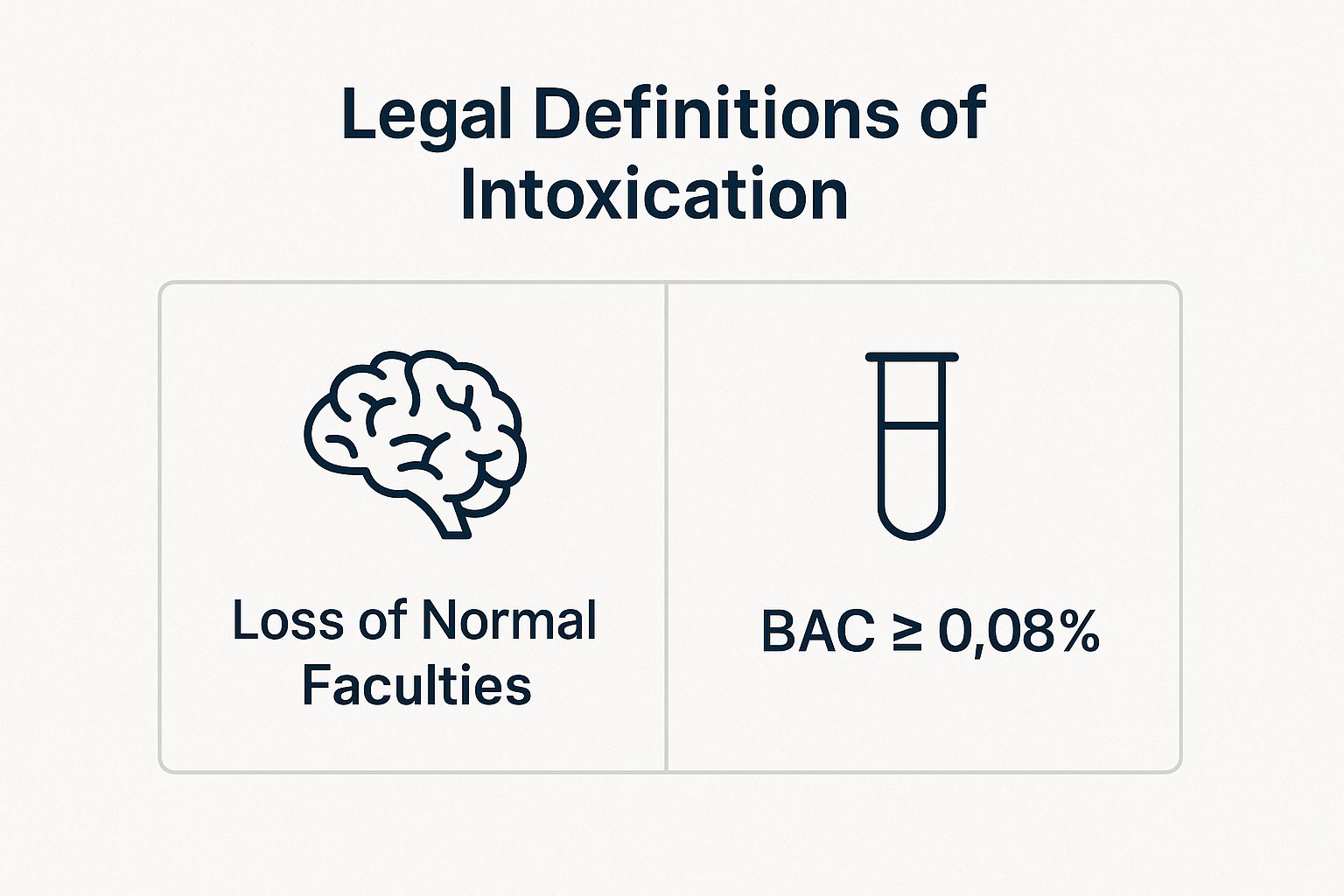
This distinction is crucial. It means the state can move forward with a DWI charge even if you refused the breath or blood test, or if the results were somehow lost or thrown out. They can build their entire case on subjective evidence, arguing that you simply lost the normal use of your mental or physical faculties.
The Two Paths to Proving Intoxication
The first route is what we call a "per se" violation. This is all about the numbers. If the prosecution has a valid breath or blood test showing your Blood Alcohol Concentration (BAC) was 0.08% or higher, they will argue that you were intoxicated by definition. It doesn't matter how well you were driving or how sober you appeared.
The second path is the "impairment theory," and this one is far more subjective. Here, the prosecutor’s job is to paint a picture for the jury that you had lost the “normal use of your mental or physical faculties.” The evidence for this almost always comes directly from the arresting officer’s observations and your supposed performance on the roadside sobriety tests.
A prosecutor doesn't need to prove both—only one. This is why a strong Texas DWI attorney must be prepared to challenge both the scientific evidence and the officer’s subjective opinions.
Evidence the State Will Use Against You
The prosecution will try to weave a story for the court using a few key pieces of evidence. A DWI defense lawyer’s job is to pull on the threads until that story unravels. The state's case typically relies on:
- The Officer’s Testimony: This is their narrative. It covers everything from their initial reason for pulling you over to their description of your appearance ("red, glassy eyes"), your speech, and the alleged odor of alcohol.
- Field Sobriety Tests (SFSTs): Your performance on exercises like the Walk-and-Turn or One-Leg Stand will be framed as objective proof of impairment, even though these tests are notoriously flawed and difficult for even sober people to pass.
- Chemical Test Results: The number from a breathalyzer or a blood draw is incredibly powerful evidence for the state, but it is far from perfect. Machines malfunction, samples get contaminated, and procedures get ignored.
Understanding how each piece of this evidence was collected is the first step in dismantling it. You can learn more about how your attorney gets their hands on all the state's evidence through the discovery process for DWI charges in Texas.
By dissecting the prosecution’s case piece by piece, an experienced attorney can find the weak spots needed to build a winning strategy and protect your rights.
Proven Strategies for Challenging DWI Evidence

Beating a DWI charge in Texas isn't about finding a magic loophole. It's about a systematic takedown of the prosecutor's evidence. A skilled defense attorney knows that every single piece of the state's case—from the flashing lights in your rearview mirror to the final breath or blood test—is riddled with potential weaknesses.
It all starts with the traffic stop. If the officer didn't have a legally solid reason to pull you over in the first place, everything that happened afterward can get thrown right out of court. This is what we call the "fruit of the poisonous tree" doctrine. An officer needs more than a hunch; they must have reasonable suspicion that you've actually broken a law.
Attacking the Initial Traffic Stop
So, what does that mean in the real world? An officer might say you were "swerving," but was it one minor drift inside your own lane or were you truly driving dangerously? They might claim you failed to signal, but what if the dashcam footage shows you did? Challenging the officer's justification for pulling you over is often the first—and most powerful—line of attack.
If the stop was illegal, your attorney files a Motion to Suppress Evidence. If the judge agrees the officer violated your Fourth Amendment rights, the prosecution’s case often crumbles on the spot. That’s a total victory.
Discrediting Field Sobriety Tests
Those roadside gymnastics—the Standardized Field Sobriety Tests (SFSTs)—are a cornerstone of nearly every DWI arrest. But they are far from foolproof. These aren't simple pass/fail exercises. They are divided-attention tasks that many completely sober people would fail under perfect conditions.
Now imagine doing them on the side of a dark, noisy highway with police lights flashing in your eyes. It’s a setup for failure.
Your attorney can challenge the results by pointing out all sorts of problems:
- Improper Administration: Officers are required to follow a rigid, standardized script when giving instructions. If they mess it up, the results are junk.
- Environmental Factors: Was the ground sloped or uneven? Was it wet or gravelly? Were you wearing work boots or high heels? These things make it nearly impossible to perform the tests correctly.
- Personal Health Conditions: Do you have back problems? Bad knees? An inner ear issue that affects your balance? Are you over 65? These are all legitimate medical reasons that can mimic the signs of intoxication.
An officer’s opinion that you “failed” a sobriety test is just that—an opinion. A skilled cross-examination can expose that conclusion as a product of flawed procedures and unfair conditions, not genuine impairment.
Challenging Breath and Blood Test Results
The breathalyzer or blood test result can feel like the final nail in the coffin. It's a number, right? Scientific proof. But in reality, this "scientific" evidence is often the most vulnerable part of the prosecution's case.
The machines used for these tests require constant, precise calibration and maintenance. The person drawing your blood has to follow strict procedures. Any misstep can contaminate the sample or corrupt the reading.
A sharp defense lawyer will dig into everything: maintenance logs, the officer's training records, and the chain of custody for the blood vial. For a deeper look at this, you can learn more about the specific DWI breathalyzer legal challenges an attorney can raise in court.
A well-planned, aggressive defense that examines every detail makes all the difference.
The table below breaks down the common types of evidence prosecutors use in Texas DWI cases and the angles a skilled attorney can use to fight back.
Common DWI Evidence and Potential Defense Angles
| Type of Evidence | What the Prosecution Argues | How Your Attorney Can Challenge It |
|---|---|---|
| Officer's Observations | "The driver had slurred speech, red eyes, and smelled of alcohol." | Argue these are signs of fatigue, allergies, or other non-alcohol-related factors. Show bodycam footage that contradicts the officer's report. |
| Field Sobriety Tests (SFSTs) | "The driver failed the walk-and-turn and one-leg stand tests, showing clear impairment." | Challenge the test administration, point out poor road conditions, or introduce evidence of medical issues that affect balance and coordination. |
| Breathalyzer Results | "The breathalyzer showed a BAC of 0.12, well over the legal limit." | Question the machine's calibration records, the officer's training credentials, or argue that medical conditions like GERD skewed the results. |
| Blood Test Results | "A blood test confirmed a BAC of 0.13, providing scientific proof of intoxication." | Attack the chain of custody, question the lab's procedures, argue the blood sample was contaminated, or show the warrant was invalid. |
| Driver's Statements | "The driver admitted to having 'a couple of beers' earlier in the evening." | Argue the statements were made before being read Miranda rights or were taken out of context. An admission to drinking is not an admission to being intoxicated. |
As you can see, every piece of evidence has a counter-argument. The key is having an experienced guide who knows how to find it and use it effectively in court.
Navigating the Texas Criminal Court Process
https://www.youtube.com/embed/as_R9WfCuAM
Getting arrested for a DWI isn't the end of the story—it's the beginning of a legal journey that can feel confusing and overwhelming. Knowing what’s coming down the road can take away a lot of the anxiety and help you work with your attorney to build a stronger defense.
Here’s a step-by-step look at what you can expect.
Arraignment: The First Court Appearance
Your first time in front of a judge will likely be for the arraignment. This is a short, formal hearing where the charges against you are officially read. You’ll enter an initial plea, which is almost always "not guilty" at this stage. This plea protects your legal rights and gives your attorney the green light to demand all the evidence the state has against you. This is called "discovery."
Pre-Trial Conferences and Motions
After the arraignment, your case moves into the pre-trial phase. This is where most of the heavy lifting happens. You'll have a series of court dates called pre-trial conferences, where your attorney will meet with the prosecutor to discuss the evidence, negotiate, and update the judge on how the case is moving along.
This is also where your attorney will file important legal motions. For example, if the police violated your rights—maybe they didn't have a good reason to pull you over—they’ll file a Motion to Suppress. If the judge agrees, that key piece of evidence gets thrown out. A successful motion can sometimes gut the prosecutor's case before you even get close to a trial.
Plea Bargaining
Plea bargaining is another huge part of this stage. Your attorney will use every weakness found in the state's case to negotiate a better deal for you. The goal might be to get the charge reduced to a non-DWI offense like Obstruction of a Highway or Reckless Driving. These offenses carry lighter penalties and don't come with the lifelong stigma of a DWI conviction.
Sometimes, being proactive about your own situation can influence these negotiations. Taking the initiative by understanding what rehab entails can show the court you're taking things seriously, which might open the door to more favorable plea options.
Plea bargaining isn't just about avoiding a trial. It's about finding a resolution that does the least amount of damage to your life, your driver's license, and your future.
Whether your case ends with a smart plea deal or moves on to trial, having an attorney who can walk you through each step and explain your options in plain English is absolutely essential.
Clearing Your Record After a DWI Case

Even when a DWI case is officially closed, the charge itself can linger for years, popping up on background checks and creating roadblocks when you're trying to get a job or rent an apartment.
The good news is that a DWI arrest doesn't have to be a life sentence. Texas law offers powerful tools to help you move forward with a clean slate: expunction and an order of nondisclosure. They sound similar, but they accomplish different things.
Can Your DWI Record Be Expunged?
An expunction is the best possible outcome. It’s like hitting the "delete" button on your arrest. When a judge grants an expunction, all records tied to that charge—from the police report to the court files—are ordered to be physically destroyed. After an expunction, you can legally deny that the arrest ever happened.
However, eligibility for a DWI expunction is very narrow. You typically only qualify if your case ended in one of these ways:
- Acquittal: You went to trial and were found "not guilty."
- Dismissal: The prosecutor dropped the charges against you entirely.
- Pardon: You received a full pardon from the governor (this is extremely rare).
If you were convicted or took any kind of probation, you will not be eligible for an expunction for that DWI.
Sealing Your Record with Nondisclosure
If an expunction is off the table, you might still have a chance to seal your record with an order of nondisclosure. This process doesn't destroy the records, but it does hide them from public view.
Government agencies and law enforcement can still see the charge, but potential employers, landlords, and the general public won’t.
An order of nondisclosure is a powerful way to protect your privacy and prevent a past mistake from defining your future opportunities. It effectively hides the conviction from most background checks.
You may be eligible for a nondisclosure if:
- You successfully completed a deferred adjudication program for a first-time DWI.
- Your case involved a first-time DWI conviction (with a BAC under 0.15), and you've fully completed your sentence.
- You have no other disqualifying criminal history.
The rules for both expunctions and nondisclosures are complex. An experienced Texas criminal defense lawyer can determine if you're eligible and guide you through every step to give you the best shot at finally clearing your name.
Answers to Your Pressing Texas DWI Questions
When you're facing a DWI charge, it’s natural to have a million questions. Getting straight answers is the first step toward building a defense. Here are some of the most common questions our defense team hears.
Should I Refuse a Breathalyzer Test in Texas?
This is a critical decision. Texas has an "implied consent" law, which means that by having a driver's license, you've already agreed to provide a breath or blood sample if lawfully arrested for DWI.
Refusing the test triggers an automatic driver's license suspension. However, it also denies the prosecutor their strongest piece of evidence. Without a BAC number, the state's case often has to rely on the officer's subjective opinion. While they can still seek a warrant for a blood draw, refusing the initial breath test is often a smart strategic move. The best decision, however, always depends on the specific facts of your arrest.
Can I Get a DWI for Using My Prescription Medication?
Yes, absolutely. This is a huge misconception. The legal definition of intoxication in Texas isn't just about alcohol.
Under Texas Penal Code § 49.01, intoxication includes impairment from "alcohol, a controlled substance, a drug, a dangerous drug, a combination of two or more of those substances, or any other substance."
If your legally prescribed medication impairs your normal mental or physical faculties while you're behind the wheel, you can be charged and convicted of DWI. This is why you should never tell an officer you've taken any medication if you're pulled over.
The key element is impairment, not whether the drug was legal. The prosecutor's only job is to prove you lost the normal use of your faculties.
What Is the Difference Between a DWI and a DUI in Texas?
People use these terms interchangeably, but in Texas law, they are completely different offenses.
Here’s the breakdown:
- DWI (Driving While Intoxicated): This is the charge for adults 21 and older who operate a motor vehicle in public while legally intoxicated (BAC of 0.08 or higher, or loss of normal faculties).
- DUI (Driving Under the Influence): This charge is reserved exclusively for minors under 21. A minor can be charged with a DUI for driving with any detectable amount of alcohol in their system. The standard isn't impairment; it's presence.
So, a DUI is about having any alcohol in your system as a minor, while a DWI is about being legally intoxicated as an adult.
If you’ve been charged with a crime in Texas, call The Law Office of Bryan Fagan, PLLC for a free and confidential consultation. Our defense team is ready to protect your rights. https://texascriminallawyer.net