Being arrested in Texas can be terrifying, but you don't have to face it alone. A lot of people sit at their kitchen table late at night, staring at a background check problem that won't go away, wondering why a dismissed case or old arrest is still following them in Houston, Dallas, Austin, San Antonio, or anywhere in between.
That stress is real. Maybe you were arrested after a misunderstanding, a DWI stop that didn't lead to a conviction, a theft accusation that was dropped, an assault case that fell apart, or a drug possession charge that was dismissed. Even when the criminal case ends, the record often stays put unless you take formal legal action.
Texas law does give some people a path forward. If you're trying to learn how to expunge your record in Texas, the key is knowing which remedy fits your case, whether you qualify, and how to avoid the filing mistakes that delay relief.
A Criminal Record Does Not Have to Define Your Future
A criminal record can feel bigger than the case itself. You apply for work, a lease, or a professional license, and the same arrest keeps showing up. For many Texans, the hardest part isn't the court date. It's the long tail after the case is over.
I've seen people assume a dismissal means the record disappears on its own. It doesn't. Texas keeps criminal records unless a court orders otherwise. That surprises people who thought the system would correct itself once the prosecutor dropped the case or a jury returned a not guilty verdict.
What matters now is your outcome and your timing. If your case ended favorably, you may be able to clear the record entirely. If it didn't, another form of relief may still exist.
Where expunction fits into the bigger criminal process
When someone is asking about expunction, they are often also trying to understand everything else that happened in their case. The criminal process usually starts with an arrest, booking, and bail decision. After that, you may face arraignment, where the court advises you of the charge and your rights.
Then the case can move into plea bargaining, pretrial motions, trial, and sentencing. In a DWI case, a Texas DWI attorney may focus on the traffic stop, field sobriety testing, and breath or blood evidence. In a Texas assault defense case, the fight may center on self-defense, witness credibility, or whether the alleged conduct fits the charge under the Texas Penal Code. In theft or drug possession cases, the issues often involve intent, possession, police procedure, and search legality.
A criminal case and a record-clearing case are not the same thing. One decides guilt or innocence. The other decides whether the paper trail can be erased or sealed.
That distinction matters because expunction happens after the criminal matter ends. It's a separate legal process, and the rules are strict.
Expunction vs Nondisclosure Which Path Is for You
Before you file anything, you need to know whether you need an expunction or an order of nondisclosure. They are not interchangeable, and choosing the wrong one wastes time and money.
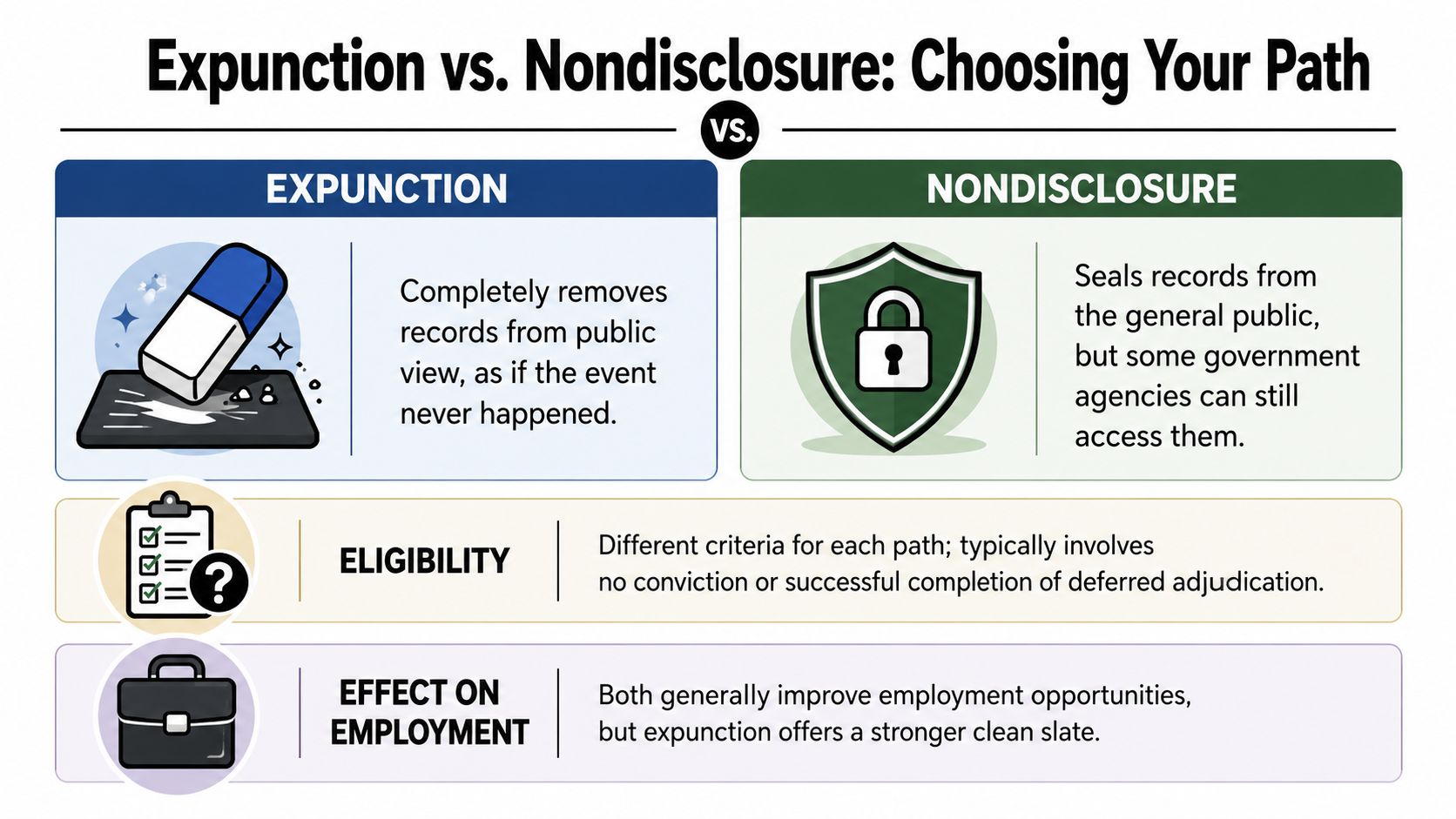
The short version
An expunction destroys the record. A nondisclosure seals it from public view, but some government agencies can still see it.
If you want a helpful overview of expungement vs nondisclosure in Texas, start there. The practical difference is simple. Expunction aims for a true clean slate. Nondisclosure gives privacy, not deletion.
You may also want to review Expunction and Nondisclosure in Texas, which explains how to clear or seal a criminal record under Texas law.
Expunction vs. Nondisclosure at a Glance
| Feature | Expunction | Nondisclosure (Record Sealing) |
|---|---|---|
| What it does | Destroys eligible records | Seals records from the public |
| Who can still see it | Record is treated as erased in most situations | Law enforcement and certain agencies may still access it |
| Typical use | Arrests with no charges, dismissals, acquittals | Certain cases involving deferred adjudication |
| Best result for background checks | Stronger clean-slate effect | Better privacy, but not full erasure |
Which one usually applies
If your case was dismissed, no-billed, never filed, or you were found not guilty, expunction may be the tool to examine first.
If you completed deferred adjudication, expunction usually isn't available. In that situation, nondisclosure may be the better path. As explained in this Texas record-clearing discussion, you can't expunge a conviction for any offense other than a Class C misdemeanor, but you may be eligible for nondisclosure if you successfully completed deferred adjudication for a non-violent, first-time misdemeanor, with waiting periods ranging from immediate eligibility to five years depending on the offense chapter.
Bottom line: Expunction erases. Nondisclosure hides from the public. If you had deferred adjudication, don't assume expunction is the answer.
That distinction matters for everyday life. An employer running a basic background check may not see a sealed record, but government actors may still access it. For some clients, that's enough. For others, only expunction gives the result they're looking for.
Determining Your Eligibility for a Texas Expunction
Texas expunction law is narrow by design. It isn't available just because you stayed out of trouble later or because the charge feels unfair in hindsight. Eligibility turns on what happened in the case and whether the statute allows the record to be removed.

The main eligibility categories
The clearest candidates for expunction are people whose cases ended without a conviction in a way the statute recognizes.
As outlined in this Texas expunction eligibility resource, your first question should be whether your case falls into one of the recognized categories.
Practical rule: Expunction usually starts with one of these outcomes. No charges filed, charges dismissed or quashed, or a not guilty result.
A detailed explanation from McCarty-Larson's Texas expunction guide states that eligibility is strictly limited to cases where no charges were filed, charges were dismissed or quashed, or the person was found not guilty. Expunction is prohibited if deferred adjudication or probation was received, or if a felony conviction occurred within five years of the arrest.
Waiting periods matter
Even if you qualify in principle, timing can block your petition.
If you were arrested and never formally charged, the waiting period starts from the arrest date. According to this eligibility summary, the wait is 180 days for a Class C misdemeanor, one year for a Class A or B misdemeanor, and three years for a felony.
If you were acquitted at trial, the rule is far better. You can seek expunction immediately after a not guilty verdict, as noted in this discussion of acquittal-based expunction in Texas.
What usually blocks expunction
These are the situations that trip people up most often:
- Deferred adjudication. In most cases, deferred adjudication doesn't qualify for expunction.
- Probation. If you received probation for the offense, expunction is generally off the table.
- Related felony history. A felony conviction within five years of the arrest can create a bar under the rule noted above.
- Assuming dismissal equals automatic clearing. It doesn't. You still have to file.
Judges don't grant expunction because a record feels burdensome. They grant it when the statute says you're entitled to it.
A word about juvenile and adult records
Juvenile cases follow different procedures than adult cases. If your arrest happened when you were younger, don't assume the adult rules apply in the same way. Juvenile Criminal Defense in Texas discusses how the Texas juvenile justice system differs from adult court.
That difference matters because many families mix up juvenile confidentiality rules with adult expunction rules. They aren't the same.
Navigating the Texas Expunction Filing Process
Once eligibility is confirmed, the work becomes procedural. In this phase, people often learn that expunction is not a motion filed back in the same criminal courtroom. It is a separate civil filing, and the paperwork has to be accurate.
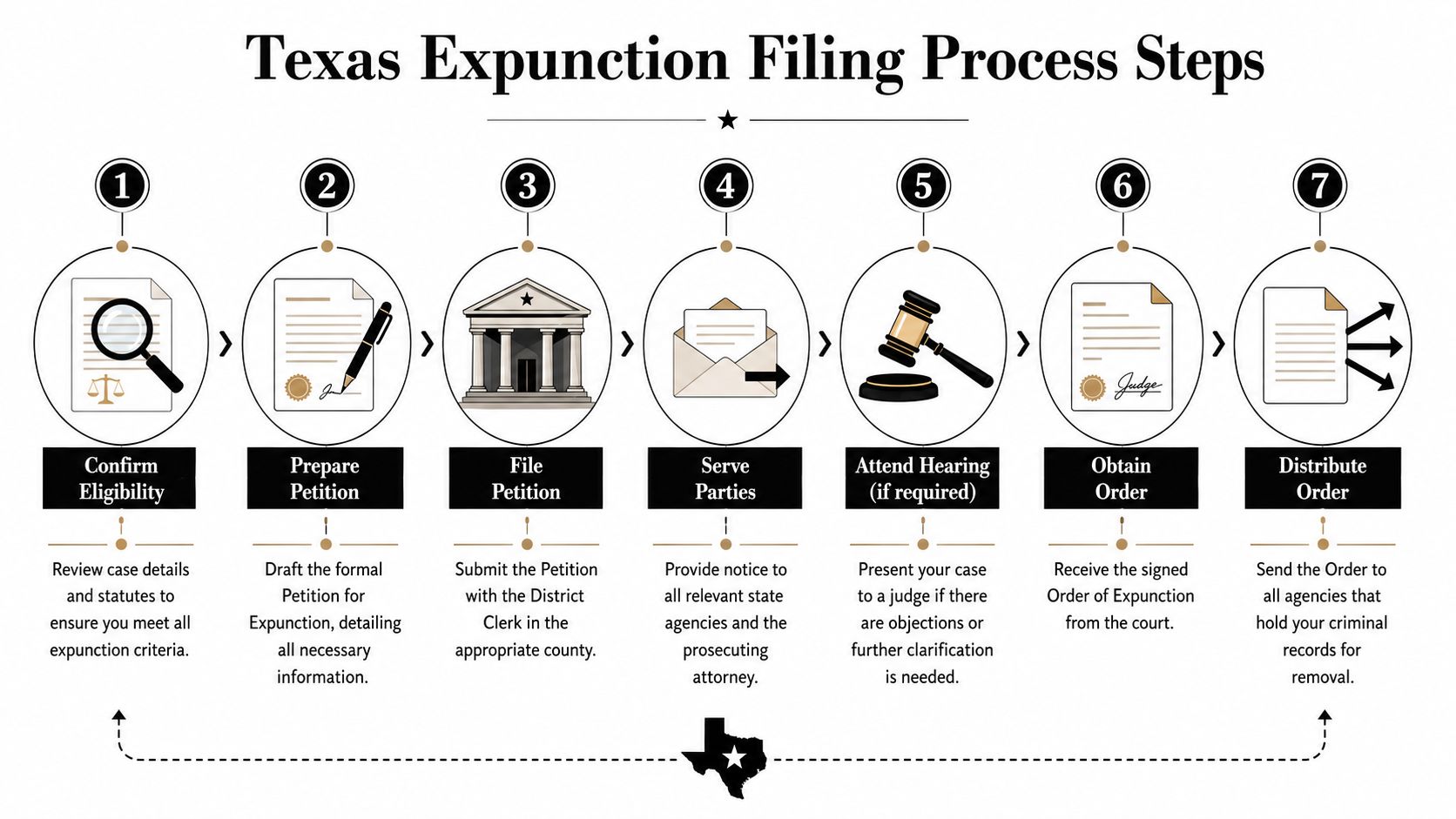
Step one through three
Start with the county of arrest, not the county where you live now. Texas requires the petition to be filed in the arresting county. This point is easy to miss if you moved after the case ended.
Under Texas Law Help's expunction guidance, you must file the petition in the arresting county and include a fingerprint card from the Department of Public Safety. The clerk then notifies DPS and sets a hearing no earlier than 30 days after filing. The same source explains that if no charges were filed, the waiting period varies by offense level.
Here is the filing sequence in plain English:
- Confirm the legal basis. Don't file because you hope you're eligible. Verify the case outcome and timing first.
- Collect the supporting records. This often includes the dismissal order, acquittal paperwork, and your fingerprint card.
- Draft the petition carefully. The petition should identify the arrest, the agencies involved, and the relief you are requesting.
Step four through seven
A lot of expunction problems come from incomplete agency lists. Police departments, sheriff's offices, jail records, clerks, prosecutors, DPS, and other entities may all hold some version of your record. If one agency is left out, that agency may keep its files.
To help visualize the process, this overview is useful:
After filing, the clerk sends notice. Then the court sets the hearing date. Some cases are agreed and move smoothly. Others raise objections about eligibility, waiting periods, or missing agencies.
Filing the petition is only half the job. The rest is making sure every agency that holds the record receives notice and is covered by the final order.
Why expunction feels harder than people expect
Unlike a typical criminal hearing, this process is document-driven. You are asking a civil court to order government agencies to destroy records. That means names, dates, cause numbers, arrest details, and agencies have to match.
It also helps to understand where expunction fits in the larger life cycle of a criminal case. A person may be arrested for DWI, theft, assault, or drug possession, then move through arraignment, plea discussions, motions, trial, and sentencing. If the result is favorable enough for expunction, the record-clearing case begins after that.
For readers who are still in the middle of a criminal matter, a Houston criminal lawyer or Texas assault defense attorney can make a difference early. Strong defense work at the arrest, charging, plea, and trial stages often determines whether expunction is even possible later.
Common Pitfalls and How to Avoid Them
The most expensive expunction mistake is often not a filing fee. It's filing the wrong petition, in the wrong place, at the wrong time, and then waiting months to learn it failed.
Filing too early
One common problem is rushing. People hear that their case was dismissed and immediately prepare paperwork. But dismissal alone doesn't always mean you can file that day. In some situations, you have to wait until the limitations issue is resolved or the law otherwise allows filing.
If you skip that analysis, the prosecutor can object, and the judge may deny relief.
Mixing up counties
This is the issue many websites barely explain. If your arrests are spread across more than one county, you usually can't fix everything with one petition.
The guidance from Clean Slate Texas on eligibility questions makes this point clearly. Texas law requires separate expunction petitions by county, which creates confusion for people with arrests in multiple jurisdictions such as Austin and San Antonio.
That means if you had one arrest in Dallas County and another in Harris County, you shouldn't assume one filing will clear both. The court where you file only controls the records connected to that county's arrest.
If your record spans Dallas and Houston, treat them as separate projects unless a lawyer confirms otherwise.
Leaving agencies off the petition
This mistake is quieter but just as damaging. You may win the order and still find the arrest surfacing later because one agency never received notice.
Watch for these practical issues:
- Arresting agency omission. A city police department may have records separate from the county jail.
- DPS omission. State-level records often continue to matter for background checks.
- Clerk and prosecutor omission. Court and prosecution files can survive if not covered.
- Assuming all records in one county fit one petition. Sometimes they do, but not if the cases are spread across different counties.
Procedural accuracy matters more here than people expect. Expunction is one of those areas where a minor paperwork mistake can undo a strong legal position.
Costs Timelines and When to Hire an Attorney
Practical answers are often sought: How much will this cost, how long will it take, and can I do it myself?
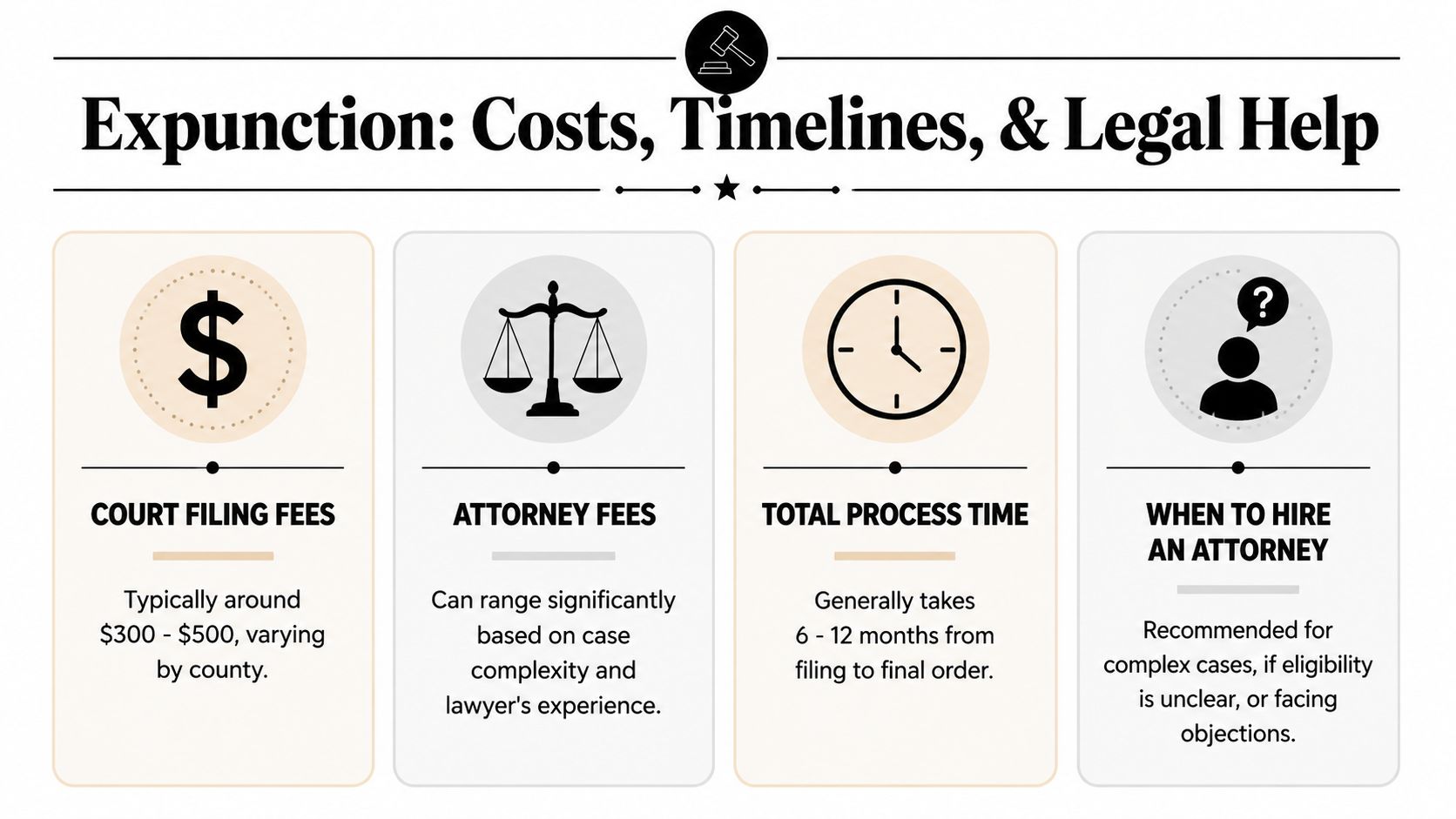
The money side
According to Texas State University's legal practice guidance on dismissals, expunctions, and record sealing, the average cost of obtaining an expunction with an attorney is about $1,500, including a filing fee of roughly $290 plus notification costs. That same source notes that filing on your own can save about $1,100 in attorney fees, but the process is still paperwork-heavy and demanding.
If you want a more focused breakdown of the cost to expunge a record in Texas, that can help you compare self-filing against hiring counsel.
The time side
The same Texas State University resource explains that some misdemeanors may be expunged as early as six months after dismissal if the prosecutor agrees, and the process takes at least three months after the hearing for the order to become final.
That means even a smooth case takes patience. The hearing itself can't happen immediately, and agencies still need time to process the final order.
When hiring counsel makes sense
Self-filing can work in simpler cases. But the trade-off is time, precision, and risk. If your record spans multiple counties, your eligibility is uncertain, or your agency list is incomplete, legal help often becomes worth the cost.
Some people also look at the broader financial impact of an unresolved record, including background-check issues and credit-related fallout. If that's part of your concern, this Superior Credit Repair cost guide offers context on another category of post-problem cleanup people often consider alongside record relief.
The Law Office of Bryan Fagan, PLLC handles expunctions, nondisclosures, and related criminal defense matters across Texas. That's especially relevant when a current criminal case and future record-clearing options need to be evaluated together.
If you've been charged with a crime in Texas, call The Law Office of Bryan Fagan, PLLC for a free and confidential consultation. Our defense team is ready to protect your rights.