Being arrested after an argument at home can feel like your whole life changed in one night. You may be worried about jail, your job, your kids, your reputation, and whether one accusation is about to follow you for years.
A domestic assault arrest in Texas is serious, but it is not the same thing as a conviction. There are ways to challenge the case, ways to negotiate a dismissal path, and ways to protect your future if you act quickly and avoid the mistakes that make these cases harder.
A Texas Domestic Assault Charge Does Not Have to Ruin Your Life
A common scene looks like this. Police arrive after a heated argument. Someone says there was pushing, grabbing, or a threat. One person leaves in handcuffs. By the next morning, the person arrested is asking the same question most clients ask first: “If we calm things down, can this just go away?”
Sometimes the situation is less about a clear crime and more about stress, fear, alcohol, a breakup, or a custody dispute. Sometimes there are injuries. Sometimes there are none. Sometimes both people were yelling. Sometimes one person was trying to leave and the other blocked the door. Texas law treats all of that seriously, especially when the allegation involves a spouse, partner, dating relationship, family member, or someone in the home.
Under Texas Penal Code § 22.01, assault can include causing bodily injury, threatening another person with imminent bodily injury, or making offensive or provocative physical contact. In plain English, the state does not need a dramatic injury to file a case. That is why early defense work matters.
The case belongs to the state
Many people assume the alleged victim controls the case. In Texas, that is not how it works. The state, not the victim, prosecutes domestic violence cases, a model reinforced by the 1994 Violence Against Women Act. That is one reason prosecutors often move forward even after a recantation. The Bureau of Justice Statistics material cited in this area reports that victims recant in 60% to 80% of cases and prosecutors sustain 70% to 85% of filed cases based on other evidence (BJS report).
That means hoping the other person “drops it” is not a legal strategy. Building a defense is.
Your first goal is stability
In the first days after an arrest, panic causes bad decisions. People text apologies that look like admissions. They violate a no-contact condition because they want to explain themselves. They talk too much to police because they think honesty will end the case.
Key takeaway: A domestic assault arrest can damage your position fast, but the earliest moves often shape whether the case gets weaker or stronger.
If your stress is spiraling, it helps to get grounded before making legal decisions. Some people find practical mental health tools useful while they wait to speak with counsel, such as Anxiety University, which offers simple education around panic, stress, and anxious thinking.
Your First 48 Hours Protecting Your Rights After an Arrest
The first two days prove more significant than anticipated. Prosecutors review reports promptly. Bond conditions start immediately. Evidence can disappear as fast.

What to do right away
Start with four priorities.
Stay silent about the facts
You have the right to remain silent. Use it. Give identifying information if required, but do not try to explain the argument, the relationship history, or why the other person is wrong.
Follow every release condition
If a magistrate orders no contact, no return to the home, or no firearm possession, treat those rules as strict. Do not test the edges.
Preserve evidence before it disappears
Save texts, call logs, photos, video, social media messages, doorbell footage, and names of witnesses. If you have injuries, photograph them.
Get legal help early
A lawyer can often start contacting the prosecutor’s office, securing footage, and identifying legal issues before the case hardens.
For a general overview of understanding your rights when arrested, that resource gives a useful plain-English summary of core protections.
What not to do
These mistakes create new problems.
- Do not contact the alleged victim. Even a short text can violate a protective order, emergency order, or bond condition.
- Do not ask friends or relatives to pass messages. Indirect contact still counts.
- Do not post about the case online. Prosecutors and investigators can review those posts.
- Do not delete messages. Deletion can look like concealment.
- Do not assume a polite conversation with police will help. It generally provides the state with more statements to use.
Practical tip: “I want a lawyer, and I am not answering questions” is enough. You do not need a speech.
Why contact is so dangerous
A lot of clients think an apology will calm things down. In reality, the state may read that message as an admission. If there is a no-contact rule, the message can also create a new violation.
As a result, domestic assault cases become more dangerous than people expect. The original accusation may be debatable. The no-contact violation may not be.
Start building your timeline
A strong defense often begins with a clean chronology. Write down:
- When the argument started
- Who was present
- Whether anyone called 911
- Whether alcohol or medication was involved
- Any injuries on either side
- What officers said and did
- Whether body cam or home camera footage may exist
Keep it private and give it to your attorney.
What happens next in court
After arrest, you may deal with bond conditions, a first appearance, formal charging decisions, and later arraignment or similar settings depending on the court and county process. During that time, your lawyer may be reviewing probable cause, police conduct, witness statements, and possible pretrial motions.
If you want a fuller look at the process, this overview of the Texas assault arrest process can help you see where your case is headed.
Can the Alleged Victim Really Drop the Charges
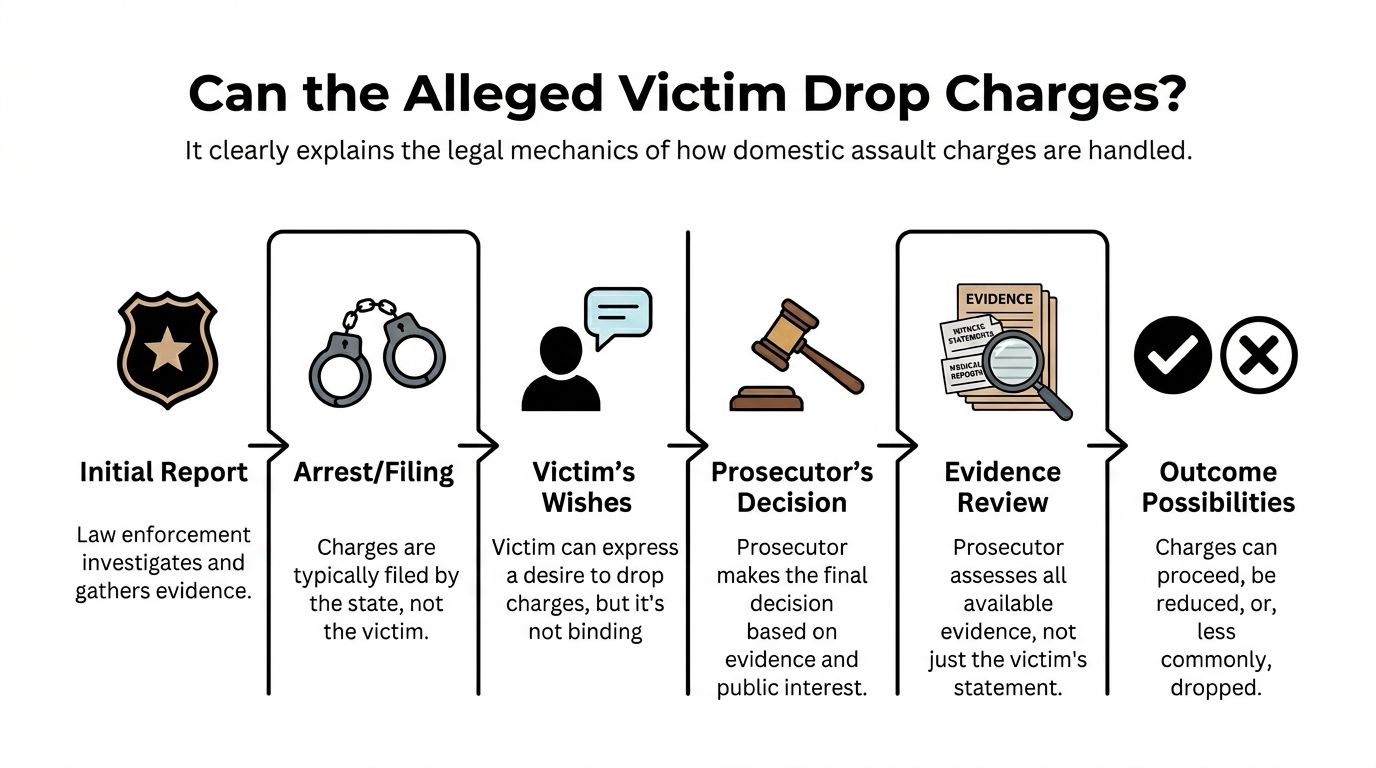
No. Not by themselves.
That answer frustrates people because it clashes with what they hear from family, friends, and sometimes even the alleged victim. In a Texas domestic assault case, the prosecutor represents the State of Texas. The district attorney decides whether to file, continue, reduce, or dismiss the charge.
Why the myth persists
The confusion comes from ordinary language. People say “press charges” and “drop charges” as if the case belongs to the complaining witness. In reality, the witness can report, cooperate, recant, refuse to cooperate, or ask for leniency. Those facts matter, but they do not control the prosecution.
That difference is the reason many people search for how to get domestic assault charges dropped and get bad advice. The legal question is not whether the alleged victim wants the case dismissed. The legal question is whether the prosecutor still believes the case can be proved and should be pursued.
What an Affidavit of Non-Prosecution can do
There is one tool people hear about for good reason. It is the Affidavit of Non-Prosecution.
This is a formal statement, typically notarized, in which the alleged victim tells the prosecutor they do not want the case pursued. It is not binding. It does not force dismissal. But it can affect how the prosecutor evaluates the case, especially early.
Verified guidance in this area states that the key to influencing a prosecutor is often an alleged victim’s formal Affidavit of Non-Prosecution, and that when the victim does not testify, prosecutors may drop about 65% of those cases before trial to avoid acquittal risk (georgelaw.com discussion).
When it helps and when it does not
An affidavit tends to matter more when:
- The case is weak on independent evidence
- The statements are inconsistent
- There are no meaningful injuries
- The alleged victim quickly says the accusation was exaggerated or mistaken
- Defense counsel presents supporting material at the same time
It matters less when:
- Police recorded strong body cam evidence
- There are clear injuries or medical records
- There are admissions by the accused
- There are prior incidents
- A protective order issue is already complicating the case
Important: Never try to pressure the alleged victim into signing anything. That can turn one case into several.
How lawyers use the affidavit strategically
A good defense lawyer does not merely hand over a form and hope for mercy. The stronger approach is to package the affidavit with evidence that gives the prosecutor a reason to dismiss or reduce.
That may include:
| Issue | Why it matters |
|---|---|
| Text messages after the event | They may contradict the report or show the incident was described differently later |
| Video footage | It may show no assault, self-defense, or missing context |
| Witness statements | They may weaken the state’s timeline |
| Medical records | They may not support the claimed injury pattern |
| Photos of your injuries | They may support self-defense or mutual combat |
A defense lawyer may also communicate with the prosecutor before charges are formally filed in some cases. Early intervention can matter because once a case is filed and settings begin, prosecutors may become less flexible.
For more detail on that question, this article on can assault charges be dropped addresses the issue from a Texas defense perspective.
Building a Strong Defense Against a Family Violence Allegation
A family violence case is often won or lost on details that looked minor on the day of the arrest. A 911 call may capture panic but not who started the physical contact. An officer may see redness, a broken phone, or a crying spouse, then make a fast decision without hearing the full history between the two people involved.

The defense starts by slowing the case down and separating accusation from proof. Under Texas Penal Code § 22.01, the prosecutor still has to prove the required act and mental state with admissible evidence. In practice, that means the case should be tested piece by piece, including what happened before the argument, during the physical encounter, and after police arrived.
Defenses under Texas law
The right defense depends on the facts, not on a standard script. Some cases turn on justification. Others turn on weak identification, conflicting statements, missing context, or evidence the state cannot cleanly explain to a jury.
Self-defense
Self-defense often arises in close-quarter domestic cases because the physical contact happens quickly and the first story police hear is incomplete. If you used force because you reasonably believed it was immediately necessary to protect yourself, that may be a legal defense.
A common fact pattern looks like this. One person tries to leave, the other blocks the exit, grabs clothing, or starts hitting. The response may be a push, restraint, or attempt to break free. By the time officers arrive, they may arrest the person who appears calmer or who does a poor job explaining what happened under stress.
Self-defense cases are built with specifics. Photos of your injuries, doorbell footage, broken property, witness accounts, dispatch timing, and text messages from before or after the incident can all matter.
Defense of another person
Sometimes force was used to protect a child, a family member, or another person in the home. That defense can be valid, but it has to be supported with facts that show an immediate threat and a measured response.
I look closely at who was present, where each person was standing, what the child or third party was doing, and whether the physical evidence matches the account. A broad statement that you were protecting someone will not carry much weight by itself.
Mutual combat and unclear aggressor issues
Domestic disturbance calls do not always involve one aggressor and one passive victim. Some involve both people yelling, grabbing, pushing, and escalating a bad argument. Texas law does not treat "mutual combat" as an automatic defense, but those facts can still weaken the prosecution's theory by making it harder to prove who committed what act, with what intent, and in what sequence.
That uncertainty matters in plea discussions and at trial. Prosecutors prefer clean narratives. A case with conflicting injury patterns, inconsistent witness accounts, and no clear primary aggressor is harder to prove beyond a reasonable doubt.
False allegations and family law motives
Family violence accusations sometimes appear in the middle of a divorce, custody fight, breakup, or dispute over who stays in the home. That does not make the report false. It does mean the defense needs to examine motive with care and document it with evidence instead of guesswork.
Questions worth answering early include:
- Did the allegation surface right after an argument about custody or possession of the house?
- Did prior messages show threats to "call the police" or "make you leave"?
- Did the story change between the 911 call, the officer's report, and later statements?
- Did the allegation create an immediate advantage in a parallel family law dispute?
This overlap can affect far more than the criminal charge. In many Texas cases, the same allegation is also used to support a protective order, temporary custody restrictions, or removal from the residence. A defense that ignores that family law track can undercut itself. The facts you present in one court need to help, or at least not damage, the position you take in the other.
A firm experienced in both criminal and family law, such as the Law Office of Bryan Fagan PLLC, can help coordinate the criminal defense with any related protective-order issues.
Key point: A strong domestic assault defense tests the state's evidence and keeps the criminal case aligned with the protective-order and family-court consequences that often follow the same allegation.
Weak evidence and procedural problems
Some defenses come from what happened between the parties. Others come from mistakes by law enforcement or gaps in the prosecution's proof.
Your attorney may challenge:
- Inconsistent witness statements
- Poorly documented injuries
- Missing body cam footage
- Unlawful police conduct
- Statements taken after a rights violation
- Overbroad charging decisions
Those issues are not technical side points. They can decide the case. If officers failed to preserve video, wrote a report that conflicts with dispatch records, or took statements after a constitutional violation, the defense may file motions to suppress evidence or exclude statements. Once that happens, the prosecutor has to reevaluate what can still be proved.
Trial readiness changes negotiations
Preparation changes outcomes. Prosecutors can tell when defense counsel has reviewed every frame of body cam footage, mapped the timeline against the call log, pulled medical records, and identified the exact element the state may not be able to prove.
That level of work also helps with a parallel protective-order case. Testimony given in one proceeding can affect the other. A rushed criminal defense may create admissions, inconsistencies, or contact problems that make the family law side worse. A coordinated strategy reduces those risks and puts you in a better position whether the goal is dismissal, reduction, or a contested hearing.
The Critical Link Between Assault Charges and Protective Orders
Many people think they have one case. In reality, they may have two. The criminal charge is one track. A protective order is another.

Why this overlap matters in Texas
In Texas, a significant number of domestic violence calls involve cohabiting partners or spouses, and those situations often trigger a parallel protective-order case. Verified material on this topic also states that standalone criminal defenses face increased challenges when the family law aspect is ignored, because violating a no-contact order can immediately damage dismissal efforts (Texas protective-order discussion).
That is the blind spot many defendants miss.
What a protective order does
A protective order can bar contact, keep you away from a home, school, or workplace, and limit communication in ways that affect daily life right away. It is separate from whether the assault charge is ultimately dismissed.
The practical problem is simple. People focus so much on beating the criminal charge that they forget the order itself has teeth. Then they send a text about the kids, ask to pick up clothes, or show up at the house because “we worked it out.” That can trigger a new arrest.
Criminal court and family court can affect each other
The statements you make in one proceeding can create problems in the other. If you testify loosely in a protective-order hearing, that testimony may shape the criminal case. If you accept certain criminal conditions without understanding the family law impact, you may hurt your position on possession of the home, custody issues, or later family court disputes.
That is why these cases need coordination, not two isolated strategies.
A coordinated defense looks different
A coordinated approach typically includes:
- Checking every no-contact rule carefully
- Reviewing whether the protective order can be challenged or modified
- Making sure criminal-case decisions do not create avoidable family-court damage
- Planning safe, lawful communication about children or property only through proper channels
Practical warning: “But she invited me over” is not a defense to violating a court order.
For a primer on the family-law side, this page explains what is a protective order and why it matters even when your main focus is the criminal case.
Exploring Dismissal Through Diversion Programs and Negotiations
Not every domestic assault case is dismissed because the evidence falls apart. Some are resolved through structured agreements that keep a conviction off your record if you complete specific requirements.
That distinction matters. If your case is not ideal for a straight dismissal, you may still have a strong path to a better outcome.
Pretrial diversion and deferred adjudication
For many first-time misdemeanor domestic assault cases in Texas, pre-trial diversion or deferred adjudication may be available in up to 80% of cases, with an 85% completion-to-dismissal rate according to the verified data provided for this topic (Texas diversion benchmark). That route can help you avoid a permanent conviction record and the federal firearm consequences tied to a domestic violence conviction under 18 U.S.C. § 922(g)(9).
These are not the same program, even though people often use the terms loosely.
How they compare
| Option | What it usually means | Main trade-off |
|---|---|---|
| Pre-trial diversion | An agreement before final conviction, often involving classes, counseling, supervision, and other conditions | You must comply fully, and eligibility depends on the facts and the county |
| Deferred adjudication | You plead or otherwise resolve the case under court supervision, and the case may be dismissed after successful completion | It can still carry conditions and reporting obligations during the supervision period |
| Reduction through negotiation | The state agrees to reduce the charge to something less damaging | You may accept some penalty to avoid the family-violence label |
| Trial | You fight for acquittal | Highest uncertainty, but sometimes the right choice |
What these programs usually require
The details vary by court and prosecutor. Common conditions may include counseling, classes, supervision meetings, community-based requirements, and no new arrests.
If family violence programming is required, take it seriously. Missing sessions, violating conditions, or contacting the alleged victim against court orders can destroy a deal that otherwise would have protected your record.
Plea bargaining is not surrender
People hear “plea bargain” and assume defeat. That is too simplistic.
A negotiated result can be the right move when:
- the state has some evidence,
- the risks of trial are high,
- the family-law consequences need to be contained,
- and a better non-conviction or reduced-charge option is available.
A skilled attorney looks at the whole picture. Not just whether the charge can be attacked, but whether a negotiated off-ramp leaves you in a better long-term position.
What happens after dismissal or completion
Even if your charge is dropped or dismissed after completion of a program, your record does not always clean itself up automatically. You may need to pursue expunction or another form of record relief if you qualify.
That is an important final step. A dismissed case can appear in background screening unless the record is handled properly.
What works and what does not
Here is the honest version.
What tends to work
- early evidence gathering,
- strict compliance with release conditions,
- a defense lawyer who evaluates both dismissal and negotiated paths,
- and careful handling of any protective-order overlap.
What typically fails
- waiting for the alleged victim to fix it,
- contacting them in violation of court orders,
- talking too much,
- and assuming the first offer is the only offer.
If you have been charged, the path forward depends on facts, timing, and strategy. Calm, fast action gives you the best chance to get the charge dropped, reduced, or resolved in a way that protects your future.
If you’ve been charged with a crime in Texas, call Law Office of Bryan Fagan PLLC for a free and confidential consultation. Our defense team is ready to protect your rights.