Being accused of a sex crime in Texas can turn your life upside down in a single day. You may have been arrested after a chat, a text exchange, a social media conversation, or a police sting. Now you're asking the same questions many ask at this stage. What exactly am I charged with? What happens next? Is my life over if no meeting ever happened?
It isn't strange to feel panicked, ashamed, angry, or frozen. Many people facing an online solicitation of a minor Texas charge have never been in serious trouble before. They may also be dealing with work fallout, family stress, and the fear of public judgment before they have even seen all the evidence.
A criminal accusation is not a conviction. In Texas, these cases are serious, but they are also defendable. A strong defense starts with understanding the law, the procedure, and the points where a prosecutor's case can be challenged. That same practical approach matters whether you're facing this allegation, a DWI, assault, theft, or drug possession charge. The process is different in each case, but the first steps are often the same. Protect your rights, stop talking about the facts with anyone except your lawyer, and get a clear strategy in place early.
Answering an Accusation of Online Solicitation
A common version of this case starts innocuously. You message someone online. The conversation gets personal. Then it turns sexual, or the other person suggests meeting. Later, police contact you, execute a search warrant, or arrest you without much warning. Sometimes the "minor" is an actual child. Sometimes it's an undercover officer posing as one. Either way, the accusation feels immediate and devastating.
The first mistake people make is trying to explain everything to investigators. The second is assuming the case will disappear if nobody ever met in person. Both choices can make a bad situation worse.
What you should do first
If you're under investigation or you've already been arrested, focus on a few basic steps:
- Use your right to remain silent. You don't have to explain texts, chats, or intent on the spot.
- Ask for a lawyer immediately. Early legal advice can shape bond conditions, protect evidence issues, and prevent damaging statements.
- Preserve your devices and accounts. Don't delete messages, wipe a phone, or shut down social media profiles in a panic.
- Stay off the facts online. Friends, relatives, and social platforms are not safe places to "tell your side."
Practical rule: In a Texas criminal case, your first job is damage control. Your second job is building a defense.
These cases often move fast at the beginning and then slow down into a long court process. That uncertainty is hard on people. Still, once you understand how the charge works and what the stages of the case look like, the situation becomes more manageable. You can start making decisions based on law and strategy, not fear.
What Is Online Solicitation of a Minor in Texas
Texas Penal Code § 33.021 is the statute at the center of these cases. In plain English, the law targets certain sexual communications with minors and efforts to persuade a minor to meet for sexual activity through electronic communication.
What the law says in simple terms
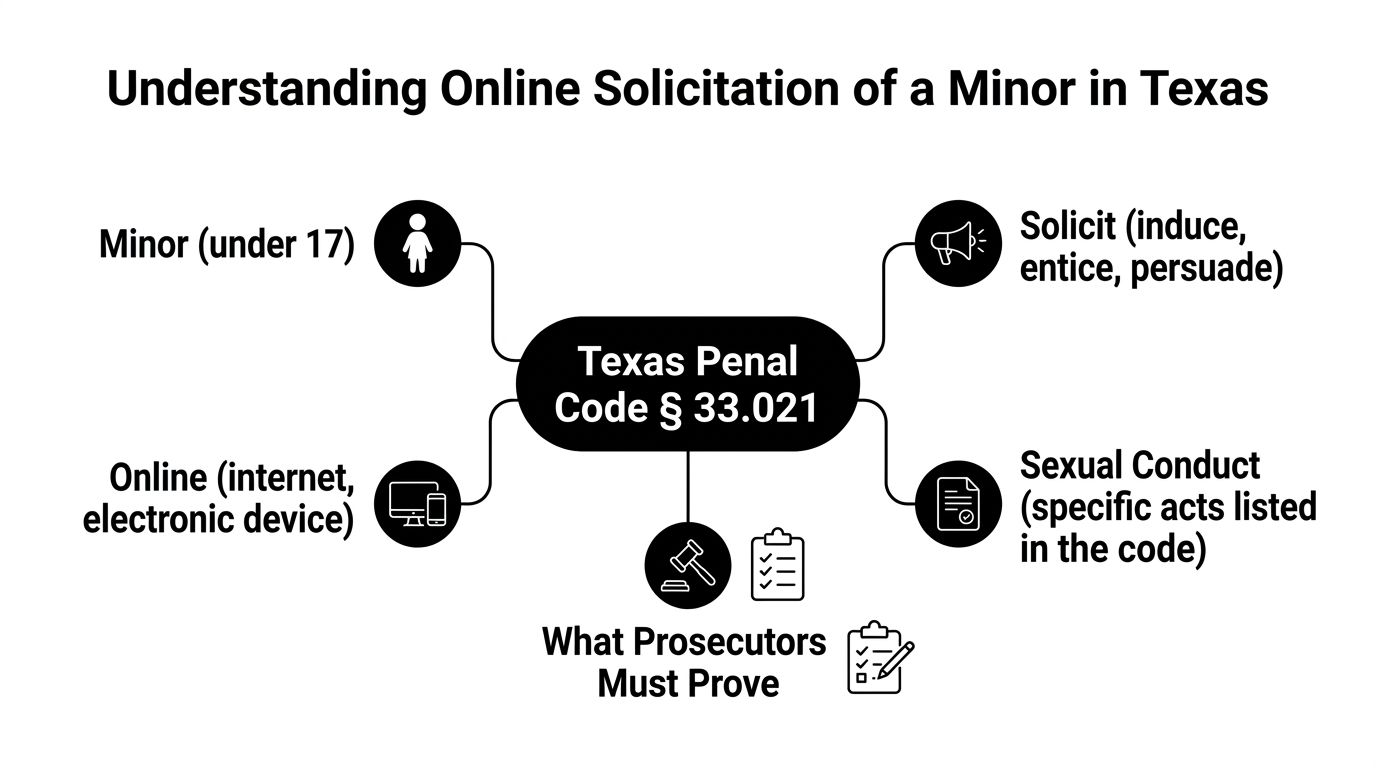
Under Texas Penal Code § 33.021 as summarized here, online solicitation of a minor means a person age 17 or older knowingly uses electronic communication to solicit a minor to meet for sexual contact, sexual intercourse, or deviate sexual intercourse, or to communicate in a sexually explicit manner. The same summary explains that an actual meeting does not need to occur for charges to be filed.
That matters because many people think the law only applies if someone shows up at a location. Texas law doesn't work that way in this area. The communication itself can complete the offense.
The two basic categories prosecutors look at
Texas treats this charge as two different technical offenses under the same statute:
- Sexually explicit communication with a minor. This focuses on the content of the messages.
- Soliciting a minor to meet for sexual activity. This focuses on trying to get the minor to meet.
Think of it this way. One part of the statute addresses what was said. The other addresses what the speaker was trying to make happen.
What prosecutors usually try to prove
In practical terms, the State will usually try to show:
- You were old enough under the statute
- You used an electronic form of communication
- The other person was a minor, or was represented as one
- The message content or invitation fit the statute
- You acted knowingly
"Knowingly" is an important word. A criminal case is not supposed to be won by guesswork or by taking isolated phrases out of context. Intent, identity, timing, and the full conversation all matter.
A short message thread can look very different once the entire conversation is reviewed in order.
Why classification matters
This is also where felony grading becomes important. If you're trying to understand how Texas sorts serious crimes generally, Felony vs. Misdemeanor Charges in Texas gives a basic overview of offense levels and penalty ranges. Online solicitation allegations under this statute are felony-level matters, which is one reason early defense work is so important.
Another point that often causes confusion is the phrase "sexually explicit." In real cases, prosecutors may argue that context matters, not just a single explicit word. That can create room for dispute, especially when messages are ambiguous, sarcastic, incomplete, or pulled from a longer exchange.
Understanding the Penalties and Felony Levels
The penalties in these cases are severe. They also depend on which part of the statute the State says you violated and the alleged age of the minor.
Basic penalty structure under Texas law
For sexually explicit communication with a minor age 14 or older, the offense is a third-degree felony, punishable by 2 to 10 years in prison and a fine up to $10,000, according to this summary of Texas online solicitation penalties.
If the minor is under 14, or if the accused believed the minor was under 14, that sexually explicit communication allegation becomes a second-degree felony, carrying 2 to 20 years in prison under the same source.
Soliciting any minor under 17 to meet for sexual purposes is also treated as a second-degree felony under the verified summaries of the statute.
School-hours enhancement
Texas law became even harsher after a legislative change. In 2021, the legislature added an enhancement that raises the offense to the next higher felony level if it occurred during regular public or private primary or secondary school hours and the accused knew or reasonably should have known the minor was enrolled in school. For allegations involving a minor under 14, that can raise the charge to a first-degree felony with a punishment range of 5 to 99 years or life in prison, as explained by Saputo Law's discussion of Texas Penal Code § 33.021.
Quick-reference penalty table
| Offense Type | Minor's Age | Felony Level | Prison Sentence | Maximum Fine |
|---|---|---|---|---|
| Sexually explicit communication | 14 to 17 | Third-degree felony | 2 to 10 years | $10,000 |
| Sexually explicit communication | Under 14, or believed under 14 | Second-degree felony | 2 to 20 years | $10,000 |
| Solicitation to meet for sexual purposes | Under 17 | Second-degree felony | 2 to 20 years | $10,000 |
| School-hours enhancement applied to qualifying offense involving alleged victim under 14 | Under 14 | First-degree felony | 5 to 99 years or life | $10,000 |
Why the felony level changes strategy
A felony charge changes almost every decision in the case. Bond conditions may be stricter. Discovery review becomes more important. Plea negotiations are more complex. Trial risk is higher.
If you need a broader explanation of how Texas defines felony offenses, what is a felony in Texas is a useful starting point. In day-to-day defense work, the exact felony degree often drives the strategy just as much as the underlying facts.
Building a Strong Defense Strategy in Texas
A strong defense usually starts with a hard reset of expectations. In online solicitation cases, the first story many people tell themselves is, "I never met anyone, so this should go away." Texas law does not work that way, and waiting too long to learn that can hurt the case.

The better question is simpler. What can the State prove, and what part of its case is weaker than it looks?
In practice, defense strategy often turns on the digital evidence. Prosecutors may have chat logs, screenshots, app data, search warrant returns, or statements made during an interview. Each piece has to be tested. I look at who controlled the account, whether the messages are complete, whether the alleged age was clearly communicated, whether the language really meets the statute, and whether officers preserved the evidence correctly.
Some of the most useful defense themes include:
- No criminal intent. A conversation can be taken out of context, edited down, or interpreted more aggressively than the full exchange supports.
- Mistaken identity. An account name does not always prove who was typing. Shared devices, reused passwords, and incomplete forensic work can matter.
- Failure to prove solicitation. Offensive or sexual language is not automatically enough. The State still has to match the facts to the legal elements of the charge.
- Investigation errors. Undercover operations, device seizures, and forensic downloads must be handled properly. Poor police work can create suppression issues or reasonable doubt.
These cases also produce side problems. A phone search can lead investigators into unrelated messages, photos, or other allegations. A home search can expand the case fast. Good defense work accounts for that risk early, instead of treating the accusation as one isolated chat thread.
Texas law also recognizes two narrow statutory defenses. As noted in Neal Davis Law's discussion of online solicitation defenses, they may apply if:
- The minor was your spouse at the time of the alleged offense
- You were not more than three years older than the consenting minor, and you had no prior requirement to register as a sex offender
Those defenses are limited. They do not fit most cases, but they should be checked right away.
The larger mistake is relying on the wrong myth. No meeting does not mean no crime. This misconception is damaging because many defendants rely on it. Prosecutors know that, and they often build the case around messages alone.
A disciplined review usually works better than a single slogan defense. That means examining the timeline, the exact words used, the age evidence, the account ownership, the search warrants, and any statement the accused gave police. For a broader look at that process, how criminal defense attorneys build a defense strategy explains the kind of structured case review that often shapes felony defense work.
Law Office of Bryan Fagan PLLC handles criminal defense matters at the investigation, bond, negotiation, trial, and post-conviction stages across Texas.
What to Expect After an Arrest The Legal Process
After an arrest, individuals often feel lost because the process seems hidden. It isn't hidden, but it does move through a series of formal steps that most Texans never see until they're inside it.
The early stage
Right after arrest, you can expect booking, fingerprinting, and a magistrate appearance. Conditions of release may be imposed quickly. In cases involving alleged online contact with a minor, those conditions can affect internet use, device access, travel, and contact with certain people.
At this stage, don't treat release conditions casually. A bond violation can create a new problem before your defense really begins.
The usual path through the case
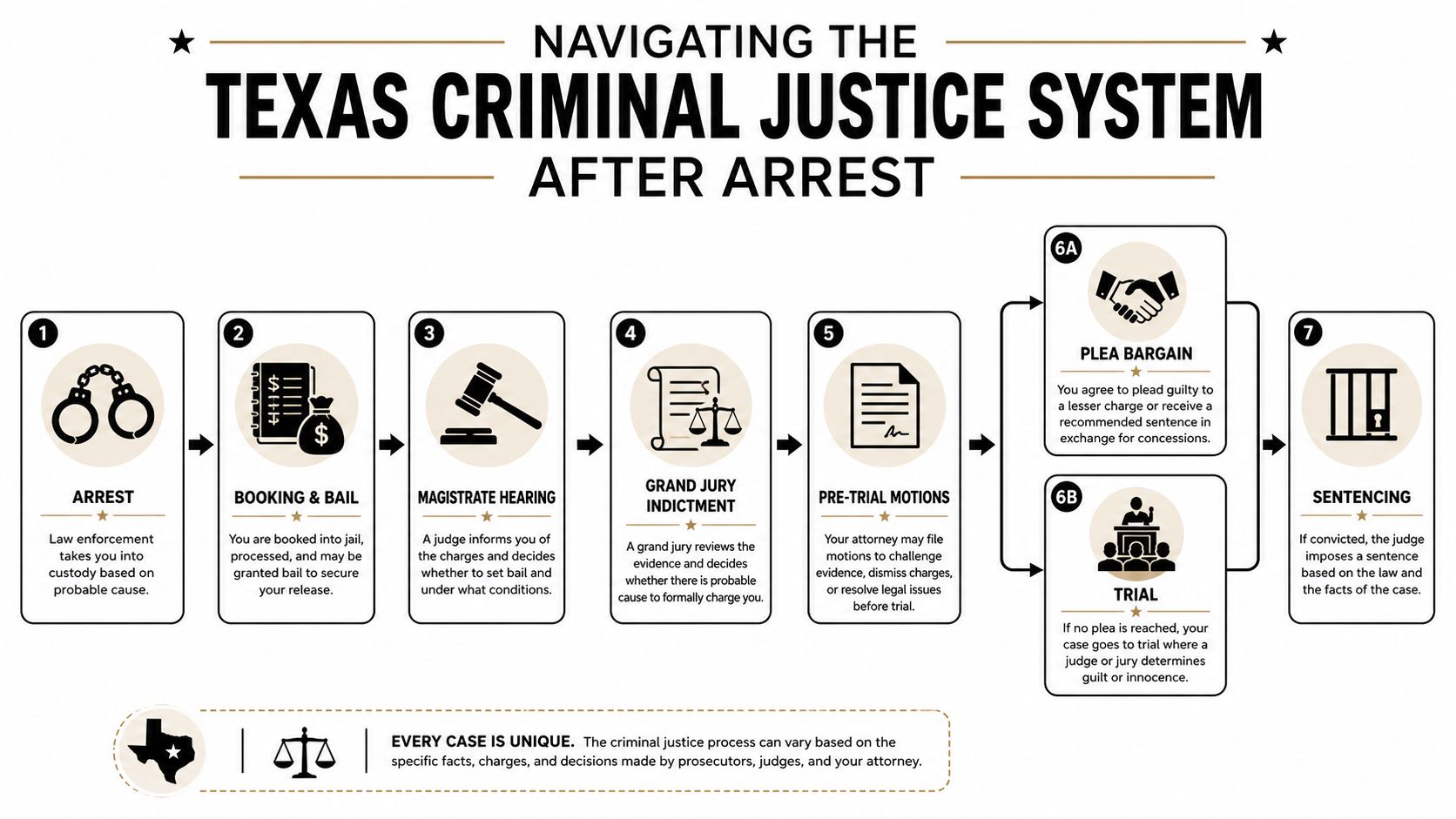
Most felony cases follow a pattern something like this:
Arrest and booking
Police process the arrest and gather identifying information.Magistrate hearing and bond
A judge reviews the charge, advises you of basic rights, and addresses bail or bond conditions.Charging decision or indictment
In felony cases, prosecutors often seek an indictment through a grand jury.Discovery and case review
Your attorney reviews chats, texts, reports, recordings, forensic downloads, and witness issues.Pretrial motions
The defense may challenge searches, statements, evidence handling, or the legal sufficiency of parts of the case.Negotiation or trial preparation
Some cases resolve through plea bargaining. Others should be prepared for trial from the beginning.Sentencing if there is a conviction or plea
Sentencing depends on the offense level, the facts, and any negotiated terms.
Where people make costly mistakes
Many defendants think court appearances are just formalities. They aren't. What you do between settings matters.
- Talking too much on monitored calls can hand prosecutors new evidence.
- Violating bond conditions can damage credibility and reduce flexibility in court.
- Waiting to hire counsel can slow down evidence review and strategy decisions.
- Assuming every case should plead out can lead to bad choices before the defense has tested the State's proof.
Court procedure feels slow from the outside, but every stage gives the defense a chance to narrow the issues and challenge the case.
Plea bargain or trial
Not every case should go to trial. Not every case should be resolved by plea bargain either. The right choice depends on evidence strength, legal defenses, witness problems, digital proof issues, and your long-term risk.
That same practical thinking applies in other criminal allegations too, whether you're dealing with a Texas DWI attorney over intoxication charges, a Houston criminal lawyer on assault allegations, or defense counsel in theft or drug possession matters. The label on the case changes. The core question doesn't. Can the State really prove what it claims?
The Lifelong Impact of a Conviction
A conviction in this area reaches far beyond jail or prison time. It can shape where you live, how you work, and how other people treat you for years.
Registration and daily life
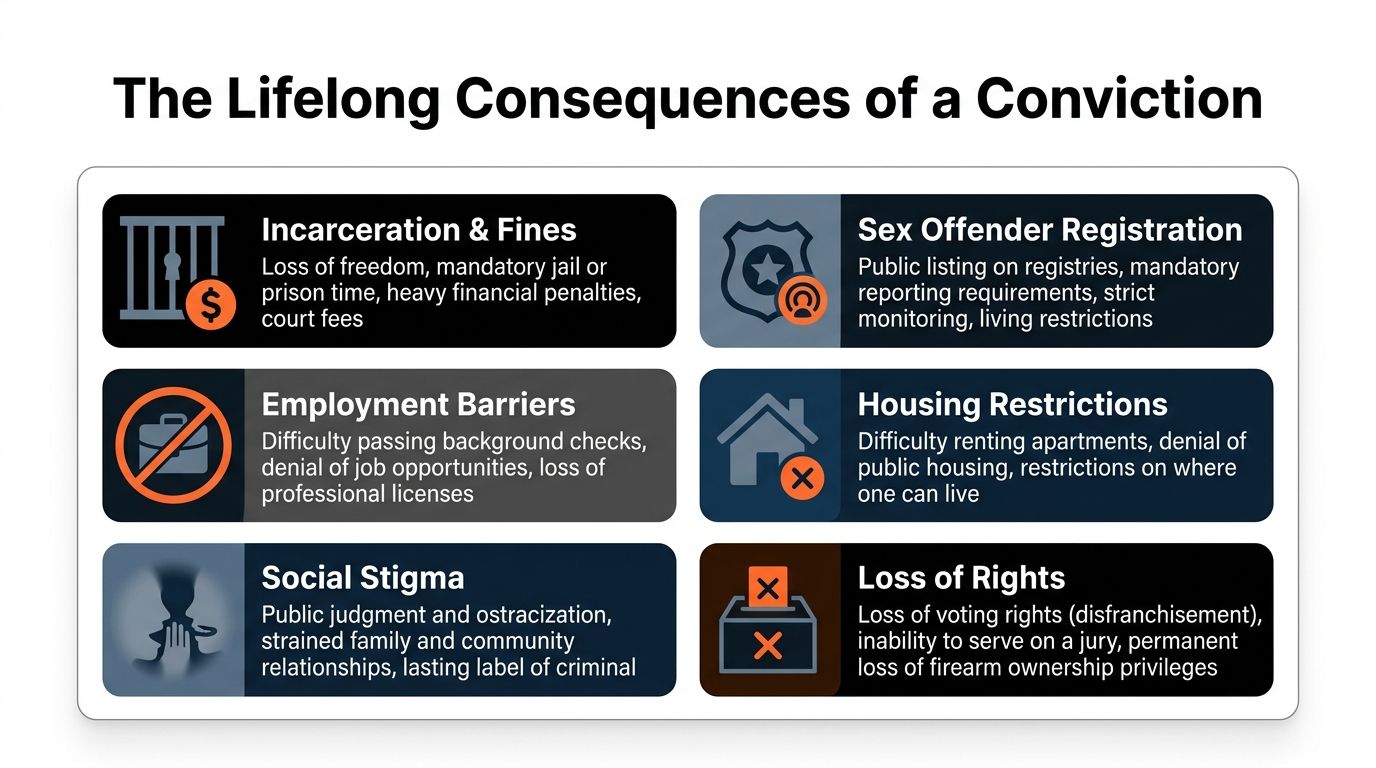
A conviction for online solicitation of a minor requires lifelong sex offender registration in Texas, and failure to comply with registration duties, which can include verifying information every 90 days, is a separate felony punishable by up to 20 years in prison, according to this explanation of registration consequences in Texas.
That isn't just paperwork. Registration can affect housing choices, employment opportunities, and ordinary public life. People often learn too late that the sentence is only one part of the punishment.
Other consequences people don't see coming
The impact can spread into several parts of life:
Work problems
Employers may hesitate to hire or retain someone with a sex offense record.Licensing issues
Professional boards may review or restrict licenses.Family strain
Parenting time, family relationships, and reputation can all suffer.Immigration concerns
Non-citizens can face serious immigration consequences and should get defense advice that accounts for that risk.
A criminal record can also affect people charged in very different felony cases. If you want a general example of how felony allegations can shape public perception before a case is resolved, this article on Ross Vollmer felony charges shows how quickly an arrest can become a lasting public story. The lesson is broader than one case. Once an accusation becomes part of the public record, the consequences can keep moving even while the court case is still pending.
The earlier the defense starts, the more chances you have to protect your future before these consequences harden into permanent ones.
Can This Charge Be Removed From Your Record
People often ask whether they can clear this charge later. The honest answer is that relief depends heavily on how the case ends.
When record clearing may be possible
In Texas, expunction generally means destroying eligible records. Nondisclosure generally means sealing certain records from public view. Those tools can help in some criminal cases, especially after dismissals, acquittals, or other favorable outcomes.
If you want a basic overview of the process, getting a record expunged in Texas explains the difference between clearing and sealing a record.
The practical reality
For a conviction involving online solicitation of a minor, record-clearing options are usually very limited. That's why the defense work at the front end matters so much. A dismissal, reduction, acquittal, or other favorable result can make a major difference later. A conviction can sharply limit what is available.
Post-conviction relief still matters for rehabilitation-focused clients. In some cases, lawyers also help people pursue appeals, challenge conditions, or address collateral issues after sentencing. But the strongest chance to protect your record is before the case is finished, not after.
If you've been charged with a crime in Texas, call The Law Office of Bryan Fagan, PLLC for a free and confidential consultation. Our defense team is ready to protect your rights.