Skip to content
Being arrested for Driving While Intoxicated (DWI) in Texas can be terrifying, but you don’t have to face it alone. A first-offense DWI conviction typically involves fines up to $2,000, jail time from 72 hours to 180 days, and a driver's license suspension. But remember, an arrest is not a conviction.
Those numbers are just the starting point. The penalty for a DWI in Texas can become much more severe depending on factors like your blood alcohol concentration (BAC) or if you have prior convictions. Understanding what you are up against is the first step toward building a strong defense, and our team is here to guide you through it.
Your First Steps After a Texas DWI Arrest
Being arrested for a DWI can make you feel like your world is collapsing. One minute you’re driving, the next you’re in handcuffs, facing a legal system that feels overwhelming. It's completely normal to feel lost, anxious, and unsure about what to do next. The most important thing to remember is that you have rights.
This is the beginning of a legal journey, not the end of the road. Understanding the process is the first step toward protecting your future, and that process is more complicated than most people realize.
The Two Battles You Must Fight
After a DWI arrest in Texas, you are not just fighting one case—you are fighting two separate legal battles at the same time, and both have serious consequences.
- The Criminal Case: This is the court process where a prosecutor will try to prove you are guilty of DWI under the Texas Penal Code. This is where you face potential jail time, fines, and a permanent criminal record.
- The Administrative Case: This is a civil case against the Texas Department of Public Safety (DPS) that focuses entirely on suspending your driver's license. This process, called an Administrative License Revocation (ALR), can take away your driving privileges long before your criminal case is resolved.
This two-front war is why you cannot afford to wait. As we explain in our guide on what to do after a DUI arrest, you have a very narrow window—just 15 days from your arrest—to request an ALR hearing to fight the automatic suspension of your license. If you miss this deadline, you lose your right to challenge the suspension.
Trying to handle this complex situation alone puts your freedom and your ability to drive in serious jeopardy. The Law Office of Bryan Fagan, PLLC is here to be your guide and your fighter from the very beginning. We make sure no critical deadlines are missed and that your rights are defended every single step of the way.
Breaking Down a First Offense DWI Penalty
If you’re facing your first DWI charge, it’s easy to feel overwhelmed by the legal jargon. Under the Texas Penal Code, a standard first-offense DWI is classified as a Class B Misdemeanor. But what does that actually mean for you?
Let's cut through the legal noise. A conviction is far more than a slap on the wrist; it's a serious disruption that can affect your job, your family, and your finances for years.
Standard First DWI Penalties
For a typical first-time DWI, the court can impose a range of penalties. These aren't just abstract numbers—they represent real time away from your life and a significant financial burden.
The potential criminal penalties include:
- Jail Time: A conviction carries a mandatory minimum of 72 hours in county jail, but the sentence can go up to 180 days.
- Fines: The court can order you to pay a fine of up to $2,000.
- State Surcharges: On top of court fines, Texas imposes annual surcharges on your driver's license for three years, which can add thousands more to your total cost.
These consequences are severe, but they are only the baseline. Certain factors can elevate the charge and the penalties, even on a first offense.
Texas has a reputation for being tough on impaired driving, and the penalties reflect that. For a first offense, jail time can range from a few days to a full year, and fines can hit $2,000—but those numbers can double if aggravating factors are present. You can find more details about how Texas DWI laws contribute to national statistics on lawcommentary.com.
The Critical Role of Your BAC
One of the most important factors in any DWI case is your Blood Alcohol Concentration (BAC). While a BAC of 0.08 is the legal limit for intoxication, testing at 0.15 or higher automatically enhances the charge.
If your BAC is 0.15 or more, the charge is elevated from a Class B Misdemeanor to a Class A Misdemeanor. This is a much more serious offense, and the potential penalties climb significantly, putting more jail time and larger fines on the table. This distinction is crucial because it changes the entire landscape of your case.
Let's put the potential penalties side-by-side to make the difference clear.
First-Time DWI Penalties in Texas Compared
This table breaks down how a high BAC elevates the consequences for a first-time DWI. The difference between a Class B and a Class A misdemeanor is substantial.
| Penalty | Standard First DWI (BAC < 0.15) | Enhanced First DWI (BAC ≥ 0.15) |
|---|---|---|
| Jail Time | Up to 180 days | Up to 1 year |
| Fines | Up to $2,000 | Up to $4,000 |
| License Suspension | Up to 1 year | Up to 2 years |
| Ignition Interlock | Possible | Often Mandatory |
As you can see, the penalties for an enhanced first DWI are a huge leap. The maximum jail time and fine both double. A judge is also far more likely to order the installation of an Ignition Interlock Device (IID), which forces you to provide a clean breath sample before your car will start, adding cost and hassle to your daily life.
How a DWI Charge Escalates to a Felony
While any DWI charge is serious, the line between a misdemeanor and a felony is a monumental one. It’s not just about steeper fines or more jail time. A felony conviction can strip away certain civil rights forever. The most common way a DWI becomes more severe is through prior convictions.
The Jump to a Second DWI Offense
A second DWI charge is automatically elevated to a Class A Misdemeanor, as defined in Texas Penal Code § 49.09(a). This is the most serious misdemeanor level, and the punishments are far tougher.
For a second DWI conviction, you are facing:
- Mandatory Jail Time: A second conviction requires a minimum of 30 days in county jail, with a maximum sentence of up to one year.
- Heftier Fines: The maximum fine climbs to $4,000.
- Longer License Suspension: You could lose your driving privileges for up to two years.
- Ignition Interlock Device (IID): An IID is almost always required as a condition of driving.
This infographic shows how penalties for even a first DWI can vary based on BAC, which gives you an idea of how seriously the state treats these charges from the get-go.
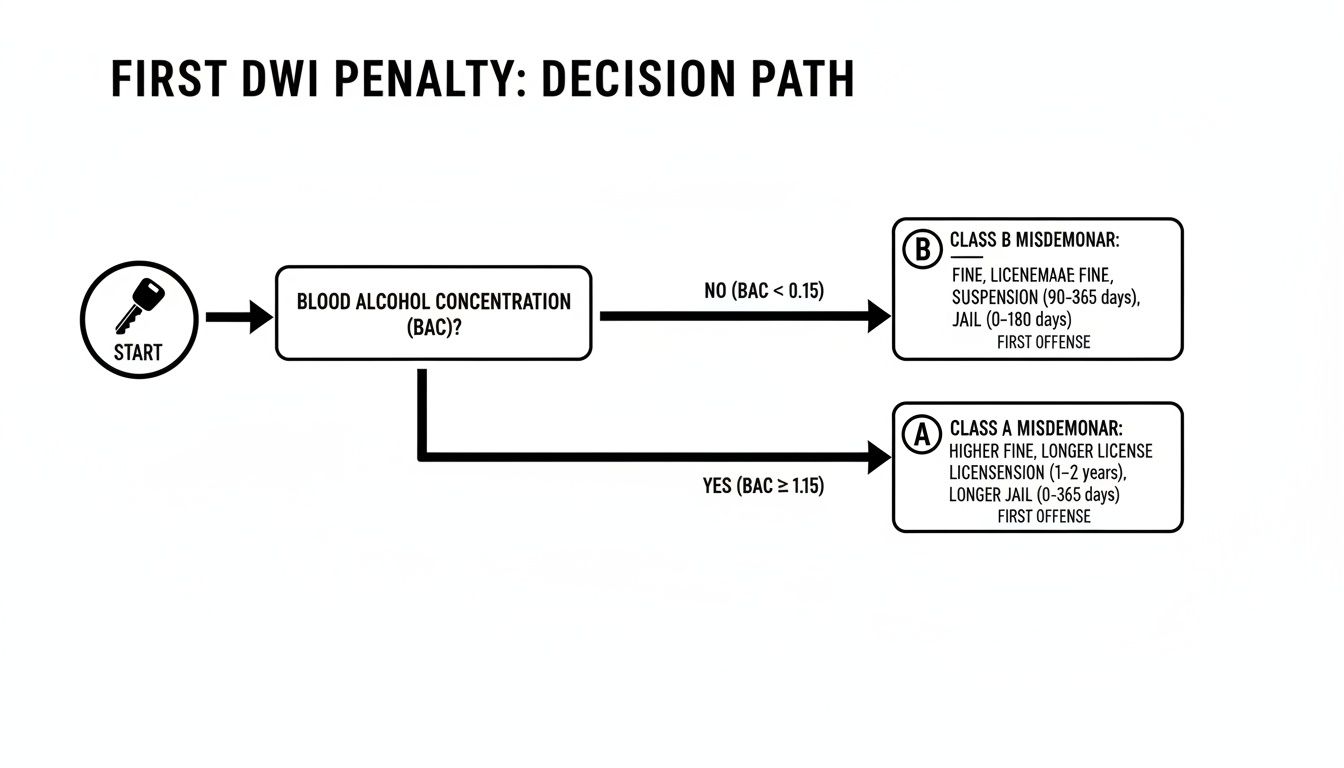
As you can see, a single factor like BAC can elevate a first-time charge. This just underscores how quickly the consequences stack up for subsequent offenses.
Crossing the Line to a Third DWI Felony
A third DWI arrest is where the penalty for DWI in Texas becomes truly life-altering. A third offense is prosecuted as a third-degree felony. This means you are no longer facing county jail but time in a state penitentiary.
The consequences of a third-degree felony DWI include:
- Prison Time: You face 2 to 10 years in the Texas Department of Criminal Justice (state prison).
- Severe Fines: The maximum fine skyrockets to $10,000.
- Loss of Rights: As a convicted felon, you permanently lose the right to vote (while incarcerated and on parole/probation), the right to own a firearm, and the ability to hold certain professional licenses.
A felony DWI conviction brings on what many call a "civil death." The loss of fundamental rights like voting and possessing a firearm, along with the permanent stain of a felony record, will follow you for the rest of your life, impacting your ability to get a job, find housing, or even secure a loan.
When a First DWI Becomes a Felony
You don’t need prior convictions to face a felony charge. Certain circumstances automatically elevate a first-time DWI to the felony level.
DWI with a Child Passenger
If you are arrested for DWI with a passenger under the age of 15 in the vehicle, the charge is automatically a State Jail Felony under Texas Penal Code § 49.045. A conviction could mean:
- Jail Time: 180 days to 2 years in a state jail facility.
- Fines: Up to $10,000.
Intoxication Assault
If you cause an accident while intoxicated that results in serious bodily injury to someone else, you will be charged with Intoxication Assault, a third-degree felony. Penalties include:
- Prison Time: 2 to 10 years in prison.
- Fines: Up to $10,000.
Intoxication Manslaughter
The most serious DWI-related offense is Intoxication Manslaughter. If your intoxicated driving leads to someone's death, you will face this second-degree felony charge, which carries:
- Prison Time: 2 to 20 years in prison.
- Fines: Up to $10,000.
Whether you're facing a misdemeanor or a felony, the legal jeopardy is immense. You are fighting for your future.
Navigating Your License Suspension and the ALR Hearing
Beyond the criminal charges, you must also fight a separate civil case against the Texas Department of Public Safety (DPS). This process is called the Administrative License Revocation (ALR) program, and its only goal is to suspend your driver's license. Many people are shocked to learn their license can be taken away long before their criminal case is decided.
The "Implied Consent" Rule
Texas operates under an “Implied Consent” law. This means that by accepting a Texas driver's license, you have automatically agreed to provide a breath or blood sample if you are lawfully arrested for DWI. You have the right to refuse this chemical test, but that refusal triggers its own immediate administrative penalties.
Refusing vs. Failing a Chemical Test
Whether you refuse a chemical test or take it and fail (meaning your BAC is 0.08 or higher), the DPS will move to suspend your license. The main difference is the length of the suspension.
- Failing a Test: A first-time offense where you fail a test usually results in a 90-day license suspension.
- Refusing a Test: If you refuse to provide a sample, the penalty is a 180-day suspension for a first offense.
The state intentionally doubles the suspension period for a refusal to discourage people from declining the test.
The Critical 15-Day Deadline for an ALR Hearing
This is the most important deadline you face: you have only 15 days from the date of your arrest to formally request an ALR hearing. This is your only opportunity to challenge the automatic suspension of your license.
If you miss that deadline, your license will be automatically suspended on the 40th day after your arrest, and you forfeit your right to contest it. Requesting the hearing pauses the suspension and gives your attorney a priceless opportunity to question the arresting officer under oath, which can reveal crucial evidence for your criminal case. Our Harris County ALR hearing guide breaks down this essential process even further.
SR-22 Insurance and Ignition Interlock Devices
After serving a suspension, you will likely need to meet additional requirements to have your driving privileges fully restored.
SR-22 Insurance
An SR-22 is a certificate your insurance company files with the DPS to prove you carry the state's minimum liability coverage. After a DWI-related suspension, you will likely need to maintain an SR-22 for several years, which almost always causes your insurance premiums to increase significantly.
Ignition Interlock Device (IID)
An Ignition Interlock Device is a breathalyzer wired into your car’s ignition. To start the car, you must provide an alcohol-free breath sample. A judge can order an IID as a condition of your bond, probation, or as a requirement to get an occupational driver's license. You are responsible for all installation and monthly monitoring costs.
How an Experienced DWI Lawyer Builds Your Defense
After learning about the harsh penalties, it’s easy to feel hopeless. But an arrest is not a conviction. The state has the entire burden of proving its case against you, and a skilled DWI defense attorney knows exactly where to find weaknesses and violations of your rights.
A dedicated lawyer meticulously deconstructs every piece of evidence. The goal is to challenge the legality and accuracy of the investigation from the very beginning.
Questioning the Initial Traffic Stop
Every DWI case begins with a traffic stop. An officer cannot pull you over on a hunch; they must have reasonable suspicion that you have violated a law. Your attorney will immediately scrutinize the officer's reason for the stop. Was it a clear violation, like speeding? Or was it something vague, like "weaving within your lane"? If the stop was illegal, any evidence gathered afterward can be thrown out, often leading to a dismissal of the case.
Challenging Field Sobriety and Chemical Tests
Field Sobriety Tests (FSTs) are notoriously unreliable and subject to human error. Your attorney will investigate key factors:
- Improper Administration: Did the officer give clear, correct instructions?
- Environmental Factors: Were the tests done on a level, well-lit surface?
- Your Physical Condition: Do you have medical conditions or injuries that could have affected your performance?
Breath and blood tests are also not foolproof. Breathalyzer machines require precise calibration and maintenance. An experienced lawyer will demand the device's service records. For blood tests, we investigate the chain of custody to ensure the sample was properly handled and not contaminated. Any break in this chain can make the results inadmissible. You can learn more in our guide on how to fight a DWI in Texas.
Fighting for You at Every Stage
Building a strong defense involves skillfully negotiating with prosecutors and fiercely advocating for you in both your criminal case and your ALR hearing. A "win" could mean getting the charges reduced to a lesser offense, negotiating for probation instead of jail time, or securing a full dismissal.
DWI remains a major public safety concern in Texas. While mandatory ignition interlock devices have helped reduce drunk driving fatalities by 8.5% since 2015, the state continues to enforce these laws with incredible aggression. You can discover more insights about these DUI statistics on greenhousetreatment.com.
At The Law Office of Bryan Fagan, PLLC, we explore every possible avenue to protect your freedom, your license, and your future.
Answering Your Urgent Texas DWI Questions
When you're facing a DWI charge, you are filled with questions and anxiety. This section provides clear, plain-English answers to some of the most common questions we hear.
Getting straightforward information is the first step toward regaining control. Our goal is to replace your anxiety with knowledge.
Is It Possible to Get a DWI Charge Dismissed in Texas?
Yes, getting a DWI charge dismissed is absolutely possible, but it requires a strategic defense. A dismissal is often the result of proving your constitutional rights were violated. For instance, if the officer lacked a valid legal reason—or reasonable suspicion—to pull you over, the entire stop was illegal. Any evidence gathered from an unlawful stop can be suppressed, often leading to a complete dismissal.
Other grounds for dismissal include:
- Challenging the Breathalyzer: Demonstrating the machine was improperly calibrated, maintained, or operated.
- Questioning Sobriety Tests: Proving the officer administered the tests incorrectly or that other factors made the results unreliable.
While a dismissal is never guaranteed, a robust defense significantly improves the chances of a favorable result, which could also include getting the charge reduced to a lesser offense like reckless driving.
What Is an Occupational Driver's License and How Can I Get One?
An occupational driver's license (ODL), or essential need license, is a special, restricted license that allows you to drive to specific places while your main license is suspended. It is a critical tool that allows people to keep their lives on track.
This license is typically limited to essential travel for:
- Work or job-related duties
- School and educational functions
- Essential household needs, like grocery shopping or medical appointments
To get an ODL, you must file a petition with the court and prove that an "essential need" exists—that without the ability to drive, you or your family would face a serious hardship.
An ODL comes with strict conditions. A judge will limit when and where you can drive and will almost always require you to install an Ignition Interlock Device on your vehicle at your own expense. Our attorneys can guide you through the petition process to help you maintain your livelihood during this difficult time.
How Long Does a DWI Stay on Your Record in Texas?
In Texas, a DWI conviction stays on your criminal record forever unless you take legal action to have it sealed. It does not automatically fall off after a certain number of years. However, Texas law does offer a path forward for some through a process called an order of nondisclosure, which seals the record from public view.
To be eligible to seal a first-time DWI, you generally must have:
- Completed your full sentence, including probation.
- Had a BAC below 0.15.
- Not been involved in an accident as part of the offense.
Securing an order of nondisclosure makes the conviction invisible to most employers, landlords, and licensing agencies. While law enforcement can still see it, this process effectively gives you a clean slate in the public eye. An experienced attorney can determine if you are eligible and help you file the petition to truly move on with your life.
If you’ve been charged with a crime in Texas, call The Law Office of Bryan Fagan, PLLC for a free and confidential consultation. Our defense team is ready to protect your rights. Find more information at https://texascriminallawyer.net.