Being arrested for a DWI in Texas can be terrifying — but you don’t have to face it alone. One minute you're driving, the next you're in handcuffs with your future feeling completely uncertain. The anxiety, confusion, and fear are completely normal, but now is the time to take control.
The single most important first step is to understand what you're up against. In Texas, the punishment for a DWI is severe and designed to send a message. You could be facing mandatory jail time, massive fines, and an automatic driver's license suspension.
Even for a first-time offense, the consequences are serious. Under the Texas Penal Code, a first DWI is a Class B Misdemeanor, which can mean up to 180 days in jail and fines climbing as high as $2,000. This shows just how seriously the state takes intoxicated driving, but an arrest is not a conviction.
What to Expect After a DWI Arrest in Texas
The legal system can feel like a maze, but the potential punishments for a DWI are spelled out clearly in Texas law. These penalties aren’t one-size-fits-all; they get harsher depending on your record and the specific circumstances of your arrest. Think of this section as your step-by-step guide to understanding the consequences you're facing.
Penalties Get Harsher with Each Offense
In Texas, DWI penalties escalate sharply with each conviction. A first-time offense is usually a Class B misdemeanor, but a second or third offense can easily become a felony with life-altering consequences.
Let's break it down. A standard first-time DWI conviction carries:
- A maximum fine of up to $2,000
- Jail time of up to 180 days (with a mandatory minimum of 3 days served)
- A driver's license suspension that can last up to one year
But there's a catch. If your blood alcohol concentration (BAC) was 0.15% or higher, the charge gets bumped up to a Class A misdemeanor. This doubles the potential penalties, with fines up to $4,000 and jail time up to one year.
The fallout doesn't stop in the courtroom. A conviction creates ripples that can affect your job, your insurance rates, and your personal life for years to come. Knowing what's at stake is critical, and our guide on what to do after a DUI arrest can give you immediate, actionable steps to protect your rights.
A DWI arrest kicks off two separate legal fights at the same time: the criminal case where the state prosecutes you, and a civil case with the Texas Department of Public Safety (DPS) that can suspend your driver's license long before you're ever convicted.
To help you get a clear picture of the potential legal outcomes, here’s a quick summary of the standard criminal penalties you might face.
Texas DWI Penalties at a Glance
This table breaks down the potential criminal penalties for standard DWI offenses in Texas, from a first-time offense to a felony charge. Keep in mind that these are just the baseline penalties—aggravating factors can make them much worse.
| Offense Level | Misdemeanor/Felony Class | Potential Jail Time | Maximum Fine |
|---|---|---|---|
| First DWI | Class B Misdemeanor | 72 hours – 180 days | Up to $2,000 |
| Second DWI | Class A Misdemeanor | 30 days – 1 year | Up to $4,000 |
| Third DWI or More | Third-Degree Felony | 2 – 10 years | Up to $10,000 |
| DWI with Child Passenger | State Jail Felony | 180 days – 2 years | Up to $10,000 |
As you can see, the stakes get incredibly high, very quickly. A third DWI isn't just a bigger fine; it's a felony conviction that can send you to prison for a decade. Understanding this progressive penalty system is key to grasping the seriousness of any DWI charge in Texas.
Navigating Your Two Legal Battles
When you’re arrested for DWI in Texas, most people think they’re only facing one legal problem. The reality is much more complicated. A single DWI arrest actually kicks off two separate legal cases at the same time. Think of it as fighting a war on two fronts—and each one has different rules, timelines, and consequences.
Getting a handle on this dual-track system is the first critical step toward protecting your future.
The first fight is the one everyone knows about: the criminal case. This is where the State of Texas prosecutes you for breaking the law. It involves court dates, negotiations with a prosecutor, and potentially a trial where a judge or jury decides if you're guilty.
The second, and often more urgent, battle is the administrative case with the Texas Department of Public Safety (DPS). This case has nothing to do with jail time or criminal fines. Its only goal is to suspend your driver's license.
The Criminal Case: Your Fight for Freedom
The criminal case is the heavyweight match. It moves through the court system to determine whether you committed the crime of Driving While Intoxicated. To get a conviction, the prosecutor has to prove beyond a reasonable doubt that you were operating a motor vehicle in a public place while you were intoxicated.
The stakes here are incredibly high. The punishments can include jail time, thousands of dollars in fines, probation, and mandatory DWI education classes. This is where a skilled DWI attorney digs in to challenge the state’s evidence, questioning everything from the reason you were pulled over to the accuracy of the breath or blood test.
The Administrative Case: Your Fight to Drive
While the criminal case is slowly making its way through the courts, the DPS is moving fast to take away your license through a process called an Administrative License Revocation (ALR). This is a civil case, not a criminal one. It gets triggered automatically if you refuse to take a chemical test (breath or blood) or if you provide a sample showing a BAC of 0.08% or higher.
You have only 15 days from the date of your arrest to request an ALR hearing. If you miss this deadline, your license will be automatically suspended—often for 90 to 180 days—no matter what happens in your criminal case.
This deadline is non-negotiable, which is why you have to act fast. Winning the ALR hearing not only saves your license but also gives your lawyer a chance to question the arresting officer under oath. That testimony can be a goldmine for your criminal defense strategy. To learn more about this critical process, check out our detailed Harris County ALR hearing guide.
This infographic breaks down the three main types of punishment you're up against in the criminal case.
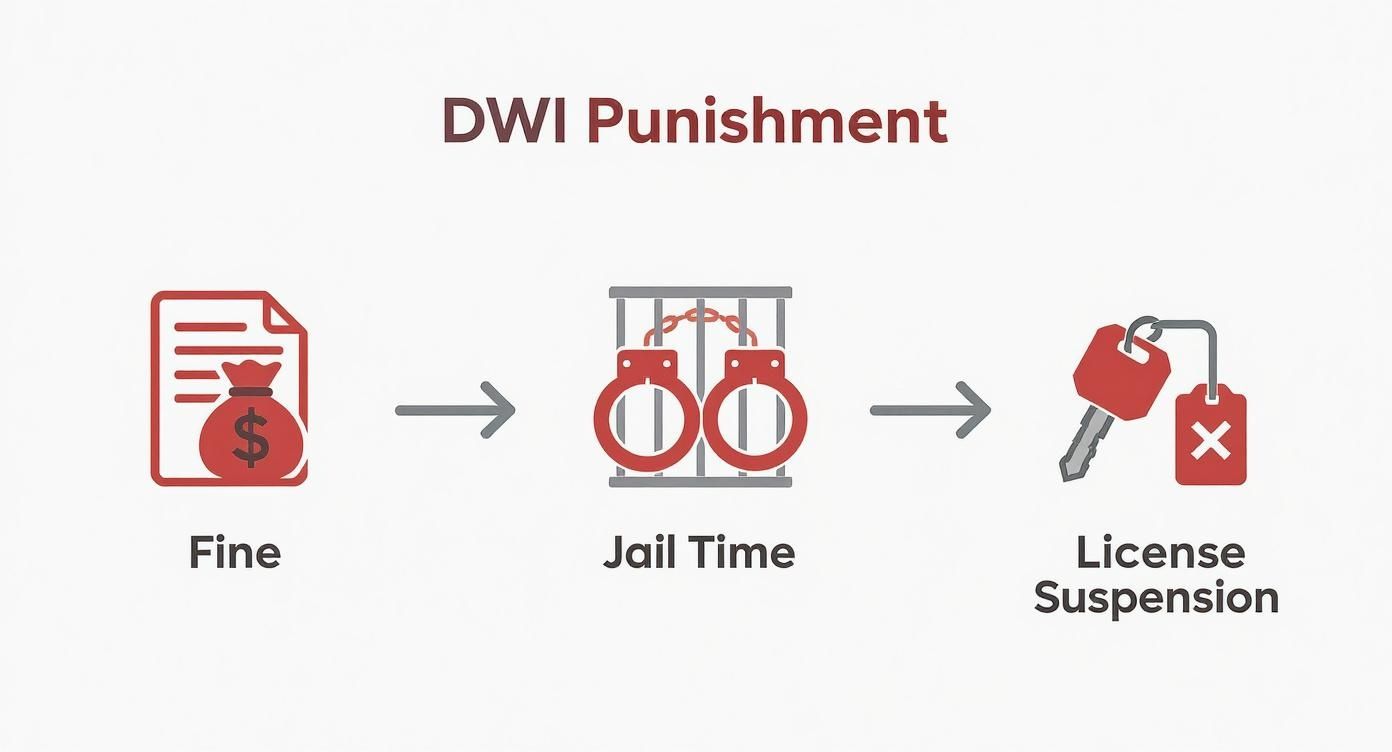
As you can see, a conviction hits you from every angle—your wallet, your freedom, and your ability to drive. Successfully managing both the criminal and administrative cases is the only way to minimize the total damage from a DWI in Texas.
Understanding First-Time DWI Penalties
If this is your first time facing a DWI charge, your mind is probably racing with questions about what happens next. Let's cut through the legal jargon and walk through the real-world punishments for a first-time DWI in Texas, assuming no other complicating factors are involved.
It's critical to understand that this isn't like a speeding ticket. A first-offense DWI is typically classified as a Class B Misdemeanor, a serious criminal charge with consequences spelled out directly in the Texas Penal Code. Knowing exactly what you're up against is the first step toward building a defense to protect your future.

Fines and Jail Time
The two penalties people worry about most are fines and jail. For a standard first DWI conviction in Texas, a judge can impose:
- A fine of up to $2,000. This number doesn't include court costs and other administrative fees, which can easily tack on hundreds or even thousands more to what you actually have to pay.
- Jail time between 72 hours and 180 days. Yes, even for a first offense. Texas law mandates a minimum of three days in the county jail upon conviction. The judge has the discretion to sentence you anywhere within that range based on the specifics of your case.
This isn't just a possibility—it's a requirement. A conviction means you are facing mandatory time behind bars.
Driver's License Suspension
On top of the criminal penalties, your freedom to drive is on the line. As part of your sentence, the court can—and almost always will—suspend your driver’s license.
For a first DWI, you're looking at a driver's license suspension ranging from 90 days to one full year. This is a court-ordered suspension and is entirely separate from the administrative license suspension we talked about earlier. Losing your license makes getting to work, school, and handling daily errands a massive headache.
Additional Court-Ordered Conditions
The punishment doesn't stop there. A judge will almost certainly pile on several other requirements as conditions of your sentence or probation. These aren't suggestions; if you fail to complete them, your probation can be revoked, and you could be sent to jail to serve out your original sentence.
These common conditions often include:
- DWI Education Program: You'll likely be ordered to complete a 12-hour DWI education course from a provider approved by the state. The class focuses on the dangers of drunk driving.
- Community Service: The court can order you to perform anywhere from 24 to 100 hours of community service.
- Ignition Interlock Device (IID): A judge may require you to install an IID in your car to get your driving privileges back or as a condition of probation. Think of it as a breathalyzer for your car—it won't start if it detects alcohol on your breath.
The combination of these penalties creates a huge burden. You aren't just paying a fine and moving on. You're facing a long list of requirements that will impact your time, your money, and your freedom for a year or more. A good defense attorney's job is to fight to minimize every single one of these consequences.
Seeing the full picture makes one thing clear: even a first-time DWI is a serious legal battle with consequences that can seep into every corner of your life.
How a DWI Charge Can Become a Felony
Not all DWI charges are created equal. While a first-offense DWI is usually a serious misdemeanor, certain factors can instantly rocket the charge up to a felony. It's crucial to understand these situations because a felony conviction brings life-altering punishments, including years in state prison and the loss of fundamental civil rights like owning a firearm.
Think of a standard DWI as the baseline charge. The Texas Penal Code then lists specific "aggravating factors" that automatically enhance the severity. These aren't minor details—they are absolute game-changers that prosecutors take very seriously. If any of these factors are present in your case, you're no longer just fighting to avoid jail time; you're fighting to keep a permanent felony off your record.
High BAC: A First-Time Misdemeanor Enhancement
One of the most common ways a DWI gets more serious is a high Blood Alcohol Concentration (BAC). In Texas, the legal limit is 0.08%. But if your BAC comes back at 0.15% or higher, the charge is automatically bumped up from a Class B Misdemeanor to a Class A Misdemeanor.
This isn't just a slap on the wrist. It means the potential punishment doubles. Instead of facing up to 180 days in jail and a $2,000 fine, you’re suddenly looking at up to one year in jail and a fine of up to $4,000. The state sees a high BAC as a sign of extreme impairment and a much greater danger to the public, and the penalties reflect that.
DWI with a Child Passenger
The law is fiercely protective of children. If you're arrested for DWI with a passenger under the age of 15 in your vehicle, the charge is automatically enhanced to a State Jail Felony. This is true even if it’s your very first offense and you were driving perfectly.
A State Jail Felony conviction carries 180 days to two years in a state jail facility and a staggering fine of up to $10,000. The mere presence of a child takes the case out of the misdemeanor category and puts your freedom in serious jeopardy.
This law, found in Texas Penal Code Section 49.045, shows zero tolerance for endangering a child by driving intoxicated. The state doesn't have to prove you meant to harm the child—only that a child was in the car while you were intoxicated.
Intoxication Assault and Manslaughter
The most severe enhancements happen when a DWI leads to an accident that injures or kills someone. At this point, these aren't just DWI cases anymore; they become distinct, violent felony offenses with devastating consequences.
Intoxication Assault: If your intoxicated driving causes an accident that results in serious bodily injury to another person, you will be charged with Intoxication Assault. This is a third-degree felony, punishable by 2 to 10 years in a Texas state prison and a fine of up to $10,000. "Serious bodily injury" means an injury that creates a substantial risk of death or causes serious permanent disfigurement or long-term impairment of a body part or organ.
Intoxication Manslaughter: If an accident caused by your intoxicated driving results in someone's death, the charge becomes Intoxication Manslaughter. This is a second-degree felony, carrying a prison sentence of 2 to 20 years and a fine of up to $10,000. The penalties can climb even higher if the person who died was a first responder.
These scenarios completely change the landscape of a DWI case, turning a driving offense into a major felony prosecution.
The following table really puts into perspective how dramatically these factors can change the potential punishment you're facing.
Common DWI Enhancements and Their Impact
| Circumstance | Charge Level | Potential Prison/Jail Time | Key Difference |
|---|---|---|---|
| Standard 1st DWI (BAC < 0.15) | Class B Misdemeanor | 72 hours – 180 days | Base-level offense with misdemeanor penalties. |
| DWI with Child Passenger | State Jail Felony | 180 days – 2 years | The presence of a child under 15 automatically makes it a felony. |
| DWI Causing Serious Injury | 3rd-Degree Felony | 2 – 10 years | Intoxication Assault charge due to causing serious bodily harm. |
| DWI Causing Death | 2nd-Degree Felony | 2 – 20 years | Intoxication Manslaughter charge due to causing a fatality. |
When you’re facing an enhanced DWI charge, the stakes are incredibly high. Having an experienced defense attorney in your corner isn't just a good idea—it's an absolute necessity to protect your freedom and your future.
The Hidden Costs of a DWI Conviction
The punishment for a DWI in Texas doesn't stop when you leave the courtroom. Long after the fines are paid and probation is a memory, a conviction leaves behind a ripple effect—hidden consequences that can follow you for years. These are often called "collateral consequences," and they can disrupt your finances, your career, and even your family life.
Understanding these long-term costs is critical. A strong defense isn't just about fighting the immediate penalties; it's about protecting your entire future from these lasting effects.

Financial and Professional Consequences
One of the first financial hits you'll feel comes from your car insurance company. A DWI conviction immediately flags you as a high-risk driver, and it's not uncommon for insurance premiums to double or triple overnight. That added expense can stick around for years, costing you thousands of dollars long after your case is closed.
Your career is also on the line. Most employers run background checks, and a DWI on your record can be a major red flag, especially for jobs that involve driving, operating machinery, or handling sensitive information.
Think about these professional impacts:
- Commercial Drivers: If you hold a Commercial Driver's License (CDL), a DWI conviction triggers an automatic license suspension. For most, this means an immediate end to their career in professional driving.
- Licensed Professionals: Nurses, pilots, real estate agents, and others with professional licenses can face disciplinary action from their state licensing boards. This could mean suspension or even complete revocation of the license you worked so hard to earn.
- Future Opportunities: A criminal record creates serious barriers when you're applying for a new job, trying for a promotion, or even attempting to start your own business.
Personal and Family Life Impacts
The consequences of a DWI conviction can also seep into your personal life, creating stressful and unexpected challenges. If you're in a child custody dispute, for example, the other parent could use a DWI conviction to argue you're an unsafe or irresponsible parent, potentially jeopardizing your custody or visitation rights.
For non-U.S. citizens, the stakes are even higher. A DWI conviction, especially a felony or one with aggravating factors, can be classified as a crime of "moral turpitude." This can trigger severe immigration consequences, including deportation or the denial of a green card or citizenship application.
A DWI conviction creates a permanent criminal record that follows you everywhere. It can pop up on background checks for housing applications, bank loans, and even volunteer opportunities, closing doors you never even knew were there.
The whole point of a strong defense is to prevent this permanent mark on your record. While there are limited options for expunging a DWI in Texas, eligibility is extremely narrow. That’s why fighting the charge from the very beginning is so vital. A conviction isn't just about a single punishment; it's about avoiding a lifetime of obstacles.
Building a Strong Defense Against Your DWI Charge
Learning about Texas DWI penalties can be unnerving, but it’s critical to remember one thing: an arrest is not a conviction. The State of Texas carries the entire burden of proving its case against you, and you have the absolute right to fight every single piece of evidence they bring.
This is the moment to stop worrying about what could happen and start taking strategic action. A strong DWI defense starts the second you’re pulled over, and what you say and do from that point forward can make or break your case. Your first and most important move is to exercise your right to remain silent and call an experienced DWI defense lawyer immediately.
Questioning Every Aspect of the State's Case
A winning DWI defense is built by meticulously dissecting the entire arrest, from the reason for the traffic stop all the way to the chemical test results. A skilled attorney acts like a detective, searching for procedural mistakes, technical errors, and constitutional violations that can be used to weaken the prosecution's case.
Common defense strategies zero in on these key areas:
- The Legality of the Traffic Stop: Did the officer even have a valid, legal reason to pull you over? This is called "reasonable suspicion." If the stop was illegal, any evidence collected afterward—including field sobriety tests and breath samples—can be thrown out.
- The Administration of Field Sobriety Tests: These tests are notoriously unreliable and hard to perform perfectly even stone-cold sober. Your lawyer can challenge whether the officer administered them correctly according to national standards or if other factors like medical conditions, bad weather, or simple fatigue affected your performance.
- The Accuracy of Breath and Blood Tests: Breathalyzer machines are sensitive instruments that need regular calibration and proper maintenance to work correctly. Likewise, blood samples can be contaminated, mishandled, or improperly stored. Any mistake in these scientific procedures can make the results completely inadmissible in court.
An arrest is simply the start of a legal process. It means an officer believes they have probable cause. A conviction only happens if a prosecutor can prove your guilt beyond a reasonable doubt, a much higher and more difficult legal standard to meet.
Strategic Options Beyond a Trial
Not every DWI case needs to end up in front of a jury. Depending on the facts, negotiating with the prosecutor for a better outcome might be the smartest path forward. Your attorney can explore different avenues that could dramatically reduce the long-term consequences of a DWI charge.
These alternatives could include:
- Plea Bargains: This is where your attorney negotiates with the prosecutor to get your DWI charge reduced to a less serious offense, like reckless driving. A good plea bargain can help you avoid a permanent DWI conviction on your record.
- Diversion Programs: Some first-time offenders might qualify for a pretrial diversion program. If you successfully complete all the requirements—which often involve classes, community service, and staying out of trouble—the original DWI charge gets dismissed entirely.
The right strategy depends entirely on the unique facts and circumstances of your arrest. Whether it's taking the fight to a jury, negotiating a dismissal, or securing a reduced charge, having a skilled legal guide in your corner is non-negotiable. You don’t have to face these decisions alone.
Answering Your Top DWI Questions
When you're staring down a DWI charge, the "what-ifs" can feel endless and overwhelming. This section is designed to cut through the noise and give you direct, straightforward answers to the questions we hear most often. This is clear information you can use right now.
What Happens If I Refuse a Breathalyzer in Texas?
Saying "no" to a breathalyzer or blood test in Texas isn't a free pass. It comes with immediate and automatic penalties for your driver's license. This is all because of the state's "implied consent" law. The simple act of having a Texas driver's license means you have already legally agreed to provide a breath or blood sample if an officer lawfully arrests you for DWI.
Refusing the test automatically triggers an Administrative License Revocation (ALR). For a first-time arrest, that means a 180-day license suspension. This is a civil penalty handled by the Texas Department of Public Safety (DPS), and it happens completely separate from—and regardless of—what happens in your criminal court case.
Can a Texas DWI Charge Be Dismissed?
Yes, a DWI charge can absolutely be dismissed. But it's crucial to have realistic expectations. A dismissal is never a guarantee; it comes down to the specific facts of your case and a tough, well-executed legal defense.
A good defense attorney will tear apart every detail of your arrest, looking for cracks in the prosecutor's case. Things that can lead to a dismissal often include:
- An Unlawful Traffic Stop: If the officer didn't have a legitimate reason to pull you over in the first place, any evidence they gathered after that could get thrown out.
- Faulty Testing Equipment: Breathalyzer machines must be properly calibrated and maintained. If they aren't, the results they produce are unreliable.
- Improperly Administered Field Sobriety Tests: The police have to follow a strict set of rules when conducting these tests. Any mistakes can make the results invalid.
How Long Does a DWI Stay on My Record?
In Texas, a DWI conviction stays on your criminal record forever. It doesn’t just fall off after a few years. That permanent mark can create real, long-term problems with jobs, housing, and other opportunities down the road.
However, there are ways to clear your name if the outcome of your case is favorable. If your case was dismissed or you were found not guilty at trial, you may be eligible for an expunction. This legal process completely destroys the records of your arrest. In other limited situations, you might qualify for an order of non-disclosure, which seals the record from public view, although law enforcement can still access it. The only way to know which path is right for you is to explore these options with an attorney to protect your future.
If you’ve been charged with a crime in Texas, call The Law Office of Bryan Fagan, PLLC for a free and confidential consultation. Our defense team is ready to protect your rights.