Facing a felony charge in Texas can be terrifying—but you don’t have to face it alone. Before you let panic set in, you need to know that a conviction isn’t a foregone conclusion. The short answer is yes, reducing a felony to a misdemeanor is often possible. It doesn't happen by magic, though. It's achieved through strategic legal work, like negotiating with the prosecutor or successfully completing a program like deferred adjudication.
Why Reducing a Felony Is a Critical Goal
Being arrested in Texas can turn your world upside down, but you don’t have to face this alone. A felony charge carries the weight of life-altering consequences, casting a dark cloud of uncertainty over your entire future. Understanding exactly what’s at stake is the very first step toward getting your life back on track.
A felony conviction isn't just a legal outcome; it’s a permanent brand on your record that can slam doors shut for years, even decades. In Texas, a felony conviction means losing fundamental civil rights, like the right to vote and the right to own a firearm. It creates enormous barriers to getting a decent job, finding a safe place to live, and even getting into college.
The Stark Difference Between a Felony and Misdemeanor
A misdemeanor conviction, while still serious, has a much less severe and lasting impact. The distinction isn't just about potential jail time versus prison time; it's about preserving your ability to move forward with your life. To really grasp what’s on the line, it helps to see the consequences side-by-side.
Felony vs. Misdemeanor Consequences in Texas
This table highlights just how different the long-term outcomes are. The fight to reduce a felony is a fight for your future opportunities.
| Consequence | Felony Conviction | Misdemeanor Conviction |
|---|---|---|
| Right to Vote | Lost while incarcerated and on parole/probation. | Unaffected in most cases. |
| Firearm Rights | Permanently lost in most circumstances. | Typically retained after sentence completion. |
| Employment | Major barrier; many employers will not hire felons. | Less of a barrier on background checks. |
| Housing | Often disqualified from rental applications. | Generally less impact on housing options. |
| Professional Licenses | May be denied or revoked. | Usually unaffected for most professions. |
As you can see, the stakes couldn't be higher. Successfully navigating this process requires a deep understanding of the Texas Penal Code and a proactive defense strategy from day one. For a more detailed breakdown, you can learn more about the difference between a felony and a misdemeanor in our comprehensive guide.
Your Path Forward After a Felony Charge
The good news is that an arrest doesn't have to end with a felony conviction on your record. A skilled Houston criminal defense lawyer can pursue several legal avenues to protect you, but the right path depends on the specific facts of your case, the type of charge, and your criminal history.
Here are a few of the strategies we use to fight for our clients:
Plea Negotiations: This is where experience really counts. An attorney can negotiate directly with the prosecutor to get the charge lowered. For instance, a low-level state jail felony for drug possession might be reduced to a Class A misdemeanor, completely changing the long-term outcome for you.
Deferred Adjudication: This is a special form of community supervision (probation) where you plead "guilty" or "no contest," but the judge defers finding you guilty. If you successfully complete all the terms of your probation, the case is dismissed. Better yet, you can often petition to have the record sealed from public view later on.
Challenging the Evidence: A sharp defense attorney will scrutinize every single piece of evidence. Did law enforcement violate your rights during the arrest? Was the search illegal? If we can find procedural errors, it could get evidence thrown out, forcing the prosecution to reduce the charge or even dismiss the case entirely.
A felony charge is not the end of the road. It’s the beginning of a legal fight where having the right defense can make all the difference. An experienced attorney can guide you through this confusing process, build a clear path forward, and fight aggressively to protect your rights and your future.
Understanding Your Legal Pathways for Charge Reduction
When you're facing a felony charge, it's easy to feel like the walls are closing in. But the first thing you need to understand is that the charge you were arrested for isn't set in stone. The legal system has several routes an experienced defense attorney can take to fight for a reduction to a misdemeanor—an outcome that can completely change the trajectory of your life.
Let's cut through the legal jargon and look at the practical ways we can work toward a better outcome.
Plea Bargaining With the Prosecutor
The most common path to reducing a felony to a misdemeanor is through plea bargaining. This is simply a strategic negotiation between your defense attorney and the prosecutor handling your case. The goal is to hammer out an agreement that avoids a felony conviction.
Think of it this way: imagine you're charged with a State Jail Felony for Possession of a Controlled Substance. As your attorney, I wouldn't just accept the charge. I'd dig into the details—your clean record, your stable job, or maybe some shaky evidence from the arrest. By pointing out these weaknesses in the state’s case, we can often persuade a prosecutor to knock the charge down to a Class A Misdemeanor, which comes with far less severe penalties and long-term baggage.
This isn't about just "taking the first deal." It's a calculated negotiation where we use legal knowledge and a strong defense strategy to protect your record and your freedom.
Using Texas Law to Your Advantage
The Texas Penal Code itself gives us some powerful tools for getting a felony charge handled like a misdemeanor. The most important one is Texas Penal Code §12.44, which gives a judge the power to punish certain state jail felonies as if they were misdemeanors. We often call this "getting 12.44 time."
There are two ways this can play out:
- §12.44(a): If the prosecutor agrees, a judge can sentence you on a state jail felony to serve time in a county jail for up to one year. The moment this happens, your conviction legally becomes a Class A Misdemeanor. This is a massive win.
- §12.44(b): A judge can also sentence you to county jail time even if the prosecutor objects. The big difference here is that the conviction still stays on your record as a felony.
Getting a §12.44(a) reduction is the goal, as it completely reclassifies the offense and gives you a much cleaner record moving forward.
Deferred Adjudication: A Second Chance
Another fantastic option in our toolkit is deferred adjudication. Think of this as a special kind of probation. You plead "guilty" or "no contest," but the judge holds off on actually finding you guilty.
A key thing to remember is that deferred adjudication is not a conviction. If you follow all the rules of your probation—like community service, classes, and regular check-ins—the case is dismissed entirely when you're done.
This is an incredibly valuable outcome because a dismissal opens the door to getting your record sealed with an Order of Nondisclosure. This prevents the charge from appearing on most public background checks, protecting your ability to get a job, rent an apartment, or get a loan. To dig deeper, check out our guide on what is a deferred adjudication and see if it could be the right fit for you.
For cases involving substance abuse, completing a rehab program can be a game-changer during negotiations. Understanding the legal implications of court-mandated treatment is often a critical part of building a strategy for a better outcome.
The flowchart below shows how a felony case can branch off, leading to very different results.
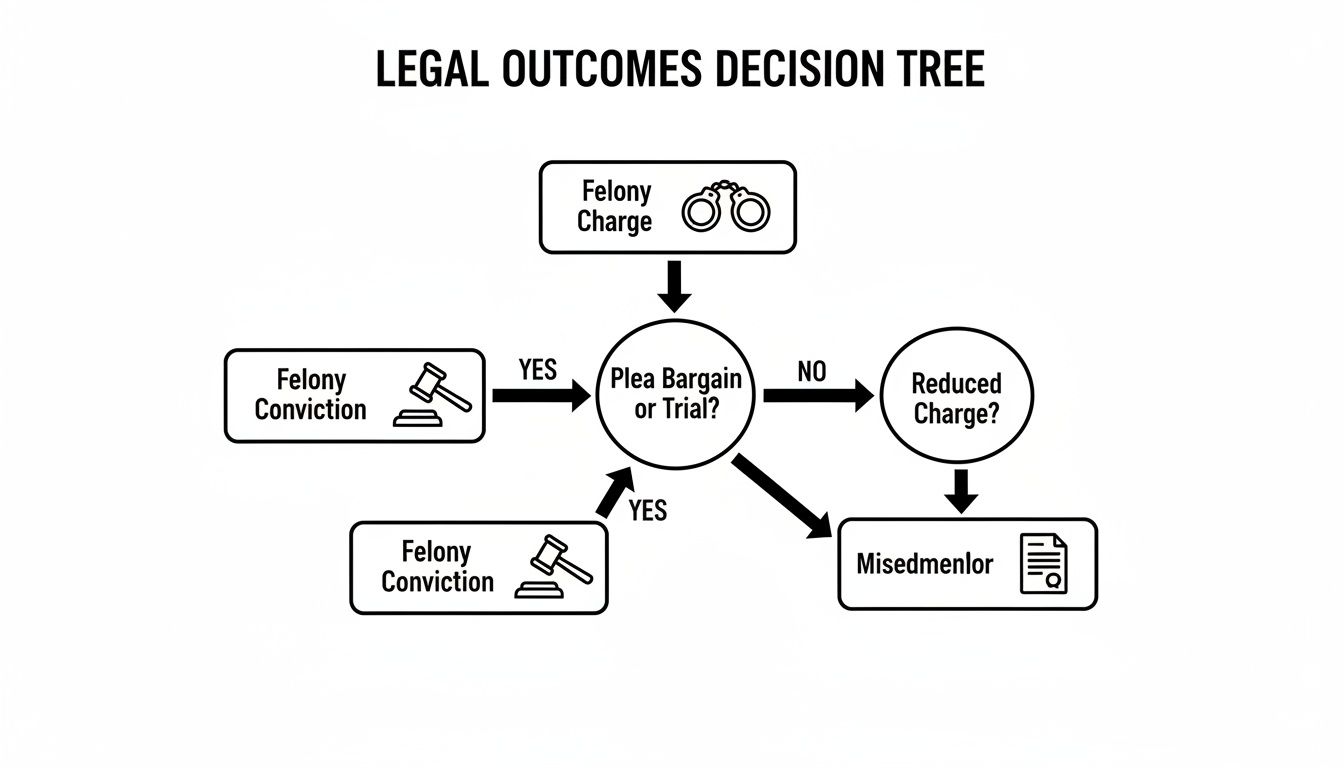
As you can see, a felony charge doesn’t have to end with a felony conviction. With a smart legal strategy, there’s a clear path to a much less damaging misdemeanor outcome. These options are never guaranteed, but they are very achievable when you have a dedicated defense team fighting in your corner.
The Real-World Benefits of Downgrading Your Charges
Getting a felony charge dropped to a misdemeanor isn't just a win in the courtroom; it’s a life-changing event that can reopen doors you thought were permanently locked. While avoiding prison is obviously the most immediate relief, the real, long-term value comes from protecting your future opportunities.
A felony conviction follows you everywhere. It’s a shadow that can hang over everything from your career to your personal life. But a misdemeanor? That's a hurdle, not a wall, and it's far less damaging on the background checks that control so much of modern life.
Successfully reducing a felony to a misdemeanor means you can honestly check "no" when a job application asks if you've ever been convicted of a felony. That one simple change can dramatically widen your employment prospects, giving you a fair shot at building a career and providing for your family. It's about more than just getting a job—it's about reclaiming your financial independence and personal dignity.

Unlocking Your Economic Future
The difference between a felony and a misdemeanor on your record is staggering when it comes to your earning potential and overall stability. Fighting for a reduction is a direct investment in your future well-being.
Here’s what that looks like in the real world:
- Access to Better Jobs: Many professional fields and licensed trades are completely off-limits to someone with a felony record. A misdemeanor opens up those pathways to higher-paying, more stable careers.
- Housing Security: Landlords frequently deny rental applications from individuals with felony convictions. A misdemeanor significantly improves your chances of securing safe, affordable housing for you and your family.
- Educational Opportunities: Getting into college or qualifying for federal student aid can be incredibly difficult with a felony. A charge reduction removes these major obstacles.
These aren't abstract concepts. They are tangible, concrete improvements to your quality of life. The fight for a charge reduction is, in many ways, a fight for a normal life.
The Proven Link Between Charge Reduction and Employment
This isn't just talk—the positive effects are backed by solid data. A 2023 study analyzed what happened when a change in the law allowed certain felonies to be downgraded. The results were crystal clear: people who had their felonies reduced saw a major boost in employment.
Specifically, reductions initiated by public defenders were linked to a 5.4 percentage point employment increase, which is a 16% jump for those convicted in the same year. The study also found a rise in platform gig work, which often serves as a crucial lifeline for people trying to get back on their feet. You can discover more about how charge reductions impact job prospects in the full study.
This data provides a powerful blueprint for what’s possible here in Texas. It proves that downgrading charges doesn't just help individuals; it strengthens our entire workforce by giving capable people a second chance.
This is exactly why investing in a strong legal defense is so critical. An experienced criminal lawyer can build a compelling case to persuade prosecutors and judges that a reduction isn't just a lenient outcome—it's the right one.
Preserving Your Civil Rights and Personal Freedoms
Beyond your career and housing, a felony conviction strips you of fundamental rights that most people take for granted. In Texas, a felony record means losing your right to own a firearm and your right to vote while on supervision.
By securing a reduction to a misdemeanor, you can often preserve these core civil liberties. It also means you may become eligible to have your record sealed down the road.
An Order of Nondisclosure prevents private entities from seeing the charge on a background check, effectively clearing your slate for most employers and landlords. After a successful charge reduction, this could be an option. You can check out our guide on the Texas Order of Nondisclosure to learn more.
Ultimately, a charge reduction gives you back control over your own story. Instead of being defined by one mistake, you get the opportunity to define your own future.
While getting a felony knocked down to a misdemeanor is a huge win, let's be clear: the best possible outcome is getting the entire case thrown out. A strong defense doesn’t start on the day of your trial; it begins the second you decide to fight back with an experienced Texas assault defense attorney. An aggressive, early approach can often stop a case cold before the prosecution even gets its feet off the ground.
The moment we take on a case, the first thing we do is demand the evidence—or, often, the lack of it. We tear into police reports, scrutinize witness statements, and analyze every detail of the arrest. Our job is to find the cracks in the prosecutor’s foundation.
Was the search of your property illegal? Did the officer even have probable cause to stop you in the first place? Are the state’s witnesses credible, or do their stories fall apart under pressure? By confronting the prosecutor with these weaknesses right away, we can often persuade them to drop the charges before they ever get traction. This is what we call securing a "non-prosecution" or getting a "no-bill" from the grand jury.
The Power of Early Intervention
Time is not on your side after an arrest. The longer the state has to assemble its case against you, the harder it can be to secure a dismissal. Getting a skilled lawyer involved immediately allows us to get ahead of the curve, control the story, and push for a dismissal before your life gets dragged through a long and stressful court battle.
When a dismissal happens, it's over. You walk away with your record clean and your future back in your hands. There's no conviction, no probation, and no need to seal anything later. The case is simply gone.
The Proven Impact of Non-Prosecution
This isn’t just a legal theory; it’s a strategy with a proven track record of helping people stay out of the system for good. The data overwhelmingly shows that avoiding a criminal prosecution has a massive positive effect on a person's life. One of the most telling pieces of research comes from a Cato Institute study that looked at misdemeanor non-prosecution policies. What they found was staggering: defendants whose cases were dropped were 58% less likely to be charged with a new crime within two years compared to those who were prosecuted. You can read the full research on how non-prosecution lowers recidivism for a deeper look.
This study confirms what we’ve seen in our practice for years. Keeping someone out of the criminal justice system is the single best way to ensure they can move on and continue to be a productive member of their community. A dismissal is more than a win in court—it's a win for society.
The study also found that these non-prosecution policies didn't cause a spike in crime rates, proving that public safety wasn't compromised. It reinforces the simple fact that smart, well-argued dismissals are better for everyone involved.
Avenues to Achieving a Full Dismissal
Every case is different, but a complete dismissal is often achieved through a few key legal strategies:
- Challenging Unlawful Police Conduct: If law enforcement violated your constitutional rights during the stop, search, or arrest, we can file a Motion to Suppress Evidence. If the judge agrees, key evidence gets thrown out, which frequently leaves the prosecutor with no choice but to drop the case.
- Presenting Mitigating Evidence: We sometimes get the chance to present your side of the story to the grand jury—the citizens who decide whether there's enough evidence to formally charge you. A persuasive presentation can convince them to "no-bill" the case, stopping a felony indictment in its tracks.
- Negotiating a Pre-Trial Diversion: Especially for first-time offenders, we can often negotiate entry into a pre-trial diversion program. This is a formal agreement where you complete certain conditions, like counseling or community service, and in return, the state dismisses the charges completely.
Securing a dismissal is the absolute gold standard in criminal defense. It gives you a clean slate and lets you move forward without the weight of a criminal record. While we always prepare a case to fight for a reduction, our first and primary goal is always to get the charges thrown out entirely.
Navigating the Texas Criminal Justice Process
Facing a criminal charge is a uniquely terrifying experience. The journey from arrest to a final court date can feel like a blur of confusion and anxiety. But when you understand the map of the Texas criminal justice system, the path forward becomes much clearer. Having a trusted legal guide in your corner makes all the difference.

The very first call you should make after an arrest is to a criminal defense attorney. That initial meeting is completely confidential, giving you a safe space to share what happened and get a no-nonsense assessment of what you’re up against.
Your First Steps in Court
After you’ve been arrested and bonded out, your first official court date is the arraignment. This is a purely procedural hearing where the judge reads the charges against you. You will enter a plea—which, at this early stage, is almost always "not guilty." This isn't the time to tell your side of the story; it’s simply the starting gun for the case.
From there, the case moves into the pre-trial phase. Honestly, this is where the real work happens. It’s often the longest part of the entire process, and it’s where your attorney digs in and starts building your defense.
This is also where the fight to get a felony reduced to a misdemeanor really begins.
The Critical Pre-Trial Phase
The pre-trial stage is all about strategy and groundwork. Your lawyer will be working methodically behind the scenes to find weaknesses in the prosecutor’s case. This isn't just one action, but several moving parts.
- Discovery: We file formal demands for every piece of evidence the state has. This includes everything from police reports and witness accounts to body cam footage and lab results.
- Investigation: We never just accept the state's evidence as the final word. Our team conducts its own independent investigation. That could mean tracking down and interviewing witnesses, visiting the scene, or hiring our own experts to challenge things like forensic evidence.
- Negotiation: Once we have a clear picture of the case's strengths and the prosecution's weak spots, we open a line of communication with the prosecutor. This is where we lay out our arguments for a charge reduction or, in some cases, a complete dismissal.
As cases have become more complex, the ability to use tools like video conferencing depositions for attorneys has become incredibly useful for gathering testimony and building a solid defense during this phase.
Understanding the Timelines and Next Steps
Criminal cases don't move quickly. Timelines can stretch from several months to well over a year, depending on the charge, the amount of evidence, and how crowded the court's docket is. During this time, you'll have several court dates called "settings," where your attorney provides the judge with progress updates.
A long timeline isn't always a bad thing. It gives your defense team the room we need to properly review all the evidence and build the strongest possible argument for a good outcome.
While some jurisdictions have seen a trend toward downgrading certain felonies, it never happens on its own. A Data Collaborative for Justice analysis of several U.S. cities found that after some drug offenses were reclassified from felonies to misdemeanors, misdemeanor arrest rates dropped significantly with no corresponding increase in crime. You can learn more about these crime trend findings to see the data for yourself.
This national data just reinforces how important aggressive, proactive legal work is. If negotiations don’t produce a plea deal you're satisfied with, the case gets set for trial. At that point, a judge or jury will hear all the evidence and decide if the state proved its case beyond a reasonable doubt.
From the first day in court to the last, every single step is an opportunity to protect your rights. With an experienced attorney managing the process, you're never navigating it alone.
Your Questions Answered: Reducing a Felony in Texas
If you're facing a felony charge in Texas, your head is probably spinning with a thousand questions and what-ifs. It’s a terrifying spot to be in, and the uncertainty can be overwhelming.
To give you some clarity, we've put together answers to the questions we hear most often from clients about the possibility of reducing a felony to a misdemeanor.
Can Any Felony Be Reduced to a Misdemeanor?
While it’s a powerful defense strategy, a reduction isn’t on the table for every single case. The best candidates are generally low-level, non-violent felonies where no one was physically harmed.
Think of charges like a state jail felony for possessing a small amount of a controlled substance or certain theft offenses. These are the kinds of cases where a prosecutor might be open to negotiation, especially for first-time offenders.
On the other hand, getting a serious or violent felony reduced—like aggravated assault or robbery—is a much steeper climb. The prosecutor and judge will scrutinize the facts, the level of violence involved, and your criminal history before they’d even entertain the idea.
How Long Does It Take to Get a Felony Reduced?
There's no magic number here. The process of getting a charge reduced is woven into the timeline of your entire criminal case, which can last anywhere from a few months to over a year. The reduction itself usually happens during the pre-trial phase through tough negotiations with the prosecutor.
Several things can affect the timeline:
- The complexity of the evidence in your case
- How much discovery needs to be reviewed
- The caseloads of the court and the prosecutor's office
- The back-and-forth of the negotiation process itself
Remember, a quick resolution isn't always the best one. Sometimes, a longer timeline is exactly what your attorney needs to build a rock-solid argument for why your charge should be reduced.
What if the Prosecutor Won’t Agree to a Reduction?
A "no" from the prosecutor doesn't mean the fight is over. Not by a long shot. Your defense attorney still has moves to make. For certain state jail felonies, your lawyer can go over the prosecutor’s head and ask the judge to sentence you to misdemeanor time under Texas Penal Code §12.44.
Even if the prosecutor objects, the judge has the final say and can grant this at their discretion. It’s a critical tool in our legal arsenal.
If a reduction just isn’t in the cards through negotiation or judicial order, our focus shifts to trial. The goal then becomes fighting for a "not guilty" verdict, which is even better than a reduction—it’s a complete acquittal.
Remember, a prosecutor's first offer is just that—an offer. A skilled defense attorney knows how to find the weaknesses in the state's case, push back, and keep fighting for the best outcome, whether that's a reduction, a dismissal, or a win in the courtroom.
Does a Reduction Mean My Record Is Clear?
Not automatically, and this is a point that trips a lot of people up. Getting a felony knocked down to a misdemeanor is a huge win, but that misdemeanor conviction will still appear on your record if you plead guilty or are placed on regular probation.
However, if we can resolve your case with deferred adjudication, things look much brighter. Once you successfully complete that type of probation, the charge is dismissed entirely.
After a dismissal—or even after some misdemeanor convictions—you may be eligible to get your record sealed with an Order of Nondisclosure. This keeps the charge hidden from the public on most background checks, clearing the way for future employment and housing opportunities. Protecting your future is always our top priority.
If you’ve been charged with a crime in Texas, call The Law Office of Bryan Fagan, PLLC for a free and confidential consultation. Our defense team is ready to protect your rights. You can reach us at https://texascriminallawyer.net.