Being arrested or accused of a crime in Texas can be terrifying — but you don’t have to face it alone. That initial fear and panic can lead to some really bad decisions. You might think about deleting texts, hiding something the police want, or telling a friend to lie for you.
But here’s the problem: those panicked actions can land you in even deeper trouble. They can lead to a separate, very serious charge called obstruction of justice. This isn’t just some high-profile political scandal you see on the news; it's a real charge that can turn a difficult situation into a legal nightmare for everyday Texans.
Defining Obstruction Of Justice In Plain English
So, what is obstruction of justice? In simple terms, it's any intentional act you take to get in the way of a police investigation, a prosecution, or a court proceeding. Think of it as deliberately throwing a wrench into the gears of the justice system.
This could be anything from destroying evidence in a serious felony case to lying during a routine traffic stop. The moment you knowingly try to hinder, delay, or prevent law enforcement from doing their job, you may have crossed the line into obstruction.

The heart of an obstruction charge is about your state of mind. A prosecutor can't just show what you did; they have to prove you did it on purpose to interfere with their case. This is where a strong defense begins.
What Does A Prosecutor Need To Prove?
To convict you for an offense like tampering with evidence—a common form of obstruction—the State of Texas has a heavy burden. They must prove your intent beyond a reasonable doubt.
Let's say you deleted a text conversation. Did you do it because you were trying to hide it from the police? Or were you just clearing out your phone's memory like you do every week? Your intent is everything. It’s the difference between a felony charge and walking away free.
This table breaks down the key elements a prosecutor must prove to convict you of obstructing justice in Texas, using clear, plain-English explanations.
Core Elements Of An Obstruction Of Justice Charge In Texas
| Legal Element | Plain-English Explanation | Common Example |
|---|---|---|
| Pending Investigation or Proceeding | You have to know there’s an active, official investigation, hearing, or trial underway. | You know the police are investigating an assault that happened last weekend, and you were there. |
| Intentional Act | You must physically do something, like hide, change, destroy, or make up evidence. | You delete photos from your phone that show you at the scene of the alleged assault. |
| Culpable Mental State (Intent) | You must act with the specific goal of interfering with the investigation or legal process. | The only reason you deleted those photos was to stop the police from finding and using them as evidence. |
As you can see, an obstruction charge is built on the prosecutor's ability to prove you acted with a "guilty mind."
Without solid proof of your intent to interfere, their case starts to fall apart. Understanding these elements is the first step toward reclaiming control of your future and preparing for the fight ahead.
How High-Profile Cases Shaped Texas Obstruction Laws
To understand why Texas courts take obstruction of justice so seriously, it helps to look at how this offense has played out on the national stage. This isn’t just some obscure legal rule buried in a lawbook. It's a core principle that has stood at the center of America’s biggest legal and political dramas, shaping the public’s trust in our government and justice system.
These high-profile cases set a critical precedent that echoes in courtrooms today: no one is above the law. Any attempt to undermine an official investigation or court case is treated as a grave offense against the integrity of our entire legal system.
The Scandal That Defined Obstruction
The most famous example is, without a doubt, the Watergate scandal of the 1970s. It ended a presidency and forever changed how we view power and accountability. On August 8, 1974, President Richard Nixon became the first and only U.S. president to resign from office. He did so while facing certain impeachment, with obstruction of justice as a central charge.
The House Judiciary Committee accused him of multiple acts aimed at derailing the investigation into the Democratic National Committee headquarters break-in. These included allegedly lying to investigators, withholding crucial evidence like the infamous White House tapes, and trying to influence witnesses with hush money.
This historic event sent a clear message that has resonated through the courts ever since: interfering with the legal process is an attack on the rule of law itself. It cemented the idea that acts of concealment and deceit during an investigation aren’t just poor judgment—they are criminal.
A key takeaway from these historical events is that the justice system views interference as a direct threat. When someone tries to hide the truth, it’s seen as an attempt to make the system itself fail. This is why prosecutors and judges take these allegations so seriously.
From the White House to Your House
You might be thinking, "What does a 50-year-old political scandal have to do with my case in Texas?" The answer is: everything.
The legal principles forged in these landmark cases form the very foundation of modern obstruction laws, both at the federal level and right here in Texas. The same logic that can bring down a president is the same logic that applies to everyday Texans facing a criminal investigation.
Whether it’s a DWI, an assault charge, or a white-collar crime, the law demands that the legal process unfolds without interference. When you are accused of obstructing justice, the state is essentially saying you tried to rig the game in your favor, just as President Nixon was accused of doing.
This connection highlights the sheer severity of the charge. An offense that can end a presidency can absolutely devastate your own legal battle. A single act of panic, like telling a witness to change their story or deleting potentially incriminating files, can stack a serious felony on top of whatever you were originally facing.
Why This Matters for Your Defense
Understanding this context is crucial. It shows that an obstruction charge isn't a minor add-on; it's a direct challenge to the authority of the court and law enforcement. While prosecutors have a duty to pursue justice, they are also human and can make mistakes. In some cases, their actions can cross a line, which is why it's important to understand your rights, including how prosecutorial misconduct can impact your case.
Because of the serious nature of an obstruction allegation, you need an attorney who understands the legal complexities and knows how to build a defense that directly challenges the prosecutor's claims about your intent. Proving you acted with a "corrupt" or "culpable" mindset is a high bar, and a skilled lawyer knows how to dismantle that argument piece by piece.
Common Examples of Obstruction in Texas Cases
Obstruction of justice isn't just a charge you hear about in political scandals or courtroom dramas. It happens every day in real-world situations, usually driven by the panic and fear that kick in when the police start an investigation. What might feel like a small, split-second decision can quickly spiral into a serious felony charge.
These charges almost never come from a criminal mastermind's grand plan. Instead, they often spring from a single moment of poor judgment. Let's look at what this actually looks like for everyday Texans.
Destroying or Deleting Digital Evidence
In today's world, your phone and computer hold a massive amount of personal information. When police start asking questions about a potential crime, one of the most common reactions is to frantically delete text messages, emails, or social media posts you think could be used against you.
For example, imagine you were at a party where a fight broke out. A few hours later, a friend who was involved texts you, "Hey, if the cops ask, just say we left before anything happened." If you delete that message because you know an investigation is underway, you have likely committed tampering with evidence under Texas Penal Code § 37.09.
The key is your intent. A prosecutor will argue you didn't delete that specific text to free up storage space. They'll claim you did it to stop law enforcement from seeing it, and that action alone can lead to a felony charge.
Hiding Physical Objects
This is another classic scenario. People often try to hide physical items connected to a crime. We're not just talking about stashing a weapon. The object itself doesn't even have to be illegal—what matters is its connection to an investigation.
Think about these common situations for charges like DWI, assault, or theft:
- A DWI Case: You get into a minor car accident after having a few beers. Before the police arrive, you toss the empty cans from your car into a nearby ditch.
- A Theft Case: Your roommate is accused of shoplifting from a local store. You hear the police are coming to search the apartment, so you agree to hide the stolen goods in your closet.
- An Assault Case: An argument turns physical. Afterward, you take the object involved, like a baseball bat, and hide it in your attic.
In every one of these examples, the act of hiding the object is a deliberate attempt to keep evidence away from investigators. It's a textbook form of obstruction.
Influencing or Lying to Others
Obstruction isn’t always about hiding evidence; sometimes it’s about manipulating people. This can mean lying directly to investigators or, more commonly, trying to convince someone else to lie for you.
For instance, if you’re being investigated for assault, calling a witness and offering them money to "forget" what they saw is a clear case of witness tampering. Even a seemingly casual text to a friend saying, "If the cops ask, tell them I was with you all night," is an attempt to obstruct the investigation by influencing their story.
Lying to an officer yourself opens up another set of problems. If you know who was involved in a crime but give the police a fake name, you are actively interfering with their duties. That’s why it’s critical to understand the serious penalties for providing a false report to a peace officer in Texas.
If you ever feel the urge to do any of these things, stop. Take a breath. The single best thing you can do is exercise your right to remain silent and immediately call an experienced criminal defense attorney. One panicked decision can create a second, far more serious legal fight that you do not want to have.
Understanding Texas Laws and Penalties for Obstruction
When you're facing a criminal charge in Texas, the term "obstruction of justice" can sound vague and confusing. That’s because it’s not one single crime. Think of it less as a specific charge and more as a category of offenses designed to protect the integrity of the legal system. Understanding exactly what you're up against is the first step toward building a real defense.

Unlike what you see on TV, a prosecutor won't just charge you with "obstruction." They'll use specific laws from the Texas Penal Code that fit your alleged actions. Two of the most common statutes that fall under this umbrella are Tampering with Evidence and Retaliation. Let's break them down in plain English.
Tampering With or Fabricating Physical Evidence (Texas Penal Code § 37.09)
This is one of the most frequent charges related to obstruction. Under Texas Penal Code § 37.09, it's illegal to knowingly alter, destroy, or hide any item with the specific intent to throw off an investigation or official proceeding.
Intent is the key word here. For the state to convict you, the prosecutor has to prove you knew what you were doing and why you were doing it. For example, if you accidentally drop and break a cell phone that happens to contain evidence, that's not a crime. But if you smash that same phone just moments after a police officer asks to see it, a prosecutor will argue that your intent was clear: to stop them from seeing what was on it.
Retaliation (Texas Penal Code § 36.06)
Another serious offense is Retaliation, covered by Texas Penal Code § 36.06. This law makes it a felony to harm someone—or even just threaten to harm them—because of their role as a public servant, witness, potential witness, or informant.
This is a broad statute. It could apply to threatening a witness to keep them from testifying, but it could also cover threatening a police officer right after they’ve arrested you. The law takes this so seriously that a Retaliation charge is automatically a third-degree felony, which shows just how much the state wants to protect people involved in the justice system.
The Stakes Are High: The Penalties for Obstruction
The consequences for these offenses are severe, ranging from a misdemeanor to a life-altering felony. A conviction means potential jail time, thousands in fines, and a criminal record that follows you forever. The exact penalty depends on the charge and the circumstances of your case.
Here’s a general breakdown of what you could be facing:
- Tampering with a Human Corpse: This is a second-degree felony, carrying a sentence of 2 to 20 years in prison and a fine up to $10,000.
- Tampering with Evidence in a Felony Case: If you allegedly interfered with a felony investigation (for a crime like assault or drug possession), the tampering charge itself becomes a third-degree felony. That means 2 to 10 years in prison and a fine of up to $10,000.
- Tampering with Evidence in a Misdemeanor Case: Interfering with a misdemeanor investigation (like for a first-time DWI) is a Class A misdemeanor, punishable by up to one year in county jail and a $4,000 fine.
These laws aren't just on the books in Texas; they are cornerstones of legal systems worldwide. Efforts to obstruct justice are seen as direct attacks on the rule of law, from local courthouses to international tribunals. You can learn more about how this issue impacts global justice and the court's 20-year history on their official site.
What’s most alarming is that an obstruction charge is often stacked on top of the original charge. If you were arrested for DWI (a misdemeanor) and then tried to hide evidence, you could now face a separate felony charge. This turns one legal battle into two, making your situation far more complex and dangerous.
An obstruction charge completely changes the game. It gives prosecutors immense leverage and exposes you to years of potential prison time. This is exactly why you cannot afford to face these allegations alone. Having an experienced Houston criminal lawyer who understands the nuances of these laws—and knows how to attack the prosecutor’s claims about your intent—is absolutely essential.
How to Build a Strong Defense Against Obstruction Charges
Hearing you’ve been accused of obstruction of justice can feel like you're caught in a legal trap. But it's critical to remember that an accusation is not a conviction. A skilled Texas assault defense attorney has powerful and effective strategies to defend your freedom, and it often starts by dismantling the single most important element of the prosecution's case: your intent.

The prosecutor carries the entire burden of proof. They must convince a jury, beyond a reasonable doubt, that you acted with a specific, corrupt motive to interfere with an investigation. Your attorney’s job is to present a different, perfectly innocent explanation for your actions.
Challenging the Element of Intent
Proving what someone was thinking is the toughest part of a prosecutor's job. This is where a strong defense finds its footing—by creating reasonable doubt about what was going through your mind. Solid proof of intent is rare, so the state usually relies on circumstantial evidence to try and piece together a story.
Common defenses that poke holes in the state's case include:
- Lack of Knowledge: The prosecution has to prove you knew there was an official investigation underway. If you weren’t aware that police were looking into something, you couldn’t have possibly intended to obstruct it. For example, deleting old work emails during a routine cleanup isn't a crime if you had no idea a fraud investigation was about to start.
- Lack of Intent: This is the cornerstone of most obstruction defenses. You might have performed the act, but you didn't do it with the specific goal of thwarting justice. Maybe you told a friend not to talk to the police because you genuinely believe officers can't be trusted, not because you wanted to help them hide a crime. Your motive matters.
- The Evidence Wasn't Material: A solid defense can also be built by showing the evidence you supposedly hid or destroyed was irrelevant anyway. If a piece of evidence wouldn’t have changed the outcome of the case, it becomes much harder for the prosecution to prove you had a corrupt reason for getting rid of it.
In the end, a jury has to weigh all the evidence and make a common-sense decision on what you were really trying to do. A good lawyer’s job is to give them a compelling, alternative story that shows your actions were not an attempt to subvert the law.
Constitutional Violations and Suppressing Evidence
Your defense isn’t just about what you did or didn’t do. It’s also about how law enforcement behaved. Your constitutional rights are a shield, and if the police violate them, key evidence against you might get thrown right out of court.
If police performed an illegal search of your home, car, or phone without a valid warrant or probable cause, anything they found could be suppressed. Similarly, if they interrogated you without reading your Miranda rights, any statements you made could be deemed inadmissible.
A successful motion to suppress can completely gut the prosecutor’s case. To learn more about this powerful tool, our firm has put together a detailed guide on what a motion to suppress evidence is and how it works to protect your rights.
Facing an obstruction charge is a serious fight, but it is a winnable one. With a Texas DWI attorney who will meticulously examine every report, challenge the prosecutor’s narrative, and aggressively defend your constitutional rights, you can build a path forward.
What to Do if You Are Accused: A Step-by-Step Guide
Of all the criminal charges you can face, obstruction of justice feels particularly personal and overwhelming. An accusation like this can leave you feeling scared, confused, and cornered. The moments after an arrest or charge are chaotic, but your next steps are absolutely critical. Let's walk through what happens after an arrest and what you need to do to protect yourself.
The natural human instinct is to explain yourself and try to clear up the misunderstanding. You have to fight that urge. From this point on, your two most powerful tools are your constitutional rights: the right to remain silent and your right to an attorney.
Step 1: Invoking Your Rights Immediately
The very first thing you need to do is state, clearly and calmly, "I am invoking my right to remain silent, and I want to speak with my lawyer." That's it. Say nothing else. Don't answer questions, don't try to tell your side of the story, and don't consent to any searches of your phone, your car, or your home.
Why is this so non-negotiable?
- Anything you say can—and will—be used against you. Police are trained to ask questions designed to trip you up. Even innocent statements can be twisted or taken completely out of context to build a case.
- You cannot talk your way out of an arrest. Once an investigation is moving forward, you won't convince an officer to drop it by explaining what happened. All you're doing is handing them more potential evidence.
Remember, staying silent is not an admission of guilt—it is a constitutional right. Police might try to make you feel like you’re being uncooperative, but you are simply using the protections the law guarantees you.
Step 2: Navigating the Arraignment and Plea Process
If you are arrested, you'll be taken to a station for booking. This is a standard procedure where they take your fingerprints, your photo (mugshot), and basic personal information. After that, a judge will set a bail amount, which allows you to be released from custody while your case is pending. An experienced attorney can argue for a more reasonable bail amount or even for your release on a personal recognizance bond, which doesn't require you to pay anything upfront.
Your first time in court is called an arraignment. Here, the formal charges are read aloud, and you’ll be asked to enter a plea. With a lawyer representing you, the plea will almost always be "not guilty." This preserves all your legal options and gives your attorney the time needed to get the evidence from the prosecutor (a process called "discovery") and start building your defense. From there, your lawyer will guide you through plea bargaining, pre-trial motions, and, if necessary, trial and sentencing.
Those first few hours and days after a charge are a stressful blur. Following these steps gives you a clear roadmap to protect yourself while you get the urgent legal help you need. It puts you back in control of a situation that feels completely out of your hands.
How Our Firm Defends Your Rights and Future
Facing a criminal charge is a frightening experience, and when that charge is obstruction of justice, it can feel like you're caught in a legal trap. We’ve spent this guide breaking down what obstruction is, the severe penalties it carries, and the defenses that can work. Now, let’s talk about how The Law Office of Bryan Fagan, PLLC, puts that knowledge into action to build a defense aimed at protecting your freedom.
When the state accuses you of obstructing an investigation, their entire case hinges on proving what was in your head—your intent. Our experienced Texas criminal defense attorneys know exactly how to poke holes in their story. We dig into your case, examining every police report and piece of evidence to find the cracks in the prosecutor’s argument.
A Comprehensive Defense Strategy
Our approach isn’t just about fighting the obstruction charge in isolation. We know these accusations are often tacked onto other charges, like a DWI, drug possession, or an assault case. That’s why we build a defense that looks at the big picture, from challenging the reason for the initial stop all the way to fighting the underlying accusation.
We bring years of experience to every phase of the criminal justice process:
- Plea Negotiations: We use our deep knowledge of the law to negotiate with prosecutors, pushing for reduced charges or even dismissals. Our goal is always to get the best possible result for you, often without ever stepping into a courtroom.
- Trial Advocacy: If a trial becomes necessary, you can be confident that our attorneys are ready to fight for you. We are aggressive and prepared to present a compelling case to a judge and jury.
- Post-Conviction Relief: For clients looking to put a conviction behind them, we handle expunctions and record sealing. We work to clear your name and give you the fresh start you deserve.
This infographic breaks down the most important first steps you can take if you are ever accused of a crime.
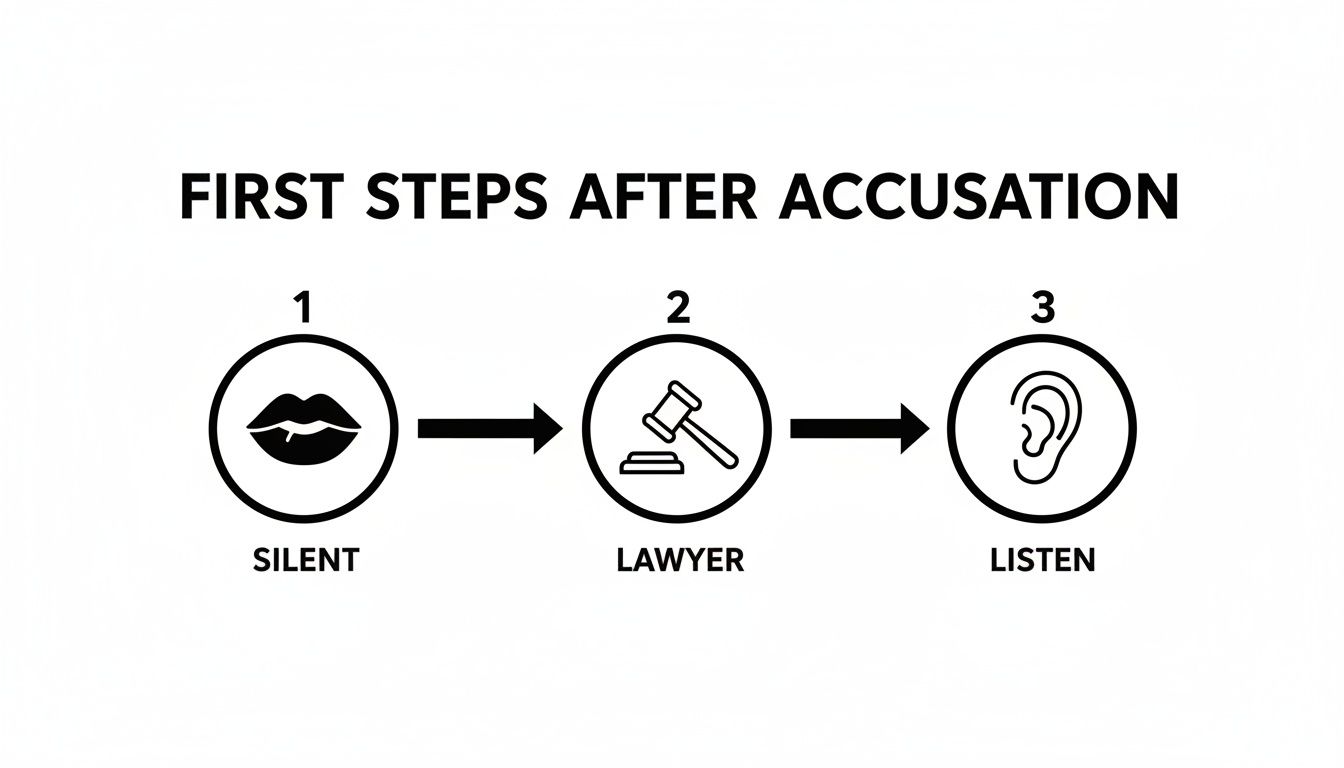
As you can see, the most powerful shield you have is what you do in those first few moments: remain silent and call an attorney. Our team is ready to step in and take over from that critical point.
You are more than a case number to us. We see the person behind the charge—the parent, the employee, the community member—and we fight to protect the life you’ve built.
We firmly believe that one mistake shouldn't get to define the rest of your life. We will stand with you as your trusted guides, offering compassionate and confident legal counsel through every single step of this journey.
If you’ve been charged with a crime in Texas, call The Law Office of Bryan Fagan, PLLC for a free and confidential consultation at https://texascriminallawyer.net. Our defense team is ready to protect your rights.