Being arrested in Texas can feel like your life just split into two timelines. In one, you fight the case and hope the jury sees it your way. In the other, you take a deal and try to move on. If you're asking whether you should take a plea deal in a Texas criminal case, you're asking the right question.
You're also not dealing with some rare courtroom twist. Plea bargaining is how most criminal cases end. A Vera Institute review found that about 97% of convictions in large urban state courts and 90% of federal convictions were obtained through guilty pleas, with more than 90% of those guilty pleas resulting from plea bargaining, according to the Vera Institute review of plea bargaining. That matters because a plea offer isn't a side issue. It's often the central decision in the case.
The hard part is that a plea deal is never just about today's stress. It can affect your work, your housing, your immigration status, your gun rights, and whether you can clear your record later. For many people, the question isn't only “Can I avoid jail?” It's “What choice gives me the best chance to rebuild my life?”
An Introduction to Plea Bargaining in Texas
When police arrest you for DWI, assault, theft, drug possession, or another offense, the process starts moving fast. You may go through booking, bail, first appearance, and then repeated court settings while the prosecutor reviews the file. Somewhere in that process, a plea offer may appear early, or it may come later after motions, evidence review, and negotiation.
A plea bargain is common in Texas criminal courts because it helps move cases without trial. That doesn't mean you should accept the first offer put in front of you. It means you need to understand what the offer does, what rights it gives up, and what it leaves behind on your record.
If you want a fuller walk-through of the process, this guide on how plea bargains work in Texas criminal cases step by step explains the sequence in more detail.
What usually happens after an arrest
Your case may move through these stages:
Arrest and booking
Police take you into custody, collect identifying information, and list the charge.Bail and release conditions
A judge may set bond and may impose conditions such as no-contact orders, drug testing, ignition interlock, or travel limits.Arraignment or first court setting
You appear in court, learn the accusation, and the case is set for future hearings.Negotiation, motions, or trial preparation
Your lawyer reviews reports, videos, witness statements, and legal issues. Plea discussions usually become serious at this point.
The right plea decision usually comes after careful review, not panic in the hallway outside a courtroom.
What a Texas Plea Bargain Really Means
A plea bargain is a negotiated agreement between you and the State. In plain English, you give up the right to make the prosecutor prove the case at trial, and in return the State offers something. That “something” might be a lower charge, a sentencing recommendation, deferred adjudication, dismissal of other counts, or a combination of those terms.
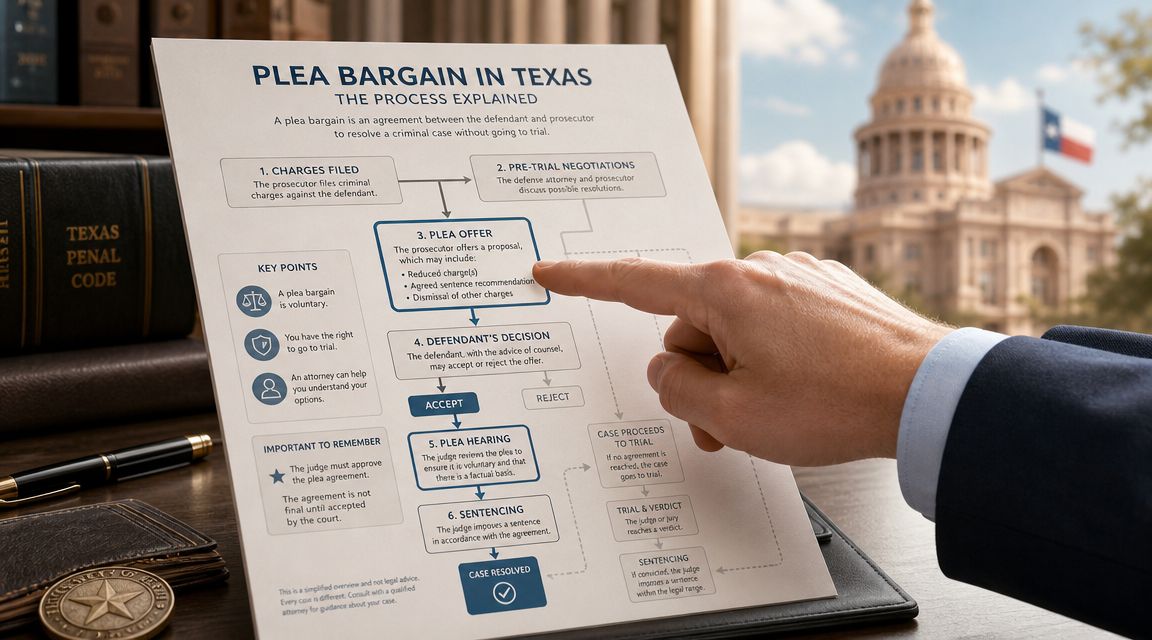
The two main forms of plea bargaining
Most plea bargains fall into two broad categories.
Charge bargaining means the prosecutor agrees to reduce the charge. A felony theft allegation might be reduced to a misdemeanor in the right case. An assault charge may be amended to a less damaging offense if the facts and negotiation support it.
Sentence bargaining means you plead to a charge in exchange for an agreed punishment recommendation. That could involve jail time, probation, deferred adjudication, fines, classes, treatment, or community service.
Sometimes the most valuable part of the deal isn't the fine or jail term. It's the structure of the outcome. A result that avoids a final conviction can protect your future in ways a quick guilty plea can't.
Who decides what
Three people matter most in this process:
| Person | Role in the plea process |
|---|---|
| Prosecutor | Makes or approves the offer on behalf of the State |
| Defense attorney | Reviews evidence, spots legal issues, negotiates terms, and advises you |
| Judge | Decides whether to accept the plea and impose the agreed or lawful sentence |
The judge's role matters more than many people realize. In Texas, a plea doesn't always mean the story is over the moment you say yes in court. If the deal includes conditions such as counseling, reporting, classes, treatment, ignition interlock, or community supervision, your future depends on completing them.
Texas procedure in everyday terms
A few legal basics help make sense of the decision:
- Guilty plea means you admit the offense.
- No contest plea means you don't contest the charge. In criminal court, it usually has a similar immediate effect as a guilty plea.
- Community supervision is what many people call probation.
- Deferred adjudication means the judge delays a finding of guilt while you complete conditions. It can be better than a straight conviction for record purposes, but it still carries risks and limits.
For common offenses, the law behind the charge also matters. A DWI often involves rules under the Texas Penal Code and Transportation Code. Assault allegations often turn on the facts covered by Texas Penal Code Section 22.01. Theft cases commonly involve Texas Penal Code Section 31.03. Drug possession charges are often governed by the Texas Health and Safety Code. The exact statute affects punishment range, defenses, and what a prosecutor may be willing to offer.
Practical rule: Never judge a plea by the label alone. Judge it by the charge, the sentencing terms, and what it does to your record later.
Weighing the Offer The Pros and Cons
The reason plea offers carry so much pressure is simple. A plea can give you certainty, but it also locks in consequences. That's why the question isn't whether pleas are good or bad in the abstract. The question is whether this plea helps more than it hurts.
An economic study found that defendants who accepted plea deals faced an average sentence of 11.1 years, while those convicted after trial faced an average of 18.92 years, a gap of about 70%, according to this economic study on plea bargaining and the trial penalty. That doesn't tell you what will happen in your case, but it explains why plea pressure is real.
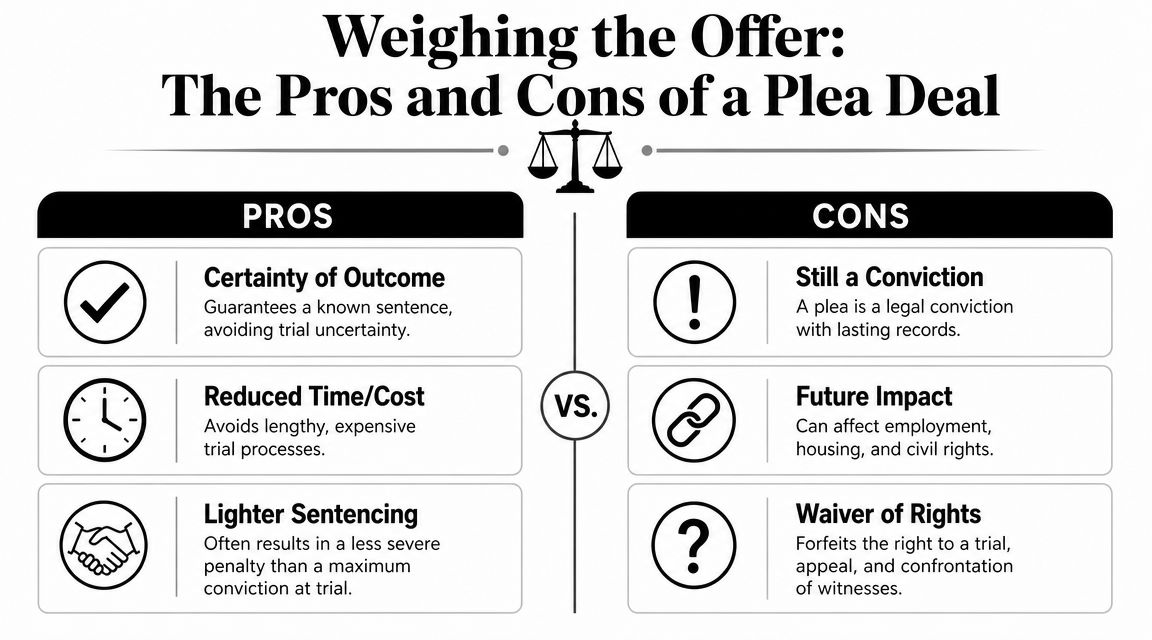
Why people accept plea offers
A plea deal can make sense when the State's evidence is strong, the punishment exposure at trial is severe, or the offer protects something important in your life.
Known outcome
A plea gives you more predictability. You know whether you're facing probation, deferred adjudication, jail, treatment terms, or fines.Reduced exposure
The prosecutor may reduce a charge or recommend a lighter sentence than what you could face after trial.Less disruption
Trials take time. They also bring stress, missed work, family strain, and public testimony.Faster closure
Some clients need to resolve a case so they can stabilize housing, employment, family issues, or immigration planning.
Why people reject plea offers
A plea can also be the wrong move, especially if the State's case has major weaknesses or the long-term damage is worse than the short-term relief.
| Possible benefit of a plea | Possible cost of a plea |
|---|---|
| Quicker case resolution | Criminal record consequences |
| Lower punishment risk | Waiver of trial rights |
| Reduced charge | Loss of leverage to challenge weak evidence |
| More certainty | Conditions that can create future problems |
Rights you give up
When you plead guilty or no contest, you usually give up key constitutional rights, including the right to trial, the right to confront witnesses, and the right to make the State prove guilt beyond a reasonable doubt. In practical terms, that means you stop forcing the prosecutor to bring in officers, lab witnesses, complaining witnesses, and video evidence to withstand scrutiny.
That matters in DWI, assault, and drug cases. A DWI case may depend on a traffic stop, field sobriety tests, body camera video, and a blood or breath result. An assault case may rise or fall on witness credibility, self-defense, or whether the alleged contact was intentional. A possession case may depend on whether police lawfully searched the car, home, or person.
A plea bargain can be smart. It can also be expensive in ways that don't show up on the judgment sheet.
What doesn't work
Two mistakes show up often.
First, people focus only on immediate punishment. They look at “time served” or “probation” and stop there.
Second, people assume that rejecting a plea automatically means a jury trial is next week. Often, there is still time for investigation, motions, suppression issues, negotiation, or alternative resolutions. Good plea decisions come from negotiating power. Negotiating power comes from preparation.
Hidden Costs How a Plea Affects Your Future
The most important part of a plea offer is often the part nobody explains clearly at first. A plea is not only about avoiding jail. It can shape what jobs you can apply for, where you can live, whether a licensing board asks questions, and whether your record can be cleaned up later.

A useful way to think about this is simple. The “best” plea isn't always the one with the lowest immediate punishment. A key factor often underexplored is how a plea affects long-term goals. The better plea may be the one that preserves eligibility for dismissal-based relief or a reduction that avoids a final conviction, which can determine your ability to get an expunction or seal your record later, as discussed in this article on how plea deal costs can affect your future in Texas.
Work, housing, and professional licenses
A conviction can follow you long after probation ends.
Employment
Many employers run background checks. Theft, assault, drug, and DWI-related history can affect hiring decisions.Housing
Landlords may deny applications based on pending charges or convictions, especially if the offense suggests risk to property or safety.Professional licensing
Nurses, teachers, commercial drivers, and other licensed professionals may face board review, reporting duties, or discipline.
A straight conviction and a deferred result don't affect your future the same way. That's why the structure of the plea matters as much as the punishment.
Record clearing in Texas
Texas offers different forms of post-case relief, but they don't apply to every result.
Expunction generally applies in limited situations, such as qualifying dismissals or acquittals. A final conviction usually blocks expunction.
Order of nondisclosure can seal certain records from public view in some circumstances, often after deferred adjudication and waiting periods, but it isn't available for every offense.
At this stage, many plea mistakes occur. A deal that looks easy today may destroy the chance to clear your record later. A slightly harder deal, such as a negotiated resolution that avoids a final conviction, may protect your future better.
Here's a short overview that helps many clients:
| Plea outcome | Record-clearing outlook in general terms |
|---|---|
| Straight conviction | Usually much harder to remove from public view |
| Deferred adjudication | May preserve some later sealing options, depending on the offense and facts |
| Dismissal-based result | May create better expunction opportunities |
Before you plead, ask not only “What do I get today?” Ask “What will this look like on a background check in two years?”
Immigration, firearms, and family consequences
These issues can be severe. Non-citizens should be especially careful because a plea can trigger immigration consequences. Firearm rights can also be affected under state and federal law depending on the offense and outcome. In family violence cases, even a misdemeanor result can create major barriers later.
A criminal case can also overlap with divorce, custody, protective orders, and employment disputes. If your case involves family violence allegations, your plea decision may affect more than criminal court.
This short video gives helpful context on how these decisions can affect your future:
Some plea deals solve a court problem and create a life problem. Your goal is to avoid that trade if possible.
Making Your Decision Key Factors and Scenarios
You are standing in a Texas courtroom hallway. The prosecutor has made an offer. Trial is a few weeks away. You want the stress to stop, but you also need to know what this case will do to your job, your housing options, your family, and your record two years from now.
That is the right frame for this decision.
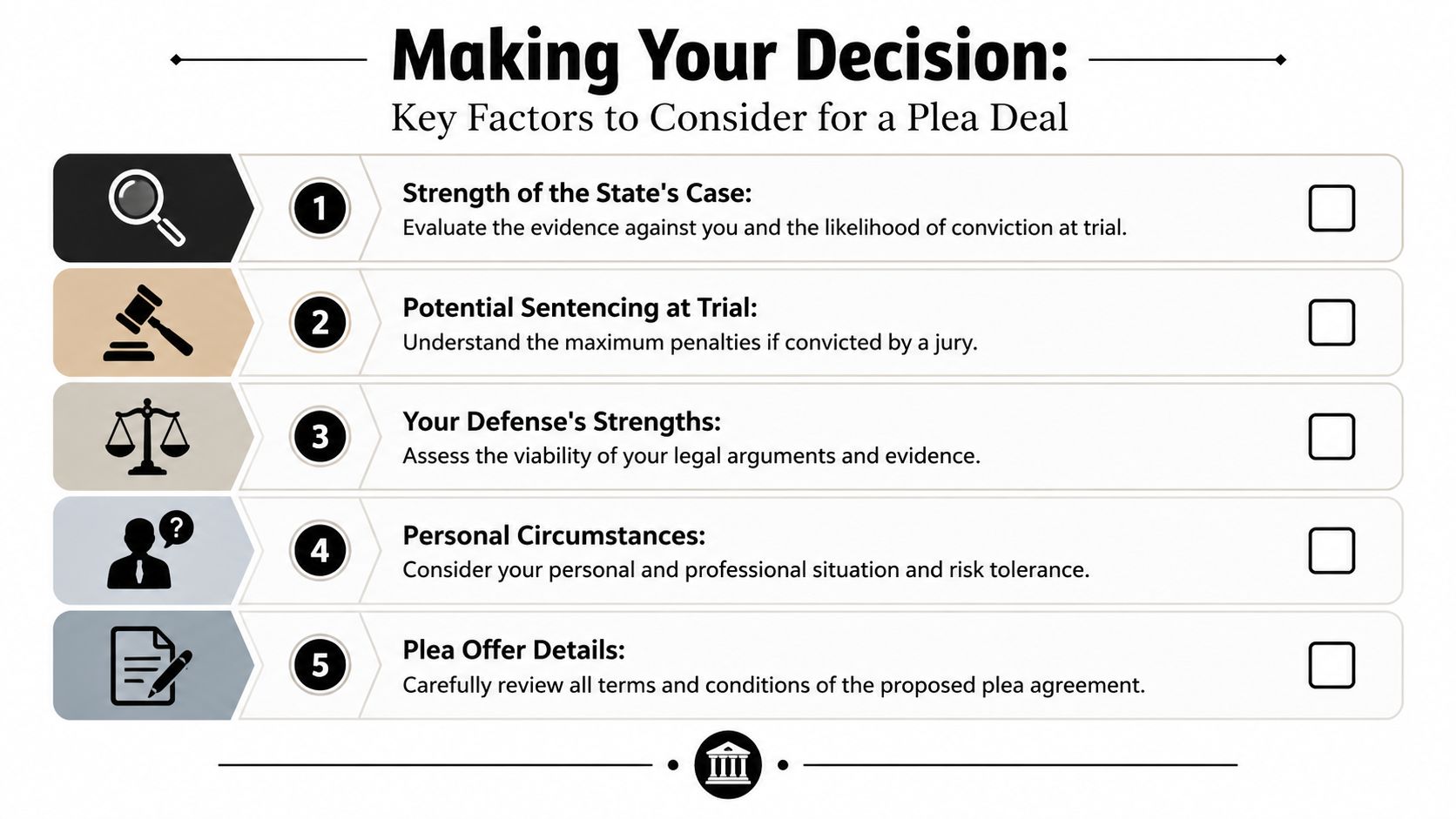
If you're asking should you take a plea deal in a Texas criminal case, use a decision process that weighs court risk and life impact at the same time. A plea can reduce immediate punishment and still create long-term problems. In other cases, accepting the right offer is the smartest way to protect your future.
Five questions that matter most
How strong is the State's case, really?
Look past the charging paper and ask what the prosecutor can prove. Video, statements, lab work, witness problems, search issues, and missing evidence all matter. A weak case should be valued differently from a strong one.What is your downside if you go to trial and lose?
Get the actual punishment range, not a simplified summary. Then compare that risk to the offer on the table. A plea is often about controlling exposure, but the comparison only helps if it is honest.What are you agreeing to, line by line?
A deal is more than a sentence recommendation. Reporting requirements, fees, treatment, classes, no-contact terms, travel restrictions, testing, ignition interlock, and community supervision rules can decide whether an offer is workable in real life.Which future goals need protection?
For many clients, the biggest issue is not jail. It is keeping a professional license, passing a background check, staying eligible for housing, preserving firearm rights, avoiding immigration trouble, or keeping open a path to clear or seal the record later.Is there a better version of this offer?
Many cases are not limited to yes or no. The better move may be asking for fewer conditions, a reduction, more time to complete terms, or an outcome that avoids a final conviction. If that option is on the table, start with a clear explanation of what deferred adjudication means in Texas.
Common Texas case examples
First-time DWI
If the stop appears lawful, the video is damaging, and the testing evidence is likely coming in, a plea may be the safer choice. But the analysis should not stop at probation versus jail. Ask how the result affects your license, your insurance, your work duties, and what future employers will see. If there are real suppression issues, a fast plea can cost you bargaining power.
Misdemeanor assault involving family or household members
These cases deserve slow, careful review. A seemingly light offer can carry consequences that last much longer than the sentence itself, especially for firearms, custody disputes, protective orders, and background checks. The wording of the final judgment matters. So does whether the case ends in a conviction at all.
Felony drug possession
Search and seizure issues often drive the value of the case. So do possession, knowledge, and lab proof. If the evidence is strong, the question becomes how to limit the long-term damage. A negotiated result that avoids a final felony conviction may do more for your future than a small reduction in jail exposure.
A practical way to compare offers
I often tell clients to put the offer on paper before they decide. Anxiety makes every deal sound either safer or worse than it is.
Use a side-by-side worksheet with your lawyer:
Trial risk
List the likely evidence, your strongest defenses, the judge, the county, and the punishment range if convicted.Plea burden
Write down every term of the offer, including the ones buried in the fine print.Life effect
Note what this outcome does to employment, housing, licensing, family matters, finances, immigration concerns, and future record-clearing options.
One option many Texans consider for this analysis is counsel from the Law Office of Bryan Fagan PLLC, which handles Texas criminal defense matters including plea negotiations, trial preparation, expunctions, nondisclosures, and related post-conviction issues.
A sound plea decision protects your position in court and your life after court.
Your Next Steps and Questions for Your Attorney
No article can tell you whether to accept your specific plea offer. That decision depends on the evidence, the court, the prosecutor, your record, your goals, and the exact wording of the agreement. But you should never make the decision blind.
Questions to ask before you say yes
Bring these questions to your lawyer and get direct answers:
What is the State relying on?
Ask about body cam, dash cam, witness issues, lab reports, search legality, and statements.What are my real chances at trial?
You don't need false comfort. You need honest risk assessment.What rights do I waive if I plead?
Make sure you understand what you are giving up.Will this be a conviction?
If not, ask exactly what the legal outcome will be.Can this result be sealed or expunged later?
This question matters in almost every case.What conditions could cause trouble later?
Drug testing, treatment, no-contact terms, reporting rules, and deadlines can all turn a “good” deal into a trap if they don't fit your life.Can we negotiate better terms?
Sometimes the prosecutor won't move. Sometimes they will. You should know whether the current offer is final or just an opening position.
Alternatives to a plea
A plea deal isn't your only option. Depending on the facts, you may decide to:
- Fight the case at trial
- File motions to suppress evidence
- Seek dismissal based on legal defects
- Pursue pretrial diversion where available
- Negotiate deferred adjudication or a reduction instead of a straight conviction
If you've already resolved a case, there may still be ways to improve your future. Some people may qualify for expunction, nondisclosure, or other forms of post-conviction relief. Those options depend heavily on the final result of the case, which is exactly why the plea decision matters so much on the front end.
A calm, informed decision beats a rushed one every time.
If you've been charged with a crime in Texas, call Law Office of Bryan Fagan PLLC for a free and confidential consultation. Our defense team is ready to protect your rights.