Being arrested in Texas can be terrifying. You may be worried about jail, your job, your family, and whether one bad night is about to change everything.
A dramatic trial is typically envisioned when considering a criminal case. In real life, that usually isn't where the biggest decisions happen. The central pressure point is often the plea bargain process, and understanding it can help you make calmer, smarter choices.
Your Guide to the Texas Criminal Justice System
If you're trying to understand how plea bargains work in Texas criminal cases step by step, start with one truth. A plea bargain is not some side route for weak cases. It is where most Texas criminal cases are resolved.
According to the Texas Bar's overview of the criminal justice system, approximately 98% of criminal cases in Texas are resolved with some form of plea bargain.
That number changes how you should think about your case. The main fight is often not “trial or no trial” in the abstract. The main fight is how the evidence looks, what weaknesses exist, what risk a jury trial creates, and whether a negotiated result protects your future better than rolling the dice.
What that means for you
A plea bargain can involve reduced charges, a sentencing recommendation, dropped counts, or another negotiated outcome. It can also involve hard choices that don't feel fair. That's especially true in cases involving DWI, assault, theft, or drug possession, where the facts may look simple on paper but the legal issues are not.
Here's the practical view:
- You still have rights: You don't have to accept the first offer.
- You need facts before decisions: Police reports rarely tell the whole story.
- You need strategy, not panic: Quick decisions often become expensive mistakes.
The system moves fast, but your decision shouldn't
Texas courts process a heavy volume of criminal cases. That means prosecutors often expect movement. But speed helps the system, not always the person charged.
Plea bargaining is often the central place where a defense lawyer protects a client's record, liberty, and leverage.
If you're charged with a misdemeanor or felony, the goal is to understand the path ahead before you commit to it. That includes knowing when to push back, when to negotiate, and when a trial setting provides the advantage you need. For many people, that clarity is the first real relief they've felt since the arrest.
The First Move When Plea Negotiations Begin
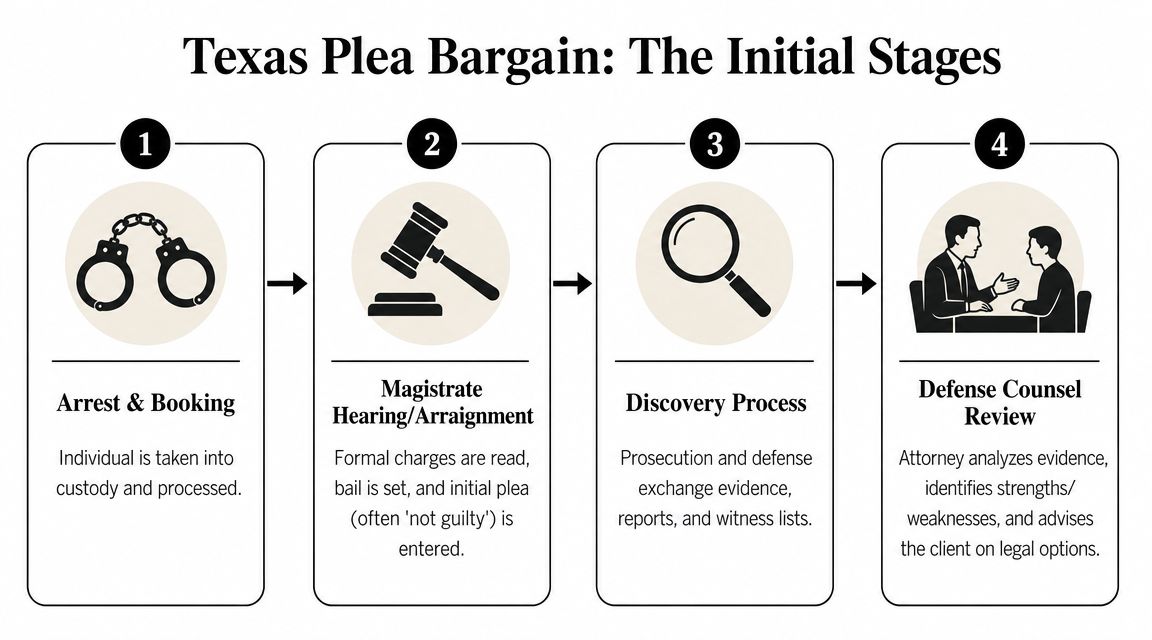
The plea process usually doesn't begin with a polished offer from the prosecutor. It begins with the mess after an arrest. You may have been booked, released on bond, and told to come back to court without anyone clearly explaining what happens next.
That early stage's importance is often underestimated. A rushed mistake there can shape the whole case.
Arrest, first appearance, and the first court dates
After an arrest, the court addresses basic issues first. That usually means the charge, bond conditions, and your next setting. In some cases, especially misdemeanors, plea discussions can begin very early. If you want a clearer picture of that stage, this guide on what to expect at a Texas arraignment hearing helps explain the courtroom side of those first appearances.
The charge itself may come from different parts of Texas law depending on the allegation. A DWI case often involves Texas Penal Code and Transportation Code issues. An assault case may turn on Texas Penal Code Chapter 22. Theft charges usually fall under Texas Penal Code Chapter 31. Drug possession cases often involve the Texas Health and Safety Code. The label on the case is only the start. The key question is what the State can prove.
Discovery is where the case starts to become real
Discovery is the process of reviewing the evidence. That can include police reports, body camera footage, dash camera video, witness statements, lab results, photographs, and sometimes prior statements that don't match.
This isn't dead time. It's the stage where a defense lawyer starts testing the State's case.
A careful review often focuses on questions like these:
- Was the stop lawful? In a DWI or drug case, an illegal stop can change everything.
- Are the witnesses consistent? In an assault case, the story told at the scene may differ from later testimony.
- Can the State prove possession or intent? In a drug or theft case, proximity is not always proof.
- What facts help the defense? Self-defense, mistaken identity, lack of knowledge, or weak identification may strengthen the defense's position.
Practical rule: Don't accept a plea offer before the evidence review is far enough along to tell you what you're really pleading to.
When the first offer shows up
In many cases, the prosecutor makes an initial offer after the charge is filed and the case is moving through court. In misdemeanor cases, that can happen quickly. In felony cases, it often takes more time because both sides need a stronger grasp of the evidence first.
The first offer is rarely the final word. It's often a starting point. Sometimes it's reasonable. Sometimes it's built on assumptions that fall apart once video, records, or witness problems come to light.
A disciplined defense at this stage does three things well:
- It slows the panic: You don't make a permanent decision from a temporary fear.
- It gathers context: Employment, immigration concerns, prior record, licensing issues, and family obligations all matter.
- It strengthens your position: Good negotiation starts with a clear theory of the case.
The Art of the Deal Negotiating Your Plea Agreement
You are sitting outside the courtroom. The prosecutor has made an offer. Your family wants this over with. You want your life back. That is usually the moment people assume plea bargaining is just about taking the least painful option.
It is not.
A plea negotiation is a series of strategic choices. The defense has to decide what to press, what to document, what to concede, and what to refuse. The prosecutor is making the same kind of calculation from the State's side. Good results usually come from clear judgment, not panic.
As noted earlier, Texas plea bargains usually move through negotiation, written terms, court review, and a final plea hearing. What matters here is the middle stage. During this stage, the case can change shape.
What actually gives a defense negotiating power
A prosecutor does not offer better terms out of sympathy alone. The State responds to risk, proof problems, witness issues, legal challenges, and practical facts about the person charged.
That means the defense has to build a case for a better outcome.
In a DWI case, that may involve the reason for the stop, the officer's instructions on field sobriety tests, body camera footage, or a gap between the report and the video. In a theft case, it may involve disputed value, unclear intent, ownership problems, or weak identification. In an assault case, it may involve self-defense, mutual combat, missing injury evidence, or a complaining witness whose account has changed.
Mitigation matters too. Treatment, counseling, restitution, steady work, military history, family responsibilities, and compliance on bond can affect the offer. Those facts do not erase a weak case for the defense or a strong case for the State. They do affect how a prosecutor values resolution.
Counteroffers are part of the process
Many clients think a plea offer is a yes-or-no decision. Often it is the start of a back-and-forth.
A counteroffer might ask for:
- A reduced charge: to limit long-term damage from the original accusation
- A different punishment structure: such as probation, treatment conditions, or time served instead of jail
- Deferred adjudication: if it is legally available and fits the client's goals
- Dismissal of weaker counts or allegations: when part of the case is overcharged or hard to prove
The best counteroffers are specific. They tie the request to facts, legal weaknesses, and real-world concerns. They also account for collateral consequences. A deal that looks fine on paper may be a bad deal if it harms immigration status, a professional license, gun rights, housing, or future employment. For a closer look at those trade-offs, see these pros and cons in plea bargaining.
Why timing changes the value of an offer
Timing matters more than people expect.
An early offer can be attractive because it promises quick relief. Sometimes that is the right call. Sometimes it is a mistake because the key evidence has not been reviewed yet, the witness statements have not been tested, or the prosecutor has not seen the problems in the case.
I often tell clients that waiting is not the same as stalling. Waiting can be a strategy. If the body cam undercuts the report, if treatment has started, if restitution is being made, or if a witness becomes less certain, the terms of the negotiation may improve.
The opposite is also true. Delay can hurt if a client misses court, violates bond, picks up a new case, or ignores conditions the prosecutor expected them to complete.
Real examples of how negotiations shift
A misdemeanor DWI may look strong from the police report. Then the video shows the driver was steady, responsive, and tested on poor ground with confusing instructions. That does not force a dismissal, but it can support a better resolution.
A shoplifting case may seem simple at filing. Then the store video is unclear, the value is questionable, and the accused has evidence of confusion or an intent to pay. That may change the charge, the punishment recommendation, or both.
An assault case can shift in a different way. The State may begin with confidence, then face inconsistent witness accounts, no visible injury, or facts suggesting self-defense. In that setting, the defense has to decide whether to push for dismissal, ask for a lesser offense, or seek terms that avoid a final conviction.
Later in the process, you may want to hear a broader explanation of the moving parts. This video gives a useful overview before any final decision:
Why even an innocent person may consider a plea
Clients ask this question discreetly, sometimes with shame attached to it. The answer is hard, but honest.
A person can maintain innocence and still weigh a plea because trials carry risk. Witnesses can be believed when they should not be. Jurors can react badly to a defendant's past, attitude, or appearance. A weak case is not the same as a safe case. If the offer avoids jail, protects a job, or reduces the chance of a felony conviction, some innocent people consider it because they are choosing between bad options, not because they are admitting the State is right.
That decision should never be rushed. It should be made with a clear view of the evidence, the likely trial exposure, and the long-term consequences of the plea itself.
What usually helps and what usually hurts
| Approach | Usually helps | Usually hurts |
|---|---|---|
| Evidence review | Identifying legal issues, contradictions, and missing proof | Guessing about facts before discovery is reviewed |
| Client preparation | Treatment, restitution, classes, and strict bond compliance | New arrests, missed settings, and bond violations |
| Negotiation strategy | Clear counteroffers tied to facts and consequences | Demands with no factual or legal support |
| Timing | Waiting until key facts are known | Accepting terms just to stop the stress |
One option Texans use for case guidance at this stage is Law Office of Bryan Fagan PLLC, which handles criminal defense matters including DWI, assault, theft, drug charges, and post-case record relief.
Understanding Your Options and Making the Choice
You get an offer that sounds decent at first glance. Maybe it keeps you out of jail. Maybe it cuts a felony to a misdemeanor. Then serious questions begin. Will this leave you with a conviction? Can you keep your job license? What happens if you miss one probation condition six months from now? That is the stage where a plea decision becomes a strategy decision, not just a legal one.
I tell clients to stop asking only, “Can I live with this sentence?” Ask, “What does this plea do to my life, my record, and my risk if anything goes wrong?”
The options that usually matter most in Texas
In practice, plea offers usually turn on a few choices that carry very different consequences.
- Charge bargain: You plead to a less serious offense than the filed charge.
- Sentence bargain: The focus is punishment, such as jail time, probation, or a capped recommendation.
- Straight probation: A conviction is entered, but the sentence is suspended while you serve community supervision.
- Deferred adjudication: The judge defers a finding of guilt and places you on community supervision instead.
Those labels matter because they affect what shows up on your record, what can happen if you violate conditions, and what options may exist later for record relief.
Deferred adjudication and straight probation are not interchangeable
Clients often hear “probation” and assume both outcomes are basically the same. They are not.
| Factor | Deferred Adjudication | Straight Probation |
|---|---|---|
| Conviction status | No final conviction if successfully completed | A conviction is entered at the time of plea |
| Court supervision | Yes | Yes |
| Risk if violated | The court can adjudicate guilt and sentence within the legal range | The court can revoke and impose the suspended sentence |
| Record consequences | Sometimes leaves better cleanup options later, depending on the offense | Usually creates fewer record-clearing options because it is a conviction |
| Practical impact | Still shows up in many background and licensing contexts | Usually carries the direct effects of a conviction |
That distinction drives a lot of plea decisions. A client trying to protect a commercial license, immigration position, or future sealing options may accept tougher supervision terms if deferred adjudication avoids a final conviction. A different client may reject deferred if the conditions are unrealistic and the risk of a violation is high. A close look at the pros and cons of plea bargaining in Texas cases can help frame that comparison.
The best offer is the one that manages the full risk. Paper terms alone do not answer that question.
Why the “best” offer on paper may still be the wrong deal
A plea can look favorable in open court and still create problems that matter more than a short jail term. Some deals come with reporting requirements, travel limits, treatment, interlock, no-contact orders, classes, curfews, firearm restrictions, or fees that a person cannot manage.
That matters because an unworkable plea is dangerous. If the conditions do not fit your life, your job schedule, your childcare situation, your sobriety history, or your transportation limits, the risk of a violation goes up. A deal that looks lenient can become harsher than trial exposure if it sets you up to fail.
This is why I push clients to evaluate the offer in practical terms:
- Can you complete every condition?
- Does this create a conviction or avoid one?
- What sentence range comes back into play if you violate?
- Will this affect immigration, licensing, housing, firearms, or custody issues?
- Are you accepting this because it is wise, or because you are exhausted and want the case over?
That last question deserves an honest answer.
Why an innocent person might still consider a plea
This is one of the hardest conversations in criminal defense, and it deserves a direct answer.
An innocent person may still consider a plea because trial risk is real. Witnesses get believed when they should not. Juries can react to bad facts that have nothing to do with guilt. Judges make rulings that shape what the jury hears. A weak case can still end in a conviction, and the penalty after trial may be far worse than the offer.
That does not mean an innocent person should plead guilty. It means the decision is sometimes a choice between two serious risks. The question is not whether that feels fair. It often does not. The question is whether the plea reduces danger enough to justify the long-term cost.
How to make the call
By this point, the decision should come down to a side-by-side comparison of real outcomes, not hope, fear, or pressure from anyone in the hallway.
Set the offer next to the likely trial range. Compare the immigration and licensing impact. Compare the record consequences. Compare the day-to-day demands of supervision against your actual life. Then decide from a position of information.
No lawyer can make that choice for you. A good lawyer can explain where the traps are, where the advantage lies, and what each path is likely to cost.
The Judge's Role and Finalizing the Plea
You and your lawyer have worked through the offer, weighed the risks, and decided to take the deal. Then you stand in court and learn one more person matters. The judge.
That surprises a lot of people. A plea agreement is negotiated between the defense and the prosecutor, but it does not become final until the court accepts it. In practice, that means the hearing is not a formality. It is the point where strategy turns into a binding result, or falls apart and sends everyone back to reassess.
The paperwork and the plea hearing
Before you ever answer the judge, you will usually review and sign plea papers. Those documents matter more than many defendants realize. They spell out the charge, the bargain, the rights you are giving up, and the court's written warnings. I tell clients to slow down here. If a term is unclear on paper, it will not get clearer after the plea is entered.
In court, the judge will usually make sure you understand:
- What charge you are pleading to
- What rights you are giving up, including the right to trial
- What punishment range or agreed recommendation applies
- Whether anyone forced you, threatened you, or promised something outside the written deal
- Whether you are entering the plea voluntarily
Those questions are not small talk. The judge is creating a record. If a problem shows up later, the court will look back at what was said in that hearing and what you signed.
If deferred adjudication is part of the agreement, understand exactly what that means before the hearing starts. A plea that avoids a conviction today can still create serious consequences if supervision is violated later. This overview of what deferred adjudication means in Texas can help you frame the right questions before you walk into court.
Guilty and no contest require a strategic choice
In many Texas cases, a guilty plea and a no contest plea lead to the same criminal judgment. That does not mean the choice is meaningless.
A guilty plea is a direct admission. A no contest plea means you are not fighting the charge in that criminal case. Sometimes that distinction matters outside the courtroom, especially where civil exposure, licensing issues, or other collateral consequences are in play. Sometimes it changes very little. The right call depends on the full picture, not just the words spoken in court.
The larger point is simple. Do not treat the plea hearing like a script you just have to get through. Every box checked and every answer given should match the strategy you and your lawyer chose for a reason.
The prosecutor can recommend a result. The judge decides whether to accept it.
If the judge does not approve the deal
Judges do reject plea agreements. It is not common in every courtroom, but it happens.
When that happens, the case does not automatically end on the judge's terms. In many situations, the defendant can withdraw the plea and decide what to do next. That matters because the plea process still involves risk management at the last stage. If the court will not accept the agreement, the defense has to quickly decide whether to renegotiate, change the structure of the deal, or prepare for trial.
This is also one reason good plea advice is never just “take it” or “turn it down.” A sound recommendation accounts for the courtroom, the judge, the paperwork, and the chance that the final hearing may not go exactly as planned.
By the time you leave court, the goal is clarity. You should know what the judge accepted, what conditions now apply, and what mistakes could put the deal in danger.
After the Deal Rebuilding and Moving Forward
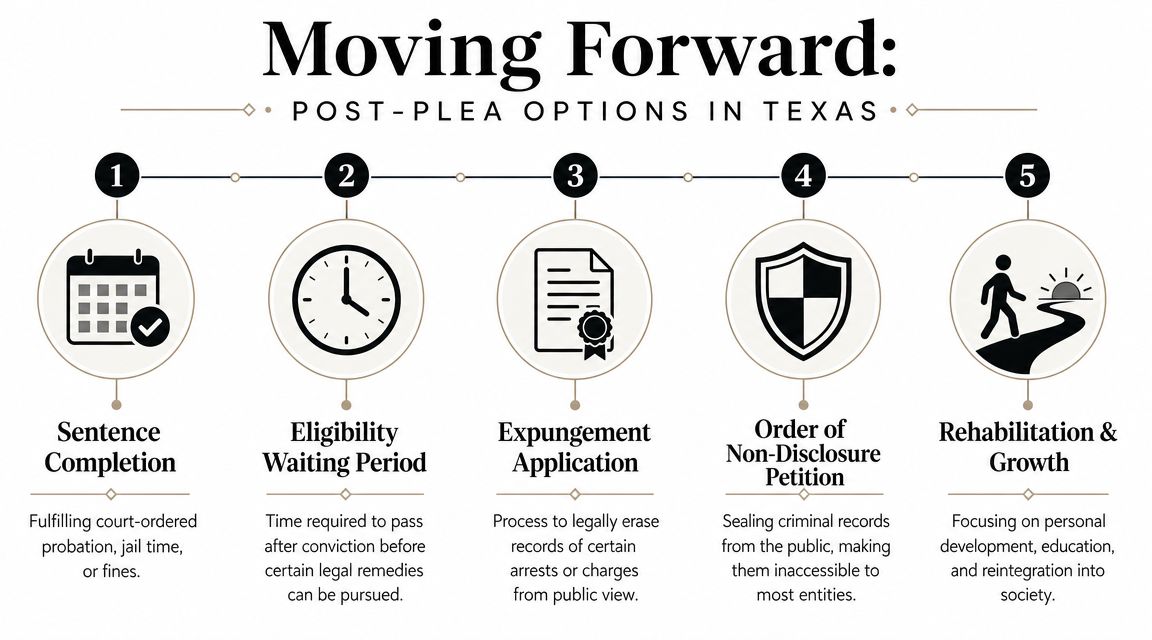
The case may end in court, but the consequences continue after the hearing. What you do next matters.
Some people need to focus on probation terms and staying compliant. Others need to plan for employment screening, licensing questions, or immigration review. In many cases, the best long-term strategy starts the day the plea is entered.
Finish strong if you're on supervision
If your sentence includes probation or deferred adjudication, treat every condition seriously. Missed reporting, failed tests, unpaid fees, new arrests, or ignored classes can turn a manageable result into a much harder one.
That usually means:
- Track deadlines carefully: Court dates, classes, fees, and reporting requirements need a calendar.
- Keep proof of compliance: Save receipts, certificates, testing records, and communication logs.
- Ask before you assume: Travel, job changes, and address changes may require approval.
- Fix problems early: If something goes wrong, address it before it becomes a violation.
Record clearing and record sealing are different tools
Many people use the word “expungement” for every kind of cleanup, but Texas law uses different remedies.
An expunction is generally used for certain arrests or charges that qualify to be erased from public view, often in situations involving dismissal or other qualifying outcomes. An Order of Nondisclosure is different. It seals eligible criminal history from the public in certain situations, commonly after successful completion of deferred adjudication, though access may still remain for some government entities.
The hidden consequences people miss
The courtroom sentence is only part of the picture. A plea can affect:
| Area of life | Why it matters |
|---|---|
| Employment | Background checks may show the case or disposition |
| Immigration | Certain pleas can create serious immigration issues |
| Professional licensing | Boards may require disclosure or take action |
| Firearm rights | Some outcomes can limit possession rights |
| Future criminal cases | A prior plea may increase exposure later |
A rehabilitation-focused strategy looks beyond the immediate deal. It asks what can be sealed later, what needs to be disclosed now, and how to avoid a probation problem that puts you back in court.
If you've been charged with a crime in Texas, waiting and hoping rarely helps. A clear defense plan does. It gives you a way to respond to the charge, evaluate plea options, and protect your future with open eyes.
If you've been charged with a crime in Texas, call Law Office of Bryan Fagan PLLC for a free and confidential consultation. Our defense team is ready to protect your rights.