Being arrested and accused of stalking in Texas can be a terrifying and disorienting experience. A stalking charge is a third-degree felony from the start, even for a first offense. This means you could be facing serious prison time, crippling fines, and a permanent criminal record that can turn your life upside down. But remember, an accusation is not a conviction, and you don’t have to face this alone. You have rights, and understanding them is the first step toward building a strong defense.
An Overview of Stalking Charges in Texas
Facing a stalking allegation can leave you feeling completely isolated and unsure of where to turn. The legal process is a maze, and the stakes couldn't be higher—your freedom, your reputation, and your entire future are on the line. It's natural to feel overwhelmed, but an experienced legal team can guide you through it.
This guide is here to give you clear, straightforward information about stalking laws in Texas and help you understand the path forward. Our goal is to cut through the legal jargon and empower you with the knowledge you need. We'll break down exactly what prosecutors must prove to get a conviction under Texas Penal Code § 42.072 and explain the severe penalties involved.
What You Will Learn
Throughout this guide, we'll cover the essentials to help you grasp your situation and start building a strong defense. You will learn about:
- The specific legal definition of stalking and how it’s different from simple harassment.
- The potential penalties, including felony convictions, prison time, and fines up to $10,000.
- How civil protective orders can complicate a criminal stalking case.
- Proven legal strategies used to defend against these serious allegations.
- Your options for clearing your record after a case is resolved.
A stalking charge often involves a series of actions that, when viewed one by one, might seem harmless. But when the prosecution weaves them together into a story of fear and intimidation, they become the foundation for a felony case. Understanding how that story is built is the first step in taking it apart.
Knowing your rights is the first and most critical step in protecting your future. While this guide provides the foundational knowledge you need, remember that every case is unique. A strategic, personalized defense is absolutely essential to navigate these complex charges and fight for the best possible outcome.
What Legally Constitutes Stalking in Texas
To build a strong defense against a stalking charge, you first have to understand what a Texas prosecutor needs to prove to get a conviction. The legal definition is much stricter than the everyday idea of "stalking." It's a specific felony offense laid out with very clear elements under the law.
The entire case boils down to two key components defined in Texas Penal Code § 42.072. First, the prosecutor must show you engaged in a pattern of conduct. Second, they have to prove your actions were meant to make another person feel genuinely threatened.
The Two Pillars of a Stalking Charge
Think of the prosecution's case like a bridge. It needs two strong pillars to stand up in court. If your defense attorney can knock down just one of them, the whole case collapses.
- A Pattern of Conduct: This isn't about a single, isolated incident. The law requires the state to show two or more actions directed at a specific person. Individually, these acts might seem minor or even perfectly legal—things like driving down a street, sending a message, or leaving a gift. But when viewed together, the prosecution will argue they form a threatening pattern.
- Specific Intent and Fear: This is where most cases are won or lost. The prosecutor must prove beyond a reasonable doubt that you knew—or reasonably should have known—that your actions would cause the other person to fear for their safety or the safety of their family. This includes the fear of bodily injury, death, or that an offense will be committed against their property.
It's the combination of repeated actions and the resulting fear that elevates the behavior from merely annoying to a felony. A deep understanding of the exact wording in Texas's stalking laws is crucial, and this often involves the principles of statutory interpretation.
This concept map breaks down the key components of stalking laws in Texas, from the legal definition to potential defenses.
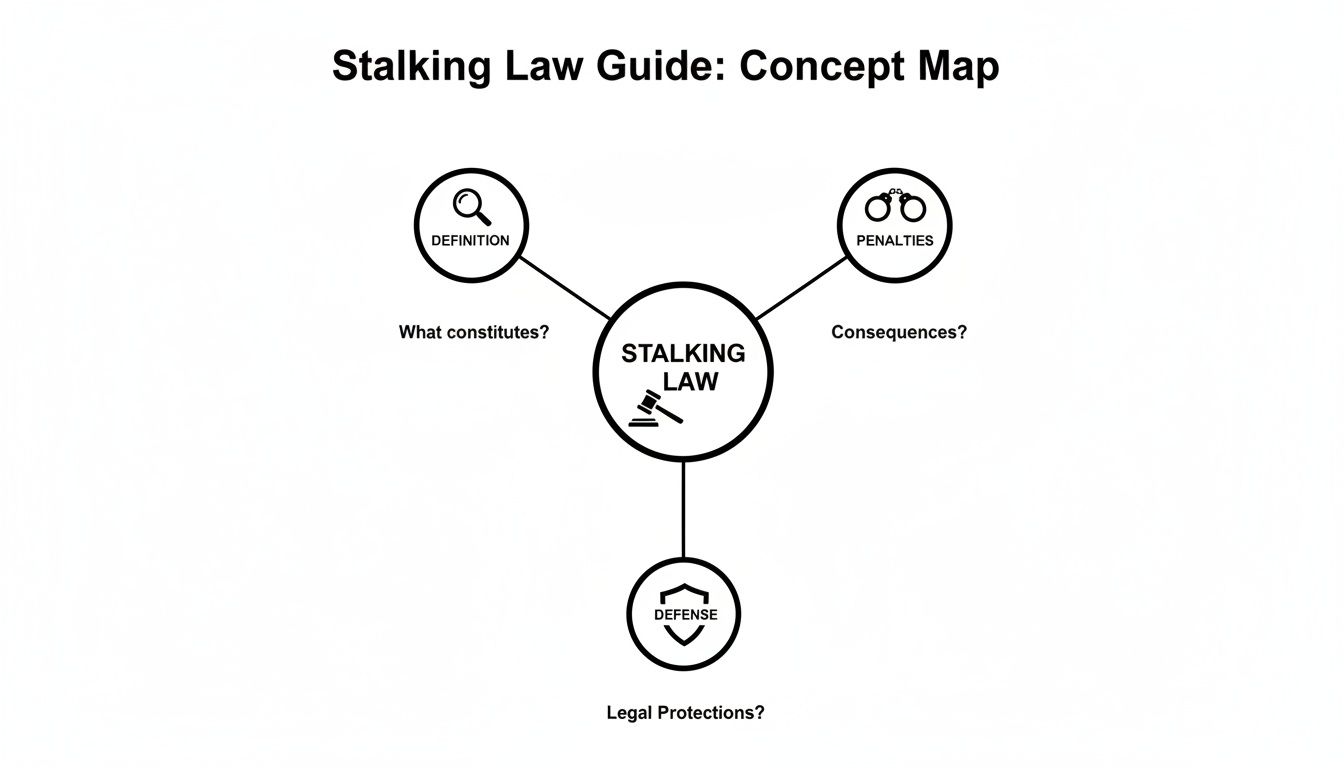
As you can see, a solid defense often focuses on taking apart the prosecution's arguments on what defines the crime or proving you never had the required intent.
Stalking vs. Harassment: A Critical Distinction
People often mix up stalking and harassment, but in the eyes of the law, they are worlds apart. The difference comes down to the level of threat involved, which in turn dictates the severity of the penalties. Understanding this distinction is vital to your defense.
The following table highlights the key differences between these two charges in Texas.
Stalking vs Harassment: A Comparison of Texas Charges
| Legal Element | Stalking (Felony) | Harassment (Misdemeanor) |
|---|---|---|
| Primary Intent | To place a person in fear of bodily injury, death, or property damage. | To annoy, alarm, torment, abuse, or embarrass another person. |
| Level of Threat | Requires a credible threat that causes reasonable fear for safety. | Does not require proof of fear for one's safety. Annoyance is enough. |
| Pattern of Conduct | Requires two or more specific acts directed at one person. | Can be based on a single communication or a series of acts. |
| Criminal Classification | Third-Degree Felony | Class B Misdemeanor (can be elevated in certain cases). |
| Common Behaviors | Following someone, showing up at their home/work, surveillance, sending threatening messages. | Repeated unwanted phone calls, obscene messages, annoying electronic communications. |
| Potential Jail Time | 2 to 10 years in state prison. | Up to 180 days in county jail. |
The line between misdemeanor harassment and felony stalking is the presence of fear. A prosecutor's entire case rests on their ability to convince a jury that your actions weren't just annoying, but genuinely terrifying to the alleged victim.
Because the penalties are so drastically different, a primary goal for your defense attorney will be to challenge the evidence of fear. If that evidence is weak, it may be possible to argue for the charge to be reduced from a life-altering felony to a more manageable misdemeanor. That shift can completely change the outcome of your case and its impact on your future.
The Escalating Penalties for a Stalking Conviction

A stalking charge in Texas is not something you can afford to take lightly. The consequences are severe, designed by the state to punish and deter, and a conviction can permanently reshape your future. Grasping the high stakes involved is the first step toward understanding just how critical a strong legal defense is.
In Texas, stalking is classified as a felony from day one. There is no misdemeanor warning shot or lesser charge for a first-time offense. The state takes these allegations extremely seriously, and the penalties reflect that unwavering stance.
Penalties for a First Offense
If you are convicted of stalking for the first time, you are facing a third-degree felony. This is a significant charge that carries life-altering consequences far beyond what most people expect.
The potential penalties for a third-degree felony stalking conviction include:
- Prison Time: A sentence of 2 to 10 years in a Texas state prison.
- Fines: A fine of up to $10,000.
- Permanent Criminal Record: A felony conviction on your record, making it difficult to find housing, secure a job, own a firearm, or obtain professional licenses.
These aren't just numbers on a page; they represent a real and immediate threat to your freedom and livelihood. A conviction can follow you for the rest of your life, closing doors and limiting opportunities long after any sentence is served.
When Penalties Get Even Harsher
The legal jeopardy increases dramatically if you have a prior stalking conviction. Texas law enhances the charges for repeat offenses, underscoring the state's zero-tolerance approach to this particular crime.
A second or subsequent stalking conviction is enhanced to a second-degree felony. This significantly raises the stakes, with potential penalties that include:
- Prison Time: A prison sentence ranging from 2 to 20 years.
- Fines: A fine of up to $10,000.
This escalation means a second conviction could potentially double your maximum prison exposure. The law is structured to ensure that repeated patterns of this behavior are met with increasingly severe consequences, making a robust defense for any stalking charge absolutely essential.
How Recent Law Changes Impact Your Case
The legal landscape surrounding stalking laws in Texas is not static; in fact, it has become progressively stricter over the years. The Texas Legislature has actively worked to close legal loopholes and expand protections for alleged victims, which in turn has created a more challenging environment for anyone accused of this crime.
Texas stalking laws, which grew out of national efforts in the early 1990s, have been refined over decades. A pivotal update in 2023 broadened the scope of what constitutes a threat to include threats against an alleged victim's family, household, or dating partner. The law also expanded the required emotional impact from mere annoyance to include feeling "terrified or intimidated." More recently, a 2025 change will make stalking ineligible for judge-ordered probation for offenses occurring after September 1, 2025, further limiting judicial discretion and pushing cases toward harsher outcomes unless a jury recommends otherwise. You can discover more about the evolution of these statutes and their penalties.
These updates have real-world implications. For instance, new bond conditions now make it a separate felony to monitor or track an alleged victim, turning what might have once been a simple bond violation into a brand-new criminal charge. It is crucial that your defense attorney isn't just familiar with the stalking statute but is completely current on these recent, critical changes that could directly affect your freedom.
How Protective Orders Overlap with Stalking Charges
When you're accused of stalking in Texas, the criminal charge is often just one front in a much larger legal battle. It’s incredibly common for the person accusing you to also file for a civil protective order. This can throw you into a confusing and high-stress situation, forcing you to fight battles in two different courtrooms—criminal and civil—at the same time.
So, what exactly is a protective order? Think of it as a legal barrier. It’s a civil court order, signed by a judge, designed to stop any future acts of family violence, harassment, or stalking. Understanding these orders is critical, because one wrong move—one simple mistake—can land you in even more legal trouble.
What a Protective Order Prohibits
While the exact terms of an order can be tailored to a specific case, most Texas protective orders share a few standard, non-negotiable rules. If a judge issues one against you, you'll almost certainly be barred from:
- Communicating with the petitioner (the person who requested the order) in any way. This means no texts, no phone calls, no emails, no social media messages, and definitely no sending messages through friends or family.
- Going near the petitioner's home, job, or their children's school or daycare. The order will spell out a specific distance you must maintain, often several hundred yards.
- Possessing a firearm for the entire time the order is active, which can be up to two years.
Violating any of these rules is a serious criminal offense. You can get a deeper understanding of the details in our guide on what a protective order is in Texas.
The Danger of Violating a Protective Order
This is the most important takeaway: violating a protective order is a brand-new crime. This isn't just a slap on the wrist. If you're accused of breaking the order—even for something as seemingly minor as sending a single text message—you can be arrested on the spot.
That new charge is a Class A Misdemeanor, which carries its own penalties of up to one year in jail and a $4,000 fine. But the damage doesn't stop there. This new arrest can seriously harm your defense in the original stalking case. A prosecutor will hold it up as proof that you're a continuing threat who can't follow a judge's direct order, making it exponentially harder to achieve a positive outcome.
If you are served with a Temporary Ex Parte Order, the clock starts ticking. You have a very short window before a final hearing where a judge will decide whether to issue a permanent order. Attending this hearing without an experienced attorney is a massive risk that can hamstring your entire defense strategy.
For someone feeling threatened, knowing how to get a Temporary Restraining Order in Texas is often the first move they make, which makes it essential for you to get legal help immediately. The criminal stalking case and the civil protective order are deeply connected, and you need a unified defense strategy that tackles both at once.
Crafting a Defense Against Stalking Allegations

Being accused of stalking can make you feel like the world is against you. But remember, an accusation is not a conviction. The prosecution carries the heavy burden of proving every single element of their case beyond a reasonable doubt, and that’s a very high bar to clear.
A strong, evidence-based defense starts by digging into the facts and challenging the state’s narrative at every turn. This isn’t just about what the accuser says happened; it's about what can actually be proven in a courtroom. The best defense is a proactive one—it's your most powerful tool for protecting your freedom and your future.
Questioning the Prosecution's Evidence
At its core, the state’s case for stalking hinges on two things: proving a "pattern of conduct" and proving you had the specific intent to make someone feel threatened. A solid defense will often focus on dismantling one or both of these pillars. Your attorney’s job is to meticulously pick apart the evidence to find the weak spots.
Common ways to challenge the state's case include:
- Lack of Intent: Can the prosecutor really prove you intended to cause fear? Many actions get misinterpreted. For example, driving through a neighborhood or sending a series of messages might have a perfectly innocent explanation that undermines any claim of criminal intent.
- Insufficient Pattern of Conduct: The law is clear—it requires two or more specific acts. If your lawyer can show the alleged actions were just isolated incidents or don't add up to a credible, ongoing pattern, the charge may not stick.
- Unreasonable Fear: It's not enough for the alleged victim to say they were afraid. Their fear must be reasonable given the circumstances. If the conduct wouldn't cause an average person to genuinely fear for their safety, this can be a huge point in your defense.
A messy breakup is a classic example where emotions run high. What one person sees as a desperate, last-ditch attempt to talk and reconcile, the other might interpret as a threat. An experienced lawyer can provide the crucial context to show that your actions, while maybe unwanted, never rose to the level of felony stalking.
Exposing False or Misleading Accusations
Sadly, not all stalking allegations are made in good faith. In high-conflict situations like a divorce or a child custody battle, it's not unheard of for one person to use a stalking accusation as a weapon to gain leverage. This is a serious problem that demands a delicate but firm defense.
Your attorney can investigate the accuser's motives and history to see if there's evidence of bias or a reason to fabricate a story. This becomes especially important when an accusation seems to pop up out of nowhere right in the middle of another legal fight. We offer more guidance on these tough situations in our article about how to respond to false accusations.
The Importance of Preserving Evidence
The moment you learn you're under investigation, preserving all evidence is non-negotiable. This means you should not delete a single thing—no matter how bad you think it might look out of context.
Save every communication you have related to the accuser:
- Text messages
- Emails
- Social media messages and comments
- Voicemails
These records can provide the full context of your interactions. They might contain evidence that directly contradicts the accuser's claims, proves consent for communication, or shows a complete lack of criminal intent. Handing all of this over to your attorney allows them to build the strongest possible defense based on the complete picture—not just the carefully selected pieces the prosecution wants a jury to see.
Clearing Your Record After a Stalking Case
When a stalking case is finally over—whether it ends with a dismissal, an acquittal, or you’ve completed deferred adjudication—the fight for your future isn't finished. That criminal charge doesn't just disappear. It leaves a public record that can pop up on background checks for years, creating roadblocks when you're trying to get a job, rent a home, or secure a professional license.
Beating the charge is only half the battle. A complete legal strategy has to include protecting your long-term reputation. In Texas, you have two main tools to do that: an expunction and an order of nondisclosure.
Expunction: Erasing the Record
Think of an expunction as completely erasing the record. If a judge grants your petition for expunction, all official records of your arrest and the charge are literally destroyed. For all legal purposes, it’s like it never happened.
However, this powerful remedy isn’t available to everyone. The eligibility rules are strict. You typically only qualify for an expunction if your case ended in one of these ways:
- You were found not guilty (acquitted) by a judge or jury.
- The prosecutor dismissed the case against you.
- You were granted a pardon.
An expunction is the gold standard for clearing your name. It gives you a true fresh start and allows you to legally deny the arrest ever occurred.
Nondisclosure: Sealing the Record from Public View
What if you don't qualify for an expunction? You might still be eligible for an order of nondisclosure. Instead of destroying the record, this court order seals it from the public. That means private employers, landlords, and anyone else running a standard background check won't see it.
A nondisclosure is the typical route for people who successfully complete a deferred adjudication program. While government agencies and law enforcement can still see the sealed record under certain circumstances, it’s effectively hidden from public view, restoring many of your opportunities. To see a detailed comparison, you can explore our guide on expungement vs. nondisclosure in Texas.
Stalking is a serious felony charge under Texas Penal Code §42.072. It carries a three-year statute of limitations and the penalties are severe—up to 10 years in prison for a first offense. Recent laws have made things even tougher, adding new bond conditions and future restrictions on probation that make having an experienced defense attorney absolutely critical. With stakes this high, planning to clear your record needs to be part of your defense strategy from day one. Navigating the complex rules for expunction and nondisclosure is tricky, and having a lawyer to guide you is the only way to ensure you’re truly protecting your future.
Answering Your Top Questions About Texas Stalking Charges
When you’re facing an allegation as serious as stalking, your mind is probably racing with questions. The legal system can be a maze, and finding clear, straightforward answers is the very first step toward getting your footing back. Let’s tackle some of the most common questions we hear about stalking laws in Texas.
Can I be charged with stalking for sending texts or DMs?
Yes, absolutely. Texas law doesn't care about the technology you use; it cares about the pattern of conduct and the threatening effect it has on someone.
A string of unwanted texts, direct messages, or emails can easily become the foundation for a felony stalking charge. If a prosecutor believes they can show that those messages were sent with the intent to make a person feel reasonably scared or intimidated, you could face serious charges. The context, frequency, and content of those messages will be key pieces of evidence.
What should I do if the police contact me about a stalking accusation?
This is critical: politely but firmly decline to answer any questions. You need to state clearly, "I am exercising my right to remain silent, and I would like to speak with an attorney." It’s your constitutional right, and you should use it without hesitation.
Trying to "explain your side of the story" to law enforcement almost always backfires. Anything you say can be twisted, misinterpreted, and used to build a case against you. Your first and only move should be to call an experienced criminal defense lawyer right away.
Is cyberstalking a separate crime in Texas?
No, it isn't. Texas doesn’t have a specific statute labeled "cyberstalking." Instead, the main stalking law, found in Texas Penal Code § 42.072, was written broadly enough to cover electronic communications.
This means threatening behavior that happens online is treated with the exact same seriousness as physical stalking. The law’s focus is on the threatening pattern of behavior, whether it unfolds in person, over the phone, or on the internet.
Is it possible to get a stalking charge reduced to a less serious offense?
Yes, and this is often a primary goal for a strong defense strategy. A skilled attorney will pick apart the evidence, looking for any weak spots in the prosecutor's case.
If the state has a hard time proving you had the specific intent to make someone afraid, or if the "threat" isn't as credible as they claim, your lawyer can often negotiate a reduction. Getting a felony stalking charge knocked down to a misdemeanor harassment charge is a common goal in plea bargaining and leads to much lighter penalties.
If you’ve been charged with a crime in Texas, call The Law Office of Bryan Fagan, PLLC for a free and confidential consultation. Our defense team is ready to protect your rights. https://texascriminallawyer.net