Being arrested in Texas can feel like the floor dropped out from under you. One call from a police officer, one bond amount you weren’t ready for, one court date on a piece of paper, and suddenly your job, your family life, and your future all feel uncertain.
If you’ve been charged with a state jail felony, take a breath. An arrest isn’t a conviction. You still have rights, you still have options, and the decisions you make early can change the direction of your case in a very real way.
Your Guide to Navigating a Texas State Jail Felony Charge
A lot of people charged with a state jail felony have never been in serious trouble before. They may have been accused of theft after a bad decision at work, arrested for a drug possession case during a traffic stop, or charged after a stressful family situation turned into something larger than they expected. What they usually have in common is fear.
They’re worried about jail. They’re worried about losing a job. They’re worried about what a felony does to their name.

A state jail felony sits in a strange place in Texas law. It’s the lowest level of felony, but it still carries serious consequences. That means you can’t afford to treat it like a minor charge, even if someone tells you it’s “not that bad.” At the same time, it’s also a category where smart defense work can matter a great deal.
What most people need to hear first
When you’re charged, the system starts moving fast. Police reports are written. bond conditions get set. prosecutors begin evaluating the file. If you wait too long to respond, you can lose an advantage that might have helped you early.
The first goals are usually practical:
- Protect your release: If you’re still in jail, bond and bond conditions matter immediately.
- Protect the evidence: Video, witness memories, receipts, phone data, and location records can disappear.
- Protect your record if possible: In some cases, the best result isn’t just avoiding jail. It’s avoiding a lasting felony record.
- Protect your future decisions: A rushed plea can create problems long after the court case ends.
The label on the charge matters, but the facts of your case matter more. Two state jail felony cases can look similar on paper and lead to very different outcomes.
Why this guide matters
You deserve a plain-English explanation of what you’re facing. You also deserve honesty about the trade-offs. Sometimes the right move is to push hard on a legal issue. Sometimes it’s to negotiate from a position of strength. Sometimes it’s to focus on a reduction that keeps a felony off your record.
That roadmap starts with understanding what a state jail felony is.
What Exactly Is a State Jail Felony in Texas
Under Texas Penal Code §12.35, a state jail felony is the lowest felony classification in Texas. It is still a felony. That part is important. But it has its own punishment structure, and that structure is different from both misdemeanors and higher-degree felonies.
The basic punishment range
Here is the core rule in plain English:
Texas Penal Code §12.35 allows punishment for a state jail felony of 180 days to 2 years in a state jail facility, plus a fine of up to $10,000, as explained in this discussion of Texas state jail felony punishment under Penal Code §12.35.
That sentence range often surprises people. They hear “lowest felony” and assume probation is automatic or that a short sentence means an easy case. It doesn’t work that way.
Why the sentence structure matters
The most misunderstood part of a state jail felony is where the sentence is served and how it is served.
A state jail sentence is served in a state jail facility, not a county jail and not a regular TDCJ prison unit used for higher felonies. Texas treats this as a separate category.
There is no parole eligibility on a state jail sentence. A person sentenced to state jail generally serves the sentence day-for-day. That changes how lawyers and clients evaluate plea offers.
A short sentence on paper can still be a hard sentence in practice if there’s no parole and no meaningful credit structure to reduce the time.
Why Texas created this category
Texas created the state jail felony category during the 1990s as part of a broader effort to separate lower-level felony conduct from more serious prison cases. The legal reason matters less to most clients than the practical takeaway. Texas built this category for offenses lawmakers considered felonies, but not at the same level as more serious violent or repeat-offender cases.
That creates a tension in these cases. The State may treat the case as routine because it’s lower on the felony ladder. But for you, the stakes can still be life-changing.
What a lawyer focuses on early
In the early stage of a state jail felony case, a defense lawyer usually looks at several pressure points:
- The charging facts: Did police overcharge what happened?
- The stop, search, or seizure: Was the evidence lawfully obtained?
- The value allegation or drug allegation: Can the State prove the level of offense it filed?
- Your background: Is this a case where mitigation, treatment, restitution, or stability can help?
Those questions often decide whether your case stays a felony, gets reduced, or becomes a stronger trial case.
How State Jail Felonies Differ From Other Texas Offenses
People often ask one simple question after an arrest. “Is this worse than a misdemeanor?” The answer is yes, because it’s still a felony. But a state jail felony also isn’t the same as a third-degree, second-degree, or first-degree felony.
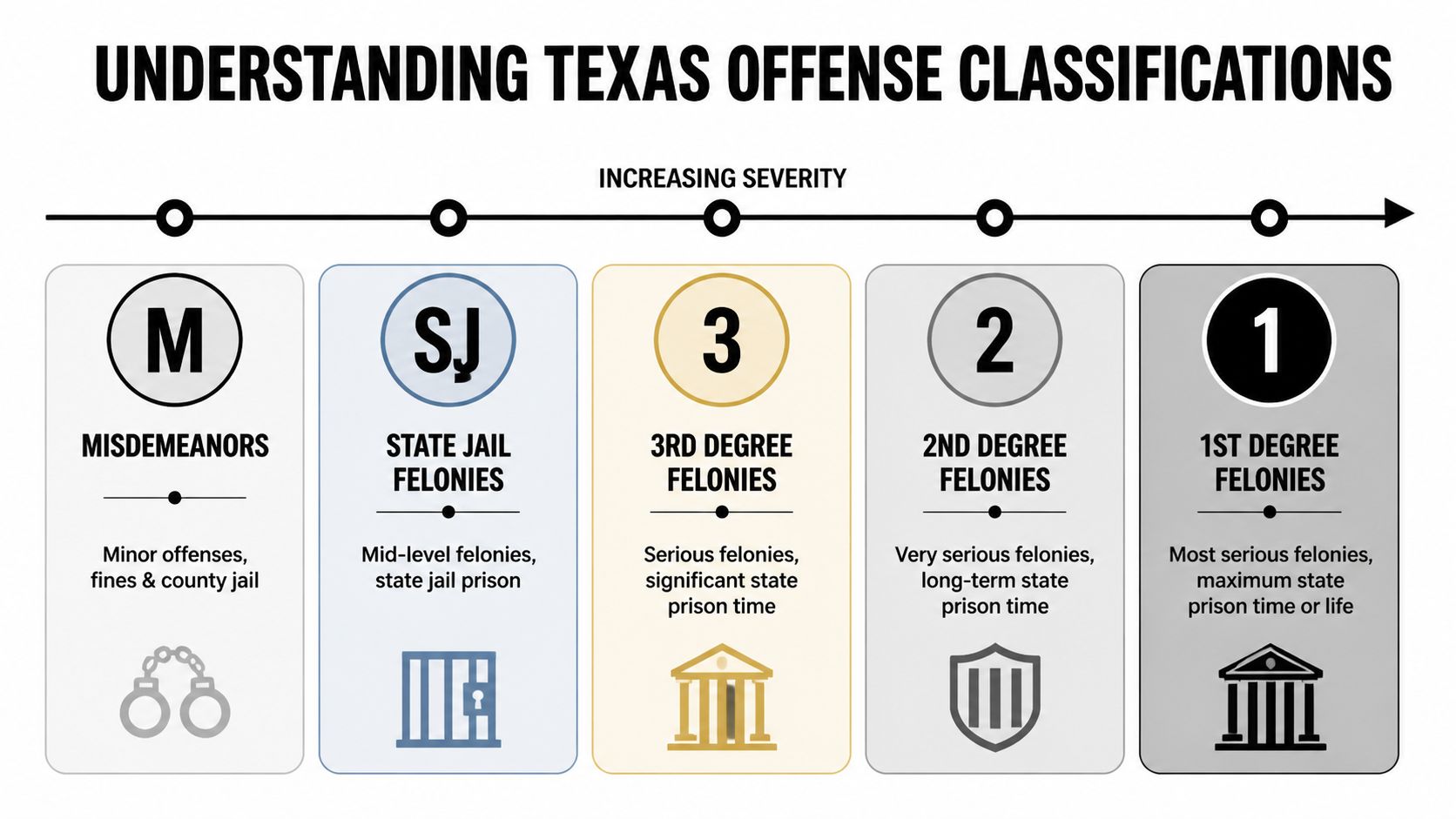
Texas offense classifications at a glance
| Offense Level | Confinement Time | Maximum Fine | Location of Incarceration |
|---|---|---|---|
| Misdemeanor | Up to 1 year or less, depending on class | Varies by class | County jail or fine-only resolution |
| State jail felony | 180 days to 2 years | $10,000 | State jail facility |
| 3rd degree felony | 2 to 10 years | $10,000 | TDCJ prison |
| 2nd degree felony | 2 to 20 years | $10,000 | TDCJ prison |
| 1st degree felony | 5 to 99 years or life | $10,000 | TDCJ prison |
If you want a broader comparison of these categories, this guide on the difference between a felony and misdemeanor in Texas gives helpful background.
The key practical differences
A misdemeanor is usually punished in county jail if jail time is imposed. A state jail felony is punished in a state jail facility. Higher felonies are punished in prison through TDCJ.
That may sound like a technical detail, but it changes negotiations. In a misdemeanor case, a lawyer may be able to negotiate around county jail exposure. In a state jail felony case, the focus often shifts to keeping you out of a state jail sentence entirely, reducing the offense, or securing community supervision when legally and factually available.
Why state jail felonies are their own category
State jail felonies are unusual because they sit between two worlds. They have the collateral weight of a felony, but they don’t carry the same sentencing framework as higher felony prison cases.
That means your options often depend on details that people outside the system miss:
- Your criminal history can change everything
- The county matters
- The assigned court matters
- Restitution, treatment, or compliance can matter a lot
- An early legal challenge can create a negotiation advantage
The right question isn’t only “What’s the maximum punishment?” The better question is “What outcome is realistically available in this court, on these facts, with this record?”
What clients often get wrong
Some people panic and assume they must plead quickly because the case is “only” a state jail felony. Others do the opposite and treat it too casually because it’s not a higher-degree felony.
Both mistakes can cost you. This category is serious enough to affect your future and flexible enough that careful defense work can make a real difference.
Common Offenses Charged as State Jail Felonies
A state jail felony charge doesn’t always come from dramatic facts. Many cases start with everyday situations that escalated.
In Texas, common examples include certain theft cases, credit card abuse, burglary of a building, low-level drug possession, forgery, embezzlement, and DWI with a child passenger. These are the kinds of charges that frequently bring otherwise steady, working people into felony court.
Charges people see most often
Some of the more common patterns include:
- Theft allegations: Property value can push a case from misdemeanor territory into felony territory.
- Credit card abuse or fraud-related allegations: These often involve disputed intent, authorization, or identity.
- Forgery cases: A signature, check, or financial document can lead to a felony filing quickly.
- Drug possession: Small-amount controlled substance cases are a common source of state jail felony charges.
- Burglary of a building: Entering or remaining in a place without consent can be filed as a felony even when no one was hurt.
- DWI with a child passenger: A driving case can become much more serious because of who was in the vehicle.
The facts matter more than the charge title
Two theft cases may carry the same charge and have completely different defense value. One may turn on weak identification. Another may involve repayment, misunderstanding, or a dispute about value. A drug case may rise or fall on whether the police had a lawful basis to search.
That’s why experienced defense lawyers don’t just read the offense name and give a canned answer.
In Harris County, 648 of 5,655 pretrial detainees, or 11.5%, were facing state jail charges, according to the FY2024 TDCJ statistical report referenced here. That tells you these cases are common. It also shows that courts and prosecutors see them every day, which makes case-specific defense work even more important.
A nonjudgmental way to look at these cases
A state jail felony charge often grows out of stress, addiction, poor planning, financial pressure, or one reckless choice. Sometimes it comes from a police investigation that moved too fast. Sometimes the accusation is entirely wrong.
A criminal charge describes what the State claims happened. It does not define who you are.
If you’re facing one of these offenses, the next issue is the process itself. Knowing what happens next can take away a lot of fear.
The Court Process and Key Defense Strategies
The court process feels confusing when you’re in it, especially if this is your first felony case. The good news is that state jail felony cases usually follow a recognizable path. Once you understand that path, you can make better decisions.

What happens after the arrest
The first stage is usually arrest, booking, and bond. If you’re released, the next issue is following bond conditions carefully. If you miss court, contact a witness, fail a test, or violate a no-contact order, you can make a hard case much harder.
After that, the case moves through settings that may include arraignment, status dates, evidence review, negotiations, motions, and possibly trial preparation.
A practical defense plan usually starts with these steps:
Get the reports and evidence
Your lawyer needs the charging documents, offense reports, body camera, lab work if any exists, and witness material.Check the stop, search, and statements
A bad search or an unlawful detention can weaken the State’s case. In some cases, a lawyer may file a motion to suppress evidence in Texas criminal court to challenge evidence obtained in violation of your rights.Develop mitigation early
Treatment records, employment history, restitution, counseling, and character support can affect negotiations.Decide whether to negotiate, litigate, or prepare for trial
Good defense work isn’t one-size-fits-all. The best route depends on the facts.
Arraignment and plea bargaining
At arraignment or early settings, the court handles formal matters and scheduling. In many cases, the substantive work happens outside the courtroom through evidence review and plea discussions.
That doesn’t mean you should just take the first offer. Plea bargaining works best when the defense has done the homework. Prosecutors are more likely to move when they see legal weaknesses, mitigation, or practical reasons to resolve the case differently.
Here is a short video that helps explain how criminal cases move through the system:
The power of a Section 12.44 reduction
One of the most important tools in a state jail felony case is Texas Penal Code §12.44(a).
Under that law, a judge may punish a state jail felony as a Class A misdemeanor, with up to 1 year in county jail, as explained in this overview of Texas Penal Code §12.44 and state jail felony reductions. In the right case, that can help a person avoid the lasting impact of a felony conviction.
This is often a major defense goal for first-time offenders, people with strong mitigation, or cases where the facts support leniency.
What tends to help and what usually doesn’t
What helps:
- Starting treatment early
- Paying restitution when appropriate
- Keeping steady work
- Following bond conditions exactly
- Giving your lawyer documents quickly
- Being honest about your history
What usually doesn’t:
- Ignoring the case because you’re scared
- Talking freely to police after charges are filed
- Contacting complainants when a no-contact rule exists
- Assuming the first plea offer is the only offer
- Posting case details on social media
The Law Office of Bryan Fagan PLLC represents people in Texas felony cases, including state jail felony matters, from early investigation through negotiation, trial, and record-clearing work.
Sentence Enhancements and Long-Term Consequences
A state jail felony is the lowest felony category, but it doesn’t always stay there. Some cases are filed or later treated more severely because of a person’s record or because of facts alleged by the State.
That’s why a lawyer looks not only at the current charge, but also at anything that could increase punishment.
When a state jail felony gets enhanced
Under Texas Penal Code §12.42(b), a state jail felony can be enhanced to a third-degree felony, carrying 2 to 10 years in prison, if the State proves a prior felony conviction. A finding that a deadly weapon was used during the offense can also make the case a third-degree felony regardless of criminal history, as described in this explanation of Texas sentence enhancement for a state jail felony under Penal Code §12.42(b).
That changes the whole case analysis. Once prison time enters the picture, negotiation strategy, motion practice, and trial risk all have a different weight.
Why enhancement issues need early attention
Enhancements are not something to sort out at the last minute. A defense lawyer should review prior judgments, identify whether an old conviction legally qualifies, and test whether the State can prove what it claims.
Important questions include:
- Is the prior conviction final and usable?
- Is the person named in the prior case the accused in the current case?
- Did the State allege a deadly weapon finding it can really support?
- Can the case be resolved before enhancement becomes the center of the negotiation?
Enhancement law is technical, but the client-side lesson is simple. Old cases and disputed facts can raise the stakes fast.
The consequences beyond the courtroom
Even when a state jail felony doesn’t get enhanced, a felony conviction can follow you long after the case ends. The punishment isn’t limited to confinement or a fine.
Common long-term consequences can include:
- Employment trouble: Many employers hesitate when they see a felony record.
- Housing problems: Landlords often run background checks.
- Professional licensing issues: Boards may review criminal history closely.
- Firearm restrictions: A felony can affect your ability to possess firearms.
- Voting rights issues until discharge: Some rights are affected until the sentence is fully discharged.
Those consequences are why defense strategy should never focus only on immediate jail time. Sometimes avoiding a felony label is the most important win in the case.
A practical way to think about risk
Clients sometimes ask whether they should “just get it over with.” That depends on what “over with” means. A quick plea may close the court file, but it can leave a permanent problem for work, housing, family law disputes, and future criminal exposure.
A better approach is to weigh three things together:
| Question | Why it matters |
|---|---|
| Can the State prove the case cleanly? | Weak proof creates leverage |
| Is there a path to reduction? | Reductions can protect your future |
| What are the long-term consequences of this plea? | The shortest path isn’t always the safest one |
Clearing Your Record and Moving Forward
A criminal charge can feel permanent when you’re living through it. It often isn’t. Texas law gives some people a way to clear or limit public access to a record after the case is resolved.
That part matters because your goal shouldn’t only be surviving the case. It should also be protecting your ability to work, rent a home, support your family, and move forward.

Expunction and nondisclosure in plain English
An expunction is the strongest form of record clearing. If you qualify, the law allows the record of the arrest and case to be removed from public access.
An order of nondisclosure is different. It doesn’t erase the case, but it can seal the record from the general public in many situations.
This guide on expunging a felony in Texas gives a useful overview of post-case record clearing.
When these remedies may matter
These options often come up in situations like:
- The case was dismissed
- You were found not guilty
- You completed deferred adjudication and may qualify for record sealing
- Your lawyer negotiated a result designed with future record relief in mind
Not every outcome qualifies. That’s why defense planning should include the endgame from the start.
Why future-focused strategy matters now
A smart defense doesn’t stop at the next court date. It asks better questions early:
- If the case can’t be dismissed, can it be reduced?
- If it can’t be reduced, is there a path that preserves later record relief?
- If treatment or restitution helps now, will it also help later when sealing or clearing the record becomes possible?
The best result is not always the fastest result. It’s the one that leaves you with the most life left after the case is over.
Rebuilding after a criminal charge
People do recover from felony accusations. They keep jobs, repair relationships, complete treatment, finish probation, clear records when eligible, and rebuild their names. That process starts with making careful choices while the case is still pending.
If you’re facing a state jail felony in Houston, Dallas, Austin, San Antonio, or a surrounding Texas county, get legal advice before you make decisions that are hard to undo.
If you’ve been charged with a crime in Texas, call Law Office of Bryan Fagan PLLC for a free and confidential consultation. Our defense team is ready to protect your rights.