Skip to content
Being arrested in Texas can be terrifying, but you don’t have to face it alone. If you or someone you love is dealing with tarrant county bail bonds, the hardest part is often the first few hours. You’re trying to figure out where the person is, what the bond amount means, who sets it, and how to get them home fast without making a costly mistake.
Few individuals plan for an arrest. They get a late-night call, hear panic in someone’s voice, and suddenly have to make legal and financial decisions under pressure. That’s when clear information matters. Bail is not a punishment. It’s the court’s way of deciding whether a person can stay out of jail while the case moves forward.
This process also affects the rest of your case. A smart bond strategy can help you return to work, care for your family, gather evidence, and meet with your defense lawyer. It can also affect plea negotiations, trial preparation, and what happens later if you want an expunction, nondisclosure, or other post-conviction relief after the case ends.
If you’re searching for a lawyer online right now, it may also help to understand understanding how criminal defense lawyers reach clients so you can better judge which firms are focused on education and trust instead of panic-based advertising.
The Phone Call No One Expects to Make or Receive
That phone rings. It’s late. The voice on the other end says they’ve been arrested in Tarrant County.
Your mind usually goes straight to the same questions. Where are they? Can they get out tonight? How much is this going to cost? Should they say anything to police?
Start with this. Stay calm and say less.
If you’re the one arrested, you have the right to remain silent. Use it. Give basic identifying information, but don’t try to explain, smooth things over, or “clear it up” in the holding area. If you’re the family member taking the call, don’t coach the person to talk. Focus on getting their full name, date of birth, where they were taken, and the charge if they know it.
What people often misunderstand
Many people assume bail is automatic. It isn’t. A magistrate usually has to review the arrest and set conditions for release.
Others think the first bond amount is final. It often isn’t. A defense lawyer can ask for a lower amount or better terms if the original decision doesn’t fit the facts.
First priority: protect your rights before you try to explain your side of the story.
Why the first hours matter so much
The early stage of a criminal case can shape everything that follows.
If you’re accused of assault under Texas Penal Code § 22.01, DWI under Texas Penal Code § 49.04, theft under Texas Penal Code § 31.03, or drug possession under the Texas Health and Safety Code, the court will start making judgments about risk, reliability, and public safety almost immediately. Those early judgments can affect bond conditions, future hearings, and how the prosecution sees the case.
A careful defense approach starts now, not later.
What Happens Immediately After a Tarrant County Arrest
A Tarrant County arrest often feels like being dropped onto a conveyor belt. Doors close. Property is taken. Questions come fast. Family members are left trying to figure out where the person is, whether release is possible, and how long this first stage will last.
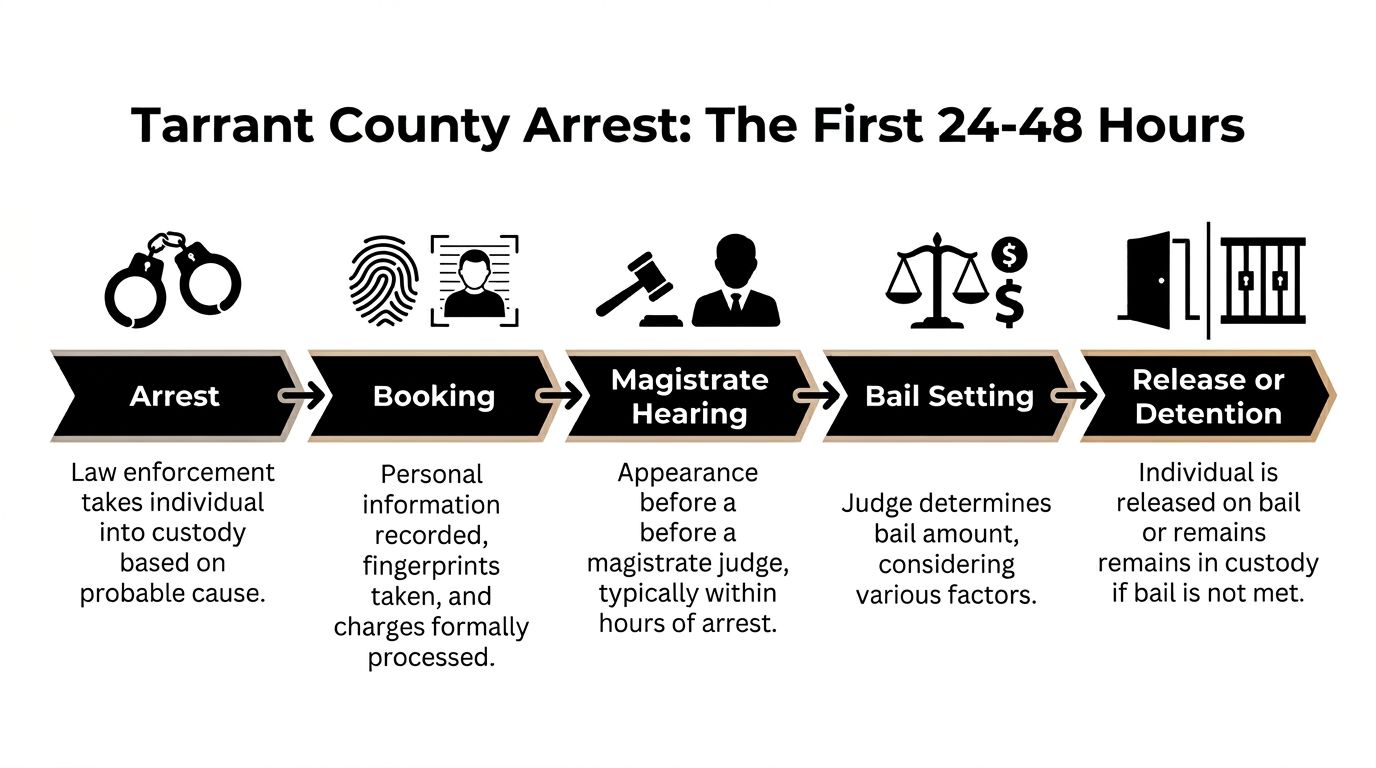
The process does follow a pattern. Once you can name the steps, the situation becomes easier to handle.
Custody and booking come first
After the arrest, officers take the person into custody and begin booking. Booking is the jail’s intake process. It usually includes recording identifying information, taking fingerprints and a photograph, listing the charge, and inventorying personal property.
In Tarrant County, many arrestees are processed through the Tarrant County Corrections Center at 100 N. Lamar Street in Fort Worth, which the Tarrant County Sheriff's Office jail information page identifies as one of the county’s detention facilities.
That does not mean release happens right away. Booking is paperwork and processing. Bond decisions usually come after that.
The first court appearance is where bond starts to take shape
After booking, the person is brought before a magistrate. Texas law requires a prompt magistrate warning after arrest. At that hearing, the court explains the accusation, advises the person of basic rights, and addresses bail and release conditions. The Texas Code of Criminal Procedure lays out those warning and bail procedures in Articles 15.17 and 17.15.
Families often call this an arraignment. In everyday conversation, that is understandable. What matters is what the court is doing at this stage. The magistrate is making an early release decision, not deciding guilt.
That early decision can shape the rest of the case.
The court is looking at more than the police report
Judges and magistrates often consider the charge, prior record, past court appearances, ties to the community, and any claimed safety concerns. In family violence, DWI, weapons, or repeat-offense cases, conditions can become stricter very quickly.
Tarrant County has also used the Public Safety Assessment, often called the PSA, to help guide release decisions. The PSA is a risk-screening tool that uses factors such as age, current charge, pending cases, prior convictions, and past failures to appear to generate recommendations about release and supervision. The Texas Judicial Branch pretrial risk assessment materials describe how these tools are intended to inform, not replace, judicial judgment.
That distinction matters. A PSA score can start to act like a label if no one pushes back. A judge may see a recommendation for tighter conditions and treat it as objective, even when the score does not capture the full story.
For example, the tool cannot fully measure context. It may not show that a missed court date happened because notice went to the wrong address, or that an old case says little about whether the person is a flight risk now. It also cannot tell the court that the accused has steady work, children at home, medical needs, or a family ready to make sure every court date is met.
A defense lawyer can challenge the PSA’s effect
This is one of the places where early legal help changes the picture.
A lawyer can point out errors in the criminal history the court is using, explain why a prior failure to appear should carry less weight, and present facts the PSA does not see. That may include proof of employment, residence, caregiving duties, military service, treatment participation, or a clean stretch of time since older cases.
A lawyer can also argue that the proposed bond conditions are broader than the facts justify. If the court is relying too heavily on a risk score, counsel can press the judge to focus on the person in front of the court, not just the worksheet in the file.
That is often the first opportunity to humanize the case.
After bond is set, the case splits into two practical tracks
If bond is posted, the person is released and must follow every condition the court imposed. If bond is too high, or the conditions are too restrictive to meet, the person remains in custody while the defense asks for a reduction or a different form of release.
Either way, the criminal case is already underway. The first hours after arrest are not just administrative. They are the point where the court begins forming opinions about risk, reliability, and control. If those early assumptions are wrong, they need to be challenged early, before they harden into the terms of release.
Your Three Main Bail Bond Options in Tarrant County
Once bond is set, the family usually faces a hard question under time pressure. How do we get this person out, and which option makes financial and legal sense?
In Tarrant County, the three main paths are PR bond, cash bond, and surety bond. Each one gets a person released in a different way. Each one also creates different risks, costs, and room for strategy.
A bond is not just a payment problem. It is also a problem of influence. If the court relied heavily on a PSA score or set conditions that do not fit the actual facts, your lawyer may need to challenge the bond itself instead of just finding a way to pay it. If you want a clearer picture of what the court considers at that stage, this guide to what happens at a bond hearing helps explain the process.
PR bond
A personal recognizance bond, or PR bond, allows release without paying money up front. The defendant signs a written promise to return to court and follow any release conditions.
This is the closest thing to the court saying, "We believe conditions and accountability are enough."
PR bonds are usually more available to people with lower-level charges, stable community ties, and fewer concerns about missing court. In Tarrant County, they are less common than many families expect, especially once the allegation involves violence, repeated arrests, or facts that can push a PSA score in the wrong direction.
That is one reason early lawyering matters. A judge may hear "risk." A defense lawyer can supply the missing details. Job history, a stable address, caregiving duties, treatment, or errors in the record can all support a request for PR release or a lower bond with fair conditions.
Cash bond
A cash bond means the full bond amount is paid directly to the court or jail.
It works like a security deposit. If the defendant appears in court and follows the rules of release, the money is generally returned at the end of the case, subject to court costs, fees, or other lawful deductions.
For some families, cash bond is the cleanest option. There is no bondsman fee. There is no third party involved. But the downside is obvious. Coming up with the full amount on short notice is often unrealistic, especially when the arrest also interrupts work, child care, or rent money.
Surety bond
A surety bond uses a licensed bail bond company. Instead of paying the full bond amount to the court, the family pays the bondsman a fee and the bondsman guarantees the bond.
This is the option many families use because it lowers the up-front cash needed for release. Under Texas law, a bail bond surety may charge a fee for executing the bond, and the fee is typically not refunded after release, as reflected in the rules governing licensed bond businesses under the Texas Occupations Code, Chapter 1704.
A surety bond can also come with strings attached. The bondsman may ask for collateral, proof of income, references, or a co-signer. If the person misses court, the family can face financial consequences beyond the initial fee.
Tarrant County Bond Types Compared
| Bond Type | Upfront Cost | Money Refundable? | Best For |
|---|---|---|---|
| PR Bond | No payment up front | No money paid at release | People with lower apparent risk and facts that support trust-based release |
| Cash Bond | Full bond amount | Often returned if court duties are met, less lawful deductions | Families who can afford the full amount and want to avoid a bond fee |
| Surety Bond | Bondsman fee and sometimes collateral | No, the fee is usually non-refundable | Families who need release without paying the full bond amount |
A practical way to choose
Start with the option that costs the least and restricts the family the least.
- Choose a PR bond if the court will allow it and the release conditions are manageable.
- Choose a cash bond if the amount is affordable and tying up that money will not create a second crisis at home.
- Choose a surety bond if the full amount is out of reach and release cannot wait.
Then ask a second question that families often miss: Is this bond fair in the first place?
If the answer may be no, the better move may be to challenge the amount, the conditions, or the court's reliance on a PSA score rather than accepting the bond as set. That is where a defense attorney stops the process from becoming mechanical and brings the judge back to the person, the facts, and the law.
How Judges Determine Your Bail Amount
A family often learns the full weight of a case at the bond hearing. The charge on paper matters, but it is only part of what the judge sees.

Judges and magistrates in Tarrant County are supposed to look at several things at once. They consider the accusation, the person’s record, ties to the community, past court attendance, and whether release would create a safety risk. Bail is not supposed to be a random number. It is supposed to reflect risk and the law.
That is why two cases that sound similar can produce very different bond amounts.
A person accused of unlawful carrying of a weapon under Texas Penal Code § 46.02 may face a much lower bond than someone accused of aggravated assault with a deadly weapon under Texas Penal Code § 22.02 or murder under Texas Penal Code § 19.02. The level of violence alleged, whether someone was hurt, whether a weapon was used, and whether there is a claimed threat to a specific person can all change the judge’s view. Prior convictions matter too. So do pending cases, probation status, and any history of missing court.
Texas law also gives courts a framework for setting bail. Under the Texas Code of Criminal Procedure, the court should use bail high enough to give reasonable assurance that the person will appear, but not use bail as an instrument of oppression. The court may also consider the nature of the offense, the person’s ability to make bail, and the future safety of the victim and the community, as reflected in Article 17.15 of the Texas Code of Criminal Procedure.
That last factor often creates the most confusion because Tarrant County may also use the Public Safety Assessment, or PSA.
The PSA is a scoring tool. It uses factors such as age, current charge information, and criminal history to estimate two things. One is the chance a person will miss court. The other is the chance of new criminal activity if released. The tool can influence recommendations about release conditions and, in practice, can shape how a judge views risk before a lawyer has fully told the client’s side of the story.
Families usually do not hear much about that part. They just hear the number.
That matters because a PSA score can make a case feel more mechanical than it should. A tool cannot tell the judge that your brother is the parent who gets a child to school each morning. It cannot explain that a prior failure to appear happened because notice went to the wrong address. It cannot show that an arrest affidavit leaves out facts that cut against the accusation. The score may be part of the file, but it is not the whole person.
The PSA has also drawn criticism in Texas and elsewhere because risk tools can be treated as more objective than they really are. Judges may say they are only one factor, and that is true as a legal matter. In a fast hearing, though, one score can still frame the discussion unless defense counsel pushes back with specific facts.
A lawyer challenging bail should do more than argue that the amount feels unfair. The stronger approach is to show why the number or the conditions do not fit the actual person in front of the court.
That can include:
Correcting errors in the record
Arrest paperwork and criminal history summaries are not always complete or accurate.Explaining community ties
A steady job, long residence, caregiving duties, and family support all help answer the court’s main question. Will this person come back.Putting the accusation in context
The court is not deciding guilt, but the judge can still hear facts that affect risk and fairness.Challenging the weight given to a PSA score
If the tool ignored important facts or overstates danger, counsel can say so directly and ask the court to rely on a fuller record.Requesting less restrictive conditions
Sometimes the problem is not only the amount. GPS monitoring, no-contact orders, travel limits, or reporting rules may also need to be narrowed.
If you want a clearer picture of that hearing itself, this guide on [what happens at a bond hearing](https://texascriminallawyer.net/what-happe