Being arrested in Texas can be terrifying, and getting out on bond may feel like the hard part is over. It isn't. Once you're released, the case is still active, the court is watching, and your next decisions can affect whether you stay free and how your case turns out.
If you're searching for what happens after being released on bond in Texas, start with this: bond is a promise. You promised the court you'll come back, follow the rules, and avoid trouble while your case moves forward. If you keep that promise, you give your defense lawyer room to work. If you break it, even by carelessness, things can get worse fast.
A lot of people leave jail tired, embarrassed, angry, or confused. That's normal. The key is to slow down, read your paperwork, and treat the next few days seriously.
Your First Steps After Being Released From a Texas Jail
You walk out of jail with a plastic bag of belongings, a stack of papers, and ten people calling at once. That moment feels like freedom, but it is also the start of a deadline-driven process. The first few hours matter because small mistakes made right after release can create problems your lawyer then has to spend time fixing.

Gather your papers and read them slowly
Start there.
Before you call friends or try to get back to normal, make sure you have your release papers, bond receipt, court date information, and any instructions from the jail, bondsman, or pretrial office. If something is missing, request a copy right away. Your lawyer cannot protect you from terms you never bothered to read.
Your paperwork usually tells you what kind of bond was posted, and that affects what happens next:
| Bond type | What it usually means for you |
|---|---|
| Surety bond | A bail bond company posted the bond. You usually paid a fee to the bondsman and may have reporting rules. |
| Cash bond | Cash was posted with the court. If you follow the rules and appear as required, that money may be returned after the case ends, depending on court processing. |
| Personal bond | You were released based on your promise to return and follow conditions. You still have to obey every rule attached to your release. |
As explained in Texas bail bond laws explained, surety bonds usually involve a non-refundable premium paid to the bondsman, while cash bonds are handled differently by the court. That distinction matters because the person or company involved in your release may expect different check-ins, notices, or paperwork from you.
Make the first calls in the right order
A lot of people focus on comfort first. I tell clients to focus on control first.
Use this order:
- Call your lawyer. If you do not have one, start looking the same day.
- Call your bondsman if a bail bond company posted your bond. Ask how often you must check in and how they want updates.
- Confirm your court date in writing. A screenshot, photo, or calendar entry is better than memory.
- Tell one reliable family member or friend how to reach you. Courts and lawyers need stable contact information.
- Get somewhere safe and quiet. Clear thinking helps you avoid careless violations.
That last point matters more than people expect. The first night out is when bad advice, panic texting, drinking, or contact with the wrong person can lead to a new accusation or a bond problem.
Protect your ability to stay free
Bond works like borrowed time from the court. You are out, but your case is still running in the background every day. Your job in this stage is not just to avoid mistakes. It is to give your lawyer good ground to stand on.
That means doing a few practical things early:
- Save every document in one folder or take photos of each page.
- Write down the names and phone numbers of your bondsman, lawyer, and court.
- Recover your phone, wallet, medication, keys, and identification as soon as you can.
- Keep your address and phone number current.
- Stop posting about the arrest, the alleged victim, or the case online.
Those steps may seem basic, but they often shape how smoothly the next few weeks go. A defense case is easier to build when the client is reachable, organized, and following instructions.
If you want a practical outside view of what happens after bond is posted, this comprehensive guide for Cherokee County bail walks through the process from a bail bond perspective.
You should also understand the bigger picture of how release works in Texas. This explanation of bail and bond in Texas and what to expect after release can help you see who may be involved and what each person does.
Start helping your defense right away
This is the part many people miss.
Getting out of jail is not only about following rules. It is also your first chance to help your lawyer protect your freedom and improve the outcome of the case. While the court expects compliance, your attorney is already thinking ahead about evidence, witnesses, deadlines, and facts that may support a dismissal, reduction, or better resolution.
So after you rest, begin collecting useful information. Save text messages. Make a timeline of what happened before the arrest. Write down witness names before you forget them. If there are work records, receipts, photos, or videos that support your side, tell your lawyer quickly. Early facts are often better facts because they are easier to verify before memories fade.
The first steps after release are simple, but they are not minor. Handle them carefully, and you give yourself a better chance to stay out, stay organized, and give your attorney something valuable to work with.
Understanding Your Texas Bond Conditions
You walk out of jail, get your phone back, and finally take a full breath. Then someone hands you paperwork filled with rules, dates, and warnings. That document matters as much as the release itself, because bond is not just permission to go home. It is a set of court orders that controls what you can and cannot do while your case is pending.
In Texas, judges can place conditions on a bond under Texas Code of Criminal Procedure Articles 17.40 through 17.50. The basic idea is simple. The court wants reasonable assurance that you will return to court and avoid new problems while the case is open. Some conditions are standard. Others are adjusted for the charge, your history, or a specific concern the judge wants to address.
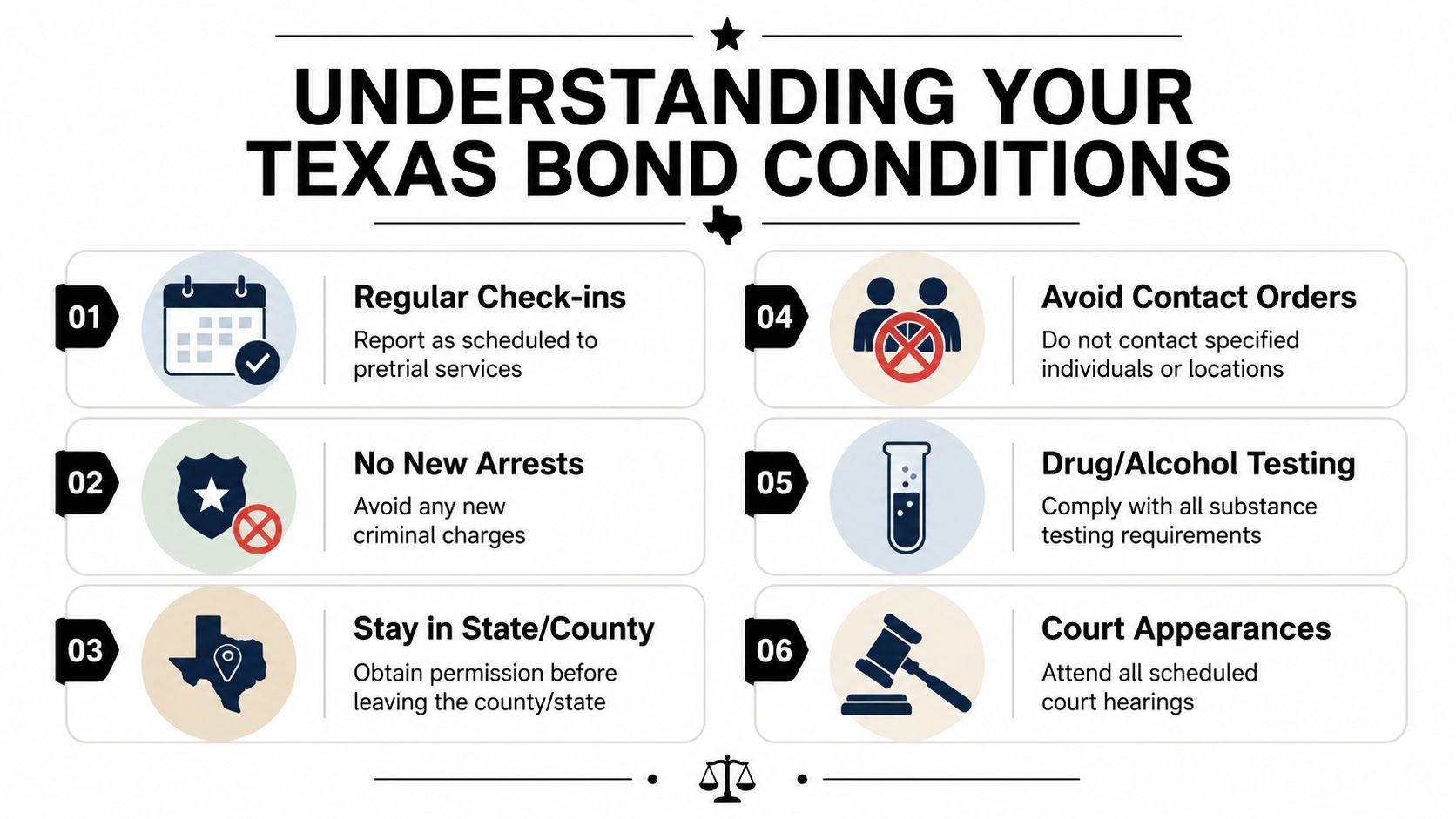
The common conditions you may face
A bond condition works like a rulebook for your release. If one part is unclear, do not guess. Ask your lawyer, your bondsman, or the pretrial office until you know exactly what the court expects.
Common conditions include:
- Appear in court every time you are ordered to appear. One missed setting can trigger a warrant and put your release at risk.
- Report as directed. You may have to check in with a bondsman, a pretrial officer, or both.
- Do not pick up a new charge. A new arrest can damage your position quickly, even if the new case seems minor.
- Follow no-contact orders. This often means no calls, texts, messages through other people, or in-person contact with an alleged victim or witness.
- Submit to alcohol or drug testing. This is common in DWI, drug, and some assault cases.
- Obey travel limits. Some bonds restrict you to a county, a group of counties, or the state unless the court approves travel first.
If your case involves violence allegations, Texas assault bond conditions such as no-contact orders and location restrictions can be stricter than people expect.
Why your conditions may be stricter than someone else's
Two people can face the same charge and leave jail with different rules. Judges often look at the full situation, not just the offense listed on the paperwork. Prior missed court dates, past convictions, substance abuse concerns, community ties, and safety issues can all affect the conditions attached to release.
That is why one person may only need to appear in court, while another may be ordered to use GPS monitoring, avoid certain places, or test regularly. It can feel uneven. In practice, the court is trying to measure risk, even if it does not always get that judgment right.
Some conditions can be changed. If a rule is too broad, interferes with work, or no longer fits the facts, your lawyer can ask the court to modify it. That is one reason to treat your bond paperwork as a defense issue, not just an administrative detail.
What these rules look like in real life
The charge often shapes the conditions. A DWI case may bring testing, ignition interlock requirements, or limits on drinking. An assault case, especially one involving family violence, may bring strict no-contact rules and stay-away zones around a home or workplace. A drug possession case may include testing, counseling, or treatment requirements.
Being proactive can help protect your freedom. If alcohol or drug use is part of the court's concern, starting appropriate services early may help your lawyer show the judge that you are taking the case seriously. In the right situation, a program for alcohol and drug addiction treatment may be something to discuss with counsel before seeking a bond modification.
Read every condition carefully. Keep a copy on your phone. If one line is vague, clear it up before you act. A preventable mistake on bond can create a second problem when your first goal should be keeping your release and giving your attorney the best chance to improve the outcome of your case.
Your Responsibilities During the Pretrial Process
A lot of people think staying out on bond means waiting for the next court date and trying not to think about the case. That's a mistake. The strongest position is to treat the pretrial period like active work.

Your job is to make compliance easy to prove
You don't want to be the person telling the judge, "I thought I was doing everything right." You want records. Save messages from your bondsman. Keep a calendar with court dates. Screenshot check-in confirmations. Save receipts for classes, testing, counseling, or treatment if those apply to your case.
Within 48 hours of release, it's critical to retrieve confiscated IDs because they are often required for employment verification, which is a common bond condition. The same resource explains that failed drug or alcohol testing can trigger a blue warrant from a bondsman, and ETGs can detect alcohol for 80 hours, as described in this guide to the Texas bail bond process.
What active participation looks like
This doesn't mean you need to become your own lawyer. It means you need to be organized and reachable.
Focus on these habits:
- Keep one reliable phone number. If your number changes, tell your lawyer and bondsman immediately.
- Show up early. Being late to court creates unnecessary risk.
- Avoid risky people and places. If a situation could lead to police contact, leave.
- Preserve evidence. Save texts, photos, videos, receipts, and names of witnesses.
- Ask before you act. If you're unsure whether travel, contact, or a social event might violate your bond, ask your lawyer first.
The court doesn't reward good intentions. It responds to documented compliance.
Why this helps your defense
When your lawyer negotiates with the prosecutor or appears before the judge, your conduct while on bond matters. A person who follows orders, keeps a job, avoids new trouble, and stays in contact gives the defense more room to argue for reduced conditions, a better plea offer, or another favorable outcome.
That matters whether you're facing a misdemeanor theft charge in Houston, a DWI in Austin, an assault allegation in Dallas, or a drug case in San Antonio. Judges and prosecutors notice patterns. Give them a good one.
Consequences of Violating Your Bond Conditions
Bond violations usually don't begin with a dramatic arrest scene. They often start with something small. A missed check-in. A positive test. A text message sent to someone you're ordered not to contact. A skipped court date because you wrote the wrong time on your calendar.

What the chain reaction can look like
Here is how a violation often unfolds:
- Someone reports the problem. That could be a bondsman, pretrial officer, law enforcement officer, or alleged victim.
- The court reviews the allegation. Sometimes that happens quickly and without much warning to you.
- A warrant may issue. If the judge believes there was a violation, you may be ordered back into custody.
- Your bond can be revoked or forfeited. That affects both your freedom and your money.
- Getting back out gets harder. The court may impose stricter terms or a higher bond.
The Texas Office of Court Administration reports that failures to appear and bond condition violations are substantial. When you fail to appear, the court begins bond forfeiture procedures under Texas Code of Criminal Procedure Article 22.01, and an arrest warrant is issued, as summarized in this analysis of Texas money bond practices.
Missing court is especially serious
If you miss court, the judge doesn't assume you had a good reason. The system treats nonappearance as a breach of the promise that got you released.
That can lead to:
- Loss of the full bond amount
- A new warrant for your arrest
- Possible extra criminal exposure depending on the facts
- Action by the bondsman to locate you
If a surety bond was used, the same source explains that the bondsman may use a bounty hunter to find you after a failure to appear.
If your case involves a protective order or no-contact issue, violating those terms can create separate and immediate problems. This article on assault protective bond violations in Texas helps explain how quickly those allegations can escalate.
A short video can help make the risk feel more concrete.
If you've violated a condition, silence usually makes things worse. You need legal advice before the problem grows.
How a Criminal Defense Lawyer Can Help Manage Your Bond
You get home after release, set your bond papers on the kitchen table, and start reading. One line says no contact. Another mentions reporting. Another seems to limit travel. If you are confused, that is normal. Bond conditions often read like instructions written for the court, not for the person who has to live by them.
A defense lawyer helps turn those papers into a workable plan.
A lawyer explains what your bond rules mean in daily life
The first job is simple but important. Your attorney should go through the bond order line by line and explain what each condition requires you to do, avoid, track, or ask permission for.
That matters because small misunderstandings can create large problems. A text message may count as contact. A trip for work may require approval first. A missed check-in may still count against you even if you had a good personal reason.
Bond rules also play out differently depending on the charge. In a DWI case, testing or interlock requirements may control your routine. In an assault case, no-contact terms can affect where you live, how you handle parenting exchanges, and what communication must go through third parties. In drug possession or theft cases, reporting, treatment, or travel limits may create problems with work unless they are addressed early.
A lawyer can ask the judge to change bond conditions
Bond conditions are not always permanent. Judges can modify them when there is a valid reason and a clear plan for compliance.
That is where being proactive helps.
Instead of waiting until a problem turns into an alleged violation, you and your lawyer can bring the issue to the court first. If you need to travel for work, care for a family member, attend treatment, or deal with a parenting schedule that conflicts with the order, your attorney can ask for clarification or a change before you are accused of breaking the rules.
Your attorney may request:
- Travel permission for work, family, or medical needs
- Adjusted reporting terms that fit your job schedule
- Clearer no-contact limits in shared parenting or household situations
- Changes to restrictions after a strong record of compliance
As noted earlier, Texas procedure allows lawyers to file motions about bond conditions. The practical point is this: asking first is far safer than explaining later.
A lawyer uses your bond compliance to help the case itself
Bond management is not separate from case strategy. It works like the foundation of a house. If the foundation stays steady, your lawyer has more room to build a stronger defense and present you as reliable, responsible, and serious about following court orders.
While you are complying with the bond, your lawyer should also be working on the case behind it. That can include reviewing police reports, identifying weak points in the state's evidence, preserving favorable evidence, preparing witnesses, and weighing negotiation against trial.
Your conduct during pretrial can also affect how the court and prosecutor view you. Compliance does not guarantee a dismissal or a favorable plea offer, but it can help your attorney argue for better outcomes than a record filled with avoidable bond problems.
| Stage | What your lawyer may do |
|---|---|
| Arraignment or first settings | Confirm the charge, appearance requirements, and bond status |
| Pretrial hearings | Challenge evidence, negotiate, and address bond issues |
| Plea bargaining | Use weaknesses in the case and your compliance history to seek a better result |
| Trial preparation | Build defenses, prepare witnesses, and contest the state's proof |
| Sentencing or post-case relief | Seek options that reduce long-term damage |
If bond terms are disrupting your work, family life, or ability to stay compliant, speaking with Law Office of Bryan Fagan PLLC can help you understand your options and address bond issues early, before they grow into bigger problems.
After Your Case What Is Bond Exoneration and Record Sealing?
Your last court date can feel like the finish line. Then a new question hits you on the drive home. Is this really over, or will this case keep following me?
That is where many people get surprised.
When the court no longer needs your bond to secure your appearance, the bond is exonerated. In plain English, that means your obligation under that bond has ended because the case has reached a final result. The financial result depends on the type of bond you had, but the bigger issue at this stage is usually your record, not the bond itself.
What stays on your record after the case ends
A closed case and a clean record are not the same thing. Court dates may be over, but the arrest, charge, and case filing can still appear in background checks unless you take separate legal action.
That matters in real life. Employers may ask about criminal history. Landlords may run screening reports. Licensing boards may review old cases long after the courtroom part is done.
Expunction and nondisclosure are different tools
These two forms of relief sound similar, but they do different jobs.
Expunction removes eligible arrest and case records from public view and, in many situations, lets you deny the arrest happened. This relief is often discussed after an acquittal, a dismissal, or a case that never led to a final conviction, depending on the facts.
Nondisclosure seals eligible records from the general public, but it does not destroy them. Certain government agencies can still see the case. This option is often more realistic for people who completed deferred adjudication or other qualifying outcomes.
A simple way to understand the difference is this. Expunction aims to erase. Nondisclosure aims to limit who can see.
Record clearing is not automatic. You usually have to file for it, meet the legal requirements, and get a court order.
Why this step matters to your future
This part of the process is not paperwork for paperwork's sake. It can affect where you work, where you live, and how you answer questions about your past.
Your lawyer should review the outcome of the case and ask a second set of strategy questions: Do you qualify for expunction? Is nondisclosure available later? Is there a waiting period? Are there probation terms, fines, treatment requirements, or other orders you still need to finish before seeking relief?
That planning can start before the case fully ends. A careful defense lawyer is not only trying to help you stay out of jail today. Your lawyer should also be looking ahead to which result gives you the best chance to protect your record tomorrow.
If you were charged with DWI, assault, theft, drug possession, or another offense, ask for a direct answer about what remains visible after the case closes and what steps can reduce the long-term damage.
If you've been charged with a crime in Texas, call The Law Office of Bryan Fagan, PLLC for a free and confidential consultation. Our defense team is ready to protect your rights.