Being arrested in Texas can be terrifying, especially when your case is headed toward trial and you start thinking about a room full of strangers judging you. For many people charged with DWI, assault, theft, or drug possession, jury selection feels like the moment everything becomes real.
That reaction is normal. But if you want to understand what happens during jury selection in Texas criminal trials, it helps to see the process for what it is. This is not a ceremony where your fate is sealed before trial starts. It is the first real chance to protect your right to a fair hearing.
If you're facing criminal charges, you also need to see jury selection in the bigger picture. It comes after arrest, bond, charging decisions, and pretrial preparation. It comes before opening statements, witness testimony, verdict, and possibly sentencing. In many cases, earlier work such as motions, plea discussions, and courtroom strategy shapes what happens in the jury room later. Charges themselves also matter. A DWI case may involve questions tied to Texas Penal Code provisions and alcohol-related driving laws, while assault, theft, and drug cases often involve the State trying to prove intent, identity, possession, or injury under the Texas Penal Code. After trial, some people may also need advice about appeals, post-conviction relief, expunctions, or record sealing if they qualify.
The Jury Box Is an Opportunity Not a Threat
The first time you walk into a courtroom for trial, the jury panel can feel overwhelming. You look up and see row after row of people who may decide one of the most important events in your life. Most clients feel a knot in their stomach at that point.
I tell them the same thing: slow down. That room is not just full of risk. It is also full of opportunity.
A Texas criminal trial does not begin with witnesses or dramatic cross-examination. It begins with jury selection, often called voir dire. That is the stage where the judge and lawyers question potential jurors before any evidence is heard. If you're still deciding whether a jury is even the right path for your case, this explanation of the difference between jury trial and bench trial in Texas can help you understand the choice.
Why this moment matters to you
Think of the jury box like the filter on a lens. The same facts can look very different depending on the people hearing them. A fair juror listens carefully, follows the judge's instructions, and waits until all the evidence is in. An unfair juror walks in with a fixed mindset and never really gives your case a chance.
That is why jury selection matters so much.
If you're charged with DWI, for example, some people may already believe that anyone arrested for drunk driving must be guilty. If you're accused of assault, some jurors may have personal experiences that make it hard for them to stay neutral. In a theft or drug possession case, others may jump to conclusions based on the accusation alone.
The point of jury selection isn't to find people who already agree with you. It's to identify people who cannot be fair.
You are not powerless here
Clients sometimes think they just sit back while the lawyers do everything. That is not how experienced trial work feels from the defense side. Your lawyer is listening for bias, attitude, rigidity, and hidden assumptions. You are not selecting jurors one by one on your own, but your defense team is actively working to shape the group that will hear your case.
That should reassure you. The process can feel formal, but it is also practical. People are questioned. Bias is exposed. Some people are removed. And the group that remains is the one that will hear the evidence.
Understanding the Goal of Voir Dire in Texas
Voir dire is the formal jury-selection stage in a Texas criminal trial. Texas courts describe it as the point where judges and lawyers question prospective jurors before evidence begins. It starts with a panel much larger than the final jury, and then the court and the lawyers work through who can serve fairly and who cannot. You can see where this fits in the broader timeline in this overview of what happens during pretrial hearings in Texas.

Fair does not mean favorable
A lot of defendants assume the defense is trying to seat jurors who will “be on our side.” That is not the right frame. A better analogy is a coach building a team for a serious game. The coach is not looking for players who promise a certain result no matter what. The coach wants people who can do the job properly.
That is what your lawyer wants from a jury.
A fair juror can hold the State to its burden. A fair juror can listen when the defense points out weak police work, inconsistent testimony, or missing proof. A fair juror understands that an accusation is not evidence. If you need a plain-English refresher on that concept, this piece on understanding burden of proof is useful because jury selection often turns on whether jurors can follow that rule.
Why lawyers ask unusual questions
Some clients are surprised by the kinds of questions lawyers ask. They can sound broad, personal, or even awkward. A lawyer may ask about law enforcement, alcohol, self-defense, theft, prescriptions, relationships, or past experiences in court.
Those questions are not random.
They help uncover whether a potential juror has a belief that would interfere with applying the law fairly. In a DWI case, one person may believe that driving after any amount of drinking should always lead to conviction. In an assault case, another person may think that if police made an arrest, the defendant probably did something wrong. In a drug case, a juror may react strongly to the word “possession” without waiting to hear whether the State can prove knowledge and control.
Practical rule: Voir dire is where lawyers test whether a juror can follow the law as written, not the law as the juror wishes it were.
Why this stage protects your rights
Texas criminal procedure gives you the right to a trial process built around fairness. That includes questioning the panel before testimony starts. The system is not perfect, but voir dire is one of the main tools for removing obvious bias before jurors ever hear opening statements.
That is why seasoned defense lawyers treat this part of trial as strategy, not small talk.
The Jury Selection Process Step by Step
When clients ask me what happens during jury selection in Texas criminal trials, they usually want a simple answer: what will I observe firsthand in court? The easiest way to understand it is to walk through the day in order.
A visual overview helps first.
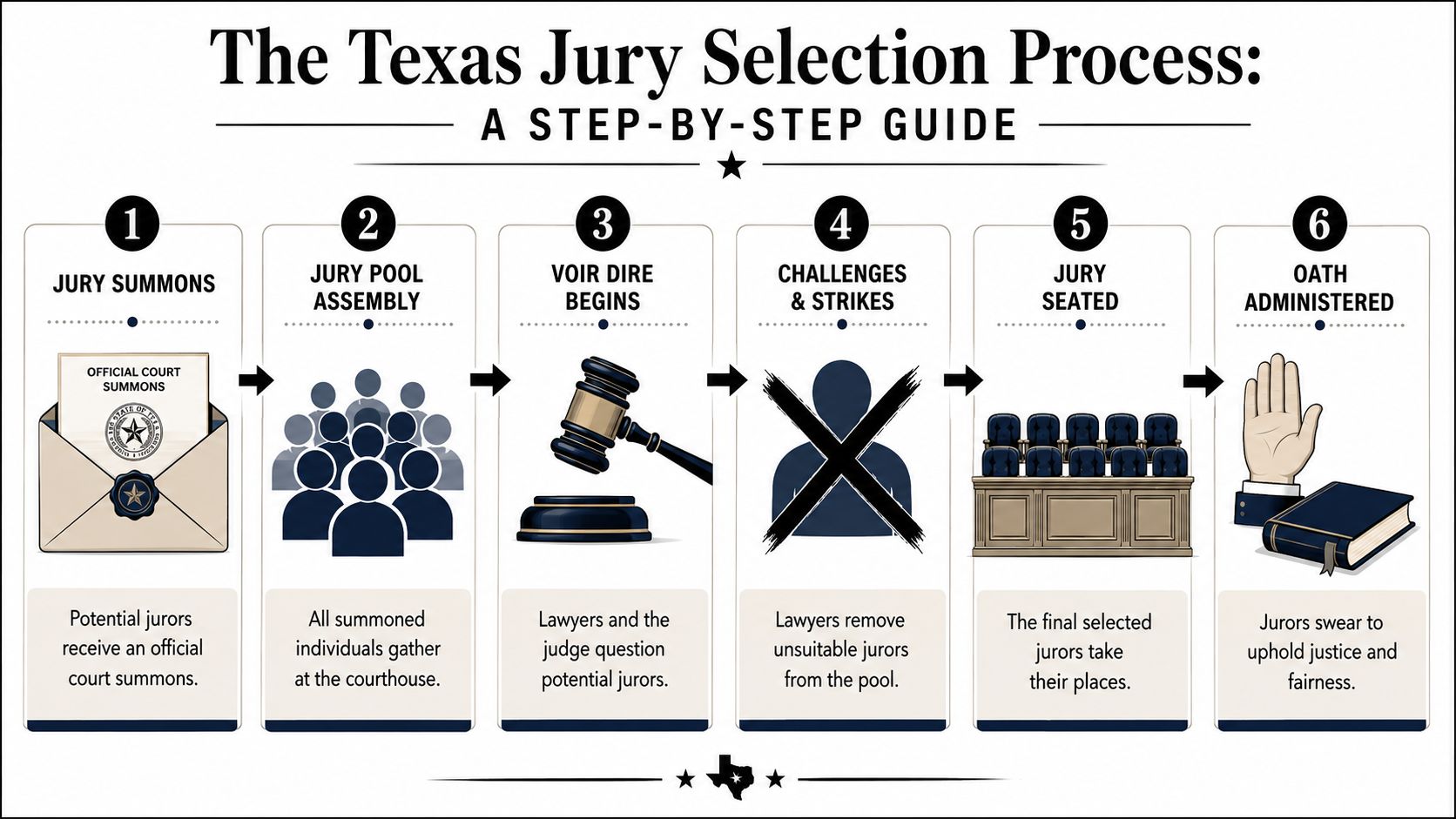
The panel comes in first
The group of potential jurors is often called the venire panel. They are brought into the courtroom, seated, and given basic instructions by the judge.
Texas courts note that district courts usually assemble 50 to 60 prospective jurors, while Texas criminal-defense guidance describes felony panels as often ranging from 60 to 90 jurors and misdemeanor panels as about 18 to 24 people. After questioning, lawyers can seek removals for cause and use peremptory strikes, and the remaining jurors are seated. Felony cases generally end with 12 jurors, while misdemeanor cases use 6 jurors, according to Texas juror information from the state courts.
That difference matters because the room may feel very different depending on the case. A misdemeanor theft case may have a much smaller panel than a felony assault or felony DWI matter.
The judge sets the ground rules
The judge usually starts with basic orientation. Jurors may hear the general nature of the case, the importance of fairness, and instructions not to decide anything too early.
The judge may also ask preliminary questions. These often involve practical issues like whether anyone knows the lawyers, the defendant, the witnesses, or court staff. The purpose is simple. If a juror has a connection that could affect neutrality, the lawyers need to know it before the trial starts.
The lawyers begin questioning
The prosecutor and defense lawyer then question the panel. The order can vary by courtroom, but both sides get time to talk with the jurors and ask follow-up questions.
This part often feels conversational, despite its critical importance. The lawyers may ask for raised hands, short answers, or individual follow-up from particular jurors. Some questions are broad. Others are designed to test a very specific belief.
For readers who want to see how this fits into the full courtroom sequence, this guide on what happens if you go to trial in Texas criminal court gives the larger timeline.
A short courtroom-focused explanation can also help:
What jurors are really being asked
Here is what the questioning is usually trying to uncover:
- Can this person follow the law even if they personally disagree with it?
- Can this person wait for evidence instead of assuming guilt from the charge alone?
- Can this person treat both sides fairly and listen to the whole case?
- Does this person carry a life experience or strong opinion that may make neutrality difficult?
A juror does not have to be blank or emotionless. Real people bring life experiences into court. The issue is whether those experiences prevent fairness.
Some of the most important answers in voir dire are not dramatic. A hesitant pause, an overly confident opinion, or a juror who says “I'd try” instead of “yes” can tell a defense lawyer a lot.
What happens after the questions end
After questioning, the lawyers and judge deal with removals. Some jurors are excused because the law says they should not serve in that case. Others may be removed using limited strike options, which I'll explain next.
Then the final jurors are seated and sworn. At that point, the trial moves forward into the evidence stage.
How Lawyers Remove Jurors Challenges and Strikes
A lot of defendants watch this part of trial and feel helpless. Names are being called, lawyers are whispering, and people are being excused for reasons that are not always obvious. From the defense side, though, this is one of the few moments when your lawyer can still shape the room before any evidence comes in.
Lawyers are trying to answer a practical question: who can judge this case by the actual legal rules, and who is likely to substitute personal rules instead? That is why the removal process matters so much.
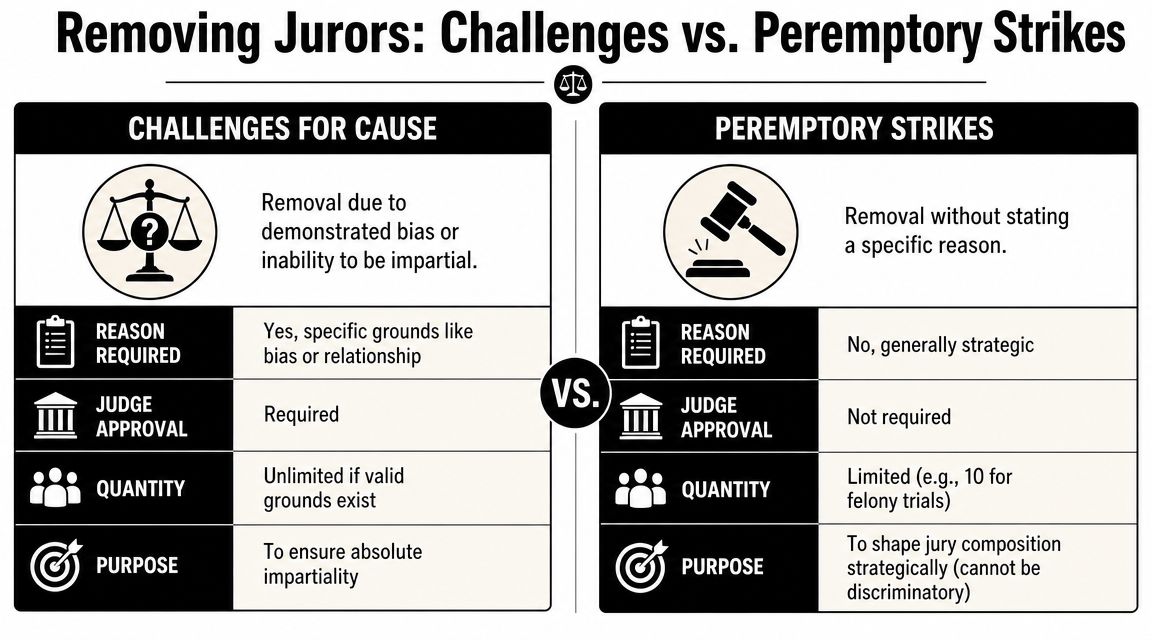
Challenges for cause
A challenge for cause means a lawyer is telling the judge, "This juror has shown a legal reason they cannot serve fairly in this case."
That reason might be bias, a fixed opinion, or an inability to follow the judge's instructions. The judge makes the final call.
Here is a common example. In a DWI case, a prospective juror might say they could never convict unless the State produces a breath test, an eyewitness, or some other extra piece of proof, even if the law does not require it. That answer matters because a juror is not allowed to rewrite the burden of proof. If a juror openly adds requirements that the law does not impose, the defense may ask the judge to excuse that person for cause.
A challenge for cause works like removing a referee who has already admitted they cannot call the game by the rulebook.
Peremptory strikes
A peremptory strike is different. A lawyer can remove a juror without proving the same kind of legal disqualification required for a challenge for cause. But there is an important limit. A peremptory strike cannot be used for a discriminatory reason, such as race or sex.
These strikes are limited, so lawyers guard them carefully.
In real life, this is often where strategy shows up most clearly. A juror may not say anything strong enough for the judge to remove them for cause. Still, their tone, wording, or life experience may suggest risk for one side. That is when a peremptory strike may be used.
Why lawyers care so much about the difference
Clients often ask a fair question: "If someone seems bad for my case, why can't my lawyer just get rid of them?"
Because the law gives lawyers two different tools, and each tool has limits.
If the juror has clearly shown legal bias, your lawyer should usually try a challenge for cause first. That preserves peremptory strikes for closer calls. If the judge denies the challenge, your lawyer may have to decide whether that juror is risky enough to spend one of the limited strikes.
That choice can shape the whole jury.
A defense lawyer may be weighing issues like these:
| Issue | What the lawyer is weighing |
|---|---|
| Strong anti-DWI views | Has the juror admitted a legal bias, or do they just sound unfavorable? |
| Law-enforcement family ties | Will the juror automatically trust police testimony more than other witnesses? |
| Emotional reactions to assault allegations | Can the juror wait for facts, or are they reacting to the accusation alone? |
| Rigid views on theft or drug cases | Will the juror expect the defense to prove innocence instead of holding the State to its burden? |
What this can sound like in court
The questions may seem ordinary, but they are doing careful work.
In a DWI case, a defense lawyer may ask whether anyone believes no one should ever drive after even one drink. In an assault case, the lawyer may ask whether a person claiming self-defense should have to prove it. In a theft case, the lawyer may ask whether possession automatically means intent to steal. In a drug case, the lawyer may test whether jurors can separate mere presence from legal possession.
Those questions are aimed at hidden rules. Every juror comes in with life experience. The problem starts when a juror's personal rule overrides the judge's rule.
Jury selection often reveals the standards jurors may use later in deliberations, long before they say a word in the jury room.
There is also a practical risk your lawyer is watching for. If too many panel members are removed and there are not enough qualified people left to seat the jury required by law, the panel can be "busted," and the court has to bring in a new group. Texas criminal trial lawyers discuss that problem, along with the difference between cause challenges and peremptory strikes, in this Texas voir dire presentation on YouTube.
From a defendant's point of view, the main thing to understand is simple. Your lawyer is not trying to find jurors who already agree with the defense. Your lawyer is trying to identify jurors who will follow the law, hold the State to its burden, and give your case a fair hearing.
Jury Selection in Houston Dallas Austin and San Antonio
The legal rules for voir dire come from Texas law, so the core process is statewide. But anyone who has spent time in criminal court knows local practice matters. The same felony case can feel different in Harris County than it does in Dallas County, Travis County, or Bexar County.
That difference usually shows up in style, pace, and courtroom management.
How local courtrooms can feel different
Some judges prefer brisk, tightly controlled questioning. Others allow broader discussion if the questioning is tied to a real issue in the case. In one courthouse, lawyers may rely heavily on oral questioning in open court. In another, written juror questionnaires may play a larger role before live follow-up begins.
The physical setup can also change the feel of the process. Some courtrooms place jurors close to counsel tables. Others create more distance. That affects eye contact, tone, and the rhythm of questioning.
Here is where local familiarity can matter:
- Houston area courts often move quickly, so lawyers need to identify bias without wasting questions.
- Dallas area courts may have their own judge-specific preferences about how directly lawyers can frame case themes.
- Austin area courts can present panels with strong views on policing, alcohol, or social issues that require careful handling.
- San Antonio area courts may differ in how judges structure panel interaction and follow-up questioning.
These are not different laws. They are different courtroom cultures.
Why local experience matters
A lawyer who regularly tries cases in major Texas counties learns what each courtroom rewards. Some judges want concise questions. Some do not tolerate repetitive ground. Some expect lawyers to get to the legal issue fast.
For a defendant, that matters because jury selection is part law and part human behavior. Knowing local customs can help your lawyer use the available time well, avoid irritating the court, and focus attention on the jurors who matter most.
If you're facing charges in a large metro area, whether you need a Houston criminal lawyer, Texas DWI attorney, or Texas assault defense counsel, courthouse familiarity is not a small detail. It can shape how effectively your defense reaches the panel.
Your Role During Jury Selection A Guide for Defendants
You are sitting beside your lawyer. A prospective juror is answering a question about police credibility, family violence, or alcohol. Across the room, several people glance at you for a second, then look back at counsel. That moment feels small. In a courtroom, it is not.
During voir dire, jurors are judging more than answers. They are also forming an early sense of who you are. They do not know the full story yet. They have not heard the evidence. Until then, they often rely on the simplest signals available, facial expression, posture, attention, and self-control.
That can make defendants anxious. It should also reassure you. Some parts of trial are outside your control. Your courtroom behavior is not.
A practical visual checklist can help.
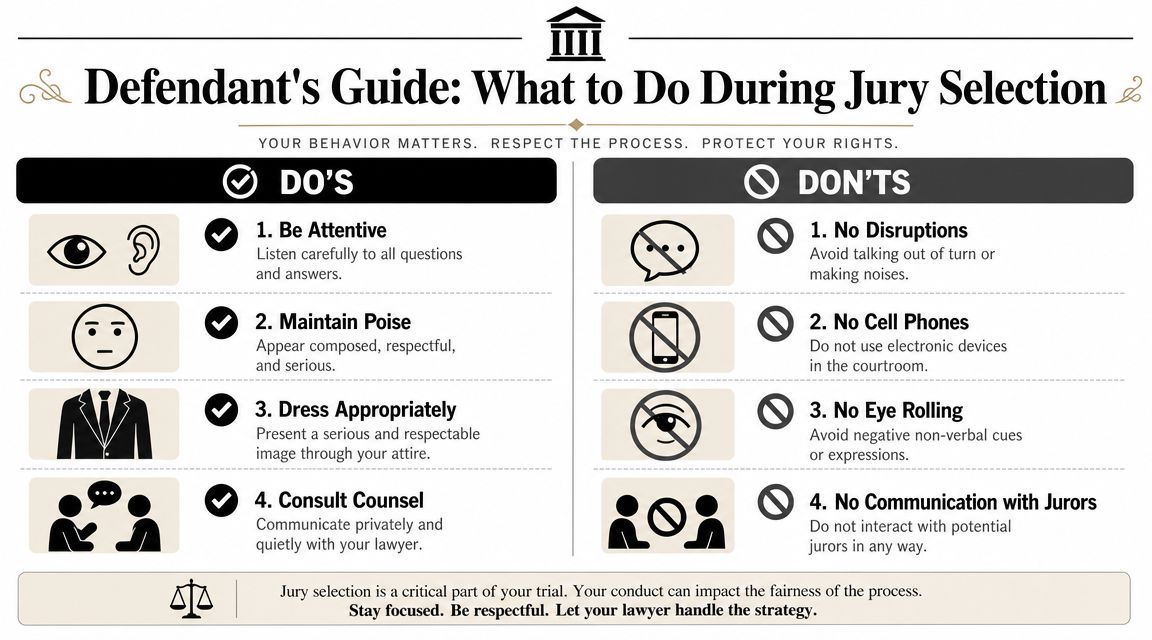
What you should do in the courtroom
Your job is to project steadiness. Jurors tend to trust what looks calm and respectful, especially before they know anything else about the case.
Focus on a few habits:
- Dress neatly and conservatively so you look like someone who understands the seriousness of the day.
- Pay attention throughout questioning even when no one is speaking to you.
- Keep your posture and expression neutral so jurors do not read frustration into your reactions.
- Communicate with your lawyer by leaning over briefly or passing a note if your attorney prefers that method.
A courtroom works like a waiting room where everyone notices more than they admit. If you look irritated, checked out, or amused at the wrong moment, jurors may attach meaning to it even if they are wrong.
What can hurt you before the evidence starts
The biggest problems are often silent ones. A smirk during a hard question. A head shake when a juror talks about crime. A long stare at someone who seems unfavorable. Those reactions can stick in a juror's mind because they seem personal.
Here is a simple way to read it:
| If you do this | Jurors may read it as |
|---|---|
| Whispering constantly | You are distracted or hiding something |
| Looking bored | You do not respect the process |
| Reacting angrily to questions | You may be impulsive or short-tempered |
| Looking attentive and calm | You are taking the case seriously |
Calm usually helps more than cleverness.
How to help your lawyer without getting in the way
Voir dire is partly about legal rules and partly about human judgment. Your lawyer is listening for words that support a challenge for cause or suggest a hidden bias. You are often noticing something different, who seems hostile, who keeps staring at you, who appears open-minded, or which answer felt rehearsed. That input can be useful if you share it the right way.
Good habits include:
- Flag concerns discreetly. If a juror worries you, tell your lawyer in a low voice or write a short note.
- Control visible reactions to painful topics. Some questions will touch raw facts or accusations. Let your attorney handle that ground.
- Be patient with repeated questions. Repetition often serves a purpose. Your lawyer may be building a record for the judge or testing whether a juror really means what they first said.
- Accept that strategy is not always obvious. A juror who makes you uneasy may stay on the panel because another juror presents a bigger legal or strategic problem.
Clients often ask me, "Why would my lawyer keep talking to someone who already sounds bad for us?" The answer is simple. Sometimes a lawyer is giving that juror room to say one more thing, clearly enough that the judge will remove them. Other times the lawyer is comparing that person to the rest of the panel and saving limited strikes for someone worse.
What to expect from your own role
You usually will not speak during jury selection unless your lawyer tells you otherwise. That is normal. Your role is closer to a co-pilot than a second speaker. Stay alert. Notice people. Pass information discreetly. Let your lawyer do the questioning and make the legal calls.
If you are nervous, use a basic routine. Sit still. Breathe slowly. Keep your hands relaxed. Look at the person speaking, whether it is the judge, a juror, or your lawyer. Small discipline in those moments can prevent the kind of first impression that is hard to undo.
The larger picture
Jury selection matters because it sets the tone for everything that follows. A fair panel gives your defense a real chance to be heard. An unfair panel can distort how the evidence is received before opening statements begin.
On the day of voir dire, your assignment is straightforward. Show respect. Stay composed. Help your lawyer discreetly. Let the defense focus on finding the jurors who can listen fairly and decide your case on the evidence.