Being arrested in Texas can be terrifying. You may be out on bond, missing work for court dates, answering questions from family, and wondering whether taking your case to trial is brave, risky, or both.
If you're asking what happens if you go to trial in Texas criminal court, you're really asking several questions at once. How long will this take. What will the prosecutor try to do. What rights do you still have. And how do you decide whether to fight in court or resolve the case earlier.
One hard reality matters from the start. Texas courts face persistent criminal-court backlogs and trial congestion, so people may wait months or longer for a trial date, and some charges move faster than others, as noted in this discussion of Texas court backlogs and trial delay. That delay changes strategy. It can affect plea talks, work schedules, custody status, and the pressure a person feels to end the case.
An Introduction to the Texas Criminal Trial Process
A criminal trial in Texas isn't one conversation in one courtroom on one day. It's a sequence of decisions, objections, testimony, rulings, and risks. Some parts move quickly. Others feel painfully slow.
For many people, the most stressful part is not knowing what comes next. They hear words like arraignment, discovery, motions, voir dire, and punishment phase, but no one translates them into plain English. A good defense lawyer does exactly that. The point isn't just to use legal terms correctly. The point is to help you make sound decisions while the case is still movable.
What trial means in practical terms
If your case goes to trial, the State must try to prove the charge under the applicable law. That could mean a DWI allegation under Texas Penal Code Section 49.04, an assault charge under Texas Penal Code Section 22.01, a theft accusation under Texas Penal Code Section 31.03, or a drug possession case charged under Texas controlled-substance laws. The specific statute matters because it shapes what the prosecutor must prove and what defenses may fit.
Trial also means your constitutional rights matter in a very real way. You have the right to challenge the State's evidence, confront witnesses, call witnesses in your own defense, and require the prosecution to meet its burden in open court. Those rights aren't abstract. They determine how the case is tested.
Practical rule: Trial strategy starts long before jury selection. The strongest courtroom defenses are usually built during the months before trial, when your lawyer is reviewing police reports, video, witness accounts, and legal issues.
Why the process feels longer than expected
People often assume that if they say, "I want a trial," the court will set one right away. That usually isn't how it works. Cases are worked through settings, hearings, evidence exchange, negotiations, and scheduling conflicts. In busy counties, congestion can become part of the case itself.
That doesn't mean waiting is always bad for the defense. Sometimes delay gives your attorney time to gather records, locate witnesses, challenge a stop or search, or negotiate from a stronger position. Sometimes delay hurts because you're in custody, paying for repeated court appearances, or living under bond conditions.
The right approach depends on your charge, your county, your record, and the actual evidence. That's why calm, specific advice matters more than broad promises.
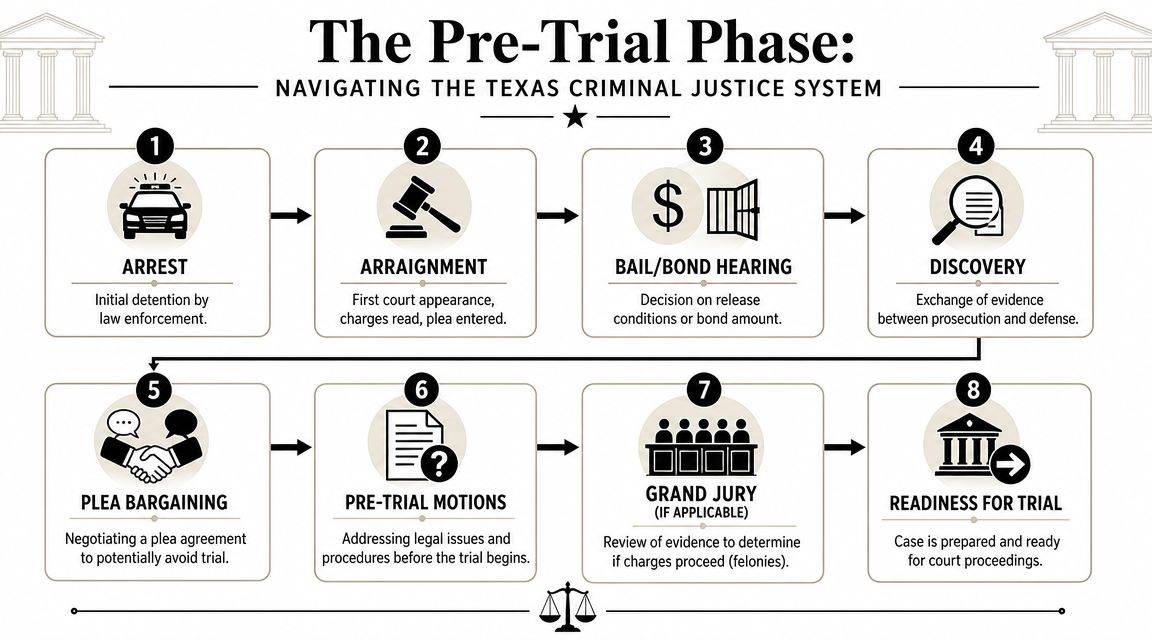
The Crossroads Before Court The Pre-Trial Phase
Most criminal cases are decided before anyone swears in a jury. In Texas, a Houston-area legal analysis says about 90% of criminal cases settle before trial, as explained in this analysis of why most Houston criminal cases settle before trial. That doesn't mean everyone should plead guilty. It means the pre-trial phase is where the primary advantage often lies.
What happens right after arrest
After an arrest, your case usually starts with early court proceedings that may include arraignment, bond decisions, and scheduling. At arraignment, the court addresses the charge and your plea. In many cases, the immediate concern is practical. Can you stay out of jail while the case is pending, and under what conditions.
For someone charged with DWI, assault, theft, or drug possession, those early terms can affect everything else. Bond conditions may limit travel, alcohol use, contact with certain people, firearms possession, or where you can go. Missing a hearing or violating a bond rule can make the case much harder to defend.
Discovery and motions are where cases are built
The next major step is discovery, which means your attorney gets the State's evidence. That may include offense reports, body camera footage, dashcam video, lab results, witness statements, photos, and any prior statements you allegedly made.
At trial, weak cases often begin to reveal their weaknesses. In a DWI case, the stop may be shaky. In an assault case, the witness accounts may conflict. In a theft case, ownership or intent may be less clear than the charging papers suggest. In a drug possession case, the search itself may be vulnerable to challenge.
Your lawyer may also file pre-trial motions. Common examples include motions to suppress evidence, motions to exclude unreliable testimony, and motions that force the State to clarify what it plans to use at trial. If you'd like a closer look at these hearings, this guide on what happens during pretrial hearings in Texas is a useful starting point.
Don't judge your case by the arrest alone. Police allegations are the beginning of the file, not the end of the analysis.
Why plea bargaining matters even if you want trial
Plea bargaining happens during this same period. A plea offer may involve reduced charges, different sentencing terms, or a resolution that avoids the uncertainty of trial. Sometimes the right answer is to reject the offer. Sometimes the right answer is to take a deal because the downside at trial is larger than people realize.
A smart decision usually comes down to a few questions:
- How strong is the State's proof: Not how serious the accusation sounds, but how well the prosecutor can prove each element.
- What legal issues exist: An illegal stop, weak identification, missing witness, or questionable search can change the case.
- What is at stake if you lose: Jail, prison, probation, fines, immigration issues, professional licensing problems, and family consequences all matter.
- Can you live with the offer: Some plea deals solve one problem while creating another, especially for employment, housing, or future charges.
Going to trial is not just refusing a deal. It's choosing to test the case in full view of a judge or jury.
Choosing Your Judge Jury Trial vs Bench Trial
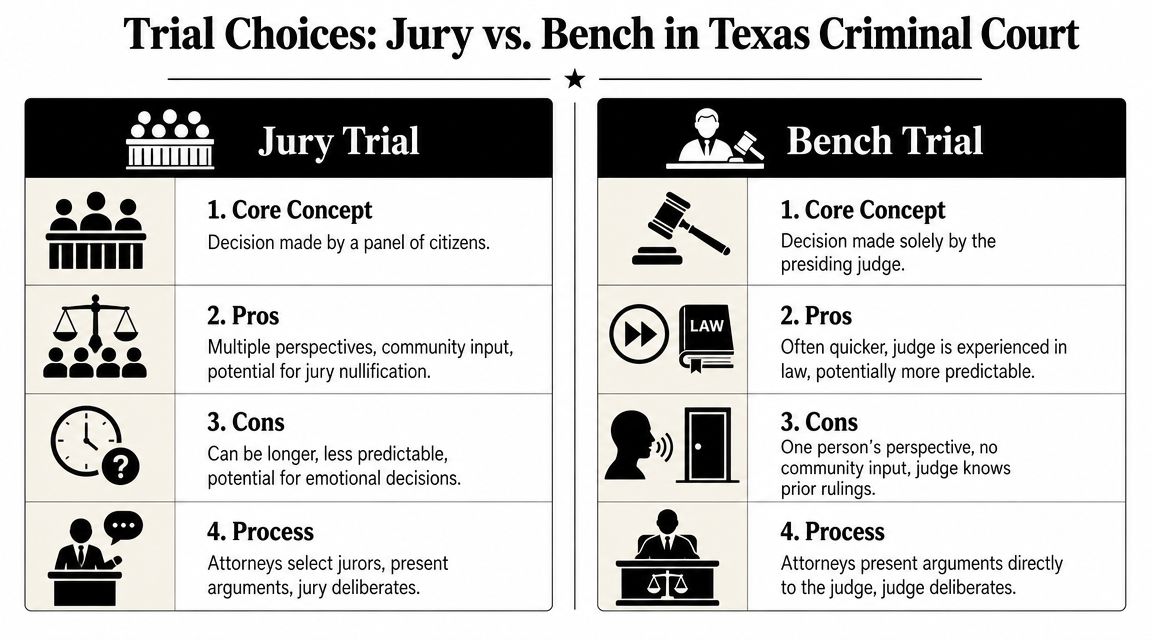
Not every Texas criminal trial is decided by a jury. In some cases, you can choose a bench trial, where the judge decides guilt or innocence. In others, a jury trial makes more sense because the facts, the witnesses, or the human element may land differently with a panel of citizens.
Texas criminal-defense reporting says jury trials accounted for only 0.8% of cases, and among those jury trials, 18% ended in acquittal while 82% ended in conviction, according to this Texas criminal trial statistics review. That same review notes county differences, including lower conviction rates in Harris County than in Tarrant County. The lesson is simple. Trial decisions are local and strategic, not theoretical.
When a jury may help
A jury brings multiple life experiences into the room. That can matter when the case turns on common sense, witness credibility, or whether police conduct felt fair. In a DWI case, jurors may react strongly to shaky field sobriety testimony or missing video. In an assault case, they may focus closely on self-defense, tone, and context. In a theft case, they may look hard at intent.
A jury can also be helpful when the defense theme is straightforward and human. If the case is about doubt, mistaken assumptions, or overcharging, ordinary people may respond well to it.
When a bench trial may help
A bench trial can be the better choice when the case turns on a narrower legal issue rather than emotional presentation. Some judges are well positioned to sort through technical evidence, legal stipulations, and procedural defects without the noise that sometimes comes with jury dynamics.
Bench trials can also be shorter and more focused. That doesn't make them easier. It just means your lawyer may choose a judge-centered format when precision matters more than broad persuasion. For readers dealing with assault charges, this article on an assault bench trial in Texas explains that option in more detail.
The real decision
The choice isn't "judge bad, jury good" or the reverse. The primary question is who is more likely to receive your defense fairly in your specific case.
A few factors often drive that call:
| Trial choice | Often worth considering when |
|---|---|
| Jury trial | Credibility is central, the police conduct is questionable, or community judgment may help |
| Bench trial | The dispute is technical, legally narrow, or better presented to a judge than to a jury |
No experienced defense lawyer should make this choice by habit. It should come from the facts, the forum, and the defense theory.
Inside the Courtroom The Stages of a Texas Criminal Trial
Once trial starts, the room gets more formal, but the logic becomes clearer. Each side has a job. The prosecutor tries to prove the charge. The defense tests whether the proof is reliable, legal, and strong enough to meet the burden.
A felony trial in Texas requires a unanimous jury verdict for conviction. If jurors can't all agree on guilty or not guilty, the judge may declare a mistrial because of a hung jury, which can leave the State to dismiss or try the case again, as explained in this overview of what happens when a Texas criminal case goes to trial.
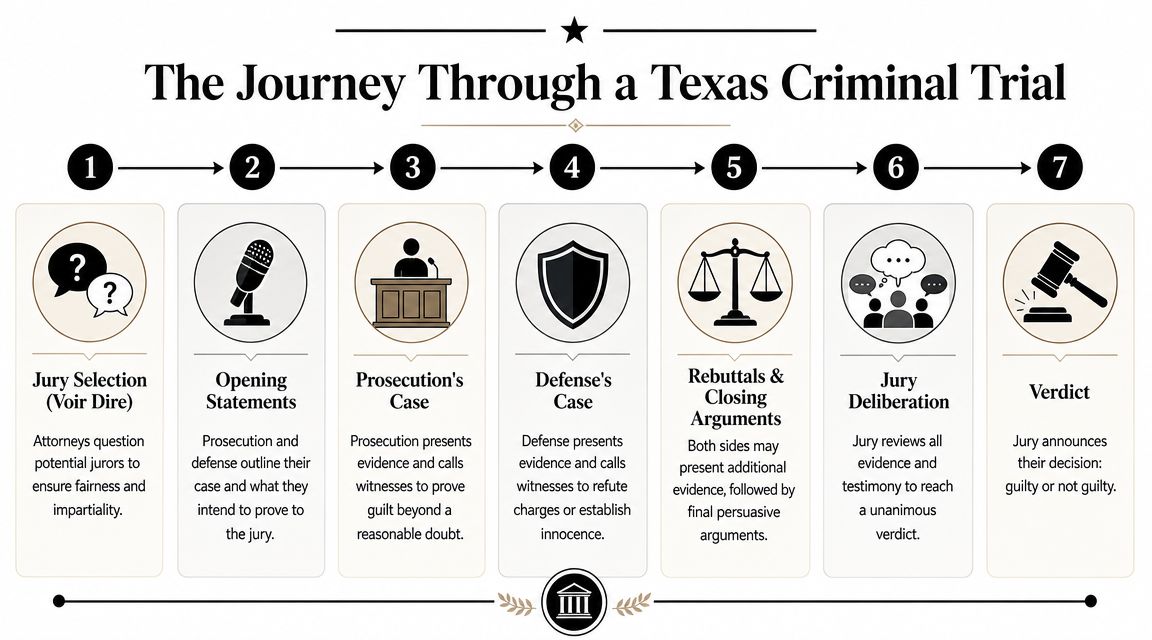
To make the sequence easier to follow, here is the courtroom roadmap.
Jury selection
If you have a jury trial, the process begins with voir dire, which is jury selection. Lawyers question potential jurors to find bias, strong opinions, or life experiences that could affect fairness.
This part's importance is often underestimated. A good defense lawyer isn't looking for "perfect" jurors. That doesn't exist. The goal is a panel willing to follow the burden of proof, listen carefully, and hold the State to it.
Opening statements and the State's case
After the jury is chosen, both sides make opening statements. These aren't evidence. They are roadmaps. The prosecutor tells jurors what the State expects the evidence will show. The defense frames the weaknesses, inconsistencies, or reasonable doubts that will matter.
The prosecution then calls witnesses and offers exhibits. In a DWI case, that may include the arresting officer, body camera footage, and testing evidence. In an assault case, it may include the complainant, medical records, photos, and responding officers. In a drug possession case, it may involve the seizing officer, lab personnel, and chain-of-custody issues.
At every step, your lawyer can object, cross-examine, and challenge the reliability of what the jury is hearing.
Courtroom reality: Trials are rarely won by dramatic speeches. They are often shaped by careful cross-examination, witness preparation, evidentiary objections, and whether the State can keep its story consistent from start to finish.
A short video can help you picture how trial unfolds in practice.
The defense case and closings
The defense may present witnesses, documents, experts, or other evidence. But the defense doesn't have to prove innocence. That point is critical. The burden remains on the State.
Sometimes the strongest defense case is a focused one. After effective cross-examination, a lawyer may decide the jury has already seen enough weakness in the prosecution's proof. In other cases, the defense needs affirmative evidence, such as medical records, phone data, self-defense testimony, or expert analysis.
Closing arguments come last, with each side tying the evidence to the legal standard. The defense theme should be simple and disciplined. If the evidence leaves reasonable doubt, the verdict must reflect that.
The Verdict Potential Outcomes and What They Mean
When the jury returns, the courtroom gets quiet fast. By that point, the legal arguments are over. The only thing left is the result.
There are three practical outcomes.
Not guilty
A not guilty verdict means the State failed to prove the charge. It does not mean the jury found you morally perfect or agreed with every part of your testimony. It means the prosecution did not carry its burden.
That outcome ends the criminal case on that charge. If you've been living under bond conditions, court settings, and public stress, this is the cleanest courtroom ending available.
Guilty
A guilty verdict means the case doesn't stop at the verdict itself. In Texas, the matter moves into punishment. What happens next can be as important as everything that came before, because sentencing exposure may widen sharply once the case enters that next stage.
For many clients, this is the point where trial risk becomes real in a different way. The question is no longer whether the State proved guilt. The question becomes what punishment the court will impose.
Hung jury and mistrial
A hung jury happens when jurors cannot reach the required agreement. In that situation, the judge may declare a mistrial.
A mistrial is not an acquittal. It doesn't erase the case. The prosecutor may retry it, dismiss it, or use the moment to reopen negotiations. In practice, a mistrial often creates a new round of strategic decisions for both sides.
A hung jury can be progress, but it isn't closure. You still need a plan for what the State does next.
If Convicted The Sentencing and Punishment Phase
Texas uses a bifurcated trial system. That means the trial is split into two parts. First comes guilt or innocence. If there is a conviction, the case moves to a separate punishment phase.
That second phase changes the risk analysis in a major way. According to this guide to the Texas criminal trial punishment phase, the court may hear evidence during punishment that was not admissible during guilt-innocence, including prior convictions and other bad-act evidence. That can lead to a much harsher sentence than a defendant expected.
Why punishment can look very different from trial
Many people think, "If the evidence wasn't allowed earlier, why can it come in now?" Because the purpose of the punishment phase is different. The court is no longer deciding whether you committed the charged offense. It is deciding what sentence is appropriate.
That can open the door to a broader picture of your background. If you're a first-time offender, that may give your lawyer room to present mitigation. If you have prior history, alleged bad acts, or facts the prosecutor can frame negatively, the exposure may increase.
What the defense tries to do here
Punishment isn't a formality. It is a second fight.
Your lawyer may present:
- Family and community testimony: People who know your character, work ethic, parenting, service, or stability
- Treatment and rehabilitation evidence: Counseling, substance-abuse treatment, anger management, or other steps that show responsibility
- Employment and education records: Proof that you work, support others, or are building a more stable path
- Context about the offense: Facts that don't excuse conduct but do matter when a judge or jury decides punishment
This can matter in DWI, assault, theft, and drug possession cases alike. A person convicted of DWI may need to show treatment efforts and accountability. In an assault case, context and history may matter. In a theft case, restitution and employment can become important. In a drug case, treatment and recovery often carry weight.
Why this phase affects pre-trial advice
This is one reason experienced lawyers sometimes recommend a plea resolution even when a trial defense exists. The issue isn't fear. It's risk management.
If the likely punishment evidence is broad and damaging, the downside after conviction may be much worse than many defendants expect. Trial may still be the right call. But that decision should be made with full awareness of what the punishment phase can reveal.
Life After the Verdict Post-Trial Options and Your Future
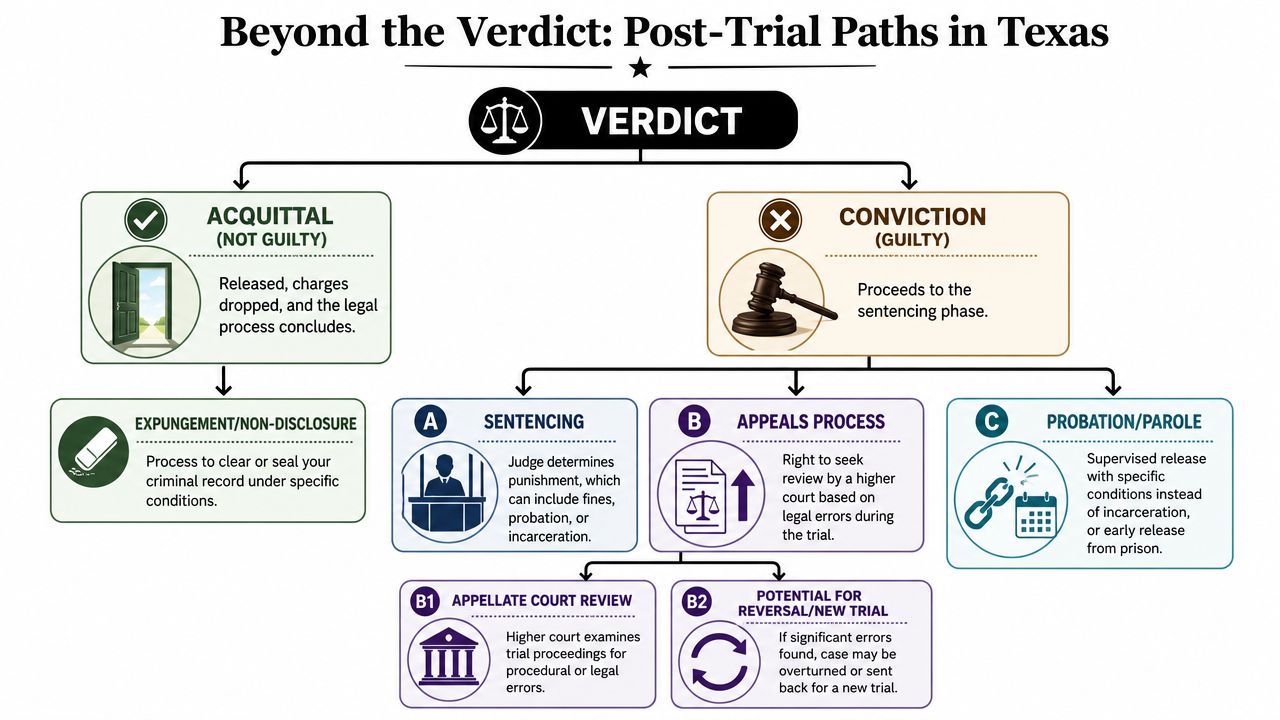
A verdict matters, but it doesn't always close every legal path. Your next steps depend on the outcome, the sentence, and whether legal errors occurred during the case.
If you were convicted
You may have the right to appeal. An appeal isn't a second trial with new witnesses. It is a review of the trial record to determine whether legal error affected the outcome. That might involve evidentiary rulings, constitutional issues, jury-charge problems, or other preserved errors. This guide on how to appeal a criminal conviction explains the basic process.
If the sentence includes community supervision, you must treat every condition seriously. Probation violations can put you back in court quickly. Reporting, testing, classes, fees, travel restrictions, and no-contact rules are not side issues. They are part of the sentence.
If you were acquitted or finished the case
The next question is often your record. Depending on how the case ended, you may be eligible for expunction or an order of nondisclosure. Those are different remedies. One destroys qualifying records. The other seals qualifying information from public view.
If you're looking for practical legal help, firms such as the Law Office of Bryan Fagan PLLC handle criminal defense, appeals, expunctions, nondisclosures, and related post-conviction matters across Texas.
For many people, this stage is about rebuilding. That may include clearing your record, protecting employment, restoring stability at home, and making sure one accusation doesn't define the next decade of your life.
If you've been charged with a crime in Texas, call The Law Office of Bryan Fagan, PLLC for a free and confidential consultation. Our defense team is ready to protect your rights.