Skip to content
Being charged with a crime in Texas can turn your whole life upside down. Then you hear that the witness against you changed their story. For a lot of people, that feels like instant relief. They assume the case is over.
Usually, it isn't.
A changed statement can be a big break for the defense, but it doesn't automatically make the prosecution walk away. In Texas criminal cases, the question isn't just whether a witness changed their story. The primary question is whether the State can still prove its case after that witness became less reliable.
That matters in assault cases, family violence allegations, theft accusations, drug cases, and even DWI cases where a civilian witness gave an important statement. It also matters at every stage of a case: after arrest, at arraignment, during plea negotiations, before trial, at trial, and sometimes even at sentencing.
If you're living through this right now, the smartest move is to stay calm and get strategic. A changed story can create reasonable doubt. It can also expose pressure, confusion, bad police work, or a witness who can't be trusted. But it has to be handled the right way.
Your Witness Changed Their Story Now What
Most clients react the same way at first. They get a call, a text, or word through family that the complaining witness “wants to take it back” or “changed what happened.” Their first thought is simple: good, the case should be dismissed.
That reaction is understandable. It's also risky.
In Texas, prosecutors often keep moving even after a witness backs away from an earlier statement. If police already made an arrest, the State may rely on the original statement, recordings, body-camera footage, photos, text messages, or testimony from officers and other witnesses. That's especially true in assault and family violence cases, where prosecutors are used to dealing with changing accounts.
A better way to look at it is this. A changed story doesn't end the case by itself. It changes the battlefield.
What this usually means for you
You now have a credibility issue in the State's case. That can be powerful if the witness was central to the allegation. It can weaken the prosecution's version of events, improve bargaining power in plea talks, and sometimes set up a trial defense built around reasonable doubt.
But none of that happens automatically. Your lawyer has to preserve the inconsistency, investigate why the witness changed course, and make sure the new version helps rather than hurts.
A witness who changes their story can help the defense, but only if the change is documented and used correctly.
This issue comes up outside Texas too. If you want a broader comparison of how recantations can affect another criminal system, this discussion of military accuser recantation shows the same core tension. A changed accusation can be important, but it rarely ends a prosecution by itself.
Where this fits in the criminal process
If you've already been arrested, your case may move through several stages before anyone decides what the changed story means:
- After arrest: police reports, charging documents, and bond conditions shape the early case.
- Arraignment or first court setting: the court addresses the charge and basic procedure.
- Plea bargaining: both sides reassess risk if a witness became inconsistent.
- Trial preparation: lawyers gather prior statements, recordings, and impeachment material.
- Sentencing or post-conviction issues: credibility problems can still matter if the case doesn't resolve early.
For readers worried about long-term consequences, the outcome of your case may also affect whether you can later seek expunction, record sealing, or other post-conviction relief.
Understanding Inconsistent Statements in Texas Law
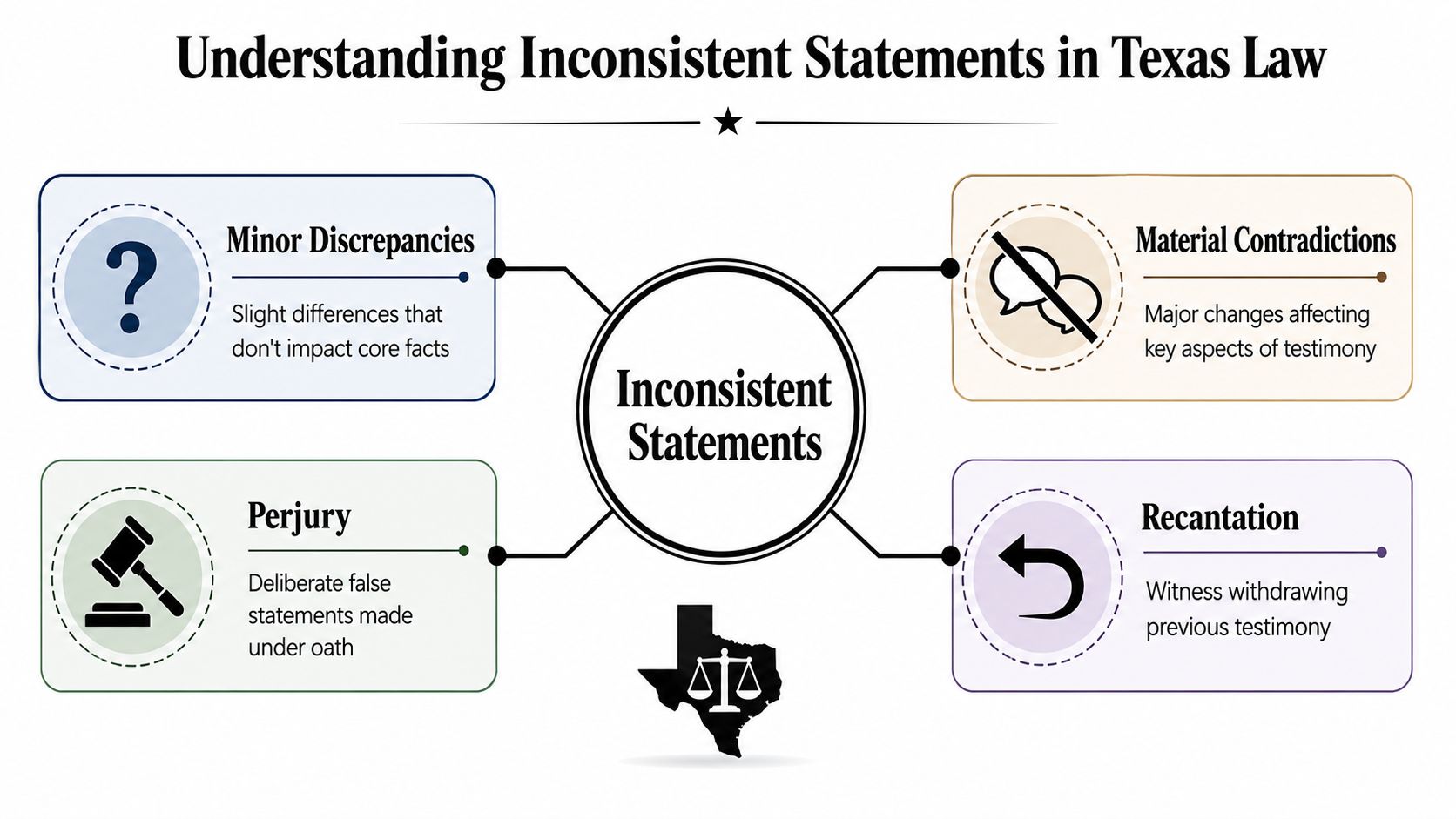
Not every changed story means the same thing. Some differences are minor. Others go straight to the heart of the case.
Minor differences and major contradictions
A witness might first say the incident happened at 9:00 p.m. and later say it was closer to 9:30. That kind of change may matter, but it usually isn't enough by itself to sink a case.
A bigger problem is a material contradiction. That happens when the witness changes a core fact, such as who started a fight, whether any threat was made, whether the accused was even present, or whether an injury happened at all.
Then there is a recantation. In plain English, that means the witness withdraws or reverses an earlier accusation. Sometimes that happens informally. Sometimes it happens in a sworn statement or in court.
The rule lawyers use in court
Texas lawyers usually deal with these changes through Rule 613. In practical terms, that rule lets a lawyer confront a witness with a prior inconsistent statement and ask the jury to consider the inconsistency when deciding whether the witness is believable. A helpful plain-English discussion appears in this post on hearsay evidence in Texas assault cases, because hearsay issues and inconsistent statements often overlap in witness-heavy prosecutions.
Here's the simplest explanation:
| Type of change | What it usually means |
|---|---|
| Small correction | May reflect memory, stress, or poor perception |
| Major contradiction | Can damage the witness's reliability on key facts |
| Full recantation | Can reshape the defense strategy and plea posture |
| False sworn statement | May raise perjury concerns |
Why this distinction matters
A witness who fixes one detail is not the same as a witness who flips the entire accusation. Courts, prosecutors, and defense lawyers treat those situations very differently.
That difference also affects case exposure. In Felony vs. Misdemeanor Charges in Texas, you can see how Texas classifies offenses and the penalty range for each level. If the accusation involves a felony, the potential penalties are greater, and a witness inconsistency often becomes a central trial issue instead of a side dispute.
Practical rule: The more the changed statement affects the core allegation, the more useful it becomes for the defense.
The Legal Impact A Changed Story Is a Credibility Problem
A lot of people ask the same question: if the witness changed their story, shouldn't the case be dropped?
Usually, no.
In Texas criminal cases, a witness's changed story is usually treated as a credibility problem, not an automatic dismissal. Under Rule 613, counsel can confront the witness with a prior inconsistent statement, and the jury may use that inconsistency to judge reliability rather than accepting the latest version as decisive, as discussed in this explanation of witness statements in Texas criminal cases.
Why the case may still continue
The prosecutor doesn't have to abandon the case just because the witness changed course. The State may argue that the first statement was true and the later one was false. Or the prosecutor may tell the jury that both statements show confusion, but that other evidence still proves guilt.
That's why changed stories often affect the weight of the evidence more than the basic admissibility of the case. The jury gets to decide what to believe.
This comes up often in:
- Assault cases: especially when the allegation depends on one person's account.
- Theft cases: where a complaining witness later softens or changes identification details.
- Drug cases: when a co-defendant or informant starts changing facts.
- DWI-related cases: when a civilian witness changes what they saw before officers arrived.
What your lawyer is trying to prove
The defense goal is not just to show that the witness changed their story. The primary goal is to show that the witness is unreliable on the facts that matter most.
That can create reasonable doubt. If jurors think the State's key witness has told two incompatible versions, they may stop trusting the prosecution's whole narrative.
A courtroom version of this often sounds simple:
- Which version should the jury believe?
- Why did the witness change?
- Is there independent evidence that confirms one version?
- If the witness can't be trusted, what is left?
If the prosecution's main witness can't keep the facts straight, that weakness can spread through the entire case.
Why this matters during plea bargaining and trial
Before trial, credibility problems can change negotiations. A prosecutor who felt confident early on may become more cautious if a witness now looks vulnerable on cross-examination. That can affect charge reductions, deferred outcomes where available, or a dismissal evaluation.
At trial, the effect can be even bigger. Jurors don't just listen to words. They watch hesitation, tone, confidence, and the witness's explanation for why the story changed. Sometimes the inconsistency hurts the State a little. Sometimes it becomes the whole defense.
How Defense and Prosecution Strategies Shift
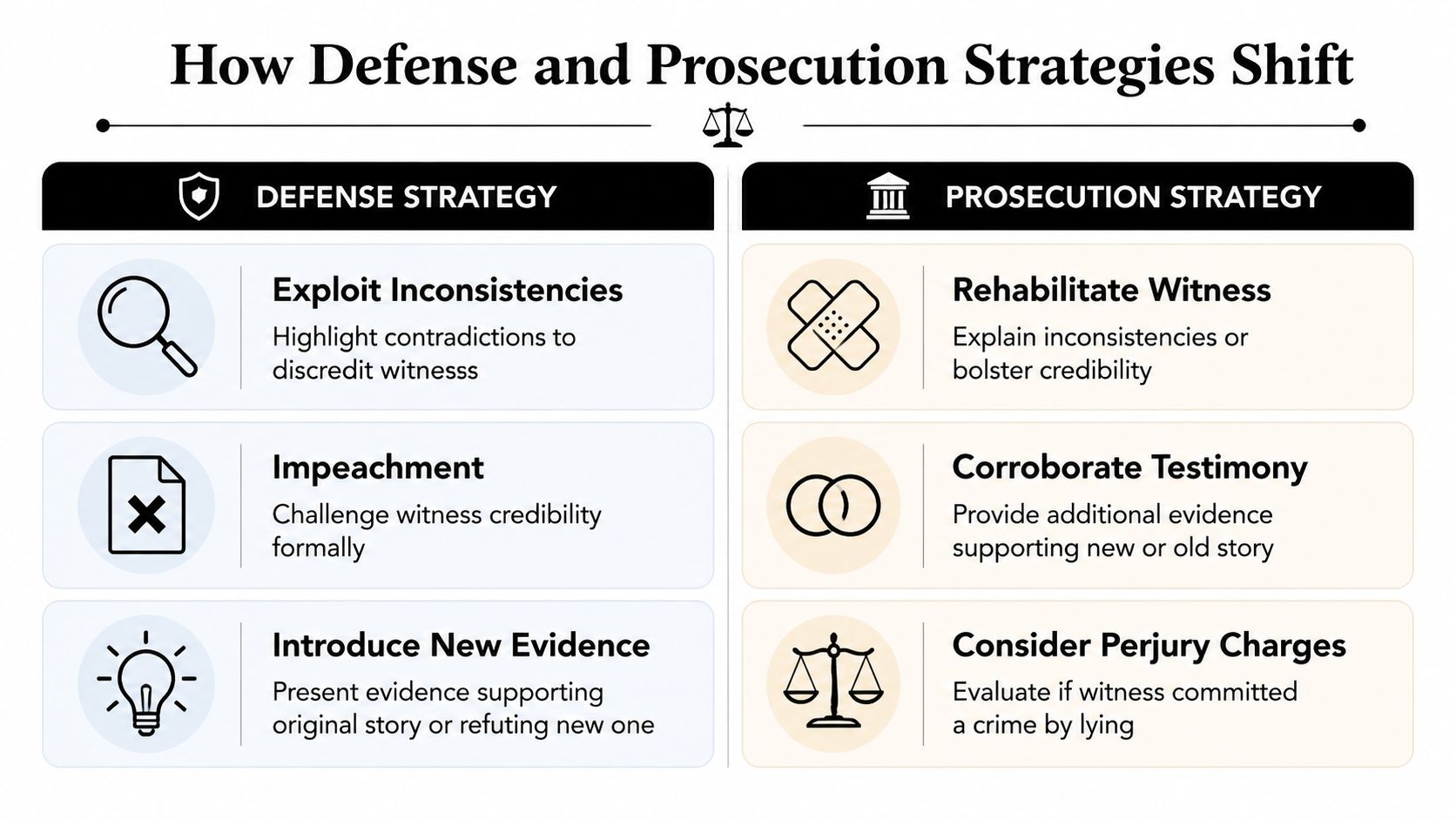
A case can change direction in one hearing when a witness tells the jury something different from what they told police, a prosecutor, or a grand jury. That does not automatically end the prosecution. It does give the defense a clear target. If the State's story depends on one person, and that person is now inconsistent, the defense can press on reliability, motive, memory, and pressure all at once.
What the defense tries to do
From the defense side, the job is to pin down every version of the account and show the jury exactly where the story moved. That includes 911 calls, body camera video, offense reports, text messages, social media posts, medical records, affidavits, and prior testimony. Good cross-examination is rarely dramatic. It is careful, chronological, and tied to facts that matter.
The legal tool for this is impeachment, which means showing why the witness should not be believed on a disputed point. In practice, that often involves four steps:
- Preserve the new version: get the changed account recorded, written, or given under oath if possible.
- Compare each version line by line: identify what changed, when it changed, and whether the change affects a key fact or a minor detail.
- Test the reason for the change: fear, outside pressure, bad memory, intoxication, anger, and regret all play differently in front of a jury.
- Tie the inconsistency to the State's burden: if the witness is shaky on identification, consent, ownership, assaultive conduct, or intent, the problem is bigger than credibility alone.
That last point matters. A changed story is not just a witness problem. It can become a prosecution problem if the revised facts undermine an element the State has to prove beyond a reasonable doubt.
What the prosecution tries to do
Prosecutors usually respond by trying to save one version of the story and explain away the other. They may argue the witness was frightened the first time, embarrassed the second time, or pressured later by family, friends, or the accused. In some cases, they will treat the recantation as the lie. In others, they will admit there are inconsistencies and ask the jury to focus on the parts they say stayed the same.
Here is how that fight usually looks in court:
| Defense focus | Prosecution response |
|---|---|
| Show the witness cannot keep the facts straight | Argue trauma, stress, or confusion explains the inconsistency |
| Show the new version helps the accused | Argue the witness changed course because of pressure or fear |
| Show key facts now lack support | Use recordings, photos, officers, experts, or other witnesses to fill the gap |
| Show the original accusation may have been false | Point to prior sworn statements or ask about possible false report exposure, including issues related to a false report charge under Texas law |
A prosecutor may also ask the court to admit prior statements under the Texas rules if there is a valid basis to do it. Whether that works depends on how the statement was made, whether it was under oath, and the purpose for offering it. Those details matter. They often decide whether the jury hears only the live testimony or also hears the witness's earlier version in a more formal way.
What usually works, and what usually fails
For the defense, the strongest approach is precision. Exact words. Exact dates. Exact changes. Jurors respond to a clean timeline more than broad claims that someone "kept changing their story."
For the State, independent corroboration is usually the difference between a manageable problem and a serious one. If prosecutors can support the charge with physical evidence, digital evidence, or testimony from someone else, they have room to argue the witness is messy but the case is still sound. If they cannot, the inconsistency can swallow the whole theory of prosecution.
I tell clients this often. A changed story makes the case harder to predict, but it also gives the defense a real opening. Used correctly, it lets us challenge far more than the witness. It lets us challenge the reliability of the State's entire narrative.
What Happens to the Witness Criminal Charges for Lying
People often worry about the witness next. If the witness changed their story, can they be charged with a crime?
The short answer is yes, sometimes. But it's not automatic.

Perjury and false reports
Under Texas Penal Code § 37.02, perjury generally means making a false statement under oath or swearing to the truth of a false statement when the person intends to deceive and the statement is required or authorized by law to be made under oath.
Under Texas Penal Code § 37.03, aggravated perjury is more serious and applies when the false statement is made during an official proceeding and is material.
A separate issue is making a false report to law enforcement. If that concern is part of your case, this discussion of Texas Penal Code false report gives useful background on how that offense is treated.
Why these charges are harder than people think
Changing a story does not automatically prove the witness intentionally lied. Memory can change. Stress affects recall. Some witnesses speak carelessly. Others try to correct something after they calm down.
To bring a charge like perjury, the State would need to prove deliberate falsity, not just inconsistency. That's a much harder task than many people assume.
In practice, prosecutors are often more focused on the underlying assault, theft, drug, or DWI case than on opening a new case against a wavering witness. That doesn't mean it never happens. It means you shouldn't assume it will.
A short video overview may help if you're trying to understand how this issue plays out in real cases:
Why defendants should be careful here
If the witness is worried about getting in trouble, that fear can affect what they say next. It can also make the case more volatile. A witness who feels trapped may retreat, freeze, or become unpredictable in court.
That is one more reason you should never try to manage the witness yourself. Any contact can be misread as pressure, coercion, or witness tampering.
Why the Story Changed How Judges and Juries View Recantations
The reason behind the change often matters more than the change itself.
Judges and juries do not hear a recantation in a vacuum. They want to know why the witness told one version first and another version later. The answer can shape the entire case.
Honest correction versus outside pressure
Some changes are innocent. A witness may remember more after reviewing messages, seeing video, or getting away from a chaotic scene. That can make the later version seem more trustworthy.
Other changes look suspicious. A witness may face pressure from family, fear retaliation, or regret involving police. In some cases, the original statement may have been pushed by officers during a stressful investigation. In others, the later statement may be the one shaped by pressure.
The verified data on this point is straightforward: the reason a witness changed their story heavily influences the legal outcome, and courts and juries treat an honest memory correction very differently from a coerced recantation due to pressure from police or family. That is why evidence like body-camera footage or text messages can be vital in showing whether the change is genuine or false, as described in this discussion of why witness story changes matter.
The types of proof that matter most
A jury usually trusts objective evidence more than shifting memory. That is why lawyers focus on records created close to the event.
Important examples include:
- Body-camera footage: shows tone, injuries, emotional state, and timing.
- Text messages: can reveal pressure, apology, fear, or planning.
- 911 recordings: may preserve the first account before later influence.
- Medical records or photos: can support or undercut the claimed harm.
- Prior written statements: help expose exactly what changed.
If this issue arose in a family violence case, this guide on assault victim recantation in Texas addresses some of the recurring problems that show up when relationships, fear, and ongoing contact complicate witness testimony.
Juries often care less about the fact that a story changed than about whether the reason for the change makes sense.
How this plays in front of a judge or jury
A believable explanation can soften an inconsistency. A weak explanation can destroy a witness.
That is why cross-examination often focuses on motive. Not because motive is everything, but because motive helps jurors choose which version, if any, deserves belief.
What to Do Next Practical Steps for Your Defense
A witness changes their story on Monday. By Tuesday, a defendant has often made the same mistake I warn clients about in almost every case. They call, text, or try to "clear things up." That can turn a helpful development into a new allegation of witness tampering, bond violations, or consciousness of guilt.
Treat the changed story as evidence to preserve, not a personal problem to solve yourself. A recantation does not automatically end the case in Texas, but it can give the defense real room to attack the State's theory if it is handled carefully and documented the right way.
What you should do right away
Start with discipline.
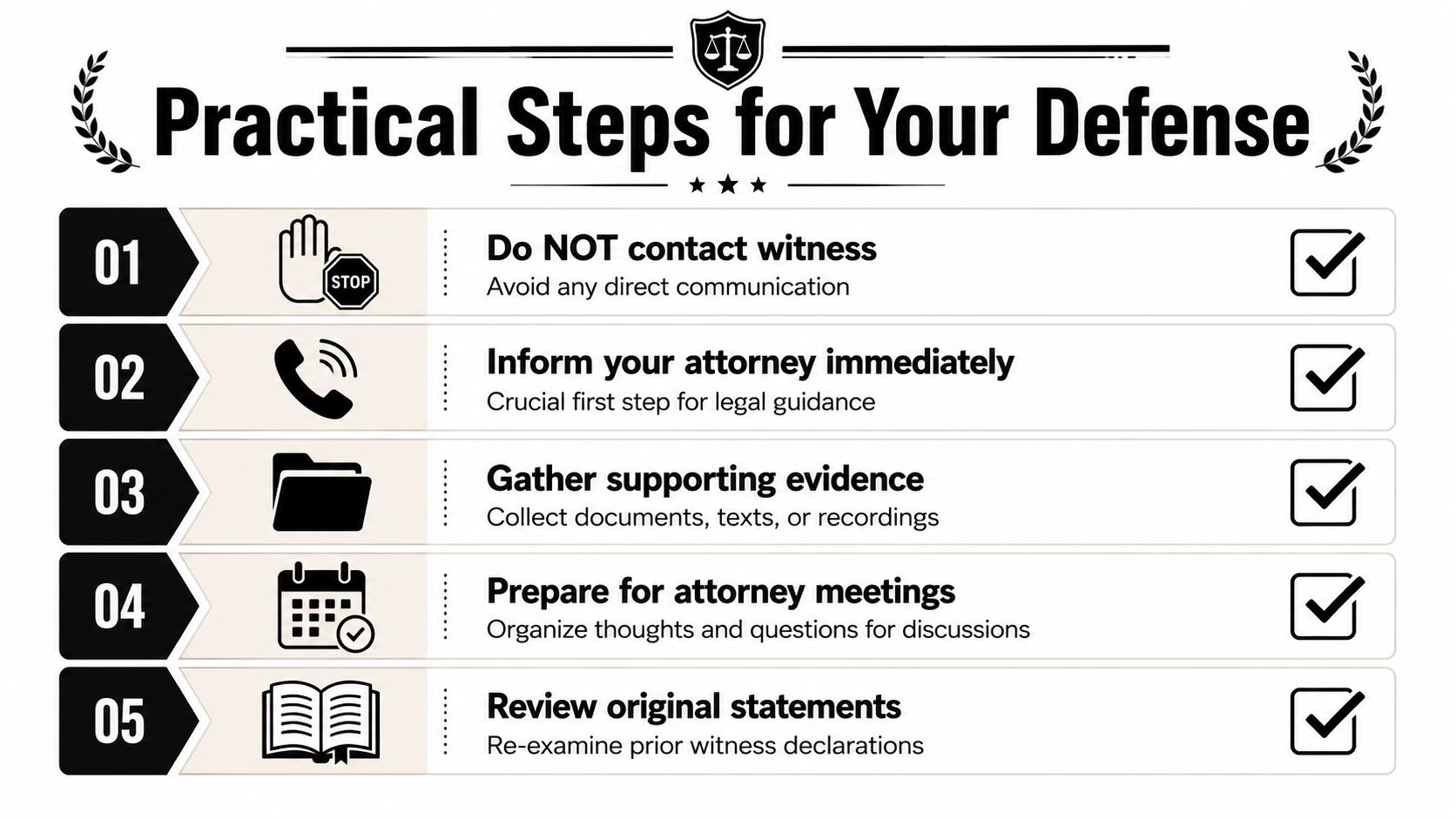
- Do not contact the witness. Even a calm or friendly message can be framed as pressure, coaching, or intimidation.
- Tell your lawyer immediately. The timing matters because your lawyer may need to preserve messages, request records, or lock down the new version before it changes again.
- Save everything. Keep screenshots, call logs, voicemails, emails, social media messages, and anything else showing what was said and when.
- Follow every bond condition exactly. A no-contact violation can put you in a worse position than the original inconsistency helps.
- Be ready for the defense strategy to change. In some cases, the best use of a changed story is a dismissal push. In others, it improves plea negotiations or becomes trial ammunition against the witness's credibility.
What your attorney may do next
A defense lawyer will usually compare the new account to the first statement, police reports, recordings, medical records, and any other evidence created close to the event. The goal is not just to show that the witness changed course. The goal is to show why the prosecutor can no longer present a clean, reliable narrative to a judge or jury.
That may mean getting a sworn statement, preserving texts, interviewing other witnesses, subpoenaing records, or forcing the State to commit to one version of events. In some courts, local practice affects how quickly those issues reach the prosecutor or get aired in a hearing. Speed matters, but control matters more.
The Law Office of Bryan Fagan PLLC handles Texas criminal defense matters involving misdemeanors, felonies, and record-related relief, including cases where witness credibility becomes a central issue. If your case is later dismissed or resolved favorably, you may also want to review Expunction and Nondisclosure in Texas to understand whether you can clear or seal your record.
What not to do
These mistakes hurt cases fast:
- Do not coach the witness on what to say.
- Do not post about the case online.
- Do not assume the prosecutor will dismiss the charge without pressure from the defense.
- Do not miss court because you think the case is falling apart.
A changed story creates opportunity, but only if the defense controls the record, the timing, and the message. I tell clients the same thing in this situation every time. Stay quiet, keep evidence, follow your conditions, and let your lawyer turn the inconsistency into a credibility attack the State has to answer.