You're at work, or at home with your family, and your phone lights up. A police officer wants to “ask a few questions.” Or maybe your spouse says they've made a report. Or your employer tells you there's been a complaint. In a few minutes, your life can feel upside down.
If you're trying to understand what happens if you are falsely accused of a crime in Texas, start with this: an accusation is serious, but it is not proof. You still have rights. You still have options. And the moves you make in the next few hours can protect you or badly damage your case.
An Accusation Is Not a Conviction
A false accusation usually hits fast. First comes panic. Then anger. Then the urge to explain everything to anyone who will listen. That urge is dangerous.
Texas courts, police, prosecutors, employers, licensing boards, and family courts may all react before facts are established. That's why innocent people get caught in the system. According to the Innocence Project of Texas on exonerations and wrongful convictions, the estimated wrongful-conviction rate in Texas is 2% to 6%, which it translates into roughly 3,000 to 9,000 innocent people in Texas prisons at any given time. The same source says perjury or false accusations contributed to 61% of exonerations.
That should tell you two things.
First, false allegations are not rare enough to dismiss as fantasy. Second, innocence by itself doesn't protect you if you handle the situation badly.
Hard truth: Good people talk themselves into charges every day because they think honesty alone will clear things up.
Maybe the accusation involves assault, theft, drug possession, harassment, or a domestic dispute. The label matters, but the early strategy is often the same. Stay calm. Stop talking. Start preserving evidence. Get legal help before you give anyone a statement.
Texas law does provide safeguards. The State has to prove its case. You have the right to remain silent. You have the right to a lawyer. You have the right to challenge the evidence and the accuser's story. But rights only help if you use them.
A false accusation is the start of a legal process. It is not the end of your story.
Your First 48 Hours After a False Accusation
The first two days matter more than is commonly understood. Phone data gets overwritten. Camera footage disappears. Witnesses forget details. And once you start talking, you can't take your words back.
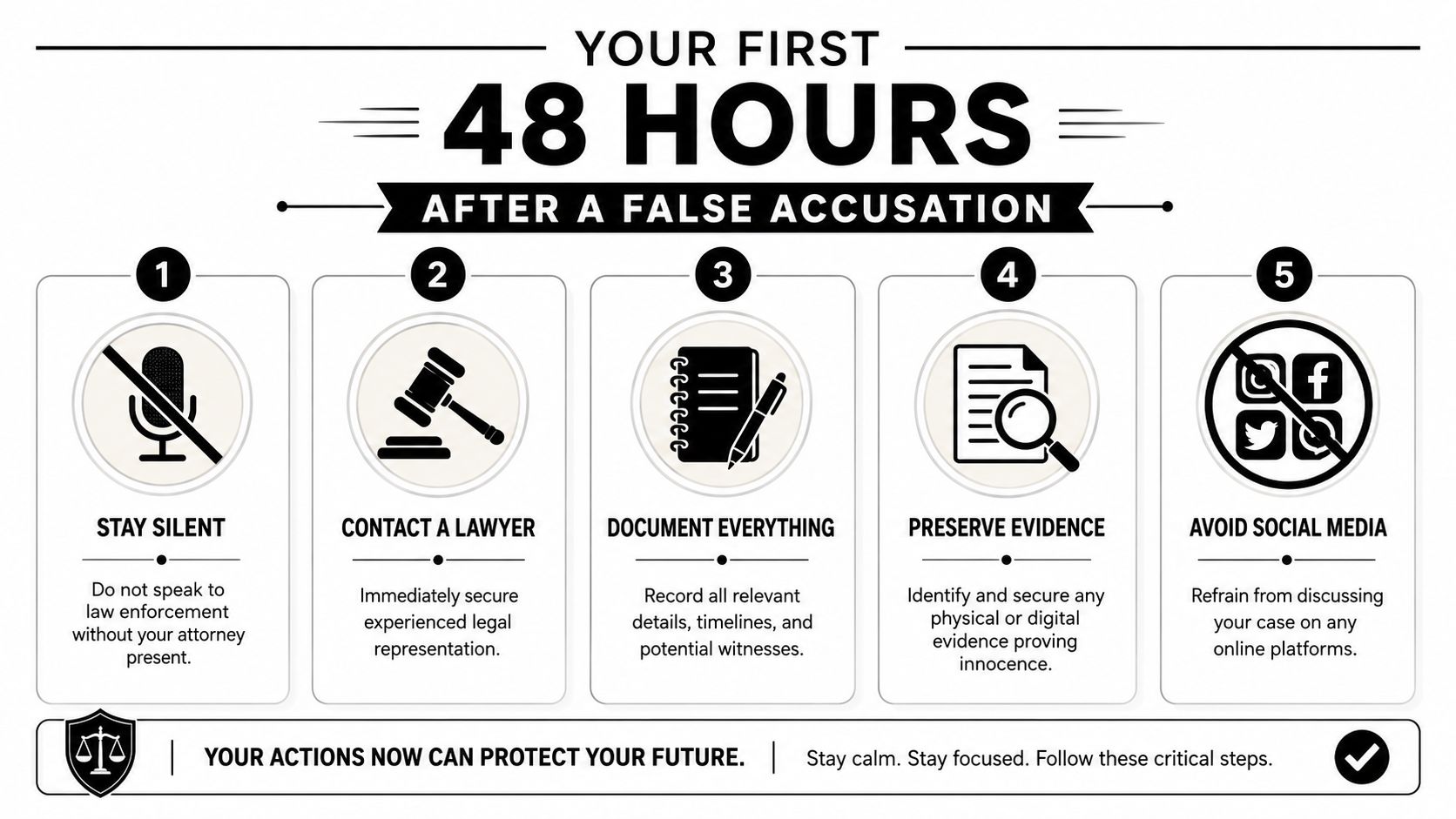
Do these things immediately
Start with five actions.
Use your right to remain silent
If police contact you, keep it simple: you want a lawyer, and you won't answer questions without counsel. Don't “just explain.” Don't try to sound cooperative by filling in gaps. A false accusation case often turns on timing, wording, and small details.
Call a defense lawyer fast
Early intervention can shape the case before it hardens. A lawyer may be able to communicate with investigators, stop a bad interview from happening, and start gathering favorable evidence before it disappears. If you need a practical companion guide, review what to do immediately after getting arrested in Texas.
Lock down your evidence
The practical defense priority is to preserve exculpatory data immediately, including texts, call logs, GPS or location records, receipts, emails, and surveillance footage, because those items are often the fastest way to build a verifiable alibi and challenge the timeline of the complaint, as explained by the Texas Criminal Defense Group on defending against false accusations.
What to preserve right now
Don't rely on memory. Gather and save:
- Texts and messages that show what happened before, during, and after the event
- Call history that places you in contact with key people
- Location data from your phone, apps, car, or photos
- Receipts and transaction records showing where you were
- Emails and calendar entries that support your timeline
- Camera footage from homes, businesses, doorbells, parking lots, or workplaces
- Witness names with phone numbers and a short note about what they saw
If the accusation involves violence, review Assault and Violent Crime Defense in Texas for issue-specific background on how these cases are charged.
A short video explanation can also help you understand the pressure points in the early stage of a criminal case.
Don't make these mistakes
People hurt themselves most often in predictable ways:
- Don't contact the accuser. No apology, no argument, no “can we clear this up.” That message can be twisted into intimidation, consciousness of guilt, or a protective-order problem.
- Don't post online. Social media is evidence. Delete nothing without legal advice, but stop posting about the case.
- Don't let officers search devices or accounts casually. Be polite. Don't consent. Let your lawyer evaluate warrants, scope, and privacy issues.
When you're innocent, silence feels unnatural. Use it anyway.
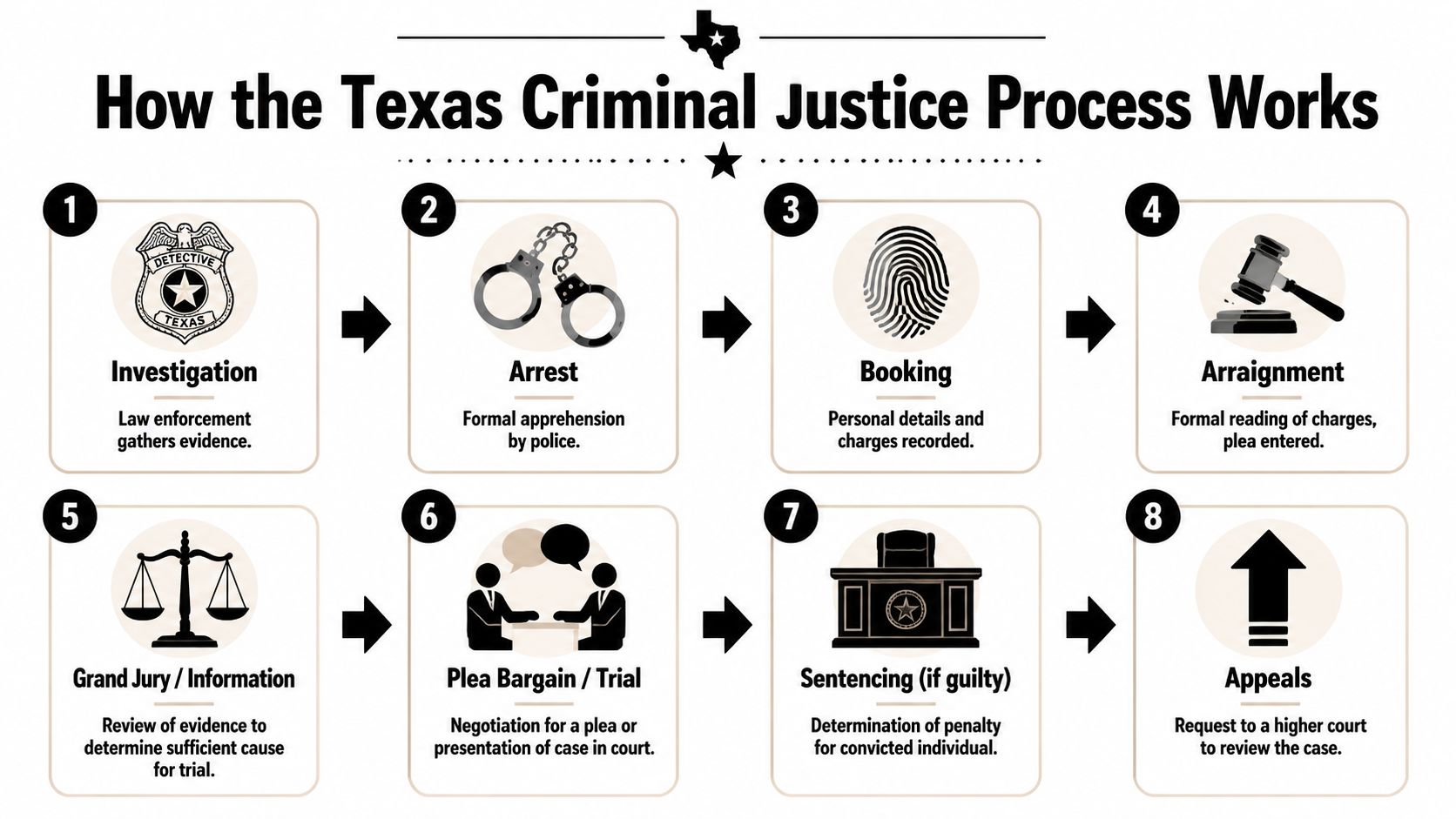
How the Texas Criminal Justice Process Works
False accusations become dangerous when they move from rumor into procedure. Once that happens, you need to know where the pressure points are.
Investigation is not the same as charges
Police may investigate before any arrest. They may interview witnesses, collect physical evidence, review messages, or seek video. If they think they have enough, they may make an arrest or refer the case to prosecutors.
An arrest is not a conviction. It isn't even a formal finding that the accusation is true. It means law enforcement believes there is a legal basis to take you into custody or require you to answer the charge.
Many people confuse three different stages:
| Stage | What it means | What you should do |
|---|---|---|
| Investigation | Police are gathering information | Say nothing without counsel |
| Arrest | You are taken into custody or processed | Focus on release conditions and defense strategy |
| Formal charge | Prosecutors move the case forward in court | Challenge evidence early |
For a plain-language overview of the sequence, this Texas criminal justice process guide is a useful starting point. If you want a second general roadmap from the bond side of the system, Cherokee Bail Bonds' justice process guide also lays out the major stages in reader-friendly terms.
What happens after arrest
If officers arrest you, they usually book you. That often means fingerprints, photographs, personal information, and entry into the jail system. Then comes the fight over release.
A judge may set bond and conditions of release. Those conditions matter. In false accusation cases, release terms can affect where you live, who you can contact, whether you can return home, and whether you can possess firearms.
Practical rule: Follow every bond condition exactly, even if the accusation is absurd. Violating conditions creates a new problem and distracts from your innocence.
How charging decisions move forward
Texas crimes are generally classified as misdemeanors or felonies. In plain English, misdemeanors are less serious than felonies, but both can hurt your record, your job, and your future. The exact charge controls the court process, possible punishment, and whether the case may go through indictment.
In many felony cases, prosecutors present the matter to a grand jury. In other cases, they may proceed using a charging instrument allowed by law. Either way, your lawyer's job is to force the State to prove each element, expose weaknesses, and push back before bad facts get accepted as settled facts.
Arraignment, plea offers, trial, and sentencing
At arraignment or your first formal court appearance, the court addresses the accusation and your response to it. This is not the time to improvise. It is the time to let your lawyer control the record.
From there, the case often moves through:
- Discovery, where your lawyer seeks the State's evidence
- Pretrial motions, which may challenge unlawfully obtained evidence or weak pleadings
- Negotiations, if dismissal, reduction, or another resolution is possible
- Trial, if the State won't back down and the facts need to be tested in court
- Sentencing, only if there is a conviction or plea that requires it
- Appeals, if legal error affected the outcome
Even if you're innocent, don't assume the case will collapse on its own. Prosecutors don't dismiss every weak case immediately. Some need pressure. Some need investigation. Some need a jury.
Building Your Defense Against a False Allegation
A real defense is not “I told them I didn't do it.” A real defense is evidence, pressure, timing, and credibility.

What a strong defense actually looks like
Your lawyer should build the case from the ground up, not wait for the prosecutor's theory to harden. In many false allegation cases, the key questions are simple:
- Was the accuser mistaken?
- Is the accuser lying?
- Is someone else responsible?
- Does the timeline make sense?
- Did police skip steps, ignore contradictions, or overread weak evidence?
That often means developing an alibi, collecting independent records, interviewing witnesses before memories shift, and comparing every statement for inconsistency. In assault cases, it may involve injuries, self-defense facts, or missing video. In theft cases, it may involve ownership disputes, permission, or sloppy identification. In drug cases, it may involve control of the area where substances were found. If your case involves substances, Drug Crime Defense in Texas gives a focused overview of common possession and trafficking issues.
False reports can matter in your defense
Texas law doesn't just focus on the accused. It can also expose the accuser to separate liability if the report was knowingly false. The Scheiner Law discussion of false accusations in Texas notes that reporting a crime falsely can lead to charges such as false report to a peace officer, with penalties that can include fines and jail time.
That doesn't mean every bad accusation turns into a case against the accuser. It does mean motive and fabrication matter. If an accuser had a reason to lie, such as revenge, gaining an advantage in custody, jealousy, or workplace conflict, your defense should develop that theme carefully and with evidence.
Use legal tools, not just arguments
A defense lawyer can do more than tell your side of the story. Depending on the facts, your lawyer may file motions to suppress illegally obtained evidence, challenge witness identifications, contest the reliability of statements, or press the State on missing evidence.
The Law Office of Bryan Fagan, PLLC handles Texas criminal defense matters involving misdemeanors, felonies, protective-order issues, and post-case record clearing. That kind of coordinated approach matters in false accusation cases because the criminal case is only part of the problem.
Some cases are won by disproving the accusation. Others are won by exposing how the accusation was built.
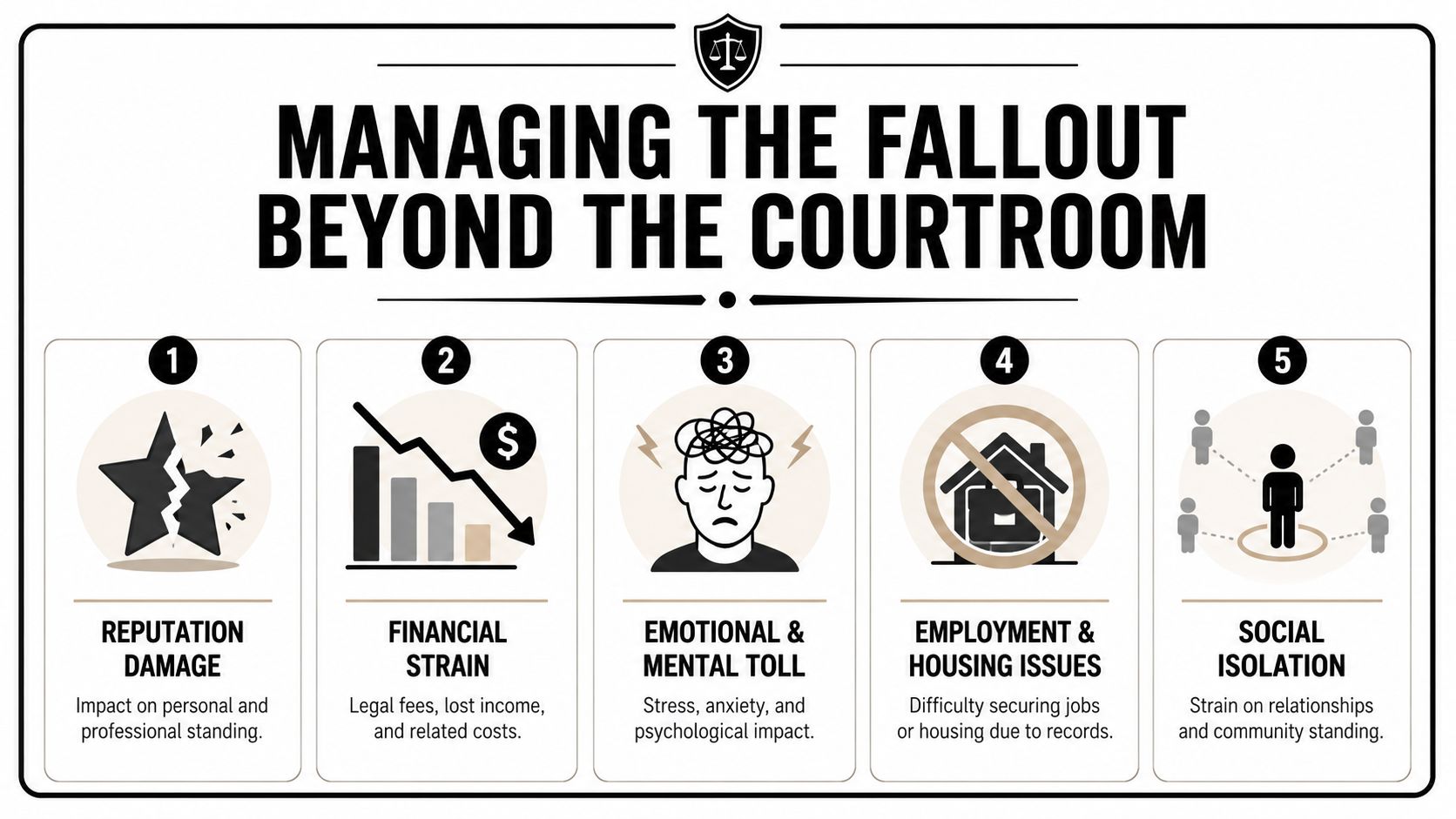
Managing the Fallout Beyond the Courtroom
A false accusation doesn't stay neatly inside a criminal file. It spills into your home, your paycheck, your children's lives, and your reputation.
Family and protective-order problems
Many people are blindsided by the consequences of a false domestic violence allegation. Such an allegation can trigger immediate arrest, loss of gun rights, and protective orders that affect child custody, professional licensing, and background checks, even if criminal charges are later dismissed, as explained in Cofer Luster's discussion of false domestic violence allegations in Texas.
If a protective order enters the picture, don't treat it like paperwork. Treat it like a direct threat to your freedom and family access.
You need to know:
- Where you can go and whether you can return home
- Who you can contact, including your spouse or partner
- How child exchanges will happen
- Whether firearm possession is restricted
- How any alleged violation could create a new criminal charge
If children are involved, don't send emotional messages trying to “set the record straight.” Judges care about restraint. Angry texts can do more damage than the original allegation.
Work, licensing, and public reputation
Employers often react before courts do. Some suspend first and ask questions later. Licensed professionals can face reporting duties, internal reviews, or discipline. Background checks can surface arrests even without convictions.
Use a controlled response. Don't overshare. Don't hand your employer a long narrative that can later conflict with your legal defense. Ask your lawyer what can be disclosed, to whom, and when.
This quick reference helps:
| Area affected | Immediate risk | Smart response |
|---|---|---|
| Employment | Suspension, HR investigation, lost income | Give a minimal, lawyer-approved statement |
| Licensing | Reporting issues, board scrutiny | Check reporting obligations fast |
| Firearms | Possession restrictions after orders or bond terms | Comply fully and document compliance |
| Family access | Child custody and visitation problems | Get court-specific advice before contact |
Think on two tracks
Many individuals focus only on beating the criminal case. That's necessary, but it's incomplete.
You should think on two tracks at once:
- Criminal defense track with silence, legal representation, bond compliance, and evidence challenges
- Damage-control track with work planning, family-law awareness, document preservation, and reputation management
If you protect only the criminal case and ignore the fallout, you can still lose your job, your license, or time with your children.
Clearing Your Name and Rebuilding Your Life
When the case ends in dismissal, acquittal, or another favorable result, don't stop there. Winning the criminal case is not the same as cleaning up the damage.
Expunction and record sealing matter
Texas offers tools that may help you move forward, including expunctions and orders of nondisclosure. In simple terms, an expunction is meant to remove eligible records from public view more completely, while nondisclosure generally seals eligible records from the public but not from every government use. Which option applies depends on how the case ended and your specific history.
If you want a practical next step, read how to clear your record in Texas. This part matters because employers, landlords, schools, and licensing bodies may keep reacting to an old arrest long after the criminal case is over.
Civil claims may follow a false accusation
Some people also have grounds to pursue civil recovery after the criminal matter is resolved. Depending on the facts, that may involve claims such as defamation, malicious prosecution, or false imprisonment. But timing matters.
Don't rush into a civil lawsuit while the criminal case is still active unless your lawyer tells you it's strategically sound. The better approach is usually to preserve every text, post, call record, witness statement, and document now so you can evaluate those claims later from a position of strength.
Texas recognizes the damage wrongful convictions cause
Texas has a formal compensation framework for people who were wrongfully convicted. Under Texas exoneree-compensation law, a wrongfully convicted person is entitled to $80,000 per year of wrongful incarceration, plus an annuity, according to the Innocence Project's overview of Texas exoneree compensation.
That law exists for a reason. Texas recognizes that a false accusation, when combined with system error, can destroy years of a person's life.
You don't have to accept that damage as permanent. Clear the record if you can. Evaluate civil options if they fit. Rebuild in a deliberate way, with legal guidance, not guesswork.
If you've been charged with a crime in Texas, call Law Office of Bryan Fagan PLLC for a free and confidential consultation. Our defense team is ready to protect your rights.