Being arrested in Texas can be terrifying and disorienting — but you don’t have to face it alone. From the very first moment, you are shielded by critical constitutional rights designed to make sure you're treated fairly. Understanding these rights isn't just a good idea—it's your first and most powerful line of defense.
Your Immediate Rights After a Texas Arrest
The moments during and right after an arrest are chaotic and stressful. Knowing your rights can keep you from turning a bad situation into a disaster. The most important things you can do are stay calm, stay quiet, and ask for a lawyer. These actions aren't an admission of guilt; they are smart, strategic moves to protect your future.
When you're arrested, you're stepping into a complex legal system where the stakes are incredibly high. Understanding what happens when you get arrested and your rights within that process is absolutely essential to protecting yourself.
The Right to Remain Silent
Your Fifth Amendment right to remain silent is your single most powerful tool. Police officers are trained to ask questions and get you talking, but you have no obligation to answer them without your attorney present. So many people feel the urge to "explain their side of the story," hoping to clear things up on the spot. This almost always ends up hurting their case.
The single most important sentence you can say is this: "I am invoking my right to remain silent, and I want to speak with my lawyer." Once you say those words, officers are legally required to stop questioning you.
Say it clearly and calmly. If they keep asking questions, just repeat it. Don't offer any other information, justifications, or even small talk. This simple act stops you from accidentally saying something that could be twisted and used against you in court.
Understanding Your Miranda Rights
You’ve heard it on TV a million times: "You have the right to remain silent. Anything you say can and will be used against you in a court of law…" This isn't just dialogue from a crime show; it's a summary of your core constitutional protections. Let's break down what those words actually mean for you in plain English:
- You have the right to remain silent: This is a direct reminder that you do not have to talk to the police.
- Anything you say can and will be used against you: Even a casual comment or an attempt to be helpful can be spun by the prosecution to build their case.
- You have the right to an attorney: You are entitled to have a lawyer with you during any and all questioning.
- If you cannot afford an attorney, one will be appointed for you: This guarantees that everyone has access to legal counsel, regardless of their financial situation.
The whole point of these rights is to protect you from incriminating yourself. If you believe the police violated your rights—for example, by continuing to question you after you asked for a lawyer—it's critical to discuss potential Miranda rights violations with an experienced Texas assault defense attorney.
Practical Steps to Take During an Arrest
While using your voice to invoke your rights is key, how you act physically matters just as much. Do not resist arrest, even if you are 100% certain it is unjust.
Resisting can lead to new charges, like Resisting Arrest under Texas Penal Code § 38.03, which only complicates your situation. Stay calm and comply with physical instructions, but remain verbally silent. This combination of physical cooperation and verbal silence is the safest way to get through the initial arrest.
To make things even clearer, here’s a quick-reference guide to what you should and shouldn't do from the moment of arrest.
Quick Guide to Your Rights During an Arrest
This table breaks down your fundamental rights and the exact actions you should take to protect them.
| Your Right | What It Means for You | What You Should Say or Do |
|---|---|---|
| Right to Remain Silent | You cannot be forced to answer questions or provide information that could be used against you. | Say: "I am invoking my right to remain silent. I want to speak with my lawyer." Then, say nothing else. |
| Right to an Attorney | You are entitled to have a lawyer present before and during any police questioning. | Say: "I want a lawyer." Do not answer any questions until your attorney arrives. |
| Protection from Unlawful Search | Police generally need a warrant to search your property (home, car, phone). There are exceptions, but you don't have to consent. | Say: "I do not consent to a search." Do not physically interfere, but clearly state your refusal. |
| Right to Know the Charges | You have the right to be informed of the specific criminal charges being filed against you, usually at your arraignment. | Ask: "What am I being charged with?" But do not discuss the details of the charge with police. |
Remembering these simple phrases can feel difficult under stress, but they are the legal shield you need to protect yourself and your future.
Navigating the Booking and Arraignment Process
Once an arrest is made, the action moves from the street to the station. This next phase is called booking, and while it can feel overwhelming, it's mostly an administrative process. Knowing what to expect here can help you stay calm and focused on protecting your rights.
During booking, the police will formally record your arrest. Expect them to take your fingerprints, snap a "mugshot," and collect basic personal information like your name, address, and date of birth. Remember, you only have to provide these identifying details—stick to your right to remain silent about anything related to the case.
This is a critical time to remember the three most important rules after an arrest: stay calm, stay silent, and call your lawyer.
This simple flowchart breaks down the best way to handle this stressful situation.
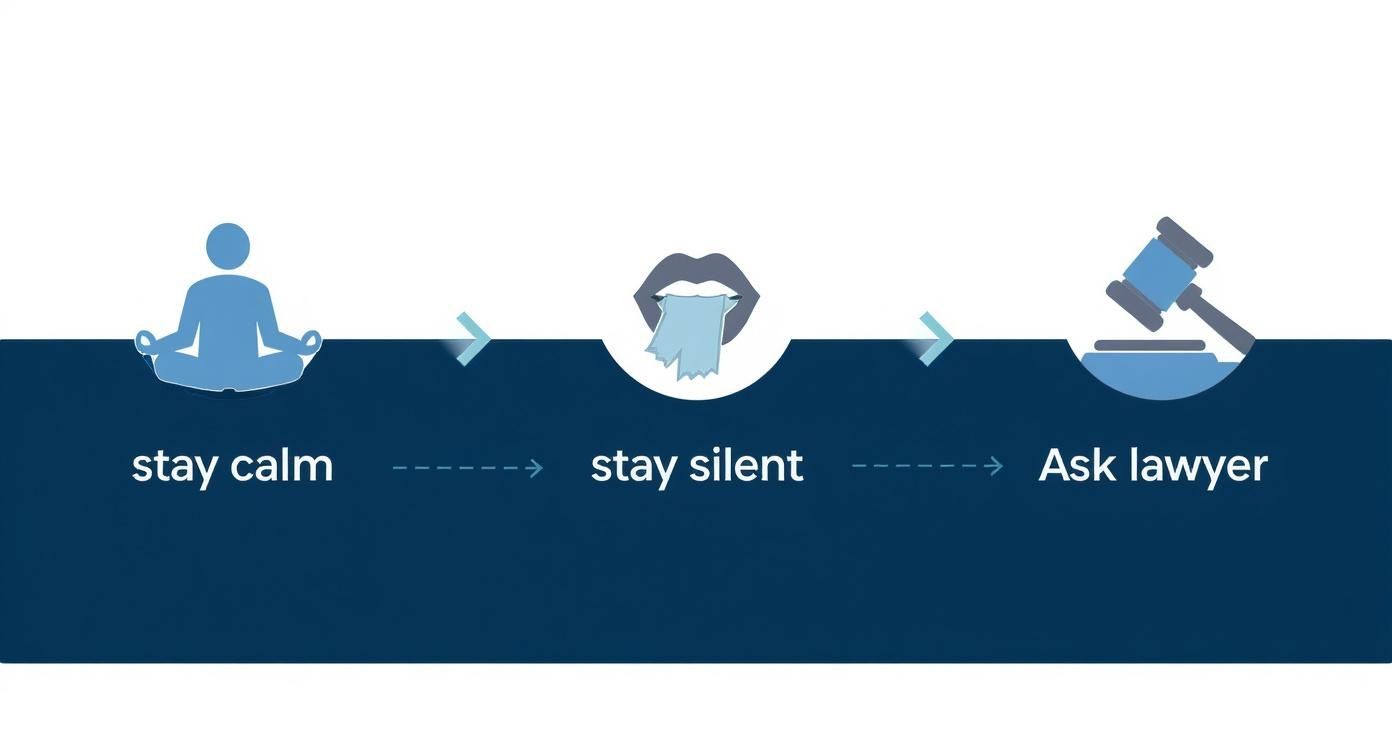
As you can see, the most effective things you can do are to stay calm, say nothing, and wait for your attorney to arrive.
Your First 48 Hours and the Probable Cause Hearing
The moment you're booked, a legal clock starts ticking. Under Texas law, you can't be held indefinitely without seeing a judge. Authorities have to bring you before a magistrate for a probable cause hearing, which almost always happens within 48 hours of your arrest.
This hearing is not your trial. It has one specific purpose: a neutral judge reviews the facts to decide if the police had a legitimate legal reason—known as probable cause—to arrest you in the first place. If the judge finds that probable cause was lacking, you could be released right then and there.
The Arraignment: Your First Court Appearance
Your first formal appearance in court is called the arraignment, and it's a pivotal moment in your case. A few key things happen during the arraignment:
- Formal Charges are Read: The judge will officially state the criminal charges the prosecutor has filed against you.
- Your Rights are Explained: The court will again inform you of your constitutional rights, including the right to an attorney.
- A Plea is Entered: You'll be asked to enter a plea of "guilty," "not guilty," or "no contest."
At this early stage, the plea should almost always be "not guilty." Pleading not guilty isn't a lie; it's a formal legal move that preserves all of your rights. It gives your attorney the time they need to review the evidence, investigate the case, and build a strong defense.
Having an experienced Houston criminal lawyer by your side during the arraignment is absolutely crucial. Your attorney will handle the legal formalities, make sure your rights are protected, and immediately start arguing for your release on the best possible terms, like a personal recognizance bond or a reasonable bail amount. You can learn more about the specifics of what happens at an arraignment hearing in our detailed guide.
This initial court appearance sets the tone for everything that follows. With a skilled defense attorney present, you can be confident that you're starting your defense from a position of strength, turning an intimidating process into a series of manageable, strategic steps.
How Bail and Bond Secure Your Release from Jail
After an arrest and booking, the first thing on your mind is getting out of jail. This is where the bail and bond system comes in. Think of bail as a financial guarantee—a kind of security deposit—you give the court to promise you'll return for all your required appearances. Securing your release isn't just about going home; it's about getting back to your life and, most importantly, working with your attorney to build a strong defense from the outside.

The bail amount isn't just a number pulled out of thin air. A Texas judge carefully considers several key factors to strike a balance between your right to be free and the court's need to ensure you don't disappear.
How Judges Determine Your Bail Amount
When you go before a magistrate for the first time, they'll weigh different parts of your case and your personal background to land on a bail figure. While the process is meant to be individualized, the seriousness of the alleged crime always plays a huge role.
Here are the key factors a judge will look at:
- The Seriousness of the Charge: A misdemeanor DWI will almost always have a much lower bail than a felony assault charge. The more severe the potential punishment, the higher the bail.
- Your Criminal History: If you have a track record of skipping court dates or have prior convictions, a judge is going to see you as a bigger risk and will likely set a higher bail.
- Your Ties to the Community: Do you have a steady job? A family that lives nearby? Have you lived in the area for a long time? These things show the judge you're not a "flight risk" and have good reason to stick around.
- Public Safety Concerns: The judge must also ask whether releasing you would pose a danger to the alleged victim or the community. This is a major consideration in cases involving assault or other violent crimes.
A sharp criminal defense lawyer can make a real difference at this hearing. They can argue on your behalf, presenting evidence of your community ties and other positive factors to push for the lowest possible bail—or even for your release without having to pay a dime.
Your Options for Posting Bond
Once the judge sets a bail amount, you have a few ways to get it paid and secure your release. Each path has different financial implications, so the best one really depends on your specific situation.
Your freedom is the priority. Understanding your bond options is the first step toward getting out of jail and starting your defense on the right foot. It allows you to fight your case from home, not from a jail cell.
In Texas, you generally have three ways to post bond:
Personal Recognizance (PR) Bond: This is the best-case scenario. A judge might agree to release you on your "personal recognizance," which is just your written promise to show up for all your court dates. No money changes hands, though you might owe a small administrative fee. PR bonds are usually reserved for people with little to no criminal history who are facing non-violent, low-level charges.
Cash Bond: This one is straightforward. You or your family pay the full bail amount directly to the court. So, if your bail is set at $5,000, you have to come up with $5,000 in cash. The good news? As long as you make it to all your court appearances, that money is returned to you when the case is over (minus some minor court fees).
Surety Bond (Bail Bondsman): This is the most common route people take. If you can't afford to pay the full cash bond, you can hire a bail bond company. You pay the bondsman a non-refundable fee, which is typically 10-15% of the total bail amount. In exchange, the bondsman puts up the full amount with the court, taking on the financial risk if you decide not to show up.
Knowing how these options work is crucial. You can dive deeper into the specifics in our comprehensive guide on how bail and bond in Texas works. Having an attorney guide you through this process will help you make the smartest financial and legal decisions for your future.
Building Your Defense During the Pretrial Phase
Once you’re released from jail, the real legal work kicks into high gear. The time between your arraignment and a potential trial is known as the pretrial phase, and frankly, it's often where your case is either won or lost. This period is anything but quiet; it’s when your criminal defense attorney is working tirelessly behind the scenes to take the prosecution's case apart, piece by piece.
This phase isn't just about waiting around for a court date. It's an active, strategic period of gathering evidence, challenging the state’s claims, and building a powerful defense. A proactive approach here can lead to reduced charges, a favorable plea deal, or even getting your case thrown out completely.
Uncovering the Evidence Through Discovery
The foundation of any solid defense is information. In Texas, the formal process that allows your attorney to get their hands on all the evidence the prosecutor has against you is called discovery. This isn't a casual request—it's a comprehensive legal demand for every single piece of information tied to your case.
Through discovery, your lawyer can obtain crucial materials like:
- Police Reports: The official story of your arrest and the alleged crime.
- Witness Statements: What people told law enforcement, which can be full of contradictions.
- Body Cam and Dash Cam Footage: Objective video evidence that often tells a very different story than the written report.
- Lab Results: Critical evidence in drug possession or Texas DWI cases, such as blood alcohol content (BAC) reports.
- Photographs and Physical Evidence: Any other items the prosecution intends to use to build their case.
This process ensures there are no surprises down the road. By seeing the state's entire hand, your attorney can spot weaknesses, inconsistencies, and potential violations of your rights.
Challenging the State's Case with Pretrial Motions
After digging through all the discovery materials, your attorney will look for opportunities to challenge the legality of the state's evidence. This is done by filing pretrial motions—formal legal requests asking the judge to take a specific action, like throwing out certain evidence so it can't be used at trial.
A successful motion to suppress can be a total game-changer. If key evidence was obtained illegally—for example, through an unlawful search of your car—a judge can rule that the prosecution is forbidden from using it against you. This can cripple their case, often forcing a dismissal.
Common pretrial motions include:
- Motion to Suppress Evidence: Argues that evidence was collected in violation of your constitutional rights against illegal search and seizure.
- Motion to Dismiss: Asks the court to throw out the charges entirely because of insufficient evidence or a violation of your due process rights.
These motions are your attorney’s tools for leveling the playing field and holding law enforcement accountable for their actions.
The Reality of Plea Bargaining
The vast majority of criminal cases in Texas—upwards of 90%—never make it to a full trial. Instead, they’re resolved through plea bargaining. A plea bargain is a negotiated agreement between your defense attorney and the prosecutor. In exchange for you pleading "guilty" or "no contest," the prosecutor agrees to a lesser charge or a more lenient sentence.
Negotiating a plea is a delicate dance. Your attorney uses the weaknesses found during discovery and the threat of winning pretrial motions to push for the best possible deal. For instance, in a drug possession case, if the lab results are shaky or the search was improper, your lawyer has serious leverage to argue for a reduction from a felony to a misdemeanor or even for a pretrial diversion program that keeps a conviction off your record.
When building your defense, it's critical to fully understand the implications of pleading guilty. Accepting a plea is a massive decision with lasting consequences, but it can also be a smart, strategic move that avoids the risk and uncertainty of a trial. Your attorney’s job is to lay out the pros and cons of any offer, give you their professional recommendation, and empower you to make the final call about your future.
Facing Your Day in a Texas Courtroom

If plea negotiations don’t resolve your case, the next stop is trial. The thought of a courtroom showdown is understandably stressful, but knowing what to expect can demystify the process and help you regain a sense of control. A trial is your constitutional right—your opportunity to formally challenge the state's evidence and tell your side of the story, all while a skilled Texas criminal defense attorney fights for your acquittal.
The entire process is built on one of the most important principles of our justice system: you are presumed innocent until the prosecution proves you guilty beyond a reasonable doubt. This is an incredibly high bar to clear, and your attorney’s entire job is to show the jury that the state simply cannot meet that heavy burden.
Selecting the Jury
A trial doesn't start with evidence; it starts with people. The first stage is jury selection, known as "voir dire" (a French phrase meaning "to speak the truth"). During this critical phase, both your attorney and the prosecutor will question a pool of potential jurors.
The goal here isn't just to pick 12 people—it's to seat a fair and impartial jury. Your lawyer will carefully question individuals about their backgrounds, beliefs, and potential biases to identify anyone who might be prejudiced against you from the start. This is a deeply strategic part of the trial, as the people chosen for that jury box will ultimately decide your fate.
The Stages of a Criminal Trial
Once the jury is selected and sworn in, the trial unfolds in a series of structured, predictable steps. Your attorney will be there to guide you through each phase, making sure your rights are protected at every single moment.
Here's a step-by-step breakdown of what you can expect:
Opening Statements: Both sides give the jury a roadmap of their case. The prosecutor goes first, explaining what they intend to prove. Then, your defense attorney gets their turn, highlighting the weaknesses in the state’s evidence and outlining the reasons why you are not guilty.
The Prosecution's Case: The state presents its evidence through witness testimony and exhibits. Your attorney's most critical role during this phase is to cross-examine every single one of their witnesses—challenging their credibility, pointing out inconsistencies, and exposing the flaws in their story.
The Defense's Case: After the prosecution rests, your attorney has the chance to present your defense. This might involve calling witnesses on your behalf, introducing evidence that supports your innocence, and directly demonstrating reasonable doubt. You have an absolute right not to testify, and your attorney will help you make the strategic decision on whether taking the stand is in your best interest.
Closing Arguments: This is the final chance for both sides to speak directly to the jury. Your attorney will summarize all the evidence, connect the dots, and passionately argue why the state has failed to prove its case beyond a reasonable doubt.
Understanding Sentencing in Texas
If the jury returns a guilty verdict, or if you previously accepted a plea agreement, the case moves to the sentencing phase. This is where the judge determines the legal consequences based on the specifics of the crime and the punishment ranges laid out in the Texas Penal Code.
The potential punishments can vary dramatically:
- Fines and court costs
- Probation (community supervision) with strict, court-ordered conditions
- Jail time (for misdemeanors, served in county jail for up to one year)
- Prison time (for felonies, served in a state facility)
Even at this stage, the fight is far from over. A skilled trial lawyer can make a powerful case for leniency. By presenting mitigating evidence—like your strong community ties, a clean record, or other personal circumstances—your attorney can argue for probation, deferred adjudication, or the minimum possible sentence.
Having a strong legal advocate by your side during sentencing is just as critical as having one during the trial itself. Their ability to persuasively argue on your behalf can make a massive difference in the outcome and, ultimately, your future.
Clearing Your Record After a Criminal Case
A criminal charge can feel like a shadow that follows you long after the case itself is over. The good news? In Texas, a closed case doesn't have to mean a permanently damaged record. The law provides powerful tools designed to give people a fresh start, allowing you to move forward without being held back by a past mistake.
These remedies aren't just about clearing your name; they are about restoring your future. A clean slate can reopen doors to jobs, housing, professional licenses, and educational opportunities that might otherwise be slammed shut. It’s a way of making sure a single event doesn't define the rest of your life.
The Power of an Expunction
The most complete way to clear your record in Texas is through an expunction. Think of an expunction as a legal eraser. When a judge grants one, it doesn't just seal your record—it orders every government agency to physically destroy all files and documents tied to your arrest.
Legally, it's as if the arrest never happened. After an expunction, you can lawfully deny that you were ever arrested for that offense on job applications, loan documents, and rental agreements.
But not everyone gets this chance. Eligibility for an expunction is narrow and very specific. You may qualify if:
- Your case was ultimately dismissed by the prosecutor.
- You were found "not guilty" by a judge or jury after a trial.
- You successfully finished a pretrial diversion program.
- You were arrested but never actually charged with a crime.
Sealing Your Record with an Order of Nondisclosure
What if your case didn't end in a dismissal or an acquittal? Many people resolve their cases by completing a special type of probation called deferred adjudication. If that sounds like your situation, you may be eligible for an Order of Nondisclosure.
An Order of Nondisclosure doesn't destroy your record, but it does seal it from public view. This means private employers, landlords, and nosy neighbors won't see the charge on a background check. Government agencies and law enforcement can still access the information, but for most practical purposes, it’s hidden.
This legal tool is absolutely vital for those who took responsibility and successfully completed their community supervision. It acknowledges that you’ve paid your debt and deserve to move on without the stigma of a public criminal record. The criminal justice system you're up against is often stretched thin, dealing with everything from local crime trends to international illegal markets—you can learn more about these global shifts from the Global Organized Crime Index 2025 and see why navigating the local legal system effectively is so important.
The path to clearing your name can seem complicated, but you don't have to walk it alone. An experienced Texas criminal defense lawyer can figure out if you're eligible for an expunction or nondisclosure, handle all the complicated paperwork, and fight for your second chance in court. It’s the final, crucial step in putting an arrest behind you for good.
Common Questions We Hear After an Arrest
Facing the unknown is one of the hardest parts of getting arrested. The questions start swirling immediately. Here are some clear, direct answers to the things people just like you ask us every day.
Do I Have to Talk to the Police When They Arrest Me?
Absolutely not. You have a constitutional right to remain silent, and you should use it.
Politely but firmly tell the officer, “I am invoking my right to remain silent, and I want to speak with my lawyer.” That's it. Don't answer questions, don't try to explain your side of the story, and don't offer any "helpful" information. Even comments you think are harmless can be twisted and used against you later.
How Long Can They Hold Me Before I See a Judge?
Under Texas law, you have to be brought before a magistrate for an arraignment hearing “without unnecessary delay.” In practice, this almost always means within 48 hours of your arrest.
This first court appearance is critical. It's where the judge will officially tell you what you're being charged with and set the conditions for your release, including the bail amount.
Will I Automatically Get Fired if I’m Arrested?
An arrest is not a conviction. Whether it affects your job really depends on your employer’s policies, the type of work you do, and the nature of the charges you're facing. Some professions have strict reporting requirements, while others may not.
It is critical to consult a Texas criminal defense attorney immediately after an arrest. Your lawyer can help you understand the potential consequences and work toward a result, like a case dismissal, that protects your career and reputation.
What’s the Best Way for My Family to Help Me Get Out?
The first and most important thing your family can do is call a reputable criminal defense attorney. A lawyer can jump into action right away, representing you at that initial arraignment hearing to argue for a lower bail amount or even a personal recognizance (PR) bond, which lets you get out without paying any money.
If the judge sets bail, your family generally has two options:
- Post a cash bond: This means paying the full bail amount directly to the court.
- Contact a bail bondsman: They can post a surety bond for a non-refundable fee (usually a percentage of the total bail).
If you’ve been charged with a crime in Texas, call The Law Office of Bryan Fagan, PLLC for a free and confidential consultation. Our defense team is ready to protect your rights.