Being arrested in Texas can be terrifying — but you don’t have to face it alone. It throws your life into chaos and leaves you with a flood of urgent questions. The biggest one is probably, "What is a Class A misdemeanor in Texas?"
Let's cut right to the chase: it’s the most serious type of misdemeanor you can be charged with. A conviction isn't just a slap on the wrist; it can lead to up to one year in county jail and a fine as high as $4,000. These penalties are serious enough to disrupt your job, your family, and your future.
Your First Questions About a Class A Misdemeanor Answered

Facing a criminal charge feels overwhelming. The legal jargon is confusing, and the potential outcomes are scary. Our goal here is to replace that fear with clarity. Understanding exactly what you're up against is the first critical step toward building a strong defense.
Remember, an accusation is not a conviction. Now is the time to act, and you don't have to figure this out alone.
Defining a Class A Misdemeanor in Texas
Under the Texas Penal Code, the law splits crimes into two main categories: misdemeanors and felonies. While misdemeanors are less severe than felonies, they still carry serious consequences. They're broken down into three levels, and Class A sits at the very top.
A Class A misdemeanor is a major offense. As mentioned, the penalties can go up to one year in county jail and a fine of up to $4,000. A conviction can slam the door on future opportunities and turn your life upside down.
To see how that compares, here’s a quick breakdown:
- Class C Misdemeanor: The lowest level, typically resulting in a fine up to $500 and no jail time. Think of a standard traffic ticket.
- Class B Misdemeanor: The middle tier, carrying penalties of up to 180 days in jail and a fine up to $2,000.
- Class A Misdemeanor: The most severe misdemeanor, with penalties that can completely disrupt your job, family, and freedom.
This tiered system shows exactly why a Class A charge demands your immediate and full attention. While it’s not a felony, the state of Texas views it as a significant crime that warrants a tough response from the justice system.
This table helps you quickly see how a Class A misdemeanor compares to other misdemeanor charges in Texas.
Texas Misdemeanor Classes at a Glance
| Misdemeanor Class | Maximum Jail Time | Maximum Fine |
|---|---|---|
| Class A | Up to 1 Year | Up to $4,000 |
| Class B | Up to 180 Days | Up to $2,000 |
| Class C | No Jail Time | Up to $500 |
As you can see, the jump from a Class B to a Class A is substantial, doubling both the potential jail time and the maximum fine.
Knowing exactly what charge you’re facing is crucial. If you're not sure about the specifics, it’s vital to get legal guidance right away. For a deeper dive, you can learn more about the classes of misdemeanors in Texas in our detailed guide.
Real-World Examples of Class A Misdemeanor Charges
It's one thing to read a legal definition, but it's another to see how these laws apply in the real world. Many people are shocked to discover that what seems like a simple mistake can quickly spiral into the most serious misdemeanor charge in Texas.
Let’s look at some common situations that result in a Class A misdemeanor charge. Oftentimes, these charges are not for new crimes but are elevated when a less serious offense is repeated or when specific details make the situation more severe in the eyes of the law.
Common Offenses Classified as Class A
The specific facts of an alleged crime are everything when it comes to its classification. What might be a Class B misdemeanor in one scenario can easily be bumped up to a Class A under different circumstances.
Here are a few common examples:
- Second DWI Offense: A first-time DWI (Driving While Intoxicated) is usually a Class B misdemeanor. If you are arrested for a second DWI, however, the charge is automatically enhanced to a Class A, and the potential penalties become much harsher.
- Assault Causing Bodily Injury: If you intentionally, knowingly, or recklessly cause someone bodily injury, that’s a Class A misdemeanor under Texas Penal Code § 22.01. This includes everything from a fight at a bar to a domestic argument that results in any level of physical pain.
- Theft of Property Valued Between $750 and $2,500: Shoplifting or any other type of theft is graded based on the value of the stolen goods or services. If the property falls into this dollar range—like a high-end bicycle or several expensive items from a store—it becomes a Class A misdemeanor.
- Burglary of a Vehicle (BOV): You don't even have to successfully steal anything for this charge. Simply breaking into someone's car with the intent to commit theft is enough to trigger a Class A misdemeanor charge.
These examples show how quickly a difficult situation can become a serious legal problem. Every case hinges on the specific evidence and the narrative the prosecution presents.
A criminal charge is the beginning of a legal battle, not the end of your story. The facts of your case matter, and a strong defense can challenge the prosecution's narrative at every step.
How Texas Law Elevates Certain Charges
The Texas Penal Code contains "enhancements"—provisions that can upgrade a charge to a Class A misdemeanor based on aggravating factors. For example, possessing a small amount of a controlled substance might be a Class B, but having just a little more can push it into the Class A category.
Another powerful example is cruelty to non-livestock animals. Intentionally torturing or cruelly killing an animal is a Class A misdemeanor, reflecting how seriously Texas law takes the protection of animals.
It’s also crucial to know that the legal landscape is always changing. For instance, the penalties for certain crimes are set to increase. A standard first-time DWI, which has long been a Class B misdemeanor, will be elevated to a Class A misdemeanor under recent legislation, effective September 1, 2025. You can learn more about how Texas lawmakers are pushing for harsher penalties to understand these important changes. This trend makes it absolutely critical to have a Houston criminal lawyer who stays on top of every update to Texas law.
Navigating the Texas Criminal Justice System Step by Step
If you've been charged with a Class A misdemeanor, the road ahead can seem confusing and intimidating. The legal system has its own language and procedures that are foreign to most people. This section is your step-by-step guide to the criminal justice process, from the moment of arrest to the final resolution of your case.
Knowing what’s coming can ease the anxiety that comes with the unknown. More importantly, understanding the process empowers you to make smart, informed decisions alongside your defense attorney, whose job is to protect your rights at every turn.
The Arrest and Booking Process
The process almost always starts with an arrest. Once in custody, you will be taken to a local jail for "booking." During this procedure, an officer will record your personal information, take your fingerprints and photograph (mugshot), and store your personal belongings.
It’s a stressful and dehumanizing experience, but it is a standard procedure. Remember this: you have the right to remain silent. You only need to provide basic identifying information like your name and address. Do not answer questions about the alleged offense until your lawyer is present.
Arraignment: Your First Court Appearance
After booking, you will have your first court appearance, called an arraignment, typically within 24 to 48 hours. At the arraignment, the judge will:
- Formally read the charges against you.
- Advise you of your constitutional rights, including the right to an attorney.
- Ask for your plea (usually "guilty," "not guilty," or "no contest").
- Set your bail amount.
Your attorney will almost always advise you to plead "not guilty" at this stage. This is a legal formality that preserves all your rights and gives your lawyer the time needed to review the evidence and build your defense.
Pre-Trial: The Discovery and Negotiation Phase
After you enter a plea, your case moves into the pre-trial phase. This is often the longest part of the process, where critical work happens behind the scenes. Your attorney will file for discovery, which is a formal request for all evidence the prosecutor has against you, including police reports, witness statements, and videos.
During this time, your lawyer will meticulously analyze the state's case, looking for weaknesses, constitutional violations (like an illegal search), or inconsistencies. This is also when plea bargaining begins. Your attorney will negotiate with the prosecutor to see if a favorable deal can be reached, such as reducing the charge to a less serious offense or agreeing to a sentence that avoids jail time.
The flowchart below shows how different Class A offenses all follow this same legal process.
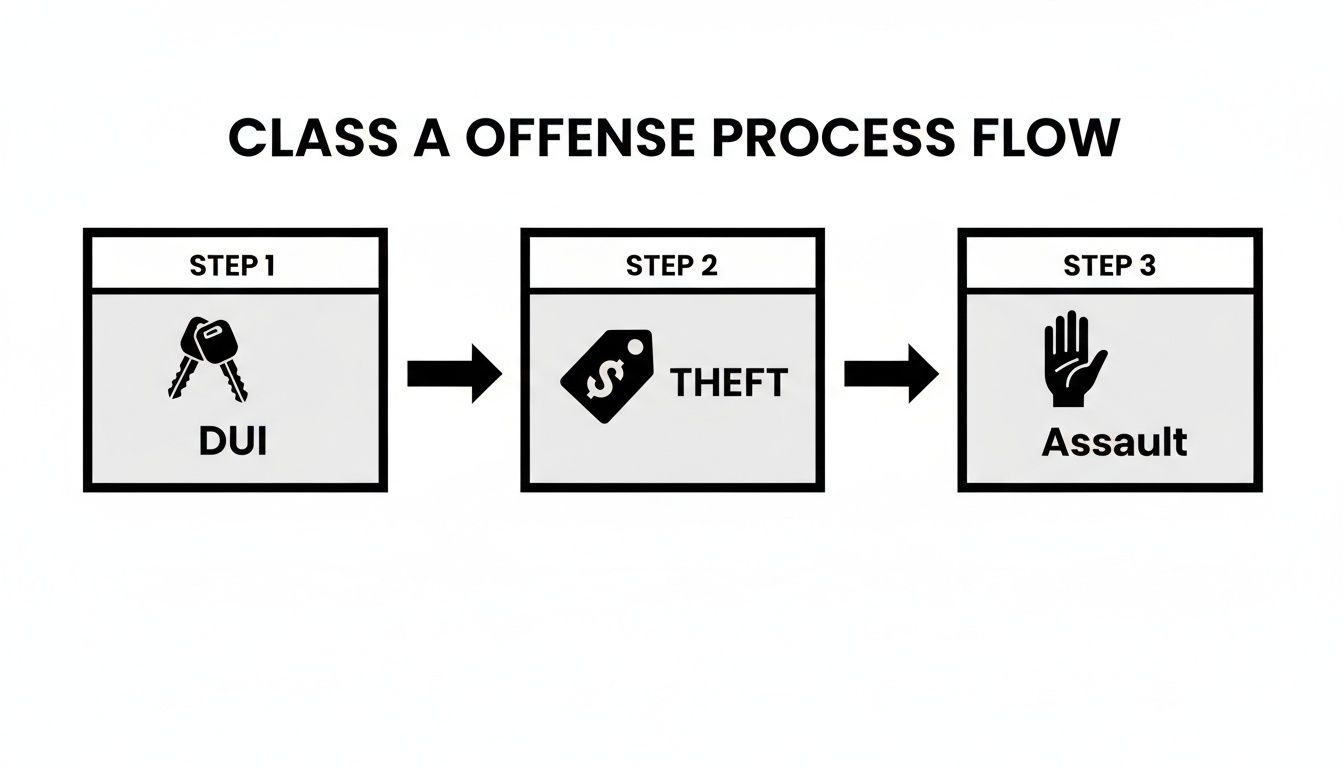
Whether it starts with a DWI, a theft accusation, or a Texas assault defense, every case funnels into the same structured criminal justice system you're navigating now.
The Path to Resolution: Plea Bargaining or Trial
The vast majority of criminal cases—over 90%—are resolved through plea bargaining, not a courtroom trial. A plea agreement is a compromise. In exchange for pleading guilty or no contest, the prosecutor agrees to a specific, often reduced, punishment. This provides certainty and helps you avoid the risk and stress of a trial.
Of course, you always have the right to a trial by jury. If a fair plea agreement isn't possible, your case will be set for trial. At trial, the prosecutor must prove your guilt "beyond a reasonable doubt." Your attorney's job is to challenge their evidence, cross-examine witnesses, and present your defense.
The decision to accept a plea deal or take your case to trial is one of the most important you will make. It should only be made after a frank and thorough discussion with your attorney about the strengths and weaknesses of your case.
Whether resolved by plea or trial, the final step is sentencing. If you are found guilty, the judge determines your punishment, which could include jail time, fines, or probation. Many people have questions about community supervision, so we've put together a guide that explains the probation rules in Texas and what to expect.
What Are Your Rights and Defense Options?
Being arrested can make you feel powerless, but remember this: an arrest doesn’t erase your constitutional rights. This is the moment to shift from focusing on the problem to finding a solution. Knowing your rights is the first step toward building a strong defense against a Class A misdemeanor.
When you're up against the state, these rights are your shield. They ensure the process is fair and give you a fighting chance. Let's walk through your protections and the strategies a skilled Texas DWI attorney or criminal defense lawyer can use to defend your future.
Your Constitutional Rights Are Not Suggestions
From the moment you are detained, the U.S. and Texas Constitutions provide powerful protections. Knowing them is one thing; using them can change everything.
- The Right to Remain Silent: You are not required to answer police questions about what happened. Legally, you only have to provide basic identification. The smartest and safest thing you can say is a polite but firm, "I am exercising my right to remain silent, and I would like to speak with an attorney."
- The Right to an Attorney: You have the right to have a lawyer present during any police questioning. This is crucial. An experienced attorney acts as a buffer, preventing you from accidentally saying something the prosecution can use against you.
Using these rights is not an admission of guilt. It’s a sign that you understand the seriousness of the situation and are taking the right steps to protect yourself.
An arrest is the start of the legal process, not the end of your story. The choices you make right now are critical, and standing on your rights is the most important first move you can make.
How a Lawyer Proactively Defends You
A good defense isn’t just about reacting to the prosecutor’s case—it’s about challenging their story from every angle. A skilled criminal defense lawyer will examine the evidence for weaknesses, procedural errors, and violations of your rights.
Here are a few common defense strategies we investigate:
- Challenging the Evidence: Was the traffic stop that led to your DWI arrest lawful? Did the police have a valid reason to search your vehicle? If law enforcement violated procedures while gathering evidence, a motion to suppress can get that evidence thrown out, often gutting the prosecution's case.
- Arguing Lack of Intent: To convict you for many crimes, the state must prove you acted "intentionally" or "knowingly." We can build a case showing your actions were a mistake, an accident, or that you lacked the required criminal intent.
- Presenting a Case for Self-Defense: If you’re charged with assault, were you defending yourself or someone else? Texas law provides a strong right to use force in self-defense, and we can present evidence to prove your actions were justified.
Powerful Legal Options That Don't Involve a Trial
While you always have the right to a trial, it isn't always the best path. A good attorney can often negotiate better outcomes that protect your record and freedom. These options are about finding a resolution, not just accepting a punishment.
Here are three powerful alternatives we can pursue:
- Negotiating a Reduced Charge: It’s often possible to negotiate with the prosecutor to get a Class A misdemeanor reduced to a less serious Class B. This can mean the difference between facing a year in jail and getting a much shorter sentence, or even no jail time at all.
- Seeking Deferred Adjudication: This is an excellent option for many first-time offenders. You plead "guilty" or "no contest," but the judge defers a finding of guilt and places you on probation. If you complete it successfully, the case is dismissed, and you are never convicted of the crime.
- Entering a Pre-Trial Diversion Program: Some counties offer special programs for certain offenses. If you are accepted and complete the requirements—like counseling or community service—the prosecutor agrees to dismiss the charge completely. This is often the best-case scenario, as it can leave you with a clean slate.
The Hidden Consequences of a Misdemeanor Conviction

The official penalties for a Class A misdemeanor in Texas—steep fines and potential jail time—are serious enough. But the real punishment often begins long after your case is closed. These "collateral" consequences can follow you for years, creating roadblocks in almost every area of your life.
A permanent criminal record isn't just a file; it's a barrier that can hold you back when you're trying to move forward. This is why fighting the charge is so critical. It's not just about staying out of jail—it's about protecting your entire future from these lasting impacts.
Your Life After a Conviction
Imagine you’ve paid your fine or served your time. You’re ready for a fresh start, but the conviction lingers. Suddenly, things you once took for granted are now out of reach. It's a frustrating reality for many Texans.
Here’s what that looks like:
- Employment Barriers: Nearly every employer runs a background check. A misdemeanor conviction, especially for offenses like theft or assault, can get your application rejected before you even get an interview.
- Housing Difficulties: Landlords and apartment complexes also screen applicants. A criminal record can make it incredibly difficult to find a safe, decent place to live.
- Professional Licensing Issues: Many careers require a state license—nursing, teaching, real estate, and cosmetology. A conviction can prevent you from getting or keeping the license you worked hard to earn.
These are not minor inconveniences. They are significant hurdles that can prevent you from providing for your family, securing stable housing, and building your career.
The real punishment of a criminal conviction often begins after the official sentence ends. Protecting your record is just as important as protecting your freedom.
More Than Just Jobs and Housing
The fallout from a conviction doesn't stop there. A Class A misdemeanor can create deep-seated problems that affect your personal rights and family life, creating stress and uncertainty for years to come.
For example, a conviction for certain offenses, particularly those involving violence, can directly impact your Second Amendment rights. Under federal and Texas law, you could be permanently barred from legally purchasing or possessing a firearm.
If you are not a U.S. citizen, the stakes are even higher. A seemingly minor offense can trigger severe immigration consequences, including deportation or making you ineligible for a green card or citizenship. The intersection of criminal and immigration law is complex, and one wrong step can have devastating results. Understanding the full scope of what a Class A misdemeanor in Texas entails is the first step toward preventing these life-altering outcomes.
How to Clear Your Record and Move Forward
A criminal charge can feel like a permanent mark on your life, but it doesn't have to define your future. Texas law offers specific legal pathways to clear your name after a case is resolved, giving you a genuine second chance. Understanding these options for post-conviction relief is the first step toward moving on.
The two primary tools for clearing your record are expunctions and orders of nondisclosure. They work in different ways, and your eligibility depends entirely on how your case was resolved.
Expunctions: The Power to Erase an Arrest
An expunction is the best way to clear your record. It doesn't just seal a file—it completely destroys the record of your arrest. Once an expunction is granted, you can legally deny the arrest ever happened. It's a true reset.
So, who qualifies? You may be eligible for an expunction if your case resulted in one of these outcomes:
- Acquittal: You went to trial and were found "not guilty."
- Dismissal: The prosecutor dropped the charges against you.
- Successful Completion of a Pre-Trial Diversion Program: You fulfilled all program requirements, and the state dismissed your case as promised.
An expunction provides the cleanest possible slate. If you think you might qualify, it is absolutely worth exploring. You can learn more about how to get a misdemeanor expunged in Texas in our detailed guide.
Orders of Nondisclosure: Sealing a Record from Public View
If your case didn't end in a dismissal or acquittal, an order of nondisclosure might be your next best option. This court order doesn't destroy the record, but it does "seal" it, preventing private entities like employers, landlords, and background check companies from seeing it.
An order of nondisclosure is most commonly available for people who successfully complete a specific type of probation called deferred adjudication.
With deferred adjudication, you are never formally convicted. Once you successfully finish your probation, you can petition the court to seal the record. While law enforcement can still access it in certain situations, it is hidden from the general public, allowing you to move forward.
The path to clearing your record can also be influenced by where your case is heard. Statistics show that misdemeanor conviction rates vary dramatically by county—Collin County has the highest rate at 65%, while Harris County's is much lower at about 31%. These differences highlight the need for an attorney who understands the local court system. You can discover more insights about how Texas counties handle criminal cases and see why local expertise is so important.
Got Questions? We Have Answers.
If you’re facing a serious criminal charge, it's natural to have many questions. This section tackles some of the most common concerns we hear from clients in your situation. These are straightforward answers to help you understand what to do next.
Can I Get Probation for a Class A Misdemeanor Instead of Jail Time?
Yes, absolutely. In Texas, probation is officially known as “community supervision,” and it is a very common outcome for Class A misdemeanors. A judge can sentence you to community supervision for up to two years.
This option keeps you out of jail but requires you to follow strict court-ordered rules, which often include:
- Regular check-ins with a probation officer.
- Completing community service hours.
- Attending required classes or counseling.
How Long Will a Class A Misdemeanor Stay on My Record?
A conviction for a Class A misdemeanor is permanent. It will remain on your criminal record for life unless it is legally cleared. It does not "fall off" after a few years.
However, if your case is dismissed or you successfully complete deferred adjudication probation, you may be eligible to either destroy the record through an expunction or seal it from public view with an order of nondisclosure.
Do I Really Need a Lawyer for a Misdemeanor Charge?
Without a doubt. One of the biggest mistakes people make is underestimating a Class A misdemeanor because it’s not a felony. The threat of spending up to a year in jail is very real. Beyond that, a permanent criminal record can damage your ability to get a good job, rent an apartment, or keep a professional license.
An experienced Texas criminal defense lawyer is your most important ally. They will protect your constitutional rights, challenge the prosecutor's evidence, and fight for the best possible outcome—whether that’s a full dismissal, a reduced charge, or a deal that keeps you out of jail and protects your future.
If you’ve been charged with a crime in Texas, call The Law Office of Bryan Fagan, PLLC for a free and confidential consultation. Our defense team is ready to protect your rights.