Being arrested in Texas can be terrifying, especially if everything started with a traffic stop, a domestic dispute, or another tense moment that got out of control fast. If you're searching for evading arrest texas penal code, you're probably not looking for theory. You want to know what you're facing, what the state has to prove, and whether this charge can be fought.
That answer is often yes.
A charge for evading arrest is serious, but it is not the same as a conviction. In many cases, the outcome turns on details people overlook in the first hours after an arrest. Did you know it was a police officer? Did you flee? Was the stop lawful in the first place? Did panic, confusion, poor visibility, or a chaotic family violence scene affect what happened?
Texas courts see evading arrest charges tied to DWI investigations, assault accusations, probation issues, and family law disputes. That overlap matters. A case that looks simple on paper can become much more complicated once bodycam footage, witness statements, and the reason for the stop are examined closely.
A Frightening Moment What an Evading Arrest Charge Means
The red and blue lights come on. You are heading home from dinner in Houston after a couple of drinks. Or officers arrive at a house in Dallas after a family violence call, voices are raised, and everyone is talking at once. You keep driving to find a better place to stop, or you walk away from the driveway because you are upset and do not want the situation to get worse.
That is how many evading arrest cases begin.

On paper, the charge sounds simple. In court, it usually is not. An officer may see flight. You may have been trying to get to a lit gas station, calm down after an argument, or make sense of a chaotic scene. Those facts matter, especially when the evading allegation is tied to another accusation such as DWI, drug possession, assault, or a family violence investigation.
I see that overlap often in Texas courts. In Austin and San Antonio, a late-night stop can quickly turn from suspected DWI into an evading case if the driver does not pull over right away. In Houston and Dallas, family violence calls create a different problem. One person leaves the scene on foot or by car, officers treat it as intentional flight, and the state then uses that allegation to argue consciousness of guilt on the underlying case too.
That is why this charge hits hard. It does not stay neatly contained. Prosecutors often use it to make the rest of the case look worse, and judges may view it as a sign that you ignored police authority. That can affect bond conditions, plea negotiations, and how a jury hears the whole story.
Practical rule: Do not try to explain the facts to police, the complaining witness, friends, or social media. Early statements often close off defense options that could have helped later.
What matters right away is not panic. It is identifying the pressure points in the case.
- Why the contact started: A weak traffic stop, a confused welfare check, or a messy family violence response can create real defense issues from the beginning.
- What was happening around you: Heavy traffic, poor lighting, an unmarked vehicle, loud arguments, or alcohol can affect what you perceived and how a jury views your actions.
- Whether the state is stacking charges: If evading is filed with DWI or assault family violence, the defense has to address how those cases interact, not just the evading allegation by itself.
- What the video and dispatch records show: Bodycam, dashcam, 911 calls, and CAD logs often tell a more complete story than the offense report.
An arrest for evading does not mean the case is open and shut. In many cases, the first question is whether the evidence shows intentional flight at all. The second is whether the surrounding charge, especially DWI or family violence, pushed officers to make the worst possible reading of a fast, messy moment.
The Law in Plain English Texas Penal Code Section 38.04
A lot of evading cases turn on one simple question. Did you attempt to get away from police, or did a fast, confused situation get read as intentional flight?
Texas Penal Code section 38.04 is the statute behind an evading arrest or detention charge. In plain terms, the state must prove that you intentionally fled from a person you knew was a peace officer who was lawfully trying to arrest or detain you. That word, intentionally, often decides the case.
In court, I do not treat this charge as just a technical add-on to a DWI stop or a family violence call. In Houston, Dallas, Austin, and San Antonio, prosecutors often file evading alongside another allegation and argue that your conduct shows consciousness of guilt. The defense has to slow that story down and test each legal part of the charge.
What the state actually has to prove
For a conviction under Section 38.04(a), the prosecution must prove these points beyond a reasonable doubt:
- Identity: You were the person involved.
- Intent: You meant to flee, not that you were startled, impaired, distracted, or trying to find a safe place to stop.
- Flight: Your actions amounted to fleeing, not mere delay or hesitation.
- Knowledge: You knew the person trying to stop you was a peace officer.
- Attempted arrest or detention: The officer was in fact trying to arrest or detain you.
- Lawfulness: The attempted detention or arrest met legal standards.
If one of those points is weak, the case has a real defense issue. For readers who want a broader explanation of how Texas charge levels work, this guide to misdemeanor and felony classifications in Texas gives helpful background.
What those points mean in real life
These cases are rarely as clean as the police report makes them sound.
On a suspected DWI stop, for example, a driver may keep going for a short distance to find a lit shoulder, a parking lot, or a safer place to pull over. On a family violence call, officers may arrive in an emotionally charged scene with multiple people talking at once, poor visibility, and conflicting commands. In either setting, the state still has to prove that you knew police were trying to detain you and that you chose to flee.
Knowledge is often disputed in unmarked-car cases, late-night encounters, apartment complex parking lots, and crowded neighborhoods. Intent is often disputed when body camera footage starts late, sirens are hard to hear, or the officer's report skips over the few seconds that matter most.
The lawful detention issue matters
The officer also needs a valid legal basis to stop or arrest you.
That issue comes up often in Texas courts. A weak reason for the initial stop, a vague disturbance call, or a rushed decision during a DWI or family violence investigation can change the whole case. If the detention was not lawful, the prosecution has a harder time proving the evading charge as filed.
Judges and juries usually understand this better than lawyers sometimes expect. The question is straightforward. Did police have a real legal reason to detain you at that moment?
Three pressure points the defense often examines
| Issue | What the defense looks for |
|---|---|
| Intent | Panic, confusion, intoxication, poor communication, or a short delay while looking for a safe place to stop |
| Knowledge | Unmarked units, poor lighting, blocked view, no clear commands, or noise and chaos at the scene |
| Lawfulness | Weak reasonable suspicion, inconsistent reports, late-starting bodycam, or a stop tied to a shaky underlying allegation |
Those are not side issues. In many evading cases, they are the fight.
Misdemeanor vs Felony Understanding Evading Arrest Penalties
One of the first strategy questions in my office is simple. Are we dealing with a misdemeanor problem that may be containable, or a felony case that changes the risk from day one?
Under Texas law, evading arrest can start as a Class A misdemeanor and rise fast based on the facts. A first allegation on foot is often charged as a misdemeanor. Using a vehicle or watercraft commonly pushes the case into felony territory. Prior history, serious bodily injury, or a death allegation can raise it even further. If you want a quick reference for misdemeanor vs felony classifications in Texas, that guide gives useful background on how Texas sorts charge levels.
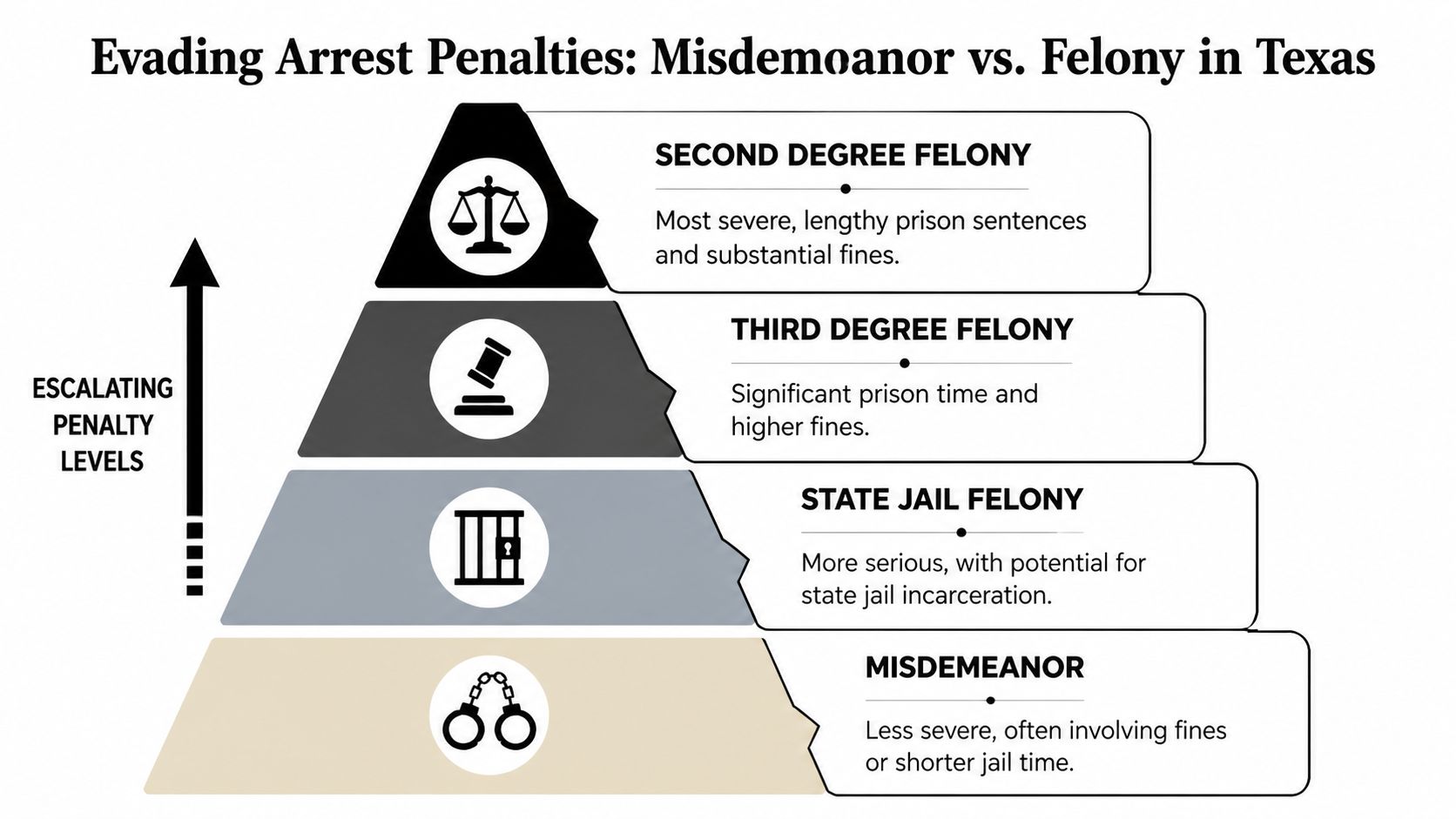
The penalty ladder in simple terms
Here is the range prosecutors usually start from under Section 38.04:
Class A misdemeanor
Often charged in a first-time on-foot case. Punishment can reach up to 1 year in county jail and a $4,000 fine.State jail felony
Often charged if the state says you used a vehicle or watercraft while fleeing. Punishment can range from 180 days to 2 years in a state jail facility, plus up to a $10,000 fine.Third-degree felony
This level can apply if the state alleges a prior evading conviction or serious bodily injury during the incident. Punishment can range from 2 to 10 years in prison and up to a $10,000 fine.Second-degree felony
If the allegation involves a death, the punishment range can rise to 2 to 20 years in prison and up to a $10,000 fine.
Texas corrections figures also show people continue to be admitted to prison and state jail on escape and evading arrest cases each year. That is one reason prosecutors do not treat this charge as minor, even when the chase was short.
Why the charge level matters in the real world
The label on the case affects much more than the sentencing range. It changes bond arguments, plea offers, immigration concerns, job screening, professional licensing, and in some cases your ability to lawfully possess firearms later.
It also changes how the state builds the story.
In Houston, Dallas, Austin, and San Antonio, I often see evading filed alongside another allegation that drove the stop in the first place. Common examples are DWI, unlawful possession, or family violence. That combination gives prosecutors more room to argue danger, poor judgment, or risk to the public, especially if they believe alcohol, a domestic disturbance call, or a child passenger was involved.
A misdemeanor evading case tied to a weak stop may leave room to negotiate for a reduction or a different resolution. A felony evading case tied to DWI or assault usually gets tougher treatment from the start, even before anyone reaches the question of guilt at trial.
Defense strategy changes with the grade of the offense
The best defense approach is not the same in every case.
In a misdemeanor case, the pressure point may be whether your actions were flight at all, or whether you were confused, scared, or trying to find a safe place to stop. In a felony vehicle case, the defense often has to address both the legal issue and the optics. Prosecutors will focus on speed, distance, traffic conditions, and any claim that someone could have been hurt.
If the evading charge is paired with DWI, the timeline matters a lot. Was there a deliberate attempt to flee, or did intoxication, delayed recognition, or poor communication explain the driving? If the case grew out of a family violence call, the defense often needs to examine whether officers rushed into a detention without sorting out who was the complainant, who was leaving to avoid conflict, and whether clear commands were even given.
Those details can change plea posture and trial posture in a serious way.
Do not rely on an old penalty chart
Section 38.04 has been amended over time, and charging decisions can get complicated fast when the case also involves injury allegations, prior convictions, DWI facts, or family violence accusations. The police report is only one piece of the file. The charging instrument, dispatch records, body camera footage, and the exact sequence of events usually matter more than a generic online summary.
If you are facing this charge, the right question is not just "What is the maximum punishment?" The better question is, "What facts can the state really prove, and what can be done now to bring this case down?"
On Foot vs In a Vehicle How Scenarios Change the Stakes
The difference between running away on foot and driving away is one of the biggest turning points in an evading case.

Texas treats vehicle cases more harshly because prosecutors and judges view them as more dangerous to officers, passengers, and the public. That practical reality shows up in charging decisions, bond arguments, and plea offers.
Two situations that may look similar but aren't
A person who runs through an apartment complex after officers approach on foot may be accused of misdemeanor evading. A person who keeps driving after lights come on may face a felony, even if the pursuit is short and ends without a crash.
That doesn't mean a vehicle case is hopeless. It means the penalties are more severe from the beginning.
A useful comparison looks like this:
| Scenario | Typical concern for the state |
|---|---|
| On foot | Did you actually flee, and did you know police were detaining you? |
| In a vehicle | Did your driving create added public risk, even over a short distance? |
Vehicle use automatically increases the charge to a felony, and 62% of the 4,127 evading arrests reported by Texas DPS in 2022 were vehicle-related (Texas DPS-related discussion of vehicle evading charges).
Why prosecutors push vehicle cases harder
When a police report mentions speeding, lane changes, neighborhood turns, or passengers in the car, the state often frames the case around danger. That is true even if your explanation is that you were trying to find a lit area, avoid stopping in traffic, or get to a safer shoulder.
Those facts still matter. But they must be developed carefully.
Here is a short explainer that helps many people understand how these cases are discussed in practice:
What often works and what doesn't
What usually helps:
- Showing a short delay was about safety, not escape
- Using video and dispatch timing to challenge the officer's narrative
- Separating panic from intent
- Explaining related charges carefully, especially in DWI or family violence investigations
What usually hurts:
- Talking too much after arrest
- Assuming "I only drove a little farther" ends the case
- Treating a felony filing like a misunderstanding that will clear itself up
Building a Strong Defense Against Evading Arrest Charges
You may have been stopped after leaving a bar in Houston, driving away from a family argument in Dallas, or pulling through one more block in San Antonio because the area felt unsafe. The officer may call that evading. The defense question is narrower. Can the state prove you intentionally fled from a lawful attempt to detain or arrest you?
That question drives the whole case.

Start where the case starts
A good defense often begins before the alleged flight. If the officer did not have a lawful basis to stop or detain you, that problem can affect everything that followed. I look closely at what the officer says drew attention in the first place, when emergency lights were activated, what commands were given, and whether a reasonable person would have understood that police were ordering an immediate stop.
If the stop or detention was unlawful, a motion to suppress evidence may remove key parts of the state's case. In some files, that is the pressure point that changes plea discussions or puts dismissal on the table.
Defense themes that matter in real cases
The best defense is usually specific, not generic. Courts in Houston, Dallas, Austin, and San Antonio see the same charge in very different factual settings, so the strategy has to fit the facts.
Common examples include:
No intent to flee
A short delay is not always evading. You may have been looking for a safe shoulder, trying to get out of traffic, or reacting badly under stress.Unclear police identification
This comes up with unmarked units, poor lighting, plainclothes officers, apartment complexes, and chaotic domestic disturbance scenes.Confusion caused by another accusation
In DWI investigations, people sometimes keep driving briefly because they are startled, embarrassed, or trying to reach a better-lit area. In family violence calls, shouting, multiple witnesses, and conflicting commands can make the scene far less clear than the report suggests.Mistaken identity or weak identification
Foot chases, parking lots, and multi-person scenes create room for error, especially when the officer's view was limited.
Evidence wins these arguments
Police reports matter, but video and timing often matter more. Dashcam, bodycam, 911 audio, dispatch logs, and GPS data can show whether this was a true attempt to escape or a short, explainable delay. I also want to know where passengers were seated, what they heard, whether the siren was used, and how far the vehicle traveled.
Related cases need extra care. In a DWI stop, the state may try to use the evading allegation to paint you as reckless before the intoxication evidence is even tested. In a family violence case, prosecutors may use the emotional setting to make ordinary confusion sound like guilt. A strong defense separates the allegations and makes the state prove each one on its own facts.
That work starts early. Families often need to gather records, preserve messages, and send paperwork quickly. Practical tools such as court document filing options can help when deadlines and document delivery become part of the scramble after an arrest.
Local strategy matters
The same facts can be treated differently depending on the county, the court, and the other charge attached to the case. Harris County prosecutors may focus hard on officer safety and driving behavior. In Travis County, video review can become the center of the case. In Bexar and Dallas County courts, judges often pay close attention to whether the detention itself was lawful and whether the alleged flight was intentional or just brief hesitation.
That is why I do not treat an evading case as a stand-alone traffic matter. If it is tied to DWI, drug possession, or family violence, the defense has to account for how each allegation affects bond conditions, plea risk, trial themes, and future record-clearing options.
The Law Office of Bryan Fagan, PLLC handles criminal defense matters involving these overlapping charges, along with expunctions and nondisclosures when a case qualifies.
What Happens Next The Legal Process After Your Arrest
After an arrest, individuals often feel like they've lost control. The process is more structured than it feels in the moment. Once you know the stages, the case becomes easier to manage.
If this is your first arrest, this overview of what happens when you get arrested in Texas can help you understand the basic sequence.
Booking, bond, and the first critical decisions
After arrest, you'll usually be booked into jail. That means fingerprints, photographs, a probable cause review, and bond processing. In some counties, this moves quickly. In others, it can take longer than families expect.
Early decisions matter:
- Don't discuss facts on recorded jail calls
- Don't try to explain the case to officers
- Get counsel involved before making strategy decisions
- Start gathering records, names, and video leads right away
If your family is helping from the outside, practical tools matter too. For example, when paperwork must be sent quickly, some people review court document filing options so they understand how filings and document delivery can work in time-sensitive situations.
Arraignment, plea discussions, and pretrial work
Your first court settings may be brief, but they matter. The court addresses the charge, conditions, scheduling, and sometimes counsel issues. You may enter a plea of not guilty while the defense investigates.
After that, the case usually moves into pretrial work, during which much of the key defense happens:
- requesting evidence
- reviewing bodycam and dashcam
- testing the legal basis for the stop
- interviewing witnesses
- identifying weaknesses in the charging theory
- discussing possible plea options if negotiation makes sense
Some cases resolve through dismissal or reduction. Others require contested hearings. A smaller group goes to trial.
Trial, sentencing, and what comes after
If the case doesn't resolve, trial becomes the next step. At trial, the prosecutor must prove each element beyond a reasonable doubt. The defense can cross-examine officers, challenge the stop, dispute intent, and point out gaps in video or witness testimony.
If there is a conviction, sentencing follows. Depending on the charge level and case history, that may involve jail, prison exposure, supervision terms, fines, or other conditions. In some situations, rehabilitation-focused options may still matter later, including record-sealing or other post-conviction relief if the law allows.
Why a Texas Defense Attorney is Your Strongest Ally
An evading arrest charge rarely stands alone. In Texas courts, it often shows up beside DWI, drug possession, resisting arrest, or an allegation that started as a family violence call. That overlap changes the defense strategy fast, because one bad statement or one rushed plea can make more than one case harder to defend.
Local experience matters for that reason. Courts in Houston, Dallas, Austin, and San Antonio do not handle these cases in exactly the same way. Prosecutors also make different charging and plea decisions depending on whether the allegation involves a vehicle, alcohol, a domestic dispute, or an officer who claims you ignored commands.
I tell clients to look at the full picture, not just the evading count. A family violence allegation can bring bond conditions, no-contact orders, and pressure at home. A DWI-related evading case can put your license, your job, and your driving record at risk at the same time. The right defense plan has to account for all of that early.
Your lawyer's job is to test the officer's version of events, protect you from making the case worse, and look for a resolution that limits the damage across the board. That can mean challenging whether you knew an officer was trying to detain you, whether the stop was lawful, whether the video matches the report, or whether the state overcharged the case because other accusations were filed alongside it.
Case preparation also depends on disciplined support behind the scenes. In document-heavy matters involving protective orders, bond conditions, and multiple court settings, organized legal staff help keep the defense on track. If you want a practical overview of that support role, this explanation of Paralegal Assistants is useful.
If you have been charged with a crime in Texas, call The Law Office of Bryan Fagan, PLLC for a free and confidential consultation. Our defense team is ready to protect your rights.
If you are facing an evading arrest charge tied to DWI, assault, drugs, or a family violence investigation, speak with a lawyer before your next court date and before answering more police questions. The Law Office of Bryan Fagan PLLC helps Texans assess the charge, identify defenses, and build a clear plan for what comes next. A free and confidential consultation can help you understand your options while the case is still manageable.