Skip to content
Being arrested in Texas can be terrifying, but you don't have to face it alone.
You may have woken up in a holding cell after an argument that got out of control. Maybe no one explained much beyond the words aggravated assault. Now you're worried about jail, your job, your family, and whether one bad night is about to change everything.
That fear is normal. So is the confusion.
A lot of people charged with aggravated assault don't understand what made the case “aggravated” in the first place. They think there had to be catastrophic injuries. Or they assume that if nobody was seriously hurt, the case can't be a felony. In Texas, that's not always true. A weapon can matter even if it wasn't fired or used to cause injury. And the legal line for serious bodily injury is more technical than commonly understood.
If you're trying to answer the question, what is aggravated assault in Texas, you need more than a one-sentence definition. You need a clear explanation of the law, the court process, the stakes, and the practical steps that can protect you right now.
Introduction with Empathy
A first-time arrest often feels unreal. One minute you're in an argument, outside a bar, in your driveway, or trying to leave a tense situation. The next minute, officers are asking questions, taking your phone, and telling you that you're facing a felony.
For many people, the shock comes from the gap between what happened and what the charge sounds like. You may be thinking, “Nobody died,” or “I only showed it, I didn't use it,” or “They're exaggerating the injury.” Those reactions are common. They're also the reason these cases need careful legal analysis, not panic and not guesswork.
Practical rule: If police, investigators, or even the complaining witness want to “clear things up,” don't try to explain your side by yourself. Statements that feel harmless can become evidence.
This article is written in plain English for Texans who are scared, frustrated, and trying to get their footing. You'll see how Texas Penal Code sections fit together, what prosecutors must prove, how aggravated assault differs from simple assault, what happens after arrest, and how issues like bail, plea bargaining, trial, sentencing, expunctions, record sealing, and post-conviction relief may affect your future.
If you're also dealing with related charges such as DWI, theft, or drug possession, the same core principle applies. Early legal advice matters because the first days after arrest can shape the whole case.
Understanding Aggravated Assault Law in Texas
A lot of aggravated assault cases begin with a moment that did not feel life-changing at the time. An argument gets loud. Someone pulls out a knife but never swings it. A shove leads to a fall and a trip to the hospital. By the time the police report is written, the case may no longer be treated as a simple assault. It may be filed as a felony.
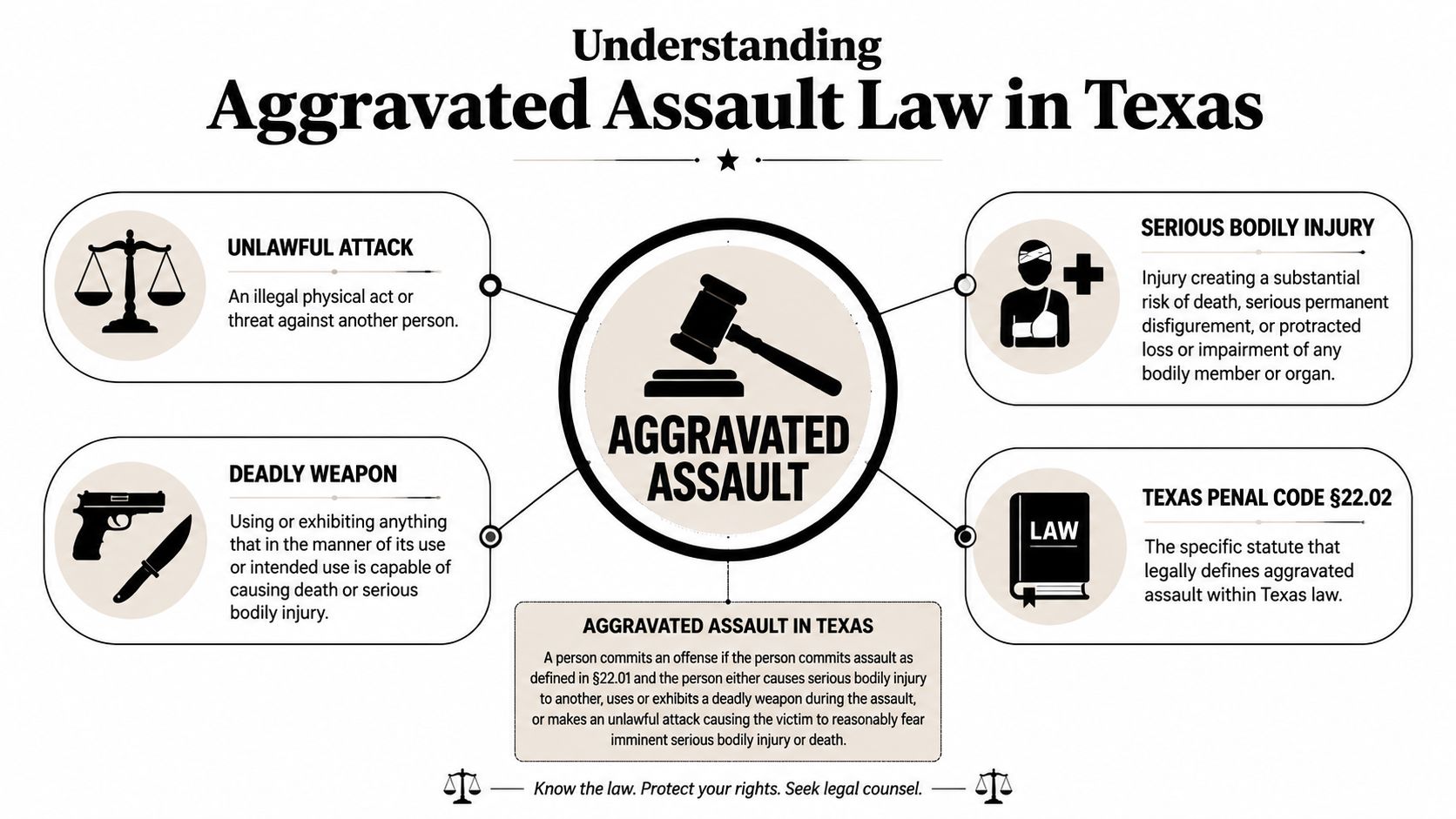
What makes an assault "aggravated" in Texas
Under Texas Penal Code Section 22.02, an assault becomes aggravated in one of two ways. The state alleges either serious bodily injury or the use or exhibition of a deadly weapon during the assault.
That two-track structure matters.
Prosecutors do not have to prove both. One route is enough to turn a lower-level assault allegation into a much more serious felony charge. That is why people asking about securing bail for simple assault are often dealing with a very different situation from someone booked for aggravated assault.
The injury threshold is higher than many people expect
This is one of the most misunderstood parts of Texas assault law. Serious bodily injury has a specific legal meaning. It refers to injury that creates a substantial risk of death, causes serious permanent disfigurement, or leads to protracted loss or impairment of a body part or organ.
In plain English, the law is asking a harder question than "Was the person hurt?" It is asking whether the injury crossed a line into lasting or life-threatening harm.
That line is often the fight in the case.
A black eye, soreness, cuts, or even a painful fracture may support an assault charge, but those facts do not automatically prove serious bodily injury. On the other hand, surgery, long-term mobility problems, nerve damage, loss of function, or visible permanent scarring give the state a stronger argument. Medical records matter, but labels in records are not the final answer. Prosecutors still have to connect the medical evidence to the legal definition.
Threat theory catches many first-time defendants off guard
The second path to aggravated assault often surprises people even more. Texas does not always require a severe injury if the allegation is that a deadly weapon was used or exhibited during the assault.
"Exhibited" is the key word.
In practice, the state may claim aggravated assault based on what your actions communicated to the other person in that moment. If a weapon was displayed in a way that allegedly threatened imminent bodily injury, prosecutors may pursue a felony even when no shot was fired and no stabbing occurred. A case can rise or fall on witness descriptions, body camera footage, 911 calls, and how officers say the object was handled.
That is why Assault and Violent Crime Defense in Texas can involve much more than visible injuries. The charge may rest on threat theory, fear, and whether the object was used in a way the law treats as deadly.
Local practice can change how these cases are charged
The written law is statewide. Charging practices are not always uniform.
In larger metro areas such as Houston, Dallas, Fort Worth, Austin, and San Antonio, prosecutors often review hospital records, photos, witness statements, and weapon allegations quickly, but local habits still differ. Some offices push hard on deadly weapon theories. Others focus more heavily on whether the injury meets the serious bodily injury standard. The same fact pattern may be screened more aggressively in one county than another.
For someone facing charges for the first time, that can feel unfair. It also means generic online explanations usually leave out what matters most. The essential question extends beyond merely what the statute says. It truly centers on how local prosecutors, magistrates, and judges are likely to treat the facts in your county.
Legal Elements Prosecutors Must Prove
A lot of people hear the charge name and assume the case is already decided. It is not. In a Texas aggravated assault case, the prosecutor still has to prove specific facts, and each one matters.
A good way to understand this section is to picture the state building a three-lock chain. If even one lock does not close, the felony case has a problem.
What the state has to prove
Prosecutors generally need to prove three things:
- An assault occurred: They must show you intentionally or knowingly threatened someone with imminent bodily injury, or intentionally, knowingly, or recklessly caused bodily injury.
- The assault was aggravated: They must prove either serious bodily injury or the use or exhibition of a deadly weapon.
- You were the actor: They must connect you to the conduct through identification, intent, and causation.
Those words sound simple until you apply them to real facts. "Threatened" does not always mean a spoken threat. "Serious bodily injury" does not mean any injury that looks bad in a photo. And "deadly weapon" can include ordinary objects if the state claims they were used in a way capable of causing death or serious bodily injury.
Serious bodily injury has a higher threshold than many people realize
This is one of the most misunderstood parts of Texas assault law.
The prosecution does not prove serious bodily injury just by showing pain, swelling, bruising, or a trip to the ER. The legal question is whether the injury created a substantial risk of death, caused serious permanent disfigurement, or led to protracted loss or impairment of a body part or organ. In plain English, the injury has to cross a much higher line than a typical assault case.
That is why defense lawyers examine medical records closely. A fracture may sound severe, but the details matter. Did it heal normally? Was surgery required? Did the person regain normal use quickly, or was there lasting impairment? Prosecutors often argue from photographs and first impressions. The defense has to test whether the records support the felony-level injury claim.
As noted in this discussion of Texas aggravated assault confusion, people charged with these cases often misunderstand the gap between bodily injury and serious bodily injury. That gap is often where the fight is.
Threat theory can support a felony even without major injury
Some aggravated assault cases are not really injury cases at all. They are threat cases.
If the state claims you used or displayed a deadly weapon in a way that placed another person in fear of imminent bodily injury, prosecutors may pursue aggravated assault even when nobody suffered lasting harm. That point surprises many first-time defendants. They focus on the absence of injury, while the state focuses on what the complainant says they feared and how the object was handled.
This is why sequence matters so much. Was the object visible the whole time, or only after the other person advanced? Was it pointed, raised, brandished, or present? Did anyone hear words that matched the alleged threat? Did the body camera video support the first report, or complicate it?
For a closer look at how Texas breaks down assault-related proof, this guide to the elements of assault charges in Texas gives useful background.
Proof usually rises or falls on the timeline
Jurors are often asked to decide which version of a fast-moving event makes the most sense.
The state may use 911 calls, body camera footage, text messages, hospital records, scene photos, and witness statements to build a minute-by-minute account. The defense does the same thing, but with a different goal. It tests weak identification, inconsistent statements, missing video, self-defense facts, and whether the alleged injury or threat really matches the charge that was filed.
Local practice can shape how this proof is presented. In some Texas metro counties, prosecutors may push the deadly weapon theory hard because it is easier to explain than the medical threshold for serious bodily injury. In others, screening decisions may turn more heavily on hospital records and follow-up treatment. The legal elements stay the same statewide, but how aggressively the facts are framed can look different from one courthouse to the next.
That is why early case review matters. In aggravated assault cases, the name of the charge is only the starting point. The fundamental question is whether the prosecutor can prove each required element with facts that hold up under close scrutiny.
Variants of Aggravated Assault Charges
Aggravated assault isn't one single fact pattern. Texas prosecutors use the same core statute in very different situations, and local practice can shape how aggressively a case is filed. In 2023, Texas reported 85,914 aggravated assault cases, the second-highest total in the United States, according to state-by-state aggravated assault data. That volume means these cases appear in both major cities and smaller counties.
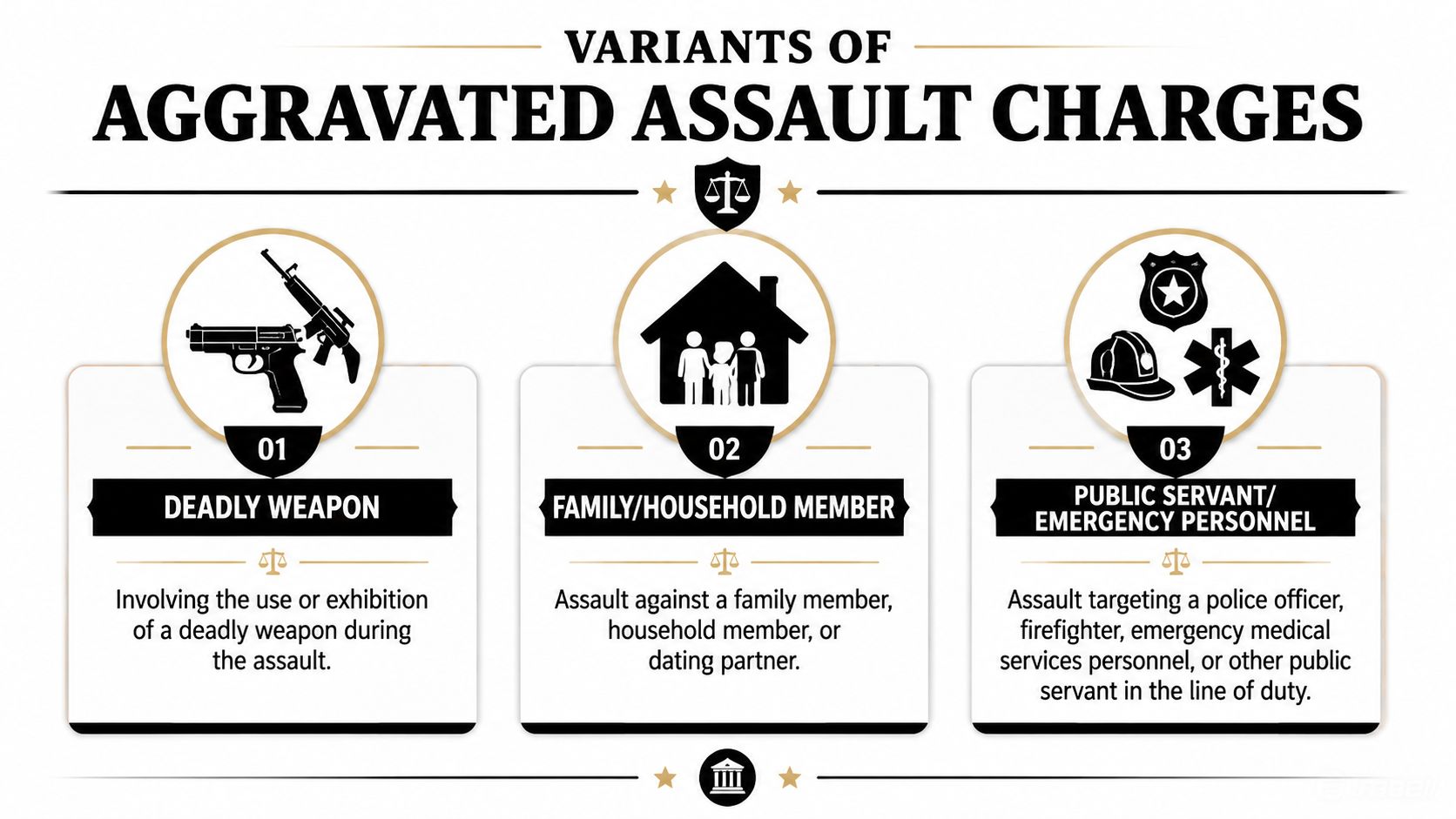
Deadly weapon cases
This is the version many people picture first.
An argument in a parking lot turns heated. Someone pulls a knife, points a gun, or uses another object in a way the state says could cause death or serious bodily injury. Even if nobody suffers major harm, the prosecution may file aggravated assault based on the exhibition or use of the weapon.
That's why “I never touched them with it” isn't always a complete defense.
Family and household cases
Domestic situations often bring added pressure. In a dating, family, or household dispute, officers may make quick charging decisions based on witness statements, visible injuries, and whether an object was displayed.
These cases can also overlap with protective orders, child custody concerns, and firearm restrictions. If your aggravated assault accusation involves a spouse, dating partner, or household member, the criminal case may affect more than your record.
Cases involving public servants or emergency personnel
An aggravated assault allegation can become even more serious when the alleged victim is a police officer, firefighter, EMS worker, or another public servant acting in an official role. These cases often move differently because prosecutors may treat them as high-priority matters.
A chaotic arrest scene is a good example. If the state claims a person used a weapon or caused qualifying injury while officers were trying to control the situation, the prosecution may seek a tougher charge and push harder on sentencing.
A quick comparison
| Scenario | What often drives the charge |
|---|---|
| Weapon allegation | Display or use of an object the state calls a deadly weapon |
| Family or household case | High-conflict facts, witness disputes, collateral family-law consequences |
| Public servant case | Enhanced scrutiny, more aggressive prosecution strategy |
Penalties and Sentencing Enhancements
Once aggravated assault is charged, the stakes rise fast because you're dealing with a felony. Sentencing depends on how the state classifies the case and whether any enhancements apply.
One of the most important rules involves deadly weapon allegations. Under Code of Criminal Procedure Article 42A.054, aggravated assault with a deadly weapon is a 3G offense, which limits probation options. Judge-ordered probation is prohibited unless a jury recommends it for a sentence of 10 years or less, as explained in this discussion of aggravated assault with a deadly weapon in Texas.
Why the 3G rule matters
People often assume probation is always available in a felony case. That assumption can be dangerous.
If your case includes a deadly weapon finding, sentencing strategy changes. Trial decisions change. Plea bargaining changes. The risk calculation changes because the path to avoiding prison becomes narrower.
Sentencing reality: In a deadly weapon case, you can't assume the judge can simply place you on regular probation after conviction.
Sentencing ranges for aggravated assault in Texas
Here is a general overview of the punishment levels commonly associated with aggravated assault charges in Texas.
| Felony Level | Prison Range | Fine Range |
|---|---|---|
| Second-degree felony | 2 to 20 years | Up to $10,000 |
| First-degree felony | 5 to 99 years or life | Up to $10,000 |
For a more focused breakdown, this page on penalties for aggravated assault in Texas gives useful context.
How enhancements affect the outcome
Enhancements can push punishment exposure much higher. The identity of the alleged victim, whether a deadly weapon was involved, and whether the facts fit a family-violence framework can all change how the state approaches sentencing.
That's also why felony classification matters beyond prison time. A conviction can leave you with a permanent criminal record unless you later qualify for relief such as record sealing or other post-conviction options. In some cases, post-conviction relief may include an appeal, a writ, or later efforts to limit public access to records when the law allows it.
If you're also facing charges like DWI, theft, or drug possession, each charge may carry its own penalty structure. But aggravated assault usually becomes the case that drives negotiations because it carries the most severe exposure.
Common Defenses for Aggravated Assault
An arrest is not a conviction. A charge is not proof. Aggravated assault cases often have real defenses, especially when the facts unfolded quickly, witnesses disagree, or the injury and weapon issues are overstated.
Self-defense and defense of others
Texas law allows people to protect themselves in some situations. If someone threatened you, rushed you, entered your home unlawfully, or attacked another person in front of you, self-defense or defense of others may become central.
The key is evidence. Jurors want details. Where were people standing? Who made the first move? Was there a chance to leave? Did anyone else see it?
A homeowner who grabs an object to stop an intruder may sound very different from the way a police report summarizes the scene.
Challenging intent and causation
Not every injury proves criminal intent.
Sometimes the defense is that contact happened, but not intentionally. Sometimes the issue is mistaken identity. In other cases, the defense argues that the alleged victim's injury came from a fall, another participant, or an event after the confrontation ended.
Through surveillance footage, phone records, body-camera video, and witness interviews, the case can be reshaped.
Disputing serious bodily injury or weapon use
A strong defense often focuses on the exact point that raised the charge.
- Injury challenge: The defense may argue the evidence shows pain or temporary harm, not the legal threshold for serious bodily injury.
- Weapon challenge: The defense may dispute whether the object qualifies as a deadly weapon in the way it was used or exhibited.
- Credibility challenge: Witnesses under stress can misremember what they saw, especially in crowded or fast-moving situations.
If you want to understand how legal defenses operate in assault cases more broadly, this resource on affirmative defenses in Texas assault cases is a helpful starting point.
Sometimes the best defense is narrow. You may not need to disprove every bad fact. You may only need to show the state can't prove the one fact that turned the case into aggravated assault.
What you should gather early
If you're out on bond, help your lawyer build the file.
- Keep your messages: Save texts, call logs, voicemails, and social media messages.
- Preserve photos: Take clear pictures of your own injuries, torn clothing, and the scene if lawful and available.
- Identify witnesses: Write down names, numbers, and what each person likely saw.
- Get treatment records: If you were hurt, your records may support self-defense or contradict the state's timeline.
Practical Steps After an Aggravated Assault Arrest
The criminal process feels less overwhelming when you know what comes next. After an aggravated assault arrest, each stage matters because decisions made early can affect bond, evidence, plea offers, and trial posture.
Early in the process, visualizing the roadmap can help.

Booking and bail
After arrest, officers complete booking. That usually includes fingerprints, photographs, property inventory, and entry of the charge into the jail system.
Bail may be set quickly, or there may be delays depending on the county, the allegation, and whether a magistrate imposes special conditions. If you're trying to get out, don't discuss the facts of the case on recorded jail lines.
First appearance and arraignment
Your first court appearance is often brief, but it matters. You'll hear the charge, the case will start moving on the court's calendar, and bond conditions may be reviewed.
If family violence is alleged, the court may issue orders affecting contact with the complaining witness, your home access, or firearm possession. Violating those orders creates new problems fast.
A short video overview can help you understand how criminal cases begin and develop in Texas courts.
Securing counsel and reviewing evidence
Your lawyer's first tasks usually include entering the case, demanding discovery, reviewing reports, and identifying urgent issues such as bond modification, no-contact orders, and evidence preservation.
This is also where related charges matter. If your arrest also involves DWI, drugs, theft, or weapons allegations, the defense strategy has to account for all of them together.
Plea bargaining, motions, and trial
Many aggravated assault cases don't go straight to trial. They move through negotiations, factual investigation, and pretrial motions.
Here's the usual flow:
- Discovery review: Police reports, videos, medical records, and witness statements are analyzed.
- Defense investigation: Your lawyer interviews witnesses, collects records, and tests the state's timeline.
- Negotiation stage: Prosecutors may consider reduced charges or a different punishment recommendation.
- Pretrial motions: The defense may challenge statements, identification procedures, or other disputed evidence.
- Trial if needed: A judge or jury decides whether the state proved the charge beyond a reasonable doubt.
- Sentencing: If there's a conviction, the court moves to punishment.
- Post-conviction options: Depending on the result, the next step may involve appeal, habeas issues, or later record-related relief where allowed.
Don't delete messages, repair damaged phones, or throw away clothing from the incident. Small details often become important evidence.
If the case is dismissed, a later expunction may be possible in some circumstances. If there's a qualifying outcome short of conviction, record sealing through nondisclosure may become relevant in other kinds of cases. The right option depends on the result and the exact charge history.
How an Attorney Can Help and Local Considerations
Local practice matters more than many first-time defendants realize. The written law is statewide, but how cases move can differ from Houston to Dallas, Austin, and San Antonio based on docket pressure, prosecutor expectations, bond practices, and how individual courts handle scheduling and negotiated outcomes.
In Harris County alone, 1,358 aggravated assault incidents were reported in January 2020, according to the January 2024 Crime Index report. High volume can affect timing, witness availability, and how quickly prosecutors review cases for possible reductions.

Why early representation changes the case
A lawyer does more than stand next to you in court.
Early counsel can help with bond conditions, witness contact issues, evidence preservation, and the framing of the case before the prosecution hardens its position. In some files, that means challenging whether the injury was legally serious. In others, it means disputing the deadly-weapon allegation or developing a self-defense record before memories fade.
If digital evidence matters, such as phone video, text chains, doorbell footage, or social posts, it helps to manage digital evidence securely so the defense can document where files came from and when they were preserved.
Metro-area differences and strategic choices
A Houston criminal lawyer may focus quickly on crowded dockets and timing pressures. In Dallas, courtroom preferences and prosecutor screening practices may shape motion strategy. In Austin or San Antonio, the facts that drive plea bargaining may look different depending on the judge, the alleged victim, and whether there are parallel family-law issues.
That local context is one reason broad criminal defense experience matters. The Law Office of Bryan Fagan PLLC handles Texas criminal cases including assault, DWI, theft, drug offenses, expunctions, record sealing, and post-conviction matters, which can matter when one arrest creates several legal problems at once.
What a defense attorney is really doing behind the scenes
A good aggravated assault defense often includes several tracks at once:
- Testing the charge: Does the evidence really support aggravated assault, or only a lesser allegation?
- Managing the process: Bond conditions, court dates, and no-contact rules need immediate attention.
- Preparing for multiple outcomes: Some cases are negotiated. Others need trial preparation from the start.
- Protecting the future: If the case ends favorably, your lawyer can advise on expunction, sealing, or other rehabilitation-focused next steps when available.
In these cases, timing is part of the defense. Waiting usually helps the prosecution more than it helps you.
If you've been charged with a crime in Texas, call The Law Office of Bryan Fagan, PLLC for a free and confidential consultation. Our defense team is ready to protect your rights.