Being arrested in Texas can be terrifying, but you don't have to face it alone. A forgery accusation often starts with confusion. You may have signed something for a family member, handled a document at work, or used paperwork that someone else prepared, and suddenly police or prosecutors are saying you committed a crime.
That fear is real. So is the risk. A forgery charge can affect your job, your record, your family, and your freedom. If you're searching for answers about forgery Texas law, the most important thing to know is this: an accusation isn't the same as a conviction. The State still has to prove specific legal elements, and those details matter.
Facing a Forgery Accusation in Texas
A lot of people think forgery charges only happen in unusual white-collar cases. That's not true. In Texas, forgery allegations come up in everyday situations involving checks, titles, IDs, deeds, credit cards, and signed documents.
You might be a parent who signed a form during a rushed family emergency. You might be an employee accused of altering a record you didn't create. You might be in the middle of a divorce or family conflict and suddenly learn that someone claims a document was fake. These cases are stressful because they often involve personal relationships, not just paperwork.
Texas law enforcement takes these accusations seriously. In 2023, Texas recorded 3,050 adult arrests for forgery and counterfeiting offenses, making it the second-highest state in the United States for this category of crime according to FBI Uniform Crime Reporting data.
Why these cases move fast
Forgery cases often connect to other allegations. A prosecutor may look at the same set of facts and consider theft, fraud, credit card abuse, or related property offenses. That can make the situation feel bigger than it first appeared.
Practical rule: Don't try to “clear things up” with police on your own. In many forgery cases, what you meant to explain can later be used to argue intent.
What to focus on right away
If you've been accused, your first job is to protect yourself.
- Stay calm: Panic leads to bad decisions, especially in interviews or text messages.
- Save documents: Keep copies of emails, texts, account records, drafts, and signatures.
- Avoid contact about the accusation: Don't pressure witnesses or argue with the complaining party.
- Get legal advice early: Early defense work can shape bond conditions, evidence review, and negotiation strategy.
People facing forgery charges often also need help with related criminal matters such as theft, assault, DWI, or drug possession. If your case overlaps with another allegation, that changes how a defense should be built.
What Is Forgery Under Texas Law
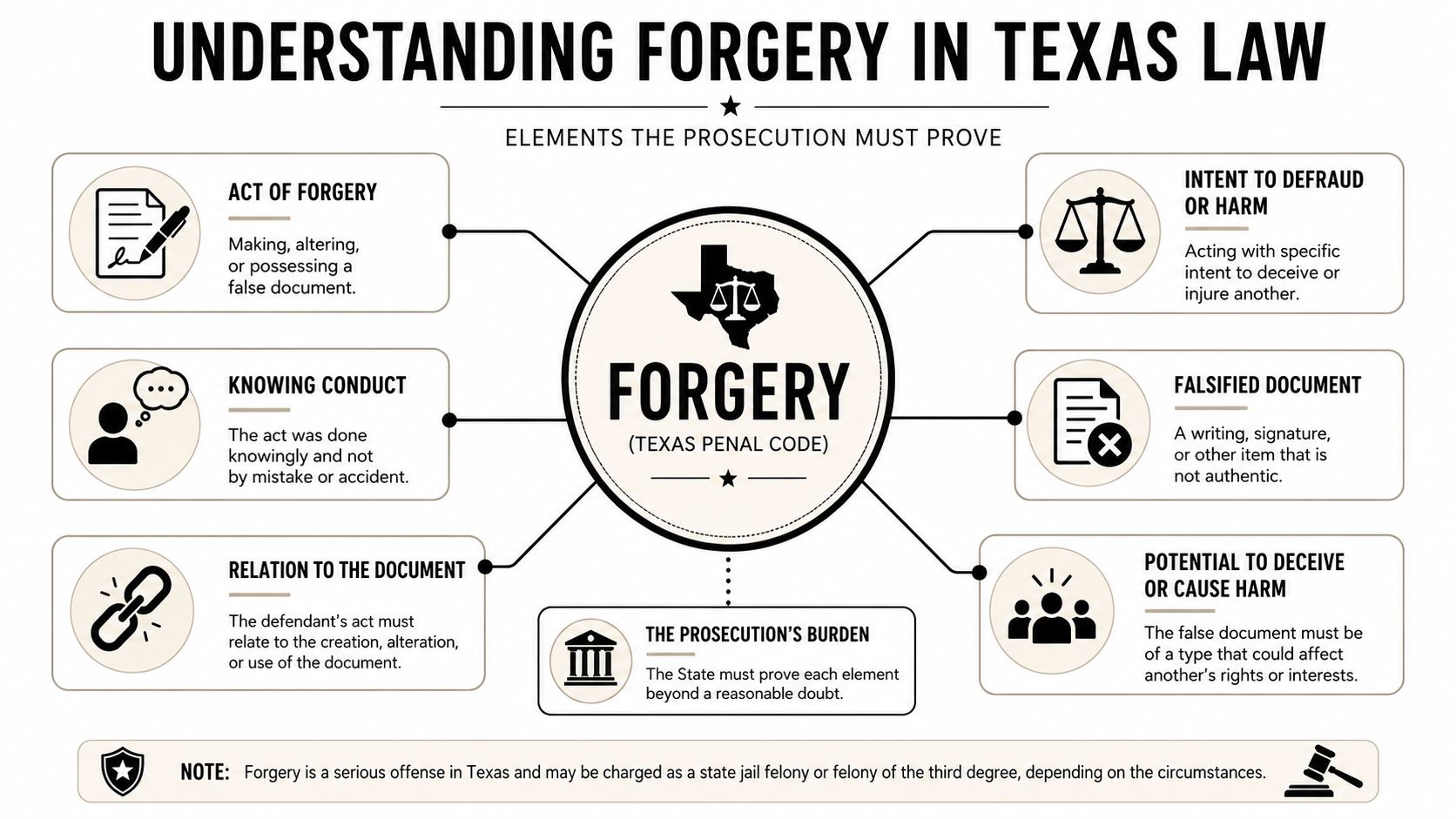
Texas forgery law sounds technical, but the core idea is simpler than it looks. The State must prove more than “a document looks wrong.” Under Texas Penal Code §32.21, prosecutors must prove two separate parts.
First, they must show an act involving a writing.
Second, they must show the required criminal intent.
According to Texas forgery law under Penal Code §32.21, the crime of forgery is legally bifurcated into two distinct elements that must both be proven beyond a reasonable doubt: the physical act of altering, making, completing, executing, or authenticating a "writing," and the specific mental state of "intent to defraud or harm another."
The act part of the case
A “writing” under the statute is broader than a sheet of paper. It can include financial instruments, identifying items, and other things that carry legal or practical value. That broad definition is why forgery charges can come from conduct involving checks, titles, cards, badges, or similar records.
A useful way to think about it is this. The act part asks, “What happened to the document or item?” Was it made, changed, completed, or used in a way that made it appear genuine when it allegedly wasn't?
The intent part is where many people get confused
The second part asks, “Why did this happen?” That's the mental state. If someone makes an honest mistake, misunderstands authority, or handles a document carelessly, that may still create a dispute. But a criminal forgery case requires proof of the required intent.
A forged-looking document and a criminal forgery case are not automatically the same thing.
That difference matters. A rushed office employee who enters the wrong date is not in the same position as someone who deliberately changes a check to deceive another person. The paperwork may be flawed in both examples, but the legal meaning is very different.
Why the charge level matters
The way Texas classifies crimes affects possible punishment, plea discussions, and long-term consequences. A clear overview of Felony vs. Misdemeanor Charges in Texas can help you understand how offense levels work and why classification becomes a major issue in forgery cases.
If you're worried because the allegations involve another charge too, the same principle applies in other areas of criminal law. In a DWI case, the State has to prove impaired driving. In a drug possession case, it has to prove knowing possession. In a Texas assault defense case, intent and context matter there too. Criminal cases turn on elements, not assumptions.
Penalties for a Texas Forgery Conviction in 2026
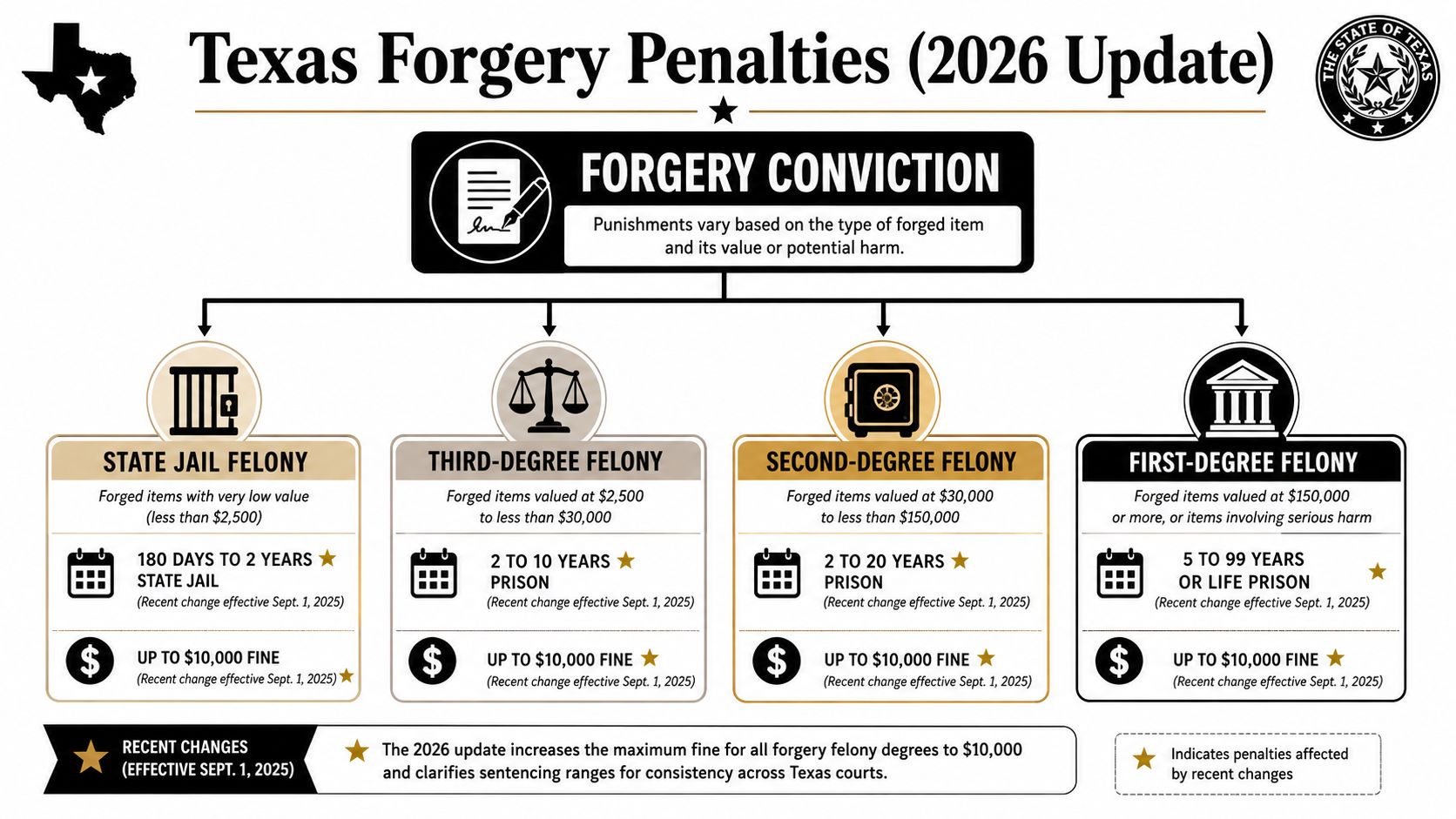
Texas increased forgery penalties through Senate Bill 1379, and those changes matter for anyone charged after the law took effect. What used to be treated less severely can now carry felony consequences.
According to the Senate Bill 1379 penalty changes, effective September 1, 2025, general forgery was upgraded from a Class A misdemeanor to a State Jail Felony, with a punishment range of 180 days to 2 years. Forgery of a check, will, or deed is now a Third-Degree Felony, carrying a sentence of 2 to 10 years in prison.
What those penalty levels mean
The label attached to the charge changes your exposure in a major way. A State Jail Felony is already serious. A Third-Degree Felony raises the stakes even more because prison time becomes a much more direct risk.
The same source also notes that forgery involving certain financial or legal documents can be charged more severely, and that aggravating facts can raise the level further. In some circumstances, the value involved or the identity of the alleged victim can increase punishment well beyond the starting level.
A simple penalty snapshot
| Charge context | Classification described in the source | Punishment described in the source |
|---|---|---|
| General forgery after the law change | State Jail Felony | 180 days to 2 years |
| Forgery of a check, will, or deed | Third-Degree Felony | 2 to 10 years in prison |
Why sentencing exposure changes defense strategy
When penalties go up, every early decision matters more. Your lawyer may need to focus on challenging the classification itself, disputing the kind of document involved, or fighting the claim that the facts fit the higher level alleged by the State.
That can affect:
- Bond decisions: Judges often look at the seriousness of the filed charge.
- Plea bargaining: A prosecutor's starting position may harden when a felony carries prison exposure.
- Trial planning: The more severe the punishment, the more important it becomes to test every weak point in the State's evidence.
- Collateral damage: A felony conviction can affect employment, housing, licensing, and future court proceedings.
Higher punishment ranges don't mean your case is hopeless. They mean your defense needs to be precise from the beginning.
Why this matters beyond forgery
Many Texans who face forgery charges are also dealing with other accusations or legal stress. Some are already worried about a DWI arrest, a theft investigation, or a drug possession allegation. The basic lesson is the same across criminal defense. You need to know the exact charge level, the exact elements, and the exact punishment range tied to your facts.
If police or prosecutors are treating your case as a felony, don't assume they got it right just because they filed it that way. Charge levels can be challenged.
Common Examples of Forgery Charges
Forgery isn't just about fake artwork or dramatic fraud schemes. In real Texas cases, the conduct often involves documents people use in daily life.
Checks and payment documents
A common example is signing another person's name to a check without authority. Another is changing the amount on a check after it was written. In both situations, the State will look at the act itself and then try to prove why it was done.
If you had permission, believed you had permission, or didn't know the document had been changed, those facts can matter a lot. The paperwork alone doesn't tell the whole story.
Titles, deeds, and ownership records
Forgery allegations also come up with car titles, property paperwork, and signed transfer records. These cases can become especially tense because they often involve family members, business partners, or former romantic partners.
A dispute over ownership may include a criminal allegation if someone claims a signature was added, changed, or used without authority. In those situations, prosecutors may rely on handwriting comparisons, witness statements, surrounding communications, and timing.
IDs, cards, and digital records
Texas law's broad definition of writing means forgery accusations can also involve fake identification, altered account information, or records used to show identity or authority. A person may be accused of creating something false, passing it to another person, or possessing it while knowing it wasn't genuine.
For readers who want a real-world example of how document fraud allegations can intersect with other legal systems, this report about a lawyer charged with immigration fraud shows how forged-document accusations can extend beyond ordinary financial paperwork.
Some forgery cases are really identity disputes. Others are family disputes. Others start in the workplace. The label is the same, but the defense often depends on the setting.
The everyday misunderstanding that becomes a criminal case
Many forgery investigations begin with one question: “Who authorized this?” If the answer is unclear, a civil disagreement or personal conflict can turn into a criminal filing. That's why your lawyer has to do more than read the police report. The defense should look at context, relationships, consent, and the communications around the document.
How to Build Your Defense Against a Forgery Charge
A strong defense usually starts with one issue. Intent. In many forgery cases, prosecutors can point to a document and say something was altered or signed. What's much harder is proving what you meant to do.
According to this discussion of intent under Texas forgery law, the most underserved angle in Texas forgery coverage is the nuanced distinction between "intent to defraud" and "intent to harm." Proving the absence of financial fraud intent may not suffice if the court finds intent to cause emotional or reputational harm.

Intent to defraud and intent to harm are not the same
This distinction is where many people get caught off guard. They assume, “I wasn't trying to get money, so this can't be forgery.” That isn't always enough.
Intent to defraud usually points toward deception for gain, often financial gain.
Intent to harm can involve trying to damage someone in a non-financial way, such as their reputation, relationships, or peace of mind.
That matters in family and domestic settings. If someone changes a document to embarrass an ex-spouse, create conflict in a custody dispute, or damage a relative's standing, the State may argue harmful intent even if there was no obvious financial payoff.
Defense themes that often matter
A forgery defense isn't one-size-fits-all. It should be built around the facts, the document, and the relationships involved.
- Lack of criminal intent: You acted by mistake, under misunderstanding, or without a plan to deceive or harm.
- Consent or apparent authority: You believed you had permission to sign, handle, or submit the document.
- No knowledge: You didn't know the record was false, altered, or unauthorized.
- Mistaken identity: Someone else created or used the document, and the State has the wrong person.
- Weak proof: The prosecution may rely on assumptions, incomplete records, or unreliable witness interpretations.
- Police or procedure problems: Statements, searches, or evidence collection may be open to challenge.
Why context wins cases
Two people can do the same physical act and still have very different legal exposure. Signing a spouse's name to a check during a long-standing shared banking practice is not the same as creating a false check to steal money. Altering a document in anger during a family dispute raises a different issue from a clerical mistake at work.
Defense insight: The document is only part of the story. The relationship, timing, permission, and surrounding messages often matter just as much.
A useful starting point is to review how criminal defense attorneys build a defense strategy. That kind of case analysis helps identify what the State can prove, rather than what the accusation sounds like on paper.
Practical steps you can take now
If you're under investigation or already charged:
- Stop discussing the facts with anyone except your lawyer.
- Gather records early. Texts, emails, drafts, bank records, and prior patterns of permission can be important.
- Write down your timeline. Memories fade quickly.
- Identify the relationship history. In many cases, consent or custom becomes central.
- Ask whether the case is really about defraud, harm, or neither.
The Law Office of Bryan Fagan, PLLC handles criminal defense matters involving forgery, theft, assault, DWI, drug possession, and other misdemeanor and felony allegations across Texas, including cases that overlap with family disputes or white-collar accusations.
Navigating the Criminal Process from Arrest to Trial
Uncertainty about the criminal process often leads to fear. However, familiarity with its stages can make the experience far less intimidating.
A forgery case usually moves through several stages. The exact path can vary, but the basic pattern is familiar in Texas courts.

The first steps after arrest
After an arrest, you'll usually go through booking. That means identification, paperwork, and holding. Soon after, a magistrate reviews basic issues such as the charge and bond.
An arraignment or first court setting follows. That's where the court addresses the case formally and where your defense starts taking shape in a visible way.
For a fuller overview, this guide to the steps in the criminal justice process helps explain how a Texas criminal case typically moves from arrest through resolution.
What happens before trial
Most of the serious work in a criminal case happens before any jury is selected. That includes obtaining police reports, reviewing witness statements, examining the alleged document, filing motions, and negotiating with the prosecutor.
This is also when plea bargaining often happens. A plea offer may involve a reduced charge, a sentencing recommendation, or another agreed outcome. You should never accept one just because you feel pressure. The right answer depends on the strength of the evidence and your long-term goals.
Here's a short video that helps explain the process in a more visual way.
A simple roadmap
- Arrest and booking: Police process the accusation and place you into the system.
- Magistrate and bond: A judge addresses release conditions.
- Formal charging stage: The State decides how to proceed on the case.
- Discovery and motions: Your lawyer reviews evidence and challenges weak or improper proof.
- Plea discussions: Both sides may explore negotiated resolution.
- Trial: If no fair agreement is reached, the State must prove guilt beyond a reasonable doubt.
- Sentencing: If there is a conviction, the court imposes punishment.
Your case doesn't move on autopilot. Deadlines, motions, and early investigation can change the outcome.
If you also face other charges
Some forgery cases arrive alongside theft, assault, DWI, or drug possession allegations. If that's happening in your case, your defense needs coordination. Statements made in one matter can affect another, and plea discussions in one file can influence how a prosecutor views the rest.
Clearing Your Name and Moving Forward
Even when a forgery case ends without a conviction, the arrest record can still cause harm. Employers, landlords, licensing boards, and schools may see that something happened, even if the case was dismissed.
That's why record clearing matters. In Texas, two common tools are expunction and nondisclosure. Expunction is generally aimed at removing eligible records. Nondisclosure limits public access to certain records in qualifying situations. Which option fits depends on how your case ended and your history.
If you're trying to understand what may still appear in a screening process, it can help to review how an FBI background check works and why record issues can follow you after the courthouse part of the case is over.
When to ask about post-case relief
You should ask about record relief as soon as your case ends, and sometimes earlier. The right timing can matter. So can the wording in a dismissal, plea, or final order.
A detailed guide on how to get a record expunged can help you understand the next step if your goal is to move on with work, housing, and professional licensing.
The bigger picture
A criminal case can feel like it defines you. It doesn't. Whether you're facing forgery, DWI, assault, theft, or drug possession allegations, the law gives you rights at every stage. A careful defense can challenge the charge. And if the case ends favorably, record-clearing options may help you rebuild.
If you've been charged with a crime in Texas, call The Law Office of Bryan Fagan, PLLC for a free and confidential consultation. Our defense team is ready to protect your rights.