Skip to content
Being arrested in Texas can be terrifying—but you don’t have to face it alone. Finding out there’s a warrant for your arrest is a gut-punch, especially when it comes with an unfamiliar term like a “capias charge.” Let’s be clear: a capias is not a new criminal charge. Instead, think of it as a direct order from a Texas court demanding your arrest. It’s the judge’s way of saying they need you in their courtroom, and they aren’t asking politely anymore.
This guide will explain in plain English what a capias is, why it was issued, and the practical steps you can take to resolve it and protect your future.
Understanding a Capias Warrant in Texas

Hearing there's a capias out for you is a stressful and confusing experience, but you have the power to take control of the situation. It’s critical to understand that a capias is simply a legal tool a judge uses to compel you to appear in court. It’s not an accusation of a new crime; it’s a consequence for not handling an obligation in a current or past case.
The term itself is Latin for "that you take" or "that you capture." In the Texas legal system, it’s a formal, written command telling any peace officer to find you, arrest you on the spot, and bring you to the court that issued it.
So, how does this happen? The situations are surprisingly common and can happen to anyone:
- You Missed a Court Date: This is the number one reason. Whether it was for a traffic ticket or a more serious charge like assault, if you fail to appear for a scheduled hearing, a judge will almost certainly issue a capias. It’s essential to know what to do if you miss a court date.
- You Didn’t Pay Fines or Fees: If a judge ordered you to pay court costs or fines as part of your sentence and you fell behind, they can issue a special type of warrant called a capias pro fine to compel payment.
- You Violated a Court Order: This includes failing to complete community service, skipping mandatory classes (like for a DWI), or breaking any other rule set as a condition of your sentence or probation.
A capias warrant can feel like a dead end, but it's really a critical turning point. How you respond will determine whether you end up in the back of a police car or walk into a courthouse with your attorney, ready to resolve the matter on your own terms.
To get a quick overview, this table breaks down the essential things you need to know about a capias at a glance.
Quick Guide to Texas Capias Warrants
| Aspect | Explanation |
|---|---|
| What It Is | A court order for your arrest, not a new criminal charge. |
| Why It's Issued | Usually for failing to appear in court, not paying fines, or violating a court order. |
| Who Issues It | A judge in the court where your original case is being heard. |
| How It's Enforced | Any Texas peace officer can arrest you during any interaction, like a traffic stop. |
| Does It Expire? | No. A capias warrant remains active indefinitely until it is resolved. |
| Key Consequence | Immediate arrest, anytime and anywhere, once you encounter law enforcement. |
Ignoring a capias is the worst possible move. That warrant never expires. It gets loaded into statewide and national law enforcement databases, just waiting for your name to pop up. Any contact with police—even for a minor traffic violation like a broken taillight—will trigger your immediate arrest. You could be taken into custody at your job, at home, or on your way to pick up your kids from school.
The anxiety this creates is completely understandable. But you have better options than just waiting for an embarrassing and disruptive arrest. An experienced criminal defense attorney can guide you through the process and help you take back control.
The Different Types of Capias Warrants in Texas
Just like not all criminal charges are the same, not all warrants carry the same weight. The word "capias" is an umbrella term for a specific type of arrest warrant, and figuring out which one has your name on it is the first critical step in getting it resolved.
Knowing exactly what you're up against demystifies the process and puts you back in the driver's seat. Each type of capias is issued for a different reason, and your next move depends entirely on which one applies to your situation.
Capias Pro Fine
A Capias Pro Fine is one of the most common types of warrants in Texas, and it often starts with something minor, like an old traffic ticket you forgot about. This warrant is issued after you’ve already been found guilty of a misdemeanor and, for whatever reason, didn't pay the fines or court costs.
For example, you might get a speeding ticket in Houston, agree to a payment plan, but life gets busy and you miss a payment. The court then issues a capias pro fine. Under Texas Code of Criminal Procedure Article 45.045, this is the court's tool to force you to pay by ordering your arrest until the debt is settled. Tens of thousands of these warrants clog the systems in major Texas counties every year, leading to jail time over non-violent issues. To understand more, you can learn more about how a capias charge works in Texas.
Standard Capias
A standard capias is different because it’s issued before your case is finished. This warrant typically comes into play when you’re already facing a pending criminal charge—like a DWI, assault, or theft—and you miss a mandatory court date.
When you fail to appear for your hearing, the judge assumes you're avoiding the legal process. As a result, they'll issue a capias to have you arrested and brought to court to answer for both the original charge and your failure to appear. This almost always means your original bond gets revoked, and a new, much higher bond is set in its place.
A capias isn't just a piece of paper; it’s a command that can disrupt your entire life. Differentiating between a capias for a pending DWI case and a capias pro fine for an old ticket is crucial—one jeopardizes your freedom on an active charge, while the other seeks to collect a past debt.
Bench Warrant
While people often use the term interchangeably with a capias, a bench warrant is a direct order for your arrest that comes straight from the judge's "bench." These are usually issued for contempt of court.
This could happen if you violate a judge's direct order, cause a disruption in the courtroom, or even fail to show up for jury duty. The sole purpose of a bench warrant is to bring you before that specific judge to explain why you didn't comply with their order.
Why a Capias Was Issued and What Happens Next
The single most common reason a judge issues a capias is frustratingly simple: a Failure to Appear (FTA) in court. Life gets in the way—maybe you mixed up the date, had a family emergency, or simply forgot. Unfortunately, the court system doesn’t see it that way. It sees a broken promise to appear, and that triggers a very serious response.
One missed court date turns what was just a legal obligation into an active arrest warrant. Once a judge signs that capias, your name goes into statewide and even national law enforcement databases like the National Crime Information Center (NCIC). From that moment on, any run-in with the police—no matter how minor—will lead to your immediate arrest.
The Reality of an Arrest on a Capias
Imagine you get pulled over for an expired registration sticker. The officer runs your license, and suddenly the entire mood of the traffic stop shifts. They see the active capias and are legally required to arrest you right there on the spot. This is the harsh, everyday reality of having an outstanding warrant.
Failing to appear is the number one trigger for a capias in Texas. Under Texas Code of Criminal Procedure Article 23.01, a capias commands any officer to bring you before the court, and it stays active forever until it is formally recalled by a judge. In 2024 alone, Texas courts issued over 250,000 capiases tied to failure-to-appear cases, making it an incredibly widespread issue. You can explore additional information on the far-reaching impact of these warrants.
Step-by-Step: What Happens After an Arrest on a Capias
Once you are arrested on that capias, the dominos start to fall quickly. Here’s what you can expect:
- Arrest and Booking: You’ll be taken to the local county jail to be photographed, fingerprinted, and held until a magistrate can see you. This process is often lengthy, stressful, and dehumanizing.
- Bond Forfeiture: The money you or a loved one paid for your original bond is almost certainly gone. The court keeps it because you failed to meet the bond's main condition: showing up for all your court dates.
- A New, Higher Bond: The judge will set a new bond for your release, and you can bet it will be significantly higher than the first one. From the court’s perspective, you’re now a higher risk for not showing up again. This can make getting out of jail much harder and more expensive.
- Facing the Original Charge: After resolving the warrant and posting a new bond, you still have to deal with the original criminal charge (e.g., DWI, theft, assault) that started this whole process.
An active capias is a legal storm cloud that follows you everywhere. Taking proactive steps with an experienced attorney is the only way to get back in control and protect your freedom.
Your Step-By-Step Plan to Resolve a Capias Charge
Finding out there’s a capias warrant with your name on it doesn't have to end in a surprise arrest. If you tackle it head-on, you can manage the situation on your own terms. Your best bet is to work with a criminal defense attorney to either arrange a controlled surrender or, in some cases, get the warrant thrown out altogether.
Ignoring it isn't a strategy—it’s just a countdown to getting caught. This chart breaks down the high-stakes chain of events that starts the moment a capias is issued.
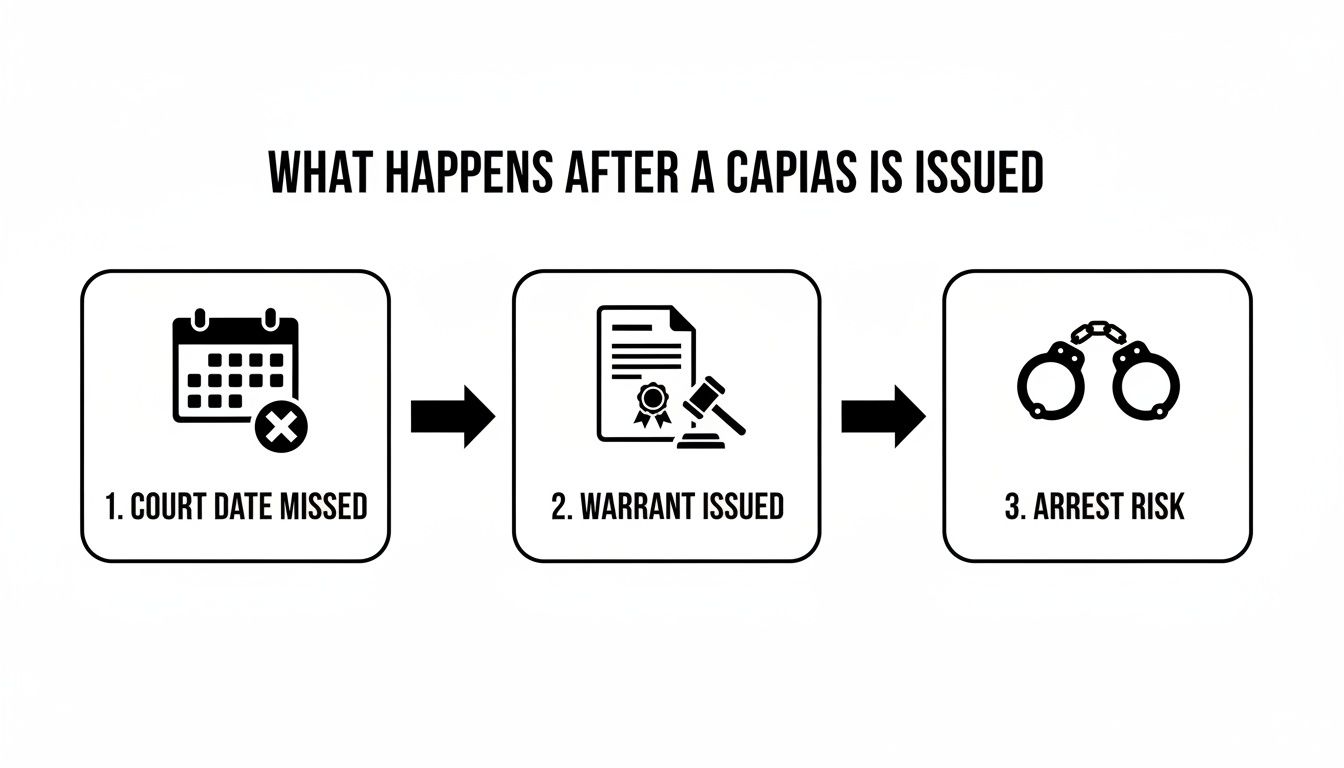
As you can see, a missed court date directly leads to a warrant, putting you at constant risk of being arrested anywhere, anytime. Here are your options for dealing with it.
Option 1: The Attorney-Assisted Surrender
One of the smartest ways to clear a capias is with an attorney-assisted surrender, sometimes called a "walk-through." This is a carefully planned process we manage for you, designed to get you in and out of custody as fast as possible.
Here’s our game plan:
- We Lay the Groundwork: First, your attorney calls the court and the prosecutor. We let them know we represent you and that you intend to handle the capias responsibly.
- We Line Up the Bond: We get a bail bondsman on standby before you ever set foot in the courthouse. This means the moment the judge sets your new bond, we’re ready to post it. You can learn more about how bail and bond in Texas works.
- We Schedule Your Appearance: We coordinate a specific day and time for you to show up. This eliminates the risk of a random, public arrest and allows you to walk in with your lawyer, looking proactive and responsible.
- You Handle Business and Go Home: You will be briefly taken into custody to see the judge, who will clear the warrant and set a new bond. Because we are prepared, we can post the bond immediately, and you're often released within a few hours.
This approach demonstrates to the court that you're taking ownership of the situation, which can go a long way toward rebuilding trust.
Option 2: Filing a Motion to Withdraw the Capias
Depending on the circumstances, your attorney may be able to get the capias canceled without you ever being arrested. We do this by filing a Motion to Withdraw Capias (or a Motion to Set Aside Capias).
A proactive legal motion can sometimes convince a judge to recall the warrant entirely, especially if there was a legitimate reason for your failure to appear. This is your attorney’s chance to tell your side of the story.
To have a real shot, this motion needs to give the judge a compelling reason to pull back the warrant. A simple "I forgot" won't cut it. Legitimate excuses might include:
- A documented medical emergency (for you or a close family member)
- Being incarcerated in another county or state at the time
- A clerical mistake where you were never properly notified of the court date
Your attorney files the motion, attaches evidence to back up your claim, and argues that the warrant should be withdrawn. If the judge agrees, the warrant is canceled, and your case is simply reset for a new court date.
How a Criminal Defense Attorney Can Protect You

Trying to handle a capias warrant alone is like walking into a storm without an umbrella—you're going to get soaked. Having an experienced criminal defense attorney isn't just about getting legal advice; it’s about having a trusted guide who can protect you from the worst of the fallout. Our first move is always to get ahead of the problem and take control of the situation before law enforcement does.
From the minute you hire our team, we go on the offensive. We don’t wait for you to get arrested at work or during a traffic stop. Instead, we immediately start working the phones, contacting the court clerk and the prosecutor’s office in Harris County, Fort Bend County, or wherever the warrant was issued. Our goal is to gather critical intelligence: Why was the capias issued? What was the original charge? And what might the new bond conditions be?
Crafting a Proactive Defense Strategy
Once we have the facts, we build a proactive strategy designed to resolve the capias with the least possible disruption to your life. We know that avoiding a public, embarrassing arrest is your top priority. Your job, your family, and your reputation are on the line, and our entire plan is built around protecting them.
Our years of experience in Houston-area courts give us a major advantage when negotiating with prosecutors. We can often arrange for a safe and dignified surrender, making sure you’re treated with respect. Instead of a surprise arrest, you walk into the courthouse with your attorney by your side, showing the judge that you’re taking this seriously.
Our immediate goal when handling a capias charge is to lift the warrant and advocate for your release under the most favorable terms possible, such as a personal recognizance (PR) bond, which requires no money upfront.
We fight hard for a reasonable bond. A PR bond is often our primary target because it secures your release based on your promise to appear for court, saving you thousands of dollars. We present the judge with compelling arguments, highlighting your ties to the community and explaining any legitimate reasons for your original failure to appear.
Getting Your Case Back on Track
Clearing the capias is only the first step. The original criminal case—whether it’s for assault, theft, or something else—is still waiting. Our team doesn't just make the warrant disappear; we stick with you to build a strong defense against the underlying charges. We can also explore options for post-conviction relief like expunctions and record sealing down the road.
We work to get your case back on the right path and fight for the best possible outcome, whether that means a full dismissal, a reduction in charges, or an acquittal at trial. Choosing the right legal partner is one of the most important decisions you'll make, and our guide on how to choose a criminal defense attorney can give you valuable things to consider. Your future is too important to leave to chance.
Your Top Questions About Capias Warrants, Answered
Finding out there’s a capias warrant for your arrest brings a wave of urgent, stressful questions. Here are plain-English answers to the questions our clients ask us every day.
Can I Be Arrested for a Capias at Work?
Yes. An active capias is a valid arrest warrant. That means law enforcement can execute it anywhere they find you—during a traffic stop, at your front door, or at your workplace. An arrest at work is public and can do serious damage to your professional reputation. This is exactly why you need to get out in front of it with an attorney.
How Long Does a Capias Stay Active in Texas?
A capias warrant in Texas never expires. It remains active in law enforcement databases indefinitely, or until it’s handled—either through an arrest or a judge's order to withdraw it. It will follow you until you take legal action to get it cleared.
Will This Capias Cost Me More Money?
Almost certainly, yes. When a capias is issued for a missed court date, the court will almost always declare your original bond forfeited. That money you or a loved one paid to get you out of jail is gone for good. Then, the judge will set a new bond, which is usually higher. If it was a Capias Pro Fine for unpaid fines, you can also expect additional court costs and late fees.
Can a Capias Be Issued by Mistake?
It's rare, but it happens. Clerical errors like sending a court notice to an old address or a data entry mistake can lead to an unjust capias. If you believe the capias was issued in error, an attorney can investigate the court records, find proof of the mistake, and file a motion to get the capias withdrawn without you ever being arrested.
What Is the Difference Between a Capias and a Bench Warrant?
People often use these terms interchangeably, and both are orders for your arrest. However, there are slight technical differences in Texas. While it can be useful to see how other states handle things, like learning What Is a Bench Warrant in Georgia and How Do You Resolve It, here is the Texas breakdown:
- Capias: Most often issued for failing to appear for a pending criminal case or for not paying fines after a case is over. It’s tied to a failure to follow through on a case-related obligation.
- Bench Warrant: This is more directly tied to a judge's authority in the courtroom. It's usually issued for direct contempt of court, like causing a disruption during a hearing or ignoring a judge's specific command.
Ultimately, both are orders for your arrest and must be treated with the same level of seriousness.
If you’ve been charged with a crime in Texas, call The Law Office of Bryan Fagan, PLLC for a free and confidential consultation. Our defense team is ready to protect your rights. https://texascriminallawyer.net