Being arrested in Texas can be terrifying—but you don’t have to face it alone. When you hear the term "Class A misdemeanor," it's easy to get overwhelmed. This isn't just a minor legal hiccup; it’s the most serious misdemeanor-level offense in the state, sitting just one rung below a felony. A conviction here isn't just a slap on the wrist—it comes with heavy penalties like jail time and steep fines that can seriously derail your life.
Understanding a Class A Misdemeanor Charge

Getting arrested for any crime is a disorienting, often terrifying, experience. When the charge is a Class A misdemeanor, it’s completely natural to feel anxious about what’s coming next. Think of the different misdemeanor levels like a swimming pool. A Class C is the shallow end, but a Class A is the deep end—the stakes are higher, and the consequences are far more severe.
But here’s the most important thing to remember right now: an arrest is not a conviction. You have legal rights, and this is just the first step in what can be a long process. The first move toward protecting your future and building a strong defense is understanding exactly what you’re up against.
What You Are Facing
A Class A misdemeanor is not a simple ticket you can pay and forget. The potential penalties laid out in the Texas Penal Code are serious and meant to be a powerful deterrent.
To put it in perspective, let’s use a common example. Say you’re out with friends, have a few too many drinks, and make the mistake of driving home. If your blood alcohol concentration (BAC) is 0.15 or higher, you could be charged with a Class A misdemeanor DWI—even for a first offense. Under Texas Penal Code §12.21, that charge alone carries up to one year in county jail and a fine of up to $4,000.
This is why taking these charges seriously from day one is so critical. Beyond the immediate legal penalties, a conviction creates a permanent criminal record that can follow you for the rest of your life.
The Immediate Consequences
If you are convicted, the fallout goes well beyond just fines and potential jail time. You could be facing:
- A Lasting Criminal Record: This mark on your record will pop up on background checks for jobs, apartments, and even volunteer positions.
- Difficulty Finding Employment: Many employers are understandably hesitant to hire someone with a recent criminal conviction, especially for a more serious misdemeanor.
- Probationary Sentences: You might be placed on community supervision, which comes with strict conditions, regular fees, and frequent meetings with a probation officer.
To really grasp the full scope of your situation, it helps to understand how different misdemeanor charges are classified. Check out our detailed guide on the classes of misdemeanors in Texas. Knowing exactly where your charge fits in helps you prepare for the fight ahead.
Class A Misdemeanor Penalties at a Glance
To make it simple, here’s a quick breakdown of what a conviction could mean according to Texas law.
| Penalty Type | Potential Consequence |
|---|---|
| Jail Time | Up to 1 year in county jail |
| Fines | Up to $4,000 |
| Criminal Record | Permanent and publicly accessible |
| Probation | Up to 2 years of community supervision |
These are the maximum statutory penalties. The actual sentence can vary based on the specifics of your case, but this table shows just how serious the stakes are.
What Are the Official Penalties in Texas?

When you look up the penalties for a Class A misdemeanor, the law books are pretty blunt. The language is cold, formal, and doesn't leave much room for interpretation. That’s why it’s so important to understand what these penalties actually mean for your life, not just on paper.
The entire framework comes from the Texas Penal Code § 12.21. This is the statute that lays out the official sentencing range for anyone convicted of a Class A offense.
Texas Penal Code § 12.21 (Punishment for Class A Misdemeanor)
An individual adjudged guilty of a Class A misdemeanor shall be punished by:
(1) a fine not to exceed $4,000;
(2) confinement in jail for a term not to exceed one year; or
(3) both such fine and confinement.
So, what does this mean in plain English? A judge has the power to sentence you to up to one full year in county jail and hit you with a fine of up to $4,000. These are the maximums, though—not what automatically happens.
Jail Time Is Not a Guarantee
The thought of spending a year behind bars is terrifying. Let’s be clear: while it’s a possibility, the maximum sentence is far from a given. A judge weighs a lot of different factors before deciding on a sentence, and this is exactly where a skilled defense lawyer makes a difference.
An attorney's job is to tell your story and present your case in the best possible light, pushing for leniency by highlighting any mitigating circumstances.
Here are a few things that can influence a judge’s decision:
- Your Criminal History: A clean record is a huge asset. On the other hand, prior convictions can tip the scales toward a tougher sentence.
- The Specifics of the Offense: The context of the alleged crime is critical. Was it a one-time mistake, or does it look like a pattern of behavior?
- Your Character and Community Ties: Showing that you're a responsible person with roots in the community can make a real impact.
These factors help a judge see you as an individual, not just another case number. A strong defense works to shrink any potential jail time—or, in the best-case scenario, eliminate it completely.
The True Cost Goes Far Beyond the Fine
That $4,000 fine looks big enough on its own, but it's rarely the final number. A conviction triggers a whole slew of other fees and financial obligations that pile up fast, creating a much bigger economic hit than most people realize.
These "hidden" costs often include:
- Court Costs: These are the administrative fees the court charges just to process your case.
- Probation Fees: If you get community supervision (probation), you'll likely have to pay a monthly fee to the county.
- Mandatory Classes: You could be ordered to attend—and pay for—classes like anger management or substance abuse awareness courses.
- Restitution: If the alleged crime caused someone a financial loss, the court can order you to pay them back.
These extra expenses can easily double or even triple the original fine. To get a better sense of how these costs stack up, you can learn more about how Texas handles misdemeanor assault fines and their impact.
At the end of the day, the official penalties in the Texas Penal Code are just the starting point. The final outcome hinges on a lot of variables, from the evidence stacked against you to the strength of your legal defense. That's why it is so critical to have an experienced attorney who can navigate the system and fight to protect both your freedom and your future.
What Kinds of Offenses Lead to a Class A Charge?
Legal jargon is one thing, but it’s far more useful to understand how a normal day can suddenly spiral into a serious legal crisis. A Class A misdemeanor charge often pops up in situations that escalate fast, turning a single bad decision or a heated argument into a problem that could follow you for years.
Knowing which offenses commonly fall into this category helps you see the real-world scenarios that land everyday Texans in hot water. This isn’t about some abstract legal theory; it’s about situations you could actually find yourself in. Let's break down some of the most frequent Class A misdemeanors.
Driving While Intoxicated (DWI) – Second Offense
A first-time DWI is usually a Class B misdemeanor. But if you're arrested for a second DWI, the charge automatically jumps to a Class A misdemeanor. That's a huge leap in severity, and it shows just how seriously Texas law treats repeat DWI offenses.
Imagine this: you were convicted of a DWI a few years back. You’ve moved on, but one night you have a couple of beers at a Houston Astros game and get pulled over. Even if nobody was hurt and your first offense feels like ancient history, that prior conviction means you’re now facing a much tougher charge with mandatory jail time and a longer driver's license suspension.
Assault Causing Bodily Injury
This is probably one of the most common ways people end up with a Class A misdemeanor. Under Texas Penal Code § 22.01, a simple assault becomes a Class A charge if it causes "bodily injury." The key thing to understand here is that the legal definition of "bodily injury" is incredibly broad.
It doesn’t require a hospital visit or serious harm. "Bodily injury" can mean anything that causes physical pain, illness, or any impairment. A shove during a fight that causes someone to stumble and scrape their knee could be enough. A punch in a bar that leaves a bruise definitely qualifies. The situation doesn't have to be some brutal attack; any physical scuffle that results in the other person feeling pain can trigger an arrest for a Class A misdemeanor.
Here’s the takeaway: The legal bar for "bodily injury" is much lower than what most people think. It doesn’t take broken bones or a trip to the ER—just causing physical pain is often enough for the charge to stick.
Burglary of a Vehicle
Another all-too-common Class A charge is Burglary of a Vehicle, or BOV. This crime isn’t about stealing the car itself. It’s about breaking into or entering a vehicle with the intent to commit a felony or any theft. It's often a crime of opportunity.
Picture this: you're walking through a parking garage and spot a laptop sitting on a passenger seat. If you smash a window or even just pull on an unlocked door to grab it, you’ve likely committed burglary of a vehicle. It doesn't matter if the item you planned to take was cheap; the simple act of entering that vehicle without permission is what makes this a serious misdemeanor.
Certain Theft Offenses
In Texas, the value of whatever was stolen dictates how serious the theft charge is. A theft becomes a Class A misdemeanor when the value of the stolen property or services is $750 or more but less than $2,500.
This range covers a lot of common items, putting them squarely in Class A territory:
- Shoplifting a new smartphone or a designer purse.
- Taking expensive power tools from a neighbor’s open garage.
- Writing a bad check for an amount somewhere in that range.
It’s easy to see how quickly a simple theft charge can escalate. What might feel like a minor lapse in judgment can easily cross that financial line, landing you just one step below a felony. Understanding these real-life examples is the first step toward figuring out how to build a defense for your specific case.
The Hidden Consequences of a Conviction
A conviction for a Class A misdemeanor in Texas is far more than just a legal headache. The penalties echo long after you’ve paid the fines or walked out of jail. These are the “hidden” or collateral consequences—the real-world impacts that don’t show up in the Texas Penal Code but can completely derail your future.
It's not just about avoiding a sentence; it's about protecting your ability to live a normal, productive life. A conviction creates a permanent criminal record, a digital mark that follows you everywhere. This single event can slam doors shut on opportunities you haven’t even thought of yet, making it incredibly hard to build the future you want for yourself and your family.
Your Career and Professional Future Are on the Line
Let's be blunt: the most immediate gut punch of a criminal record is its effect on your job. Nearly every employer runs a background check today. It’s just standard practice. A Class A misdemeanor conviction is a massive red flag, and it's often the reason an employer simply moves on to the next candidate.
For some professions, it’s even worse. Many jobs require a state-issued license, and a conviction can make you completely ineligible to get or renew one. Think about fields like:
- Nursing and Healthcare: Trust is everything, and a record can destroy it.
- Teaching and Education: School districts have zero-tolerance policies to ensure student safety.
- Real Estate: Licensing boards frequently deny applications based on criminal history.
Losing your ability to work in your chosen field is financially and emotionally devastating. Suddenly, all your education and experience are overshadowed by one mistake.
Finding a Place to Live Just Got Harder
Just like employers, landlords and property managers almost always run background checks. To them, a criminal conviction screams "risk," which often leads to a denied rental application.
This can seriously limit your housing options. You could find yourself struggling to find a safe, affordable place to live, forced into less desirable neighborhoods, or hit with much higher security deposits. Securing a stable home is a basic need, and a conviction puts that stability in real jeopardy.
A Class A misdemeanor conviction isn't just a legal problem—it's a life problem. It can block you from getting a job, finding a home, and even exercising your constitutional rights. Fighting the charge isn't just about the case; it's about protecting your entire future.
Your Constitutional Rights Can Be Stripped Away
A conviction can also take away some of your most fundamental rights. Here in Texas, a conviction for certain misdemeanors—especially those involving family violence—can mean losing your right to legally buy or own a firearm. For many Texans who value their Second Amendment rights for sport or self-protection, this is a huge blow.
This isn't a temporary slap on the wrist. It’s a permanent change to your status as a citizen, taking away freedoms you probably always took for granted.
Serious Immigration Trouble for Non-Citizens
For anyone who isn't a U.S. citizen, the stakes couldn't be higher. Even a misdemeanor can trigger devastating immigration consequences. Depending on the exact offense, a conviction can lead to:
- Deportation or Removal: You could be forced to leave the country, no matter how long you've called Texas home.
- Inadmissibility: If you leave the U.S., you may be barred from coming back in.
- Ineligibility for Citizenship: A conviction can be a major roadblock on the path to becoming a naturalized U.S. citizen.
These outcomes tear families apart and upend lives built over decades. If you are not a citizen and are facing any criminal charge, it is absolutely critical that you speak with a defense attorney who understands how criminal and immigration law intersect.
Navigating the Texas Criminal Justice System
Getting arrested for a Class A misdemeanor in Texas can throw your entire life into chaos. The legal system is a confusing and intimidating maze, but knowing what’s coming down the road can replace that fear with a sense of control. Understanding the process, step by step, is the best way to get ready for what lies ahead.
The journey from the moment of arrest to a final resolution follows a very specific path. Each stage comes with its own rules, procedures, and purpose. Having an experienced criminal defense lawyer in your corner from day one is the only way to ensure your rights are protected at every single turn.
The First Steps After an Arrest
The process kicks off the second you're taken into custody. For most people, this initial phase is the most disorienting and stressful part of the whole ordeal.
- Arrest and Booking: Once arrested, you'll be transported to a local jail for booking. This is an administrative process where they take your fingerprints, your photo (the classic mugshot), and record your personal information. Your personal items will be collected, inventoried, and stored until your release.
- Setting Bail: Shortly after you're booked, a judge or magistrate will set your bail. Bail is the amount of money you must pay to get out of jail while your case moves forward. The whole point of bail is to make sure you show up for your future court dates.
If your case has any potential immigration implications, it's also smart to be understanding the distinctions between criminal bonds and immigration bonds, as they operate very differently.
Your First Court Appearance: The Arraignment
Your first time standing in front of the judge is called an arraignment. This is a quick but incredibly important hearing where a few key things happen.
First, the judge will formally read the charges filed against you, making sure you know exactly what the State of Texas is accusing you of. Next, you'll be asked to enter a plea. Your attorney will almost always advise you to plead "not guilty" at this point, even if you think you might eventually take a deal. Pleading "not guilty" protects all of your legal rights and gives your lawyer the time needed to dig into the evidence.
This hearing is also where the judge will review your bail amount and set any conditions for your release. For a DWI case, for example, this could include an order to install an ignition interlock device on your car.
The Plea Bargaining Phase
The overwhelming majority of criminal cases in Texas—well over 90%—don't end with a dramatic courtroom trial. They're resolved through plea bargaining. This is the negotiation stage where your defense lawyer and the prosecutor talk about the case to see if they can reach a resolution that works for both sides.
A good plea bargain can lead to several positive outcomes:
- Reduced Charges: Your attorney might negotiate to get a Class A misdemeanor dropped to a less serious Class B.
- Lighter Sentence: You could agree to a specific punishment, like probation instead of serving jail time.
- Case Dismissal: Sometimes, a lawyer can convince the prosecutor to drop the charges completely if you agree to complete certain conditions, like counseling or community service hours.
This flowchart shows how the consequences of a conviction can ripple out into the most critical areas of your life, from your job to your fundamental rights.
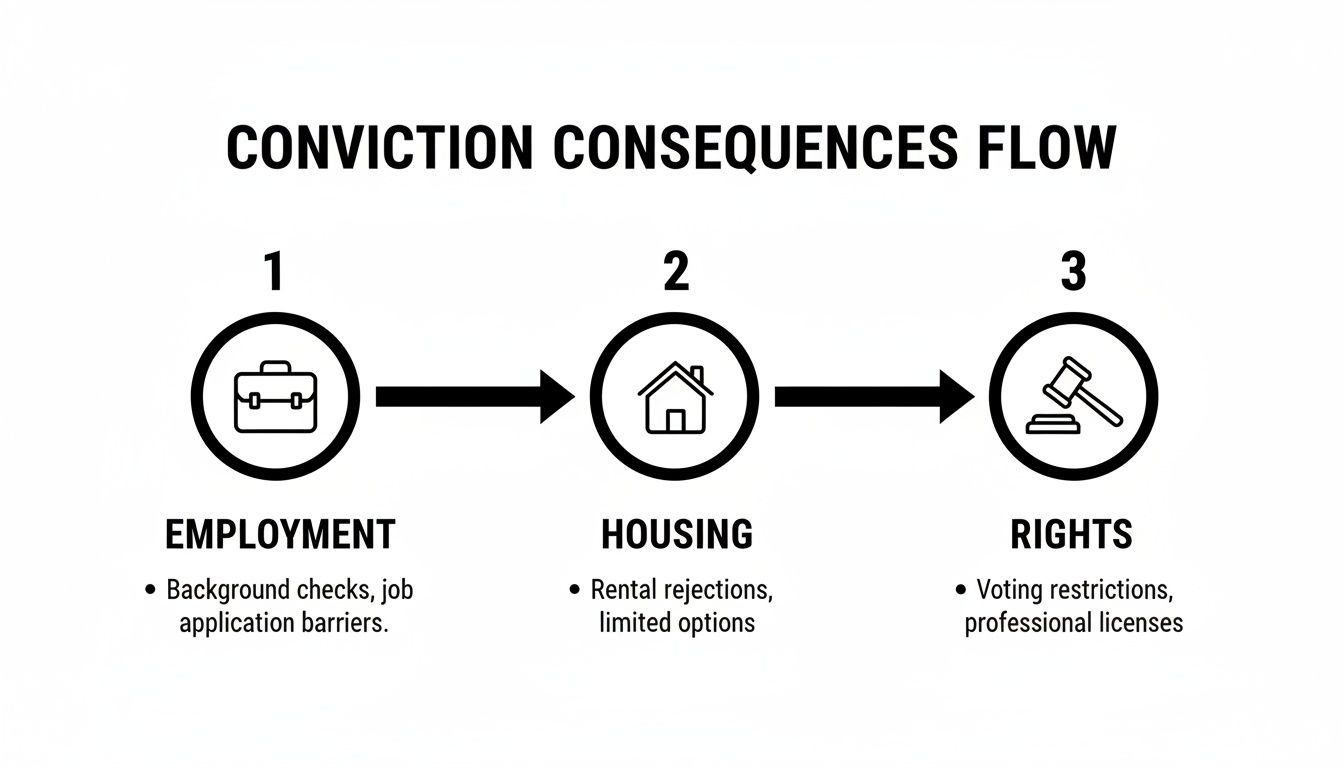
As you can see, the impact of a conviction on employment, housing, and your personal freedoms is deeply interconnected, creating long-term hurdles that are hard to overcome.
Pre-Trial Motions and Preparing for Trial
If a fair plea agreement can't be reached, your case will be set for trial. But before that happens, your attorney will get to work on crucial pre-trial matters.
This phase involves filing pre-trial motions, which are formal legal requests asking the court to do something specific. One of the most powerful is a Motion to Suppress Evidence. If the police violated your constitutional rights during the search or arrest, your lawyer can ask the judge to exclude that illegally obtained evidence. If the judge agrees, it can sometimes destroy the prosecutor's case, forcing them to dismiss the charges.
If your case does head to trial, you’ll have to choose between a jury trial (where 6 citizens from your community decide your fate) or a bench trial (where the judge alone makes the decision). Your attorney will walk you through the pros and cons of each, helping you decide which path gives you the best shot based on the unique facts of your case.
This entire process, from arrest to a potential trial, is designed to see that justice is done, but it is anything but simple. Having a legal guide you trust is absolutely essential to protecting your freedom and your future.
Clearing Your Record After a Misdemeanor Case
Many people believe a criminal charge is a life sentence—a permanent stain that follows you everywhere. But in Texas, the law actually gives you a real shot at a clean slate. A Class A misdemeanor arrest doesn't have to define your future, and figuring out how to clear your record is the first real step toward getting your life back.
The two main tools for this are expunctions and orders of nondisclosure. They might sound similar, but they do very different things and apply to different case outcomes. Knowing which one you might qualify for is absolutely critical.
The Power of an Expunction
Think of an expunction as the ultimate reset button. When a judge grants an expunction, it’s like your arrest never legally happened. The court orders every government agency—from the arresting police department to the county clerk—to track down and physically destroy every single record tied to your case.
This is a complete and total erasure. Once it's done, you can legally deny that you were ever arrested for that offense on job applications, apartment leases, or pretty much anywhere else.
The catch? Getting an expunction isn't easy. The eligibility rules are very strict. Generally, you only qualify if your case ended in one of these ways:
- The prosecutor dismissed your case outright.
- You went to trial and were found "not guilty" (acquitted).
- You got into and successfully finished a pre-trial diversion program.
There are also specific waiting periods you have to follow before you can even file, which change depending on the charge and how your case was resolved. We've put together a detailed guide on this, and you can learn more about how to get a misdemeanor expunged in Texas.
Sealing Your Record with Nondisclosure
So, what happens if your case wasn't dismissed? If you successfully completed a special kind of probation called deferred adjudication, you might be able to get an order of nondisclosure. This doesn't destroy your record like an expunction, but it does seal it from public view.
An order of nondisclosure acts like a privacy shield. It stops private companies—like most employers, landlords, and the background check services they use—from ever seeing your criminal record. Law enforcement and certain government agencies can still see it, but for all practical purposes, your mistake is hidden from the public.
This is a massive advantage when you're trying to move on with your life. For many Class A misdemeanors, you can file the petition for nondisclosure the moment you successfully finish your deferred adjudication probation.
Taking Control of Your Digital Footprint
Getting your official record cleared is a huge win, but the internet never forgets. Mugshot websites love to post arrest photos, and those pictures can linger online long after your case is over. While you're working on clearing your official record, it’s also a good idea to look into how you can get your mugshot removed online. Getting that photo taken down can be a key part of truly reclaiming your privacy.
Navigating the rules for expunctions and nondisclosures is complicated. The specific facts of your Class A misdemeanor case are what determine your eligibility, the waiting periods, and the best strategy to use. The surest way to figure out your options is to work with an experienced defense attorney who can file the right paperwork and help you secure the clean slate you deserve.
Answering Your Most Pressing Questions
When you're staring down a Class A misdemeanor charge in Texas, your mind is probably racing with urgent questions. Let's cut through the noise and get you some straightforward answers to the concerns we hear from clients every single day.
Is Jail Time a Certainty for a Class A Misdemeanor?
No, jail time is not guaranteed. While the law says a Class A misdemeanor can land you in county jail for up to a year, it’s not a mandatory sentence for most of these offenses. A judge looks at the whole picture—your criminal history, the specific facts of your case, and what happened.
An experienced criminal defense attorney can build a case for you, highlighting mitigating circumstances and arguing for better alternatives. Options like probation (what Texas calls "community supervision"), deferred adjudication, or even a full dismissal are often on the table.
Can a Class A Charge Be Reduced to Something Less Serious?
Yes, it’s often possible. This is where good old-fashioned negotiation, known as plea bargaining, comes in. Your attorney can negotiate with the prosecutor to get the charge knocked down to a less severe offense, like a Class B misdemeanor.
Of course, this is never a sure thing. But a strong defense strategy can poke holes in the prosecutor's case, creating the leverage needed to secure a much better deal that minimizes both the immediate penalties and the long-term damage.
How Long Will This Stay on My Record?
This is the big one. An arrest for a Class A misdemeanor can haunt your public record permanently unless you take legal action to get it off. A conviction is even worse—it stays there forever.
But there is hope. If your case gets dismissed or you successfully finish a deferred adjudication program, you might be eligible to either destroy the record through an expunction or seal it from public view with an order of nondisclosure. Taking this final step is absolutely critical to protecting your future job prospects, housing applications, and reputation.
If you’ve been charged with a crime in Texas, call The Law Office of Bryan Fagan, PLLC for a free and confidential consultation. Our defense team is ready to protect your rights.