Skip to content
A hard knock at your door late at night can change the feel of your whole house. You may be standing in your kitchen, your kids may be asleep, and all you can think is, “Can the police come in if they don't have a warrant?” If you're in that position right now, the fear is real, and so is the confusion.
Texas law gives your home strong protection, but that protection isn't unlimited. Police can enter without a warrant in some narrow situations. The problem is that officers and prosecutors often describe those situations broadly, while courts look at them much more carefully. That gap matters if you're facing charges for DWI, assault, drug possession, theft, or another offense that started with police showing up at your home.
Your Home Is Your Castle But Police Sometimes Have a Key
You hear pounding on the front door. An officer says he needs to “ask a few questions.” Another says they just want to “step inside for a minute.” Those words sound casual. Legally, they're not casual at all.
Your home gets the highest level of privacy protection under search-and-seizure law. That means police usually need a judge's permission before they cross your threshold. But in practice, officers often rely on one of a few exceptions and act first. Later, everyone argues about whether that entry was lawful.
Many people make the same mistake in that moment. They think they have only two choices: open the door wide or get arrested. Usually, that's not true. The law often gives you more room than you think, especially during a first encounter at the door. If you want a broader overview of what to do during police contact, this guide on Texas police encounter rights can help.
Practical rule: A police request is not always a legal command.
A common example is a drug investigation. Officers knock, say they've received a complaint, and ask to come in and “clear things up.” Another common example is a domestic disturbance call where officers want to separate people and talk inside. In both situations, whether they can lawfully enter often depends on facts many individuals don't know they should question.
That's why the key issue isn't just when can police enter your home without a warrant in Texas. It's also this: if they entered illegally, how do you prove it, and what can your lawyer do with that violation?
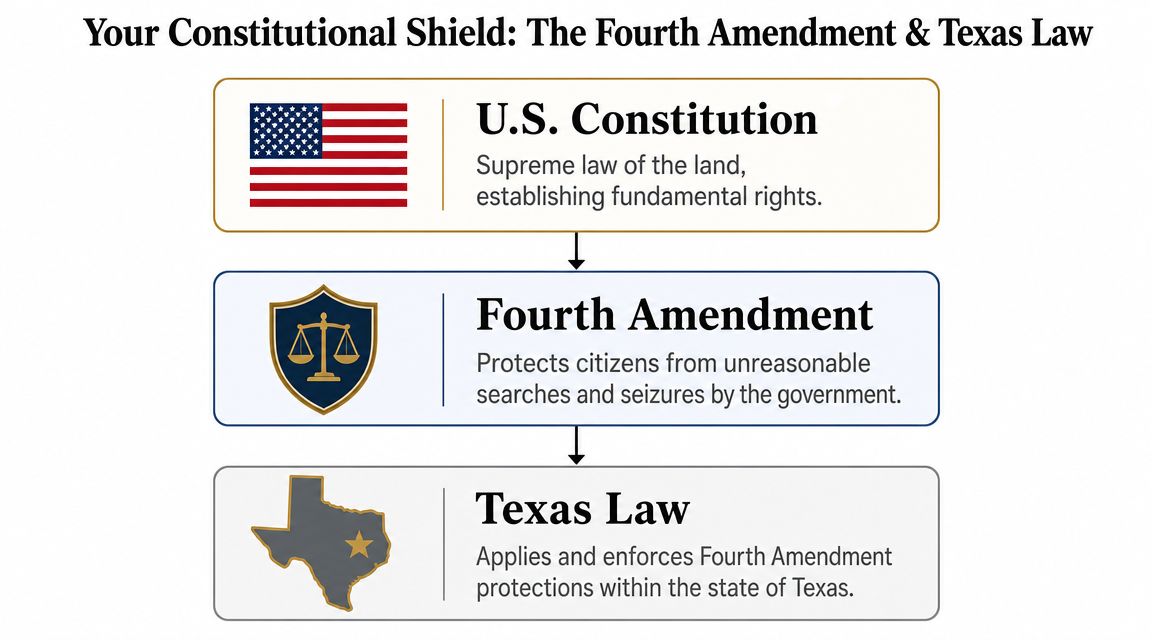
Your Constitutional Shield The Fourth Amendment and Texas Law
The starting point is simple. Police generally need a warrant to enter your home without consent. That rule comes from the Fourth Amendment, which protects you against unreasonable searches and seizures.
The modern version of that rule traces back to the Supreme Court's decision in Payton v. New York. In that case, the Court drew a constitutional “firm line at the entrance to the house” and held that warrantless, nonconsensual entry into a suspect's home to make a routine felony arrest violates the Fourth Amendment absent exigent circumstances.
What a warrant does
A warrant is a judge's written authorization. In plain English, it's the legal key that usually lets police cross your doorway. Officers must go to a judge, explain why they believe they have probable cause, and identify what place they want to enter.
If you've never dealt with the criminal system before, it also helps to compare different types of warrants, because an arrest warrant, a search warrant, and other warrant types don't all give police the same authority.
Why this matters in Texas criminal cases
Texas courts follow the same constitutional baseline. That means your lawyer starts with a strong question: did officers have a warrant, valid consent, or a real emergency?
If the answer is no, the entry may have violated your rights. That can become a serious issue in cases involving:
- Drug possession charges where officers found contraband after stepping inside
- Assault or family violence allegations that grew out of a home visit
- DWI-related arrests where officers entered during a welfare check and then claimed intoxication
- Theft or firearm cases where evidence was first seen after crossing the threshold
For a fuller look at how courts evaluate unlawful police conduct, this explanation of illegal search and seizure in Texas is a useful starting point.
The house is the line. Once police cross it, the legal analysis changes fast.
Exigent Circumstances When Waiting Is Not an Option
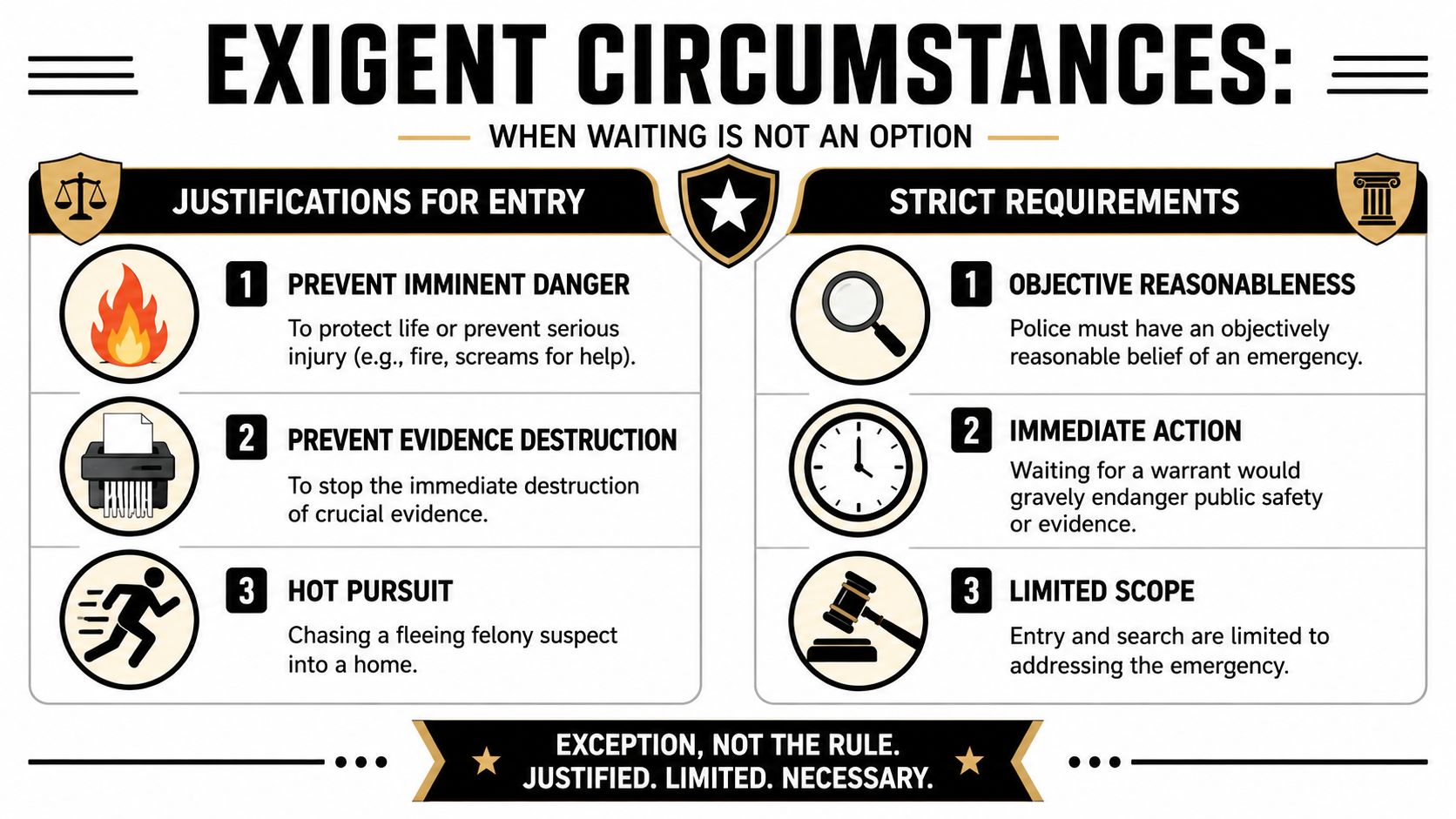
Some situations move too fast for police to stop and get a warrant. The law calls those exigent circumstances. That doesn't mean convenience. It means a real emergency where delay could cause harm, escape, or loss of evidence.
Texas authorities describe the main categories as preventing destruction of evidence, rendering aid to a person believed to be in danger, protecting officers from an armed and dangerous person inside, and stopping a suspect's escape. Texas criminal procedure discussions also tie this exception to Article 14.05 of the Texas Code of Criminal Procedure.
The emergency must be specific
Readers often get misled on this point. Officers don't get to say, “We had probable cause, so we went in.” That's not enough by itself. The legal question is whether waiting for a judge would have created a concrete risk.
Texas appellate guidance summarized by the Texas District and County Attorneys Association explains that exigent-entry analysis looks to the seriousness of the offense, the strength of probable cause, and the likelihood evidence will be gone if officers wait for a warrant.
A few examples show the difference:
| Situation | More likely lawful entry | More likely unlawful entry |
|---|---|---|
| Possible drug case | Officers can point to facts showing evidence is about to be destroyed | Officers only suspect drugs may be inside |
| Pursuit | Police are actively chasing a fleeing suspect into the home | Police arrive later and claim the suspect might still be there |
| Threat inside | Officers have facts suggesting an immediate danger to someone or to themselves | Officers rely on a vague fear with no clear factual basis |
Common fact patterns in Texas
- Hot pursuit: A suspect runs from officers and enters a house while being chased.
- Destruction of evidence: Officers can explain why evidence was at immediate risk of disappearing.
- Immediate threat: Police have objective reasons to believe someone inside poses an urgent danger.
- Risk of escape: Delay would likely let the suspect flee before a warrant could be obtained.
What matters is articulation. Officers have to explain what they knew, when they knew it, and why immediate entry was necessary.
If the report uses broad phrases like “officer safety” or “possible destruction of evidence” without detailed facts, that's often where a defense challenge begins.
How this plays out in real charges
In a drug possession case, an officer might claim entry was needed to keep narcotics from being destroyed. In an assault case, the officer may say someone inside was armed and dangerous. In a theft investigation, police may argue the suspect was about to flee. Every one of those claims has to be tested against the actual facts, not just repeated in a report.
That's where a defense attorney looks at dispatch records, body-cam footage, doorbell video, and the timing between the officers' arrival and their entry.
The Emergency Aid and Community Caretaking Exceptions
Not every warrantless entry starts as a criminal investigation. Sometimes officers say they entered because someone needed help. That falls under the emergency aid or community caretaking line of cases.

Welfare checks are not automatic entry passes
This issue comes up often after 911 hang-ups, reports of shouting, texts from worried relatives, or requests for a welfare check. Police may be allowed to enter, but not just because something felt off.
The Supreme Court has said emergency aid and community-caretaking-style entry cannot be based on vague generalizations; officers need an objectively reasonable basis to believe someone inside needs immediate help. That point matters in Texas cases involving loud arguments, family violence calls, or concerns about someone's safety inside the home.
What counts as an objectively reasonable basis
The phrase sounds technical, but the idea is straightforward. The officer needs facts that would make a reasonable person think someone inside may need immediate aid.
That could include circumstances like these:
- Clear signs of distress: screams, calls for help, or visible injury
- Specific outside information: a report that someone inside may be hurt or unable to respond
- Scene observations: broken property, blood, or facts suggesting violence in progress
By contrast, a vague concern is weaker. A simple hang-up call without more facts may not justify entry. The same is true when officers rely on assumptions instead of what they observed.
Why these cases are heavily disputed
This exception often appears in charges that weren't the original reason officers showed up. Police may enter for a welfare check, then claim they smelled marijuana, saw drugs in plain view, noticed signs of intoxication, or found evidence related to assault.
That can lead to charges under the Texas Penal Code or related criminal procedures, even though the first question should have been whether the entry itself was lawful.
A defense lawyer usually focuses on a few things:
- What did dispatch tell the officers?
- What did officers observe before entry?
- Did body-cam video match the written report?
- Did officers limit their actions to the emergency, or start searching for evidence?
A lawful welfare check has a narrow purpose. If officers use it as a shortcut into your home, the court may see the difference.
Giving Consent Knock-and-Talks and Your Right to Say No
The most common path into a house isn't force. It's permission.
Police often use what's called a knock-and-talk. They approach your home, knock, start a conversation, and try to get consent to enter. The Supreme Court has recognized that officers may approach and knock like any other citizen, but that authority is limited and doesn't itself permit entry or a search. Whether consent was voluntary depends on the totality of the circumstances, not just whether the resident said yes, as discussed in this explanation of knock-and-talk limits and home entry.
What you can say at the door
You don't have to make the officers' job easier. In many situations, you can speak through the closed door and keep the encounter short.
Useful phrases include:
- “I don't consent to any search.”
- “I want to remain silent.”
- “If you have a warrant, please show it.”
- “I'm not giving permission to come inside.”
If you choose to speak with officers outside, close the door behind you. That removes one of the most common ways police claim they were invited in.
Consent must be voluntary
People often find themselves in a bind. They think being polite means saying yes. It doesn't.
Consent can be challenged if it came from pressure, confusion, implied authority, or fear. The same issue comes up when the wrong person gives permission. A person needs actual authority over the premises to validly consent, and an arrest warrant for one person doesn't automatically allow entry into a third party's home without a search warrant, consent, or exigency.
Here's the practical point. If officers say, “We just need to step in for a minute,” that minute may become the foundation of the entire case.
A lot of home-entry disputes begin this way in drug possession and assault cases. Someone opens the door, steps back, and officers later describe that movement as consent. Sometimes body-cam footage supports that claim. Sometimes it doesn't.
What Happens After an Illegal Entry Evidence Suppression
If police entered your home unlawfully, that doesn't automatically erase the case. But it gives your defense attorney a serious tool. The remedy is usually a motion to suppress.
That motion asks the judge to exclude evidence gathered through the unlawful entry. The basic idea is often called the exclusionary rule. If the government got evidence by violating your constitutional rights, the court can keep that evidence out.
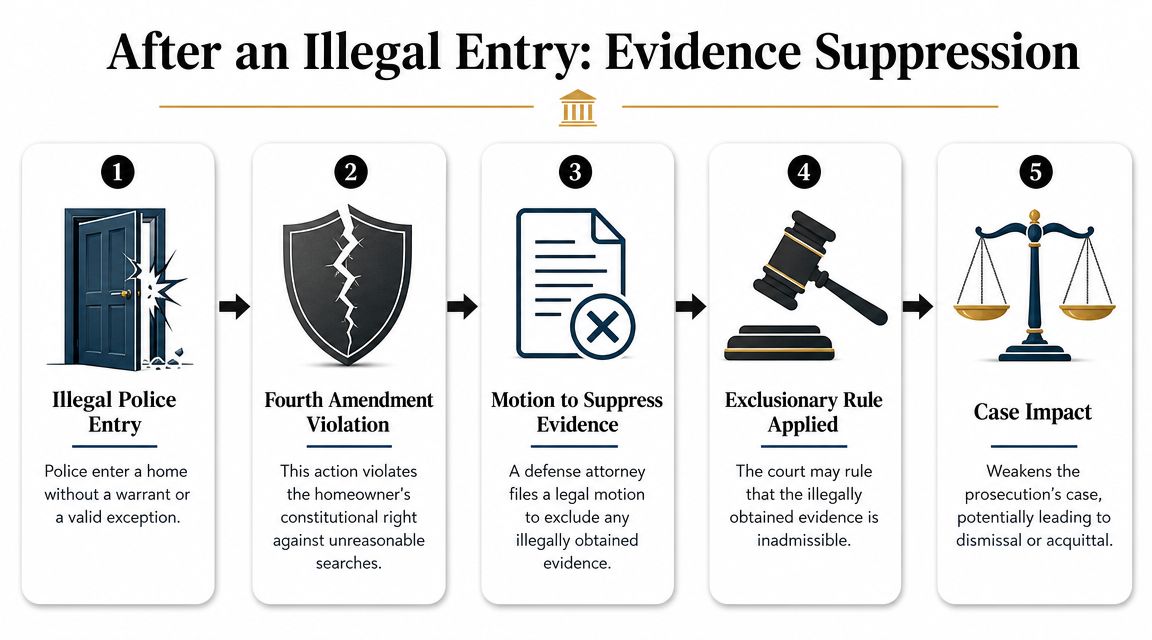
For a more direct explanation of how this works, review this discussion of the exclusionary rule in Texas criminal cases.
How a suppression fight is built
A strong suppression issue is usually proven, not announced. Your lawyer gathers the facts and compares them against the officers' legal justification.
That often includes:
- Body-cam and dash-cam footage
- Dispatch audio and call logs
- Search warrant documents, if officers later got one
- Photos, diagrams, and doorbell camera footage
- Cross-examination of the officers involved
In practice, many illegal-entry cases turn on small details. Did officers hear something before entering, or only claim that later? Did they ask for consent clearly? Did they go beyond the reason they said they entered?
Why suppression can change everything
Suppression matters because prosecutors still have to prove the case with admissible evidence. If the drugs, firearm, statements, or observations came from an illegal entry, the State may lose essential proof.
That can affect every stage of the case:
| Stage | Why illegal entry matters |
|---|---|
| After arrest | Your lawyer can begin preserving video and records before they disappear |
| Arraignment and early hearings | The defense can identify constitutional issues and challenge bond conditions tied to the allegations |
| Plea bargaining | A strong suppression issue may give the defense leverage in negotiations |
| Trial | The judge may keep key evidence away from the jury |
| Sentencing | If the case weakens or charges are reduced, exposure may change dramatically |
If the court suppresses the core evidence, charges may be reduced or dismissed. If the case survives, your lawyer still may use the unlawful conduct to attack officer credibility.
And if you're thinking beyond the immediate case, ask about what comes after. Depending on the outcome, some Texans may later pursue expunction, nondisclosure, record sealing, or other post-conviction relief options. Those remedies depend on the case result and your record, but they matter if your goal is rebuilding your life.
Protect Your Rights with an Experienced Texas Defense Attorney
Home-entry cases are fact-heavy and unforgiving. A single step backward from your doorway, a vague statement in a police report, or a missing minute of body-cam video can become the center of the case. That's why these cases need careful review, not quick assumptions.
If you've been arrested after police entered your home, your next steps matter. Stay off the phone about the facts of the case. Don't try to explain things to investigators. Save screenshots, messages, call logs, and any home security footage. Then get legal advice fast.
For people facing charges such as DWI, assault, theft, or drug possession, a defense lawyer should examine not just what police found, but how they got inside in the first place. The Law Office of Bryan Fagan, PLLC handles Texas criminal defense matters that can include search-and-seizure issues, suppression litigation, plea negotiations, trial defense, and post-case relief such as expunctions and record sealing.
A solid defense also means knowing the road ahead. After an arrest, your case may move through booking, bail, arraignment or first appearances, pretrial hearings, plea discussions, trial, and sentencing. A constitutional challenge to the entry can shape every one of those stages.
If you've been charged with a crime in Texas, call The Law Office of Bryan Fagan, PLLC for a free and confidential consultation. Our defense team is ready to protect your rights.
If you've been charged with a crime in Texas, call Law Office of Bryan Fagan PLLC for a free and confidential consultation. Our defense team is ready to protect your rights.